Unitree Scales Up with Massive Robotics Factory (Unitree, Robotics, Market Growth, Competition)
Description: Topic Overview
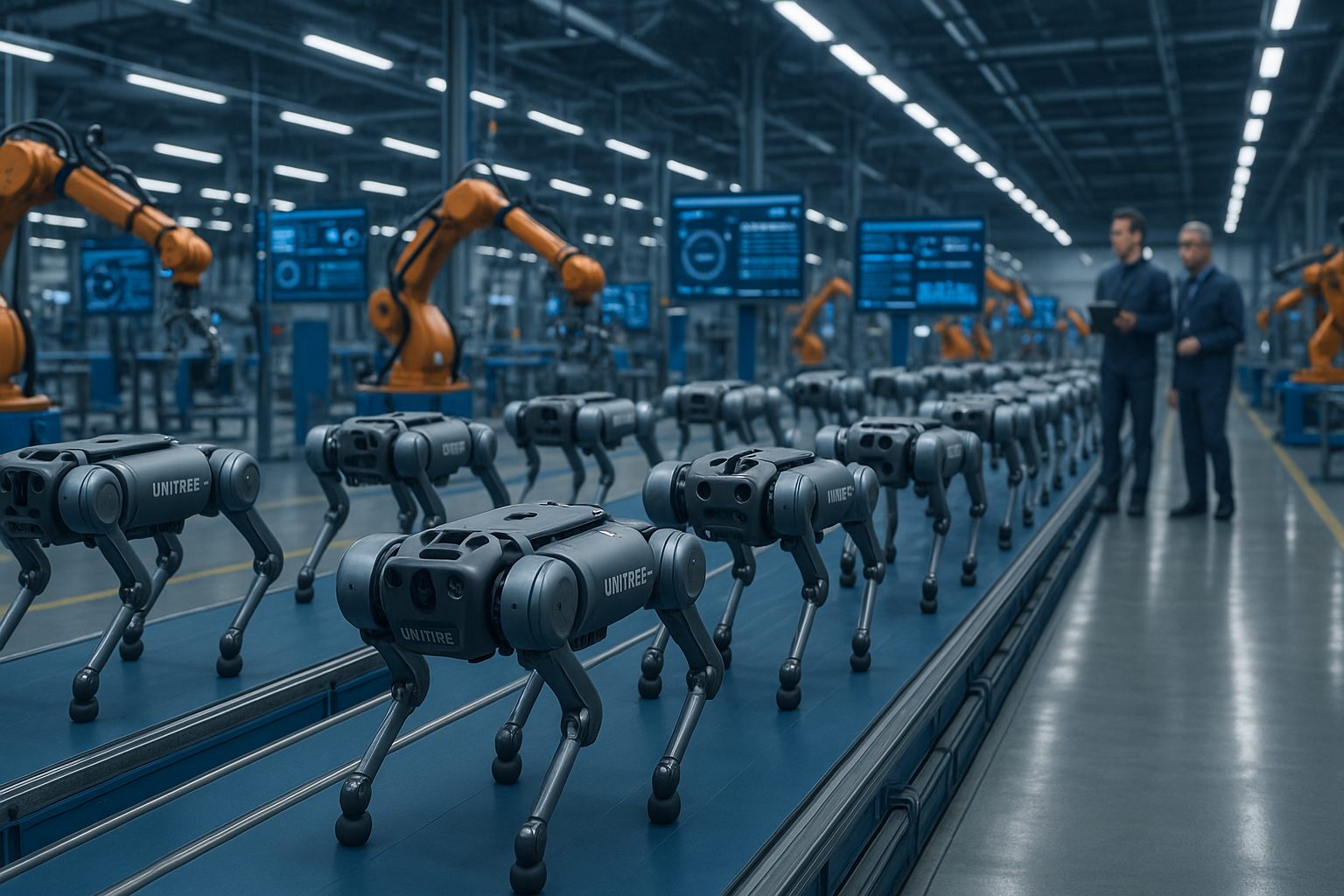
Chinese robotics company Unitree Robotics has just taken a major step in scaling its operations by building a 100,000-square-meter smart factory to mass-produce quadruped and humanoid robots. Known for offering highly agile robots at significantly lower price points than competitors, Unitree’s move represents more than a company milestone—it signals a bold entry into mass-market robotics manufacturing at a time when global demand for robotics is rapidly accelerating.
This article explores why Unitree’s new facility is a potential game-changer, delving into global robotics market data, competitive positioning, and broader implications for automation, artificial intelligence, and hardware innovation.
1. Who is Unitree Robotics? (Affordable Quadrupeds, Developer Focus, Global Reach)
Unitree Robotics, founded in 2016 in Hangzhou, China, has quickly gained attention in the robotics community for its affordable and developer-friendly quadruped robots. The company’s product line includes:
- Go1 (lightweight quadruped, ~$2,700 USD)
- B1 (industrial-grade quadruped, ~$10,000 USD)
- AlienGo (advanced R&D-focused bot, ~$15,000 USD)
- Unitree H1 (humanoid robot, under $90,000 USD — far cheaper than Tesla’s Optimus or Figure AI’s humanoid)
These prices are a fraction of competitors like Boston Dynamics’ Spot (>$74,000) or ANYbotics’ ANYmal (~$100,000+ with payloads), opening doors to startups, educational institutions, researchers, and mid-sized enterprises that were previously priced out of the robotics market.
The company’s emphasis on open SDKs, modular hardware, and out-of-the-box autonomy has made its robots popular in the education, logistics, defense, and research sectors.
2. Why a Mega Factory? (Scaling for Demand, Market Timing, AI Integration)
A. Strategic Timing and Market Size
The global robotics market is undergoing explosive growth:
- $42.5 billion (2022) → forecasted to reach $160 billion by 2030 (CAGR of ~17%)
(Source: Fortune Business Insights, 2023) - Industrial automation is driving demand, but service and mobile robotics are the fastest-growing segments.
- Quadruped robots alone are expected to grow from $1.4 billion in 2023 to over $7 billion by 2030 (Source: Allied Market Research).
Unitree is strategically scaling just as robotics becomes commercially viable at scale for logistics, healthcare, security, and more.
B. The Factory’s Capabilities
The new 100,000㎡ facility is designed for:
- Producing hundreds of thousands of robots annually
- In-house development of AI chips, motors, sensors
- Vertical integration: reducing reliance on overseas suppliers
- Testing zones for autonomy, environmental resistance, and safety
This gives Unitree a massive advantage in terms of:
- Speed to market
- Cost control
- Rapid innovation cycles
In a robotics landscape plagued by expensive supply chains and long development timelines, Unitree’s model mimics Tesla’s Gigafactory strategy—but for smart robots.
C. AI as a Core Component
Unitree’s robots use deep learning for:
- Obstacle detection
- Gait prediction
- Voice and gesture control
- Multi-sensor SLAM (simultaneous localization and mapping)
With the new factory, the company can train and deploy custom AI models onsite, ensuring faster iteration and real-time optimization across models.
3. Competitive Analysis (Unitree vs Boston Dynamics, ANYbotics, Figure AI, Agility)
Unitree is operating in a space that’s getting crowded—fast. But its strategy sets it apart in several key ways.
| Company | Product Type | Price Range | Target Market | Manufacturing Capacity |
|---|---|---|---|---|
| Unitree Robotics | Quadrupeds & Humanoids | $2,700 – $90,000 | R&D, SMEs, Defense, Edu | Mass manufacturing (new factory) |
| Boston Dynamics | Quadrupeds (Spot) | ~$74,500 | Military, Industrial | Low-volume (US-based) |
| ANYbotics | Industrial Quadrupeds | $100,000+ | Oil & Gas, Infrastructure | Focused on pilot deployments |
| Agility Robotics | Humanoids (Digit) | ~$250,000 | Logistics (Amazon) | Currently scaling, US-focused |
| Figure AI | Humanoids (Prototype) | Undisclosed | Manufacturing (Tesla, BMW) | Pre-commercial phase |
Key Differentiators for Unitree:
- Price Accessibility: Its robots are 3x to 10x cheaper than competitors.
- Developer Ecosystem: Open APIs and global community of programmers.
- Speed of Innovation: Faster hardware iterations due to in-house R&D.
- Manufacturing Edge: High-scale production gives them cost and supply chain control.
Boston Dynamics has reputation and legacy, but it’s not built for scale. ANYbotics focuses on high-value industrial niches. Figure AI and Agility target humanoid use cases but are still in early rollout stages with limited units.
Unitree, meanwhile, is quietly building both quadruped and humanoid robots, and now has the physical infrastructure to mass-produce them.
4. Global Implications (Democratizing Robotics, Workforce Disruption, Adoption Acceleration)
A. Robotics for Everyone
What smartphones did for mobile computing, Unitree could do for robotics:
- Affordable, modular, AI-enabled
- Rapid integration into SMEs, startups, schools, municipalities
- Use in robot competitions, fieldwork, research, disaster response
As robots become cheaper and more versatile, we’ll see wider adoption across:
- Warehousing (picking, delivery, security patrol)
- Construction (terrain mapping, payload carrying)
- Agriculture (monitoring crops/livestock, spraying)
- Healthcare (hospital delivery bots, elder assistance)
- Retail (mall patrol, inventory checks)
B. Labor Augmentation, Not Replacement
While fears about job displacement exist, Unitree’s bots are designed to augment human work, not replace it. The real opportunity lies in:
- Automating repetitive, dangerous, or remote tasks
- Enabling one worker to control multiple bots
- Creating new jobs in robot maintenance, AI integration, and robotics education
C. Standardization and Global Influence
With Chinese leadership in electric vehicles and solar panels, robotics could be China’s next global tech export—and Unitree is a strong candidate for standardization across industries.
The company is also attracting attention from global defense, security, and education markets, signaling potential international government contracts or public-private partnerships.
Conclusion: Unitree’s Expansion Could Reshape the Robotics Industry
Unitree’s massive factory is more than an infrastructure project—it’s a strategic leap forward that positions the company as a global player in affordable, scalable robotics.
While competitors focus on niche use cases or high-margin clients, Unitree is betting on volume, accessibility, and modularity—a combination that could make it the “Android of robotics,” bringing smart bots to businesses, researchers, and public agencies at every level.
As the robotics market continues its rapid growth, Unitree’s cost-effective production model could democratize access to intelligent machines the same way cheap smartphones transformed computing. The race is on, and Unitree just changed the game.
📊 Market Sources Cited:
- Fortune Business Insights: Robotics Market Report 2023
- Allied Market Research: Quadruped Robotics Forecast
- Boston Dynamics, Agility Robotics, ANYbotics official product sites