Unitree R1 Robot: The $5900 Smart Companion is Real?
I. A Price Tag That Breaks Reality (and the Internet!)
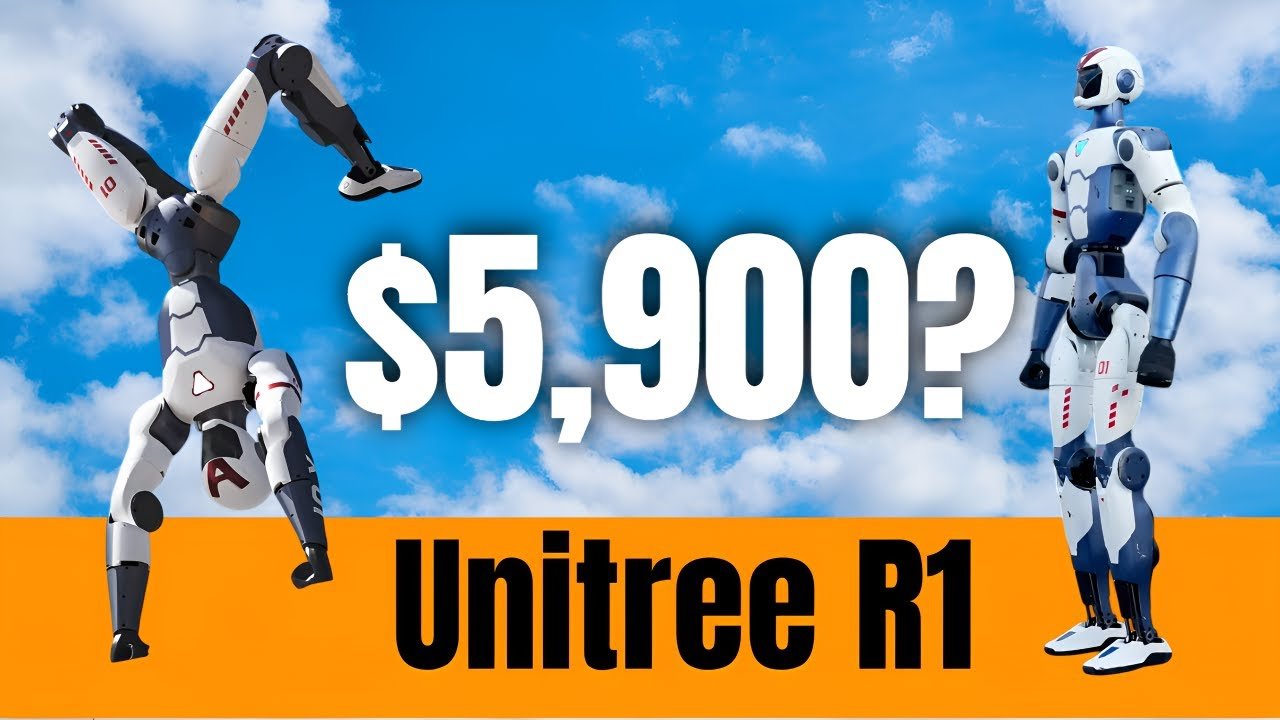
🔥 Wait… a $5,900 Humanoid Robot? That’s Not a Typo. The very idea of an AI-powered humanoid robot, capable of intricate movements and intelligent conversation, typically conjures images of science fiction or multi-million dollar corporate research labs. Yet, Unitree Robotics, a company already known for its agile and affordable quadruped robots, has once again redefined expectations with the unveiling of the Unitree R1. Priced at an astonishing $5,900, this bipedal machine immediately sparked disbelief and excitement across the tech world.1
This price point is not merely competitive; it is industry-shattering.3 For context, leading humanoid robot projects from companies like Tesla (Optimus) and Figure AI (Figure 02) are targeting price tags ranging from $20,000 to $100,000, while industrial-grade robots like Boston Dynamics’ Atlas come at a much higher cost.2 The R1’s accessibility at under $6,000 represents a fundamental shift, potentially democratizing the field of humanoid robotics. This unprecedented affordability means that advanced humanoid hardware is no longer exclusive to well-funded research institutions or large corporations. Instead, it opens the door for a much broader array of individuals, smaller educational institutions, and independent developers to engage directly with this cutting-edge technology. Such widespread access could catalyze an explosion of innovation and applications previously deemed unfeasible due to prohibitive costs.
This moment for the Unitree R1 bears a striking resemblance to the “iPhone moment” for smartphones.3 Just as the iPhone made advanced mobile computing accessible and desirable to the masses, fundamentally reshaping the mobile industry, the R1 could serve as a similar catalyst for humanoid robotics. By drastically lowering the barrier to entry for functional humanoids, it suggests a future where these machines move beyond niche industrial or research roles into broader societal integration. This expansion would be driven by an ever-growing ecosystem of developers and users, pushing the boundaries of what humanoid robots can achieve and how they integrate into daily life.
II. In a Nutshell: Your Robotic Future, Demystified
In a Nutshell: The Unitree R1 is a futuristic, AI-powered humanoid robot priced at just $5,900—a fraction of what similar robots cost. It’s not just a prototype or concept; this is a real, working smart companion built for homes, classrooms, and offices. With face tracking, GPT-powered conversations, and adorable gestures, it’s like having a robotic friend who actually gets you. But is it too good to be true? Let’s unpack whether the Unitree R1 is the next big leap in robotics—or just a flashy gadget [User Query].
The R1 is presented as a tangible step towards bridging the gap between science fiction and everyday reality. It can walk, talk, understand voice commands, and perceive its surroundings.5 This positions the robot as a potential game-changer that challenges preconceived notions about robot accessibility and capability, inviting a deeper exploration into its authenticity and practical value.
III. Unitree’s Bold Move: Redefining Humanoid Robotics
Unitree Robotics has a well-established reputation for disrupting the robotics market with affordable, high-performance machines. The company gained significant recognition for its agile quadruped robots, such as the Go1 robot dog, which offered advanced capabilities at a price point of $2,700 to $8,500, making them a much more accessible alternative to high-end competitors like Boston Dynamics’ Spot.2 This track record of delivering sophisticated robotics at a fraction of the expected cost provides crucial context for understanding the R1’s groundbreaking price.
A significant factor enabling Unitree’s aggressive pricing strategy is its commitment to vertical integration.6 The company has invested heavily in research and development, independently designing and manufacturing core robot components such as motors, reducers, controllers, and even some sensors.6 This in-house production of critical, often expensive, parts allows Unitree to maintain tight control over manufacturing costs, significantly reducing the per-unit expense compared to companies that rely on external suppliers for these components. This strategic approach directly underpins their ability to offer products like the Go1 and now the R1 at prices far below what the market typically expects.
Furthermore, Unitree’s advancements are not occurring in isolation. The company ventured into humanoid robotics in 2023, aligning with a broader national strategy in China to mass-produce humanoids by 2025 and establish leadership in the emerging market by 2027.8 This governmental support likely provides Unitree with a favorable regulatory environment, potential R&D funding, and a robust domestic market, further facilitating aggressive pricing and rapid development cycles. Such a long-term, sustained commitment to humanoid robotics, backed by significant investment (Unitree has raised $248 million from investors including Alibaba Group and China Mobile), extends beyond typical startup funding cycles, allowing for ambitious market plays.9
The company’s proven expertise with affordable and agile quadrupedal robots offers a substantial advantage in humanoid development. The core competencies in motion control, balance, robust powertrains, and integrated AI systems, honed through years of developing robot dogs, are directly transferable and adaptable to bipedal humanoid designs.2 This continuity means Unitree is not starting from scratch in a new domain but rather leveraging accumulated knowledge and intellectual property, which contributes to faster development and lower production costs for the R1. This logical evolution of their product line reinforces the credibility of their latest offering.
IV. Meet the R1: Specs, Smarts, and Seriously Agile Moves
The Unitree R1 is designed as an ultra-lightweight and highly customizable humanoid robot, packed with impressive technical specifications and dynamic capabilities.
Physical Attributes:
Standing at approximately 121 cm (4’2″) tall and weighing a mere 25 kg (55 lbs), the R1 is significantly lighter than many of its humanoid counterparts, such as Boston Dynamics’ Atlas (89 kg) or Unitree’s own G1 (35 kg).1 This design choice is deliberate: it enhances the robot’s agility, makes it safer for operation in human environments, and contributes directly to its lower manufacturing cost.14 The R1 boasts 26 degrees of freedom (DoF) across its body, allowing for fluid motion, balance, and expressive gestures.5 For comparison, the G1’s base model has 23 DoF, with high-end versions reaching up to 43 DoF.8 The R1 is powered by a swappable lithium-ion battery, offering approximately one hour of runtime, allowing for quick battery changes during extended use.4
AI and Sensing Capabilities:
Central to the R1’s identity as a “smart companion” is its integration with a large multimodal model, enabling GPT-powered conversations.1 This AI allows the robot to understand both voice commands and visual cues, facilitating real-time interaction and learning. Its perception system includes a binocular camera for ultrawide-angle visual input, complemented by a depth camera and 3D LiDAR for comprehensive environmental mapping and obstacle detection.3 A four-microphone array ensures the robot can accurately hear and interpret voices from various directions, crucial for natural language understanding and interaction.4 The R1 supports face tracking and image recognition, further enhancing its interactive capabilities.5
Processing Power:
The R1 is equipped with an 8-core high-performance CPU and GPU support, providing robust computing power for its AI and motion control systems.4 For users requiring even greater AI performance, an educational variant includes an optional NVIDIA Jetson Orin module.8
Mobility and Acrobatics:
Demonstrations of the R1 showcase its impressive agility and advanced motion control. It has been seen performing dynamic movements such as running, cartwheels, handstands, spin-kicks, and punches, and even the world’s first kip-up.4 These acrobatic feats highlight the sophistication of its joint articulation and balancing algorithms.
Connectivity and Control:
For seamless communication and data streaming, the R1 features WiFi 6 and Bluetooth 5.2.4 It can be controlled via a manual remote controller and responds to voice commands.8
The R1’s design philosophy prioritizes agility and accessibility over raw power or heavy payload capacity. Its ultra-lightweight build is a strategic engineering decision that not only contributes to its low cost but also makes it inherently safer for interaction in human-centric environments. While this means the R1 is not designed for heavy-duty industrial tasks, it perfectly facilitates its “born for sport” marketing and positions it for personal and educational use where safety and dynamic movement are valued more than brute strength.4
The integration of a large multimodal model and GPT-powered conversations is not merely a feature; it is central to the R1’s identity as a “smart companion.” The combination of binocular cameras, 3D LiDAR, and a four-microphone array provides the rich sensory input necessary for the AI to understand what people say and what it sees.4 This indicates Unitree’s significant investment in intelligent interaction and perception, which are paramount for a robot intended for homes, classrooms, and offices, even if its physical manipulation capabilities are currently less emphasized. The AI is the core element that distinguishes it from a mere automaton.
Despite its companion branding, the R1’s robust computing power and the optional NVIDIA Jetson Orin module for the educational variant reveal a deeper purpose. This powerful, extensible hardware, coupled with open SDKs and support for Python and ROS, positions it as a serious platform for developers.8 It is designed as a “blank canvas” for innovation, implying that its full potential and diverse applications will largely be realized through the creativity and efforts of the developer community. This is a critical distinction from a ready-to-use consumer appliance; it is a tool for future creation.
Here is a quick comparison of the Unitree R1 against other prominent humanoid robots:
| Robot Name | Company | Price (approx.) | Height (m) | Weight (kg) | Degrees of Freedom (DoF) | Key Use Case/Focus |
| Unitree R1 | Unitree Robotics | $5,900 | ~1.21 | ~25 | 26 | Research, Education, Companion, Prototyping |
| Unitree G1 | Unitree Robotics | $16,000 | 1.32 | ~35 | 23 – 43 | Academic, Research, Light Industrial |
| Unitree H1 | Unitree Robotics | $90,800+ | 1.8 | >45 | N/A | Industrial, Advanced Mobility |
| Tesla Optimus | Tesla | $20,000 – $100,000 | 1.73 | 57 | N/A | Industrial, Domestic |
| Figure 02 | Figure AI | ~$50,000 | N/A | N/A | N/A | General-purpose, AI-driven tasks |
| Apptronik Apollo | Apptronik | ~$50,000+ | 1.73 | 72.6 | N/A | Manual & Service Tasks, Warehousing |
| Agility Digit | Agility Robotics | ~$50,000+ | 1.75 | 45 | N/A | Logistics, Package Handling |
| UBTech Walker S | UBTech Robotics | ~$100,000 | 1.45 | N/A | 36 | Home Security, Elder Care, Smart Home Control |
| Boston Dynamics Atlas | Boston Dynamics | Millions | 1.5 | 89 | 28 | Advanced Research, Agile High-Strength Tasks |
Note: Prices and specifications for some robots are estimates based on available information and may vary.
This table provides a direct visual comparison, highlighting the R1’s disruptive price point. It helps to contextualize where the R1 fits within the broader humanoid robot market, demonstrating that it is carving out a new, more accessible segment rather than directly competing with heavy-duty industrial robots. The inclusion of weight and DoF alongside price allows for an understanding of the design philosophies, such as the R1’s lighter weight being linked to its lower cost and focus on agility rather than heavy payload capacity.
V. The Skeptic’s Corner: Demos vs. Daily Life
While the Unitree R1’s promotional videos showcase impressive acrobatic feats, a healthy dose of skepticism surrounds its real-world utility beyond these controlled demonstrations.2 Critics have noted that the R1’s demos focus heavily on dynamic movements like cartwheels, handstands, and kicks, rather than practical, everyday tasks.2 This has led to questions about its true intelligence and autonomy, with some online observers even suspecting remote control or computer-generated imagery in the videos.2
Many potential users express a preference for a robot that can assist with household chores over one that performs gymnastics. Common questions from netizens include: “Can it vacuum? Can it run the washing machine? Can it fold clothes? Can it iron? Can it cook?”.15 This highlights a significant disparity between the public’s expectations for a “smart companion” and the R1’s currently demonstrated capabilities.
This gap between impressive athletic demonstrations and mundane practical tasks can be understood through what is known as “Moravec’s Paradox.” As Jim Fan, NVIDIA’s director of robotics, pointed out, robots often excel at tasks that are difficult for humans (like complex calculations or precise, repetitive motions) but struggle with tasks that are intuitively easy for humans, such as common sense reasoning or fine motor manipulation in unstructured environments like a home.8 For example, a robot might perform a perfect backflip but struggle to fold a towel or navigate a cluttered living room. Fan emphasized that robots performing parkour and flips often lack true awareness of their surroundings, leading to situations where they might “slam into [a wall] at full force” if it were placed in front of them during a practiced motion.8 This challenge is not unique to Unitree but applies broadly to many acrobatic robot demonstrations across the industry, reflecting a fundamental hurdle in developing truly general-purpose robots.
Unitree itself has been transparent about the R1’s current stage of development. The company has warned that the R1 is still in active development and that the final product may differ from the demos.2 This acknowledgment is crucial; it indicates that while the potential for impressive performance is evident, achieving robust, autonomous, and versatile functionality for unpredictable, real-world tasks remains a significant ongoing development challenge. This transparency helps to manage expectations realistically, ensuring that potential users understand the current limitations and the developmental nature of the product.
VI. Beyond the Hype: Who is the R1 For?
Despite the broader “smart companion” marketing, the Unitree R1’s primary target audience and immediate practical role are clearly defined: it is a high-performance hardware platform aimed squarely at developers, researchers, and educational institutions.4 Its design positions it as an ideal tool for robotics labs, educational settings, and interactive prototyping.13
The R1 serves as an “enabling technology” for future innovation rather than a finished consumer product ready for complex household tasks. It is described as a “blank canvas” for creative hobbyists, classrooms, and labs, inviting users to program and explore its capabilities.5 This means its true value lies in accelerating the development cycle for new humanoid behaviors and functionalities, particularly for individual coders and small research teams who previously lacked access to such advanced hardware due to cost barriers.4 Its current practical applications are limited to research and development, and it is not yet a fully functional home companion.2
Unitree’s product lineup reflects a strategic market segmentation within the humanoid robotics space. While the company offers higher-end humanoids like the H1, priced over $90,000, for heavy-duty industrial applications, and the G1, retailing around $16,000, for professional and institutional use, the R1 carves out a new, highly accessible segment.4 Its significantly lower price point and lighter build are deliberate choices to open the door to a broader audience, including developers, educators, and makers.4 This strategy expands Unitree’s overall market footprint, positioning them as a key player across various tiers of the humanoid market, from high-end industrial solutions to affordable development platforms.
VII. The Developer’s Dream: Openness and Potential
The Unitree R1 holds significant appeal for developers, researchers, and educators due to its emphasis on openness and customizability. Unitree explicitly supports “secondary development” for the R1, providing an open SDK (Software Development Kit) that allows users to expand its features and behaviors.10 This commitment to an open platform is further evidenced by Unitree’s broader open-source initiatives, which include various SDKs (like unitree_sdk2 and unitree_legged_sdk), simulators (such as unitree_mujoco and unitree_ros), and teleoperation examples (e.g., Kinect Camera Teleoperation and Apple Vision Pro Teleoperation) for their robot lines.18
The R1 supports programmatic control via popular robotics frameworks like Python and ROS (Robot Operating System), which are widely adopted in academic and research environments.8 This compatibility lowers the barrier for entry for many robotics students and professionals already familiar with these tools. The availability of an optional NVIDIA Jetson Orin module for the educational variant further enhances its computing power for more demanding AI development tasks.8
By providing an accessible “blank canvas” and robust development tools, Unitree is actively fostering a community of developers.5 This approach leverages collective intelligence, accelerating the discovery of new applications and functionalities far beyond what Unitree could develop internally. This is the primary mechanism through which the R1 might evolve from its current “sporty” state into a truly versatile and practical companion, driven by external creativity and diverse use cases.
A crucial advantage for developers and institutions is the R1’s shared control stack with Unitree’s more expensive models.4 This means that software, algorithms, and applications developed on the affordable R1 can potentially be seamlessly transferred and scaled up to Unitree’s more powerful, industrial-grade robots like the G1 or H1. This provides a clear, cost-effective upgrade path for researchers and businesses, protecting their software development investment and making the R1 an attractive entry point for serious robotics development, not just a fleeting hobbyist toy. It positions the R1 as a foundational learning and prototyping tool within a larger, professional ecosystem.
VIII. Shaking Up the Market: Unitree’s Disruptive Impact
The Unitree R1’s aggressive pricing strategy is poised to significantly disrupt the global humanoid robotics market. At $5,900, it is positioned as the most affordable mass-produced humanoid robot to date, effectively redefining the low-end segment of the market.2 This unprecedented affordability will inevitably force a competitive response from other major players in the humanoid space. Companies like Tesla and Figure AI, whose robots are currently priced significantly higher, may face substantial pressure to innovate on cost or risk losing market share, particularly as the market for more accessible humanoids expands.3
More importantly, this price point dramatically expands the addressable market for humanoids. It moves beyond the exclusive domain of large corporations and elite research institutions, opening up opportunities for a much wider array of educational bodies, smaller startups, and individual developers.3 This broadened access could lead to a rapid increase in the number of people experimenting with and developing for humanoids, thereby accelerating the entire industry’s growth and the pace of innovation. The global humanoid robot market is already projected to grow substantially, from an estimated USD 1.55 billion in 2024 to USD 4.04 billion by 2030, at a Compound Annual Growth Rate (CAGR) of 17.5%.19 The R1’s introduction could further accelerate this trajectory.
Unitree explicitly positions the R1 as a “Humanoid agent AI avatar” and aims to “accelerate the advent of the agent era!”.1 This vision extends beyond merely building a robot; it is about creating intelligent, embodied agents that can interact seamlessly with the physical world. The R1’s unprecedented affordability makes this ambitious vision more tangible and accessible for development. By putting sophisticated embodied AI platforms into more hands, it could catalyze a new phase of AI development where intelligent systems are no longer confined to digital screens but can physically operate and interact within human environments. This represents a significant long-term implication, positioning the R1 as a foundational piece for the future of AI and robotics.
IX. The Verdict: Is the $5,900 Smart Companion Real?
The Unitree R1 is undeniably real. Its existence is confirmed by official product pages, promotional videos, and detailed specifications released by Unitree Robotics.1 It is available for pre-order or inquiry through Unitree’s website and official distributors.2 The price point of $5,900 is also confirmed, making it one of the most affordable humanoid robots to enter the market.1
However, it is crucial to distinguish between a “real” product and a “ready-for-mass-consumer-market” appliance. The R1 is currently positioned primarily as a research, development, and demonstration platform.13 Unitree itself has stated that the R1 is still in active development and has cautioned that the final product may differ from the impressive demos.2 Its practical applications are currently limited to research and development, and it is not yet a fully functional home companion capable of performing a wide range of complex household tasks autonomously.2
The “too good to be true” question transforms into a more optimistic outlook when considering the R1’s role as a foundational tool. Given its strong positioning as a developer platform with open SDKs and support for popular robotics frameworks like Python and ROS, its ultimate evolution into a truly versatile “smart companion” will largely depend on the broader robotics community.8 Its affordability and accessibility mean that a larger, more diverse group of developers can experiment, innovate, and contribute to its capabilities. The R1 is not a finished product that will immediately revolutionize homes, but rather a powerful, accessible enabler for the next wave of robotic innovation. Its full potential is a collaborative project, driven by collective intelligence and creativity, making it a truly exciting development to watch in the robotics space.