1. 🧠 Tesla Optimus: Ambition Meets Manufacturing Scale
Latest updates
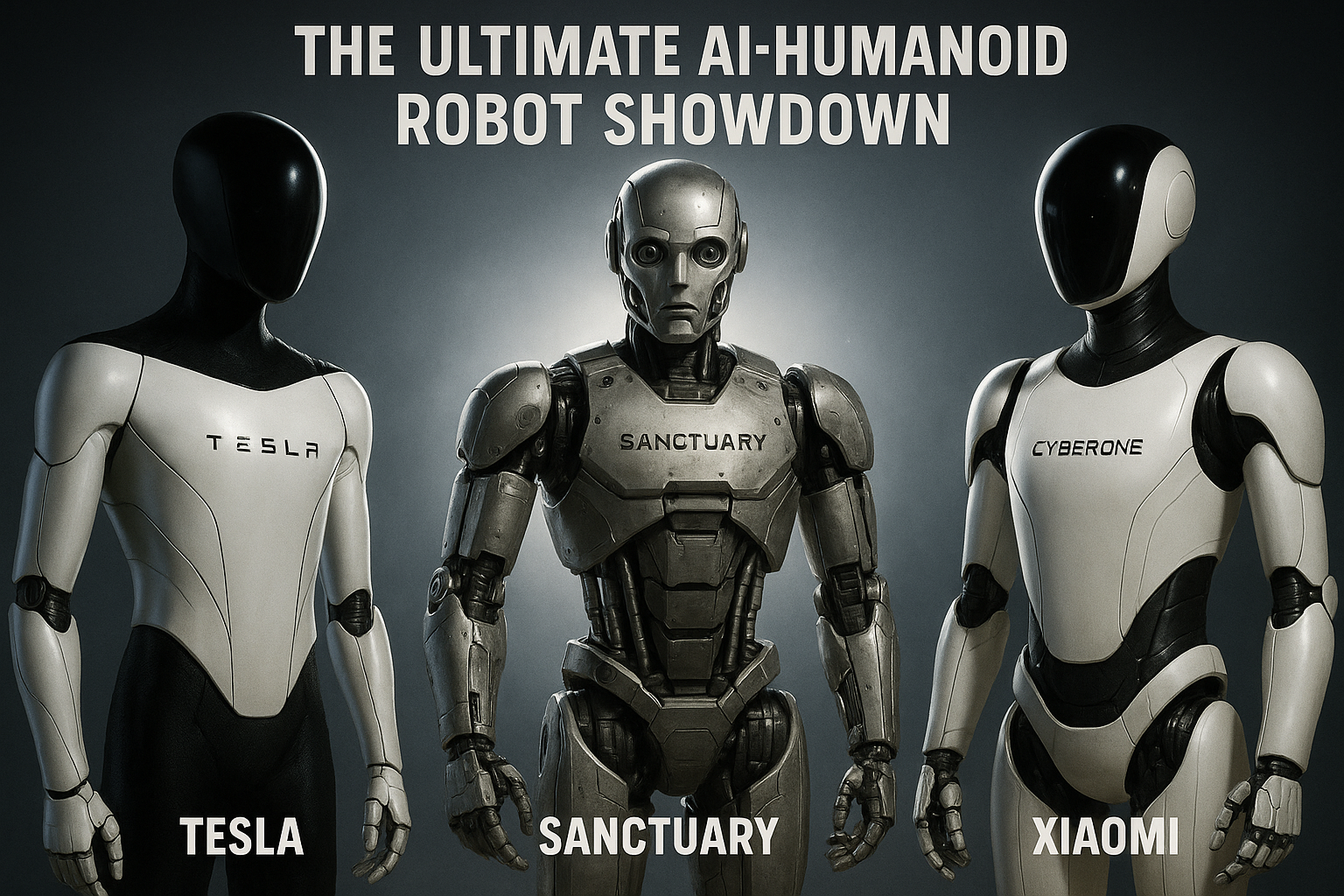
Elon Musk has reaffirmed Tesla’s robotics vision. Optimus is set to begin pilot production in Fremont by late 2025, with thousands of units slated for in-house factory deployment this year (businessinsider.com). Musk formed bold scaling goals: “one million units per year by 2029,” with initial mass production ramping through 2026–2027 .
Tech potential & sim2real innovation
Optimus leverages Tesla’s FSD neural networks and sim‑to‑real reinforcement learning. Internal demos have shown tasks like dancing, balancing, poaching eggs, and folding shirts—though skeptics note some actions may be teleoperated (en.wikipedia.org).
Risks & reservations
🚧 Leadership turnover: Head of Optimus engineering, Milan Kovac, recently departed—though Tesla maintains production targets remain intact (barrons.com).
🧲 Geopolitical components risk: Rare-earth magnets from China could slow production unless Tesla secures alternatives (notateslaapp.com).
📉 Mixed reactions: Investor response to robotics news has been lukewarm, and Tesla’s track record includes delays and over-promises (businessinsider.com).
2. 🤖 Sanctuary AI Phoenix: Tactile Intelligence in Action
Physical fluency
Sanctuary AI’s sixth-gen Phoenix combines sleek design and dexterous hands—20 degrees of freedom—powered by the “Carbon” architecture, which unites symbolic reasoning, LLMs, and reinforcement learning in sim environments (reddit.com).
“Industry‑leading robotic hands … haptic technology that mimics the sense of touch” (reddit.com).
It features human-like reasoning, goal-seeking behavior, and auditable planning—all stepping toward true general-purpose autonomy.
Recent breakthroughs
In April 2025, Sanctuary revealed advanced tactile sensors and hydraulic hands capable of highly dexterous interactions in real-world settings (reddit.com, sanctuary.ai). They leverage NVIDIA’s Isaac simulation platform to accelerate learning and sim‑to‑real transfer (sanctuary.ai). Morgan Stanley recently ranked Sanctuary third globally in humanoid robotics patent filings (sanctuary.ai).
Challenges ahead
Phoenix remains mostly in experimental labs and hasn’t entered mass manufacturing. Scaling hardware from prototype phase to affordable production remains a major hurdle. User-facing demos are still limited.
3. 😃 Xiaomi CyberOne: Emotion‑aware Social Robot
Innovative sensing
Unveiled in 2022, CyberOne stands 1.77 m tall with 21 joints, 0.5 ms response time per DOF (designboom.com). It excels at emotional responsiveness, identifying 45 human emotions and 85 environmental sounds, projecting them visually via an OLED face (analyticsindiamag.com).
Industrial deployment
Xiaomi’s robotics division is piloting CyberOne within its own factories for tasks like inspection and material handling (gizmochina.com). Reports indicate mass production began in early 2024 in Beijing, with ambitions toward open-source integration and cross-sector applications (ic-online.com).
Limitations & outlook
Although emotionally intelligent, CyberOne lacks the full-body agility seen in competitors like Atlas. Technical specs like its 300 Nm torque motors and human-scale dimensions are impressive, but real-world autonomy and pricing remain uncertain; estimates suggest ~$90–104 k per unit initially (arabnews.com).
4. 🔍 Side‑by‑Side Comparison
| Feature | Tesla Optimus | Sanctuary Phoenix | Xiaomi CyberOne |
|---|---|---|---|
| Height / Weight | ~5’8″, lean humanoid (est.) | ~5’7″, ~155 lb (70 kg) | 1.77 m, 52 kg |
| Mobility / DOF | Slim Gen-2 design, teleoperated demos, sim2real gains | HR-quality dexterous hands, general motion | 21 DOF, stable bipedal walking |
| Perception & AI | FSD neural net + instruction-level control | Carbon platform: LLMs + symbolic reasoning | Emotion/vocal detection, OLED feedback |
| Production Status | Pilot line late 2025; factory use imminent | Lab demos; no mass production yet | Mass production since early 2024 |
| Target Price | ~$20–30 k model cost; optimistic scale | Unknown, likely high R&D cost | ~$90–104 k commercial units |
| Use Cases | Factory work, tasks, robotaxi (Tesla Network) | Multi-purpose autonomous tasks | Manufacturing, social/emotional interaction |
5. 🌟 Who’s Leading & Why It Matters
- Tesla Optimus is the most production-driven. By leveraging Tesla’s factory ecosystem and sim2real training, Tesla aims to deploy real labor-saving robots in volume—but faces supply-chain and credibility hurdles.
- Sanctuary Phoenix is at the cutting edge of tactile intelligent agents with learning systems tailored for nuanced human-like autonomy—but remains in research mode, not yet scalable.
- Xiaomi CyberOne is the first mover in emotional humanoids, with real factory deployments—but it’s less mobile and more niche.
6. 🔮 What to Watch in the Coming Year
- Optimus: Did Fremont pilot line start? Are thousands operational in factories? Does rare-earth sourcing become an issue?
- Phoenix: Any announcements on commercialization? Will we see real-world autonomous demos beyond labs?
- CyberOne: Are factory deployments expanding? Is Xiaomi reducing costs or launching social companion versions?
7. 🎯 Verdict: Which Is “Best” Today?
- For scaling & industrial impact: Tesla Optimus leads in roadmap execution, even if aspirational.
- For research-grade autonomy: Sanctuary Phoenix is unmatched in cognitive dexterity and general-purpose AI.
- For emotional & social robots: Xiaomi CyberOne stands out as the only emotion-savvy humanoid in mass production.
Final Thoughts
Each of these robots represents a different dimension of the humanoid frontier:
- Optimus = volume + connected ecosystem
- Phoenix = tactile intelligence + autonomy
- CyberOne = emotional awareness + practical deployment
As they evolve through 2025–2026, keep an eye on production rollouts, real-world functionality, and whether prices fall close to those ideal $20k targets.