The Rise of Embodied AI and Humanoid Robotics in Everyday Life
Artificial intelligence is moving off the screen and into the real world. Embodied AI – AI embedded in physical bodies – is rapidly gaining momentum. No longer confined to virtual assistants or datacenters, robots are becoming more intelligent, agile, and human-like. Advanced sensors, actuators, and on-board AI now allow machines to sense, move, and learn from their surroundings. In one view, Embodied AI “refers to AI that is integrated into physical systems, such as robots, enabling them to interact with their surroundings in a meaningful way”. This marks a profound shift: instead of computers operating in isolation, AI systems are beginning to learn by doing in real, unpredictable environments. The result is a new generation of humanoid robots – machines with arms, legs and sensors – that can perform human-like tasks. This convergence of AI and robotics is already reshaping industries, from manufacturing floors to retail shops, and promises to transform everyday life.
Humanoid robots combine advanced AI with dexterous bodies to interact in human environments. Unlike traditional AI (which often runs on servers or in simulation), embodied AI gains knowledge through direct physical interaction. Early experiments in embodied AI date back decades – for example, the 1960s “Shakey” robot could perceive its hallway surroundings and navigate autonomously. But modern advances in machine learning have accelerated the trend. Today’s systems use deep learning and reinforcement learning on billions of data points to improve perception and control in real time. As one expert puts it, giving AI a “body” allows it to try actions, feel the feedback, and adapt through experience – much like a child learning to walk by wobbling and rising again. In short, embodied AI emphasizes that intelligence emerges from the tight coupling of perception, action and the physical world.
From Disembodied to Embodied AI
The term “embodied AI” underscores a key difference from classical AI: most AI today (like chatbots or image classifiers) operates on abstract data. Embodied AI, by contrast, treats the body as part of the mind. It leverages the “embodiment hypothesis” from cognitive science, which holds that cognition is deeply influenced by the body’s interactions with its environment. As Rodney Brooks and others argued, a robot can develop intelligence simply by engaging with the world rather than relying on pre-programmed models. In practice, this means integrating fields like computer vision, control theory, physics simulation, and natural language to create a feedback loop: the robot perceives the world with its sensors, decides an action, executes it, and then learns from the outcome.
For example, a modern robotic arm with embedded AI not only sees parts moving on a conveyor belt but actually grasps and manipulates them, learning on the job. This trial-and-error learning in the real world improves performance in ways that purely virtual training cannot. Unlike traditional AI models (which might recognize images or play chess in isolation), embodied AI systems must deal with sensor noise, motor uncertainty, and dynamic environments, making them far more generalizable. In short, by embedding AI in a robot’s body, engineers enable machines to develop context-aware intelligence that is grounded in physical reality.
Why Humanoids?
Humanoid robots – machines with human-like torso, arms and legs – represent the most advanced form of embodied AI. Why adopt a human shape? The rationale is practical: human environments are built for humans. Door handles, tools, hallways and staircases are all designed with people in mind, so a bipedal robot can in principle use the same infrastructure without special retrofits. Moreover, a human-like form with a “face” or two arms makes interaction more intuitive and socially acceptable. For instance, an elderly patient may feel more comfortable receiving a reminder to take medicine from a robot with a friendly digital face than from a faceless appliance. In caregiving and customer-facing roles, humanoid form factors leverage our innate ability to read faces, gestures and voice tones, allowing natural social interaction.
Technologically, convergence towards humanoids is enabled by advances in sensors and actuators. New 3D vision systems, force-sensitive skin, and highly articulated limbs mean robots can now walk over rough terrain, manipulate objects of many shapes, and interpret gestures and spoken language. Integrating large language models (LLMs) and vision-language models with these hardware platforms is a major focus: for example, the startup Figure AI equips its robots with LLM-driven conversation capability so they can understand verbal instructions in context. As one report notes, combining AI with cloud computing and edge processing gives humanoids “more natural and context-aware conversations” and better autonomy. Collectively, these advances mean that today’s humanoids are far more capable than the clunky, slow machines of the past.
Emerging Humanoid Robot Examples
Several companies have unveiled humanoid robots that demonstrate the current state of the art. Tesla’s Optimus is perhaps the most famous: a 5.5-foot biped intended for both factory work and eventually home use. Optimus walks on two legs and has two dexterous hands, allowing it to lift and sort objects as well as navigate uneven ground. Tesla’s prototype videos show Optimus balancing on one leg, carrying objects, and even traversing rough terrain while catching itself when it slips. Tesla describes Optimus as a general-purpose machine powered by the same AI systems used in its cars to map the world. Production is slated to begin as early as 2025, with optimistic cost estimates under $30,000. If successful, Optimus aims to automate repetitive or dangerous factory tasks and ultimately serve as a home assistant, fulfilling Elon Musk’s vision of an “age of abundance” where goods and services are plentiful. (Observers note that early demonstrations had human operators in the loop, underscoring the challenges remaining.)
Another Silicon Valley startup, Figure AI, is similarly racing to bring humanoids into homes and factories. Its latest model, Figure 02, is equipped with speakers and microphones to engage in natural conversations on the job. Figure’s founder reports that by late 2025 the company will begin “alpha testing” Figure 02 in real home environments. To do this, they’ve developed a new “Helix” AI platform that combines vision and language so the robot can learn new tasks quickly from human instructions. In 2024 Figure also began piloting its robots in industrial settings; for example, Figure 02 has already been tested at a BMW auto plant in South Carolina to assist on the assembly line. These dual strategies – factory trials first, then home trials – reflect a common path: structured environments like factories are safer proving grounds before tackling the chaos of a family kitchen. Figure’s approach highlights the crucial role of AI integration: its robots leverage cutting-edge neural networks (initially OpenAI’s models, now proprietary ones) so that even unstructured tasks can be handled under human guidance.
Boston Dynamics’ humanoid Atlas offers another glimpse of embodied AI in action – albeit as a high-end research platform. In late 2024 the company released video of its all-electric Atlas performing complex warehouse tasks entirely autonomously. In the demo, Atlas was given a list of engine parts and instructed to move them between storage bins and a sorting cart. Using onboard cameras and machine-learning models, Atlas identified the correct bins and then coordinated its joints, arms and gripper hands to pick up and relocate each part. Crucially, Atlas responded to unexpected obstacles in real time: when a part got stuck during placement, the robot immediately sensed the resistance, reoriented the object, and tried again until successful. Throughout, a “Fully Autonomous” watermark emphasized that no humans were directly controlling it. This contrasts with some headline-making demos elsewhere (e.g. at Tesla’s events) where humanoid robots were later revealed to be remotely guided by people. In short, Atlas showcases how far embodied AI has come: complex tasks involving vision, manipulation and balance can now be done by a legged robot with minimal human input.
Other notable humanoids deserve mention. SoftBank’s Pepper has been deployed worldwide as a greeter in stores and hotels, leveraging its friendly face and voice to interact with customers. Hanson Robotics’ Sophia has toured tech shows as a talking “social robot.” And research platforms like Toyota’s Human Support Robot (HSR) have long targeted eldercare: HSR can fetch objects from floors and shelves, assisting aging individuals at home. Commercial interest is growing across the board: as one market report notes, retailers, hotels, and healthcare providers are already experimenting with humanoid robots to boost efficiency and customer service. For example, robots are trialed as concierges that understand guest queries, as room-service couriers, and even as automated shop assistants that recognize shoppers’ needs. (In fact, a recent report forecasts the global humanoid-robot market reaching over $4 billion by 2030, up from under $2 billion today.)
Applications in Everyday Settings
Humanoid robots are transitioning from lab curiosities to practical assistants. Key commercial applications include:
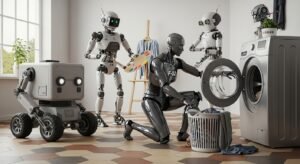
- Home and Personal Care: With an aging population and busy lifestyles, there is demand for robots that can help around the house. Startups aim to deliver general-purpose home helpers to do chores, monitor security, or provide companionship. Figure, for example, explicitly targets eldercare by helping older adults live independently outside care facilities. Robots are also being envisioned as domestic aids – fetching items, cleaning, or even cooking – though consumer-ready models are not yet widespread.
- Offices and Industry: In workplaces, humanoids can take on menial or hazardous tasks, complementing human staff. On factory floors, Optimus and similar bots could handle repetitive assembly or heavy lifting, freeing workers for oversight and quality control. Warehouses may deploy humanoids to sort inventory or transport goods alongside automated vehicles. Even in typical offices, simple robots could deliver documents, clean common areas, or facilitate video conferencing. The advantage of a humanoid form is flexibility: one robot might learn to operate a copier today and later restock office supplies, adapting via AI to changing needs.
- Retail and Customer Service: Stores and restaurants are already trialing robots to enhance service. Humanoids can greet customers, answer questions, and guide shoppers to products, providing a novel interactive experience. For example, Pepper robots greet guests at hotels and help restaurant patrons, while AI-powered kiosk robots answer queries in malls. Behind the scenes, humanoids may handle inventory tasks – scanning shelves or fetching items – improving accuracy and stock management. The end goal is a seamless, personalized shopping experience: robots that recognize customer preferences, process transactions, and integrate with cashierless systems.
- Healthcare and Eldercare: Hospitals and clinics see immediate use for humanoids in logistics and patient support. Robots can autonomously deliver medications, blood samples, or supplies, reducing staff walking time. In eldercare and home health, humanoids can assist with daily routines: reminding patients to take medicine, helping with rehabilitation exercises, or simply providing social interaction to combat loneliness. Early deployments have shown nurses using robots to fetch items and chatbots giving light social engagement to dementia patients. Studies note that humanoid robots today serve mainly as task-specific helpers (transporting lab samples, guiding visitors, or providing companionship), rather than medical professionals. But as AI and sensors improve, these robots are poised to become valued members of care teams – so long as safety and empathy are prioritized.
- Hospitality and Services: The hotel and travel industry has been experimenting with robotics to delight guests and improve efficiency. Notable examples include Japan’s Henn na Hotel, which famously tried a fully-robotic staff (reception, cleaning, etc.). Although that experiment encountered practical and social challenges, it demonstrated several service tasks that robots can handle: delivering towels, serving room service, and guiding guests around the facility. Today’s service robots (whether humanoid or wheeled) can autonomously bring food to tables, carry luggage, and perform basic cleaning. High-end resorts and cruise ships are even using robots for check-in or multilingual concierge work. Luxury properties are careful to balance automation with personal touches – for instance, using robots as a novelty attraction while keeping human staff for high-touch interactions. Nonetheless, AI-powered service robots are already streamlining operations: they work around the clock without fatigue, collect data on guest preferences, and can handle unpredictable crowds more safely than in the past.
Technology Advances Fueling the Trend
Several technological breakthroughs have made this robotics revolution possible. AI and Perception: The rise of deep learning and neural networks means robots can now interpret camera images, depth sensors, and lidar with human-like proficiency. Modern vision systems allow humanoids to recognize objects, localize in complex environments, and even gauge human emotions. Researchers have demonstrated robots that use multimodal learning – combining sight, sound, and touch – to understand their surroundings in rich context. For example, embedded NLP engines (comparable to ChatGPT or Google’s Gemini) give robots the ability to process spoken language and answer questions. In practice, this means you can instruct a robot in natural speech (“Bring me the red mug on the counter”) and it will parse the command, locate the mug via vision, and grasp it. As one tech journalist notes, outfitting robots with LLM-based speech capabilities “helps humans instruct the robots” and also makes the robot’s actions more transparent to people. This kind of real-time language interface is doubly important for safety: if a falling object occurs or a hazard is detected, a humanoid can verbally alert nearby humans and receive immediate feedback.
Sensory and Motor Systems: Humanoids today use an array of advanced sensors – stereo/3D cameras, force-sensitive skin, LIDAR, and internal proprioceptive sensors – to navigate and manipulate. Boston Dynamics’ Atlas, for example, uses high-fidelity sensors to feel when an object doesn’t slide correctly, triggering an automatic re-grip. Miniaturized IMUs, joint encoders, and even tactile fingertip sensors give robots a much finer control than earlier models. Meanwhile, progress in actuators (brushless motors, hydraulic-servo systems, artificial muscles) has dramatically improved agility. Robots can now run, jump, and dance (as demos show) – skills that directly translate into robust handling of real-world obstacles. In warehouses, this means a humanoid can step over uneven ground or shift awkward parts into bins without toppling. All these hardware advances are marrying with cloud and edge computing so that real-time decision-making is feasible on a moving robot.
Integration and AI Models: An important trend is the fusion of robotics with the latest AI software platforms. Beyond just vision and speech, robots increasingly incorporate planning algorithms and even RL-trained policies. Some companies are building custom on-board chips (like Tesla’s Dojo brain) to run these demanding models locally. Others leverage 5G and cloud AI to offload heavy computation. A key recent example is how Figure AI’s Helix platform “orchestrates” multiple robots on the same task by combining vision and language models. Similarly, research groups (including those led by Google and Agility Robotics) are integrating generative AI to let robots learn new skills from video data. The upshot is that an engineer can record a human performing a task once, and a modern humanoid can begin mimicking it under supervision. This dramatically accelerates development and customization of robot behaviors for specific business needs. In summary, the convergence of AI (especially vision and language models) with robust sensory and motor tech is what makes today’s humanoids far more capable than ever.
Societal and Ethical Implications
The rise of everyday robots brings more than just technology—it raises important social and ethical questions. Trust and Safety: For people to accept humanoids in homes and public spaces, the machines must be reliable and safe. As Stanford’s Steve Cousins warns, “Making humanoids safe is the biggest barrier to adoption in hospital and home care settings.” Humanoid robots are large, heavy, and complex; they must operate without injuring humans, especially vulnerable groups like children or the elderly. Achieving this requires rigorous testing, built-in fail-safes, and transparent behavior. Natural language interfaces help here: by enabling robots to explain their intentions in words, humans can stay informed about what the robot is doing at any moment. Indeed, the first generation of practical robots are likely to be used in relatively structured roles (factory or hospital tasks) while control algorithms and regulatory frameworks catch up to ensure safety in less controlled environments.
Human–Robot Interaction and Trust: Humanoid form factors can be a double-edged sword for trust. On one hand, robots that move and speak like humans are more intuitive to work with, since we naturally understand gestures, expressions, and tone. On the other hand, this anthropomorphism raises ethical concerns. If a robot’s face smiles or nods, people might overestimate its understanding or form emotional attachments. Ethical scholars note that designing machines with human-like emotions can inadvertently manipulate people’s trust or create confusion. We must ensure robots do not deceive users into believing they have motivations or consciousness. This also ties into privacy: humanoid companions in healthcare or homes will collect vast amounts of personal data (health metrics, habits, conversations). Without strong safeguards, this data could be misused or leaked. Experts are calling for new legal and policy frameworks to govern how robots interact with humans. For instance, a recent Cambridge handbook on human–robot interaction highlights the need for ethics standards and regulations, emphasizing that technologists should work alongside legal scholars to address issues like privacy, liability, and data protection.
Economic and Workforce Effects: Another major question is how humanoids will affect jobs. There is concern that robots could displace certain labor, but many analysts argue the reality will be more nuanced. Early deployments show humanoids excelling at repetitive, boring or dangerous tasks – ironically, the very work many humans find undesirable. By taking over such tasks (warehouse sorting, factory lifting, home cleaning), robots can free people for higher-level work and creative duties. In fact, a recent market report notes that the goal is often augmentation, not replacement – humanoids are designed to collaborate with humans in places that are ergonomically hard for people. For example, rather than replace a warehouse worker, a robot might become an assistant that lifts heavy cases on demand. Companies and governments are also exploring how to reskill workers so that they can work alongside robots. Still, there will be transitions: roles in robotics operation, maintenance, and oversight will grow, while some manual roles may shrink. Society will need proactive policies, job retraining, and possibly universal safety nets to manage this shift responsibly.
Looking Ahead
The momentum behind embodied AI and humanoid robotics is unmistakable, but so are the challenges. In the near term, we are likely to see robots succeed in niche roles where their strengths are clear – for example, automating logistics in warehouses, serving as telepresence agents in offices, or assisting seniors in controlled home settings. Each successful deployment will build confidence and drive further innovation. Companies like Tesla, Figure, Boston Dynamics and others continue to push both software and hardware; their prototypes are improving every year. Market analyses predict strong growth: one report projects the global humanoid robot market growing at over 17% per year through 2030.
Technologically, future advances in AI will bleed into robotics. As generative models become smarter and more efficient, robots will learn new skills by watching more video, by being “instructed” with language prompts, and by continuous online learning. Meanwhile, sensor and battery technologies will improve, making robots faster, quieter, and more affordable. On the software side, open-source robotics platforms and simulation tools are lowering the barrier to entry, so we may see startups or hobbyists develop new applications that established players haven’t envisioned yet.
In society, we will grapple with questions of standards and ethics. The conversation is already shifting from “can we build them?” to “how should we build them?” Multidisciplinary groups are forming to set guidelines (for instance, IEEE working groups on AI ethics, and government task forces on robot regulation). By the end of the decade, we may well have international standards for robot safety and data use.
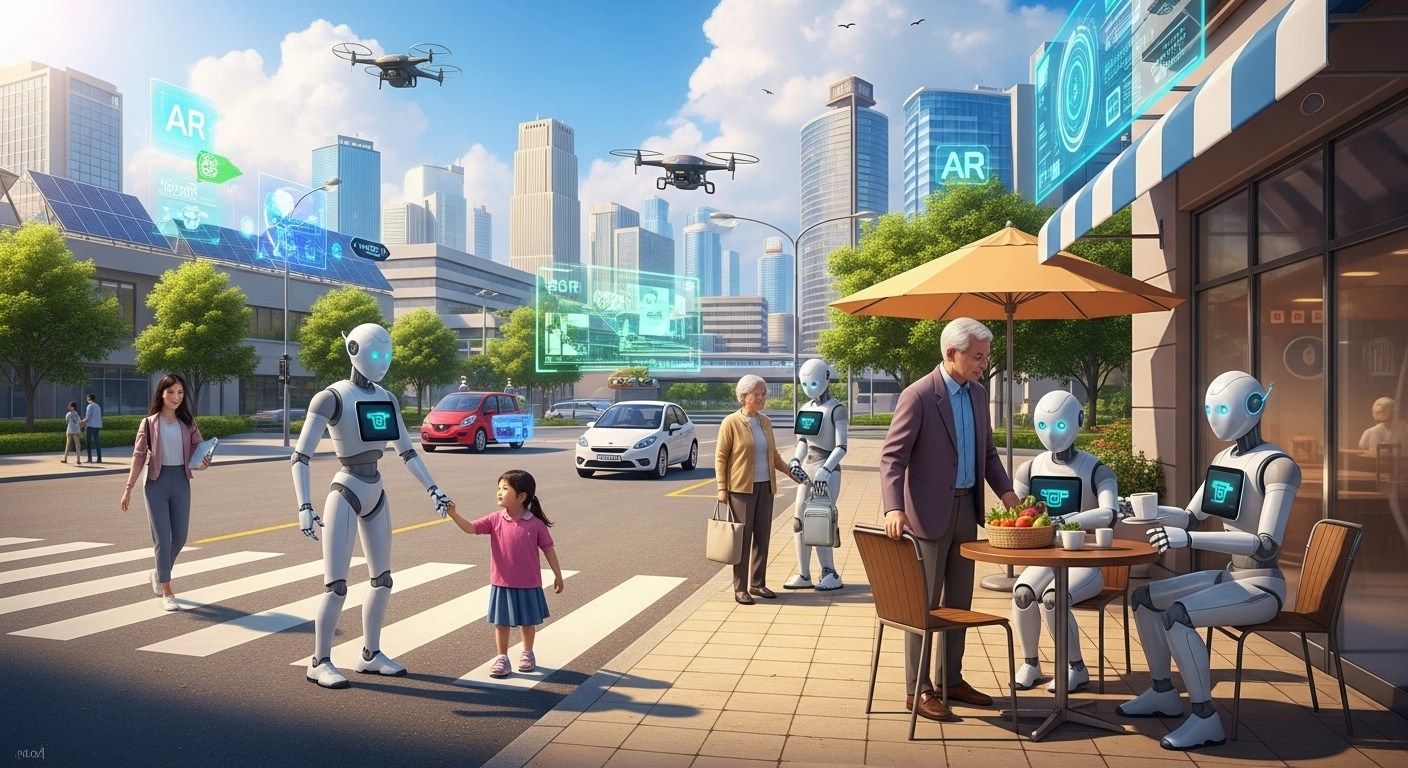
Ultimately, the vision is that humanoid robots will gradually become as commonplace as computers and smartphones, though likely first in commercial and institutional settings. For example, future smart homes might include a household robot that responds to voice commands, fetches a drink, or even helps children with homework, all while seamlessly connecting to the home’s AI ecosystem. In workplaces, robots could become ubiquitous co-workers, handling logistics, monitoring equipment, or interfacing with AI control rooms. In public spaces, humanoid guides in malls, airports or museums might be routine.
The journey is complex, and predictions always carry uncertainty. But the trend is clear: AI is no longer just a brain – it’s getting a body. And as those bodies become more capable and our confidence in them grows, humanoid robots are poised to take on an ever-greater role in daily life. The era of embodied AI is upon us, and its impact on business, healthcare, service industries, and even our homes will be profound in the years ahead.