The First World Humanoid Robot Games: Where Machines Chase Glory
”Tomorrow, the stadium won’t echo with pounding human footsteps. Instead, the sound will be the high-pitched whir of electric actuators — and one of those whirs might just set a new speed record”
📺 Watch the Action
🏟️ Tomorrow’s Athletes Don’t Breathe — They Compute
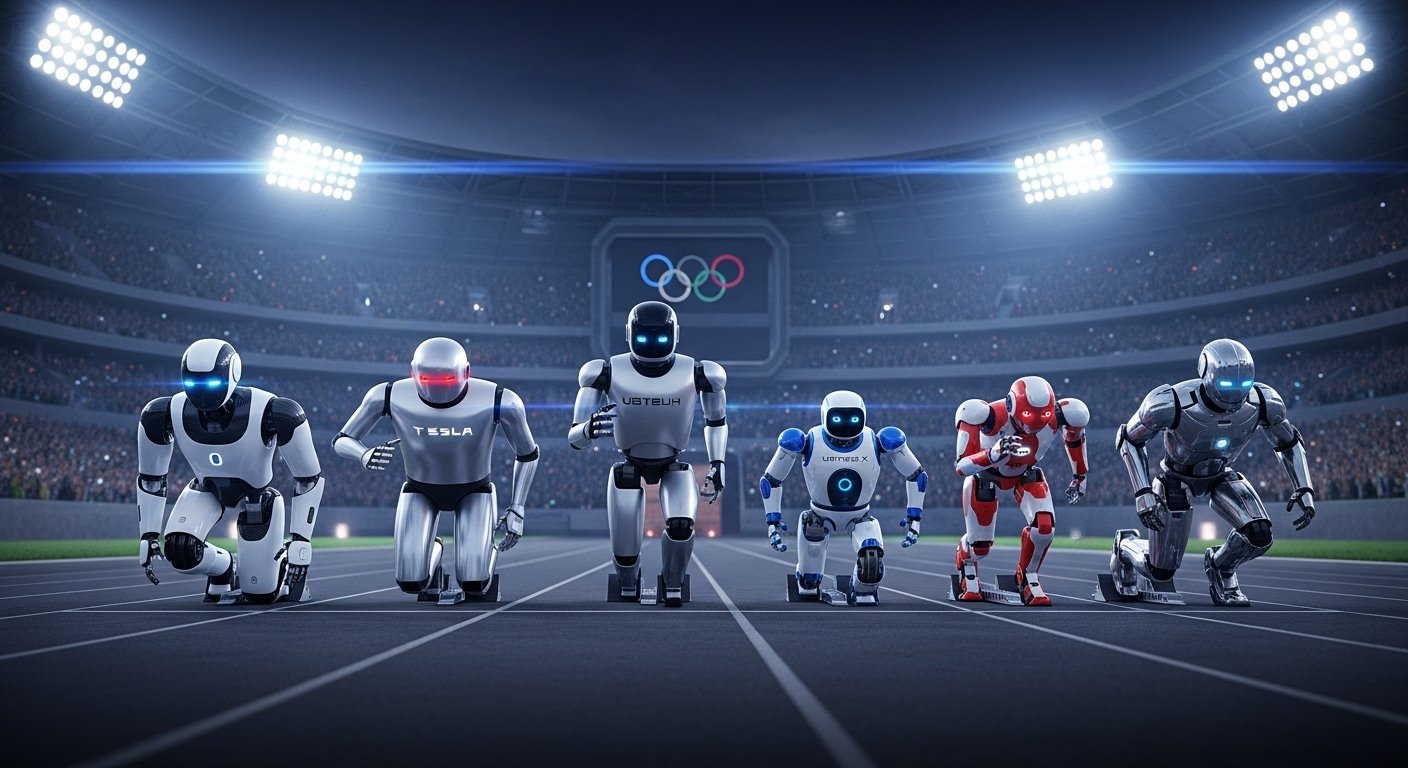
Picture this: A sleek humanoid robot crouches at the starting line. Its twin fisheye lenses lock onto the track. A mechanical hand twitches as balance systems fine-tune microsecond corrections. The starting gun fires.
In a blur of carbon fiber limbs and aluminum joints, the robot explodes forward — running not just with speed, but with perfect, unwavering form. No gasping lungs. No aching muscles. Only relentless, mathematically optimized motion.
This is not science fiction. It’s August 15, 2025, in Beijing, China — and the First World Humanoid Robot Games are officially underway.
Executive Summary
This report provides a comprehensive analysis of the inaugural World Humanoid Robot Games (WHRG), a groundbreaking event that took place in Beijing from August 14 to 17, 2025. It serves as a strategic brief for creating a high-impact, viral blog post by providing an expert breakdown of the event’s factual context, technical achievements, geopolitical implications, and a practical blueprint for content creation.
The investigation found that the event, a part technology showcase, part competition, and part history-making moment, was not hosted by Unitree Robotics or located in Hangzhou as a common misconception suggests. Instead, it was a massive state-backed initiative, hosted by the Beijing municipal government. Unitree Robotics participated as a key contender, using the platform to validate its market-leading H1 robot and establish itself as a foundational hardware provider for a burgeoning industry. The Games themselves were a form of “extreme testing,” strategically designed to shift the public perception of robotics from a research-bound field to a commercially viable and ready-for-market sector.
The potential for a viral narrative lies in framing the WHRG not as a niche competition but as a symbolic “Robolympics”—a pivotal moment that signals a new era where robots are no longer confined to laboratories but are poised to enter our daily lives, from factories and hospitals to our homes.
I. A Historical Pivot Point: The Inaugural World Humanoid Robot Games
The inaugural World Humanoid Robot Games (WHRG), held in Beijing in mid-August 2025, represented a critical inflection point for the global robotics industry. The event, which brought together over 500 humanoid robots from 280 teams, was deliberately framed as a “history-making moment”.4 It marked a strategic, national-level effort to transition robotics from a theoretical, laboratory-based field into a public, practical, and commercially viable industry. By showcasing humanoid robots performing a diverse range of athletic, artistic, and service-oriented tasks, the event’s organizers aimed to make the technology more relatable and accessible to a broad audience, fostering public confidence and accelerating commercial adoption.
A key correction to a widespread misconception is essential for an accurate and authoritative report. The event was not held in Hangzhou, nor was it hosted by Unitree Robotics. Instead, the WHRG was a three-day competition from August 15 to 17, with its opening ceremony on the 14th, at the National Speed Skating Oval in Beijing, a venue from the Winter Olympics.2 The event was officially organized by the Beijing municipal government, with Unitree Robotics participating as a leading competitor and technology provider. The meticulous planning and state-level backing underscored the event’s gravity and its alignment with China’s national strategic goals.
The sheer scale and scope of the WHRG were unprecedented. It featured a massive international turnout, with 280 teams from 16 countries across five continents, including the United States, Germany, and Japan.2 The participant list was deliberately diverse, comprising 192 university teams, 88 enterprise teams, and even three middle school teams, demonstrating a concerted effort to foster innovation across all levels of society and academia.3 The robots competed in 26 event categories and 538 individual competitions, which ranged from athletic challenges like running, long jump, and gymnastics to skills-based tasks such as material handling, drug sorting, and hotel cleaning.2 The inclusion of artistic performances like hip-hop, martial arts, and dance further broadened the event’s appeal, showcasing the robots’ fluidity and entertainment potential.
The opening ceremony itself was a highlight, blending culture with technology. Robots dressed as Terracotta Warriors performed martial arts, and humanoids played live music on guitars, drums, and keyboards. A futuristic fashion runway featured robots modeling hats and clothes alongside human models, though in one notable mishap, a robot model fell and had to be carried off the stage by two humans.3 In a demonstration of sports, a robot soccer player scored a goal after a few tries, causing the robot goalkeeper to fall to the ground, while another player fell but stood up unassisted.
The design of the WHRG was a strategic rebranding effort for the Chinese robotics sector. A previous high-profile humanoid robot marathon in Beijing drew criticism after several competitors failed to complete the course and some even “emitted smoke,” raising questions about the technology’s readiness.7 The WHRG’s organizers learned from this public relations setback by avoiding long-distance endurance events. Instead, they focused on short-distance, high-explosive events that test burst performance, body coordination, and dynamic stability, which are areas where the technology is currently strongest. This pivot maximized visual impact and minimized the risk of public failures, effectively managing public perception and building market confidence in the industry. This shift in strategy demonstrates a clear link between a past failure, a new event design, and a successful public perception campaign, ultimately enhancing confidence for future investment.
Furthermore, the WHRG served as a form of “soft power” on the global stage. The significant international media presence, with 97 overseas outlets and 282 reporters covering the event, illustrated its geopolitical importance.2 By hosting and leading an international competition, China signaled its rapid ascent as a global leader in AI and robotics, a move that aligns with its national strategic goals. The Beijing municipal government’s sponsorship and its support for the industry with over $20 billion in subsidies and a planned one trillion yuan fund for startups further underscored this national-level commitment.7 The event became a public platform for technological leadership, boosting the country’s prestige in a field that is widely seen as a key driver of future economic and military power.
Table 1: The Games in Context
| Category | Events Include | What It Tests |
| Athletics | Sprinting, long jump, gymnastics, football, boxing, 4x100m relay | Explosive power, dynamic stability, body coordination, and multi-robot collaboration |
| Scenario Challenges | Hospital medicine sorting, hotel cleaning, material handling, logistics | Fine motor skills, object manipulation, navigation in complex environments |
| Performance Showcases | Hip-hop dance, martial arts, fashion runway, musical performance | Autonomous control, fluid motion, precision, and coordination with other robots |
Table 2: Fast Facts
| Metric | Value |
| Duration | August 15–17, 2025 |
| Teams | 280 from 16 countries, including the U.S., Germany, and Japan |
| Robots Competing | Over 500 humanoids |
| Events | 538 competitions across 26 categories |
| Venue | National Speed Skating Oval, Beijing |
| Host | Beijing Municipal Government |
II. The Athlete and the Machine: A Deep Dive into Competitive Robotics
The World Humanoid Robot Games was more than a spectacle; it was a rigorous, “extreme test” of hardware and software designed to accelerate innovation by forcing companies to push their technological boundaries. The event categories were meticulously chosen to test specific, critical aspects of humanoid robot design, from individual athletic prowess to complex team dynamics. For instance, events like the 100-meter dash, obstacle courses, and long jump relied on explosive power and body coordination.1 In contrast, multi-robot football games tested real-time perception, complex motion control, and multi-agent tactical cooperation, as well as the ability to recover from falls autonomously.
The competitive challenges provided a public litmus test for the core engineering principles that enable modern robotics. The ability of a robot to run, jump, or get back up after being knocked over is a direct reflection of its underlying systems. At the heart of a robot’s athletic ability are its actuators, which function as its joints or “muscles”. These components must provide high torque and rapid response while being energy efficient. Unitree’s H1 robot, for example, utilizes low-inertia, high-speed internal rotor Permanent Magnet Synchronous Motors (PMSMs) to achieve a peak torque density of 189 N.m/kg, with a knee torque of about 360 N.m.13 This technical capability is what allows for the agile, human-like movements required to perform at a high level. Similarly, the robot’s structure relies on lightweight, high-strength materials like carbon fiber to maximize its strength-to-weight ratio, allowing it to move faster and more efficiently while maintaining durability.
The robot’s “brain” is equally critical. For perception and navigation, the Unitree H1 is equipped with 360° depth sensing, which it achieves using a 3D LiDAR and a depth camera. This sensor suite allows for the real-time acquisition of high-precision spatial data, which is crucial for tasks like path planning in an obstacle course or positioning oneself on a football pitch. The robot’s intelligent motion capabilities are enabled by dynamic control strategies that use reinforcement learning, a form of artificial intelligence that allows the robot to learn and adapt to its environment.16 This is what enables a robot to recover from a stumble or get back up after a fall unassisted, as seen in the opening ceremony.
While previous robotics competitions like the DARPA Robotics Challenge (DRC) were primarily academic and focused on high-risk, military-adjacent tasks like disaster response, the WHRG signals a new, commercially-oriented direction for the industry. By using the universally understood metaphor of human sports, the event stress-tests the general-purpose skills that are essential for mass-market, service-oriented robots. This shift from specialized, high-stakes tasks to more relatable, everyday capabilities such as running, carrying objects, and performing synchronized movements broadens the technology’s appeal and directly links it to potential commercial applications in factories, hospitals, and homes. This approach is an effective strategy to accelerate the timeline for mass adoption and attract a wider range of investment and talent.
A striking feature of the WHRG was the public display of the technology’s imperfections. The event’s narrative was punctuated by moments of vulnerability, such as a robot goalkeeper falling after a goal or a robot model collapsing on stage. These are not mere technical failures to be hidden but are crucial data points that highlight the current state of the art. These “mishaps” ironically make the robots more relatable and “human,” creating a powerful emotional connection that drives engagement and sharing. An audience that sees a machine struggle and recover is more invested than one that only sees flawless, pre-programmed feats. The public’s emotional response to these moments is a potent driver of virality, and the narrative of a robot overcoming an obstacle is a classic storytelling device that captures attention.
Table 3: Competitive Events & Technical Capabilities Tested at the WHRG
| Event Category | Primary Event | Technological Capability Tested | Key Competitors & Examples | |
| Athletics | 100-meter Dash, Long Jump, Obstacle Course | Explosive power, dynamic stability, body coordination, high-torque motors, gait algorithms. | Unitree H1, Tiangong | |
| Team Sports | 3v3 and 5v5 Robot Football | Multi-agent collaboration, real-time perception, path planning, autonomous decision-making, physical resilience. | Teams using Booster and Unitree hardware, Tsinghua University | |
| Performance | Solo Dance, Group Dance, Martial Arts | Autonomous control, fluid motion, precision, balance, coordination with music and other robots. | Unitree, Booster | |
| Scenario-Based | Material Handling, Medical Sorting, Hotel Services | Fine motor skills, object manipulation, grasping, navigation in a defined environment, practical application of dexterity. | Beijing Institute for General Artificial Intelligence, Unitree |
III. Unitree Robotics: From Quadrupedal Dogs to Bipedal Legends
Unitree Robotics’ role in the WHRG was a testament to its strategic evolution from a company focused on consumer-grade quadrupedal robots to a global player in humanoid robotics. Founded in 2016 by Wang Xingxing, a roboticist who gained early fame for his “XDog” prototype, Unitree has a history rooted in accessible and affordable technology. This background gave Unitree a unique market position, as its robots, such as the Go1, were priced at a fraction of the cost of competitors like Boston Dynamics’ Spot, making advanced robotics more widely available.22 This business model laid the groundwork for Unitree’s broader vision.
The company’s participation in the WHRG was a major showcase for its most advanced creation, the Unitree H1. This full-size humanoid robot, standing at 1.8 meters tall and weighing 47 kilograms, was a highly anticipated competitor, especially in the 100-meter dash. The H1 had previously set a world record for bipedal speed at 3.3 m/s, with a potential mobility exceeding 5 m/s, making its performance a key benchmark for the industry.13 Its participation in the race was not just about winning but about publicly validating its powerful and efficient design, from its high-torque motors to its advanced perception systems.
Beyond its own competitive team, Unitree demonstrated a subtle but profound business strategy at the WHRG. The research indicates that “multiple teams” at the event used Unitree’s hardware with their own independently developed algorithms. This positions Unitree not just as a product company, but as a key platform provider for the robotics ecosystem. By allowing its technology to be stress-tested by third-party teams in a public, competitive environment, Unitree is effectively creating a foundation for others to build on, much like NVIDIA has done in the broader AI sector. The success of these teams directly validates the robustness and versatility of Unitree’s core technology, securing future market share and investment.
The H1’s performance in the 100-meter race provides a powerful narrative, not just of technical achievement, but of economic potential. Analysts from Morgan Stanley have articulated the concept of “Robonomics,” where humanoid robots perform increasingly complex and economically valuable tasks.23 According to their analysis, a single humanoid robot costing $5 per hour could generate a net present value of approximately $200,000 over its working life by replacing two human workers earning $25 per hour. The H1’s speed and efficiency are therefore not just technical metrics; they are directly translatable to business productivity. A technical win for the H1 in the race becomes a financial promise for investors and a compelling story for the public, linking a seemingly simple competition to the potential for a multi-trillion dollar industry.
IV. Geopolitics and ‘Robonomics’: The Event’s Broader Significance
The World Humanoid Robot Games must be viewed within the context of a larger national push for robotics in China. Driven by the twin pressures of an aging population and slowing economic growth, the Chinese government has made AI and automation a national imperative, backing the sector with over $20 billion in subsidies and a planned one trillion yuan fund.7 The WHRG is a highly visible manifestation of this strategic commitment, signaling to the world that China is not merely a follower but a leader in the global race for embodied autonomy.
When compared to other major players in the robotics space, the WHRG reveals a distinct strategic approach. Western companies like Boston Dynamics, an outgrowth of Marc Raibert’s Leg Laboratory at MIT, have built their reputation on highly dynamic, research-focused robots like the quadrupedal BigDog and the bipedal Atlas.25 Their viral content often features spectacular, pre-programmed feats of agility and balance, such as backflips and choreographed dances, which showcase the height of engineering but are often disconnected from practical, commercial applications.
In contrast, companies like Tesla and Figure AI have focused their viral moments on the integration of AI and practical, human-like tasks.28 Videos of Tesla’s Optimus serving popcorn or Figure 01 making coffee from observation have gone viral because they demonstrate the robot’s “brain” and its ability to learn and perform mundane, yet complex, tasks. The WHRG, by combining elements of both the spectacular (running, dancing) and the practical (scenario-based challenges), is a reflection of a hybrid strategy that is uniquely Chinese.
This difference in approach represents a tale of two strategies. The Western model, as exemplified by the DARPA Challenges, has historically focused on high-risk, military-adjacent tasks with significant government funding, often leading to limited commercialization in the early stages.17 The Chinese model, as embodied by the WHRG, is a national-level, multi-faceted public event that broadens participation to include universities and enterprises. By stress-testing robots in scenarios that are directly applicable to commercial uses—such as service roles, manufacturing, and logistics—the WHRG is designed to accelerate the timeline for mass adoption and economic impact. This strategy is an attempt to leapfrog traditional development cycles by fostering a domestic ecosystem of innovation and signaling commercial readiness to the world.
V. The Competitive Landscape: A Hypothetical Showdown
To fully appreciate the significance of the World Humanoid Robot Games, one must look beyond the scores and into the capabilities being tested. While the event was not structured as a head-to-head battle between a single set of world-famous robots, the competition categories provide a perfect framework to analyze how different models would theoretically fare. The following sections benchmark the capabilities demonstrated at the WHRG against a wider, hypothetical competitive field, using a popular “showdown” format to illustrate the core engineering philosophies at play.
The research indicates that the event organizers deliberately avoided crowning an overall champion. Instead, the focus was on using competition rules to drive technological breakthroughs and to use market attention to nurture industrial development. A robot that excels in a 100-meter sprint may be ill-suited for a group dance, and a machine that dominates in medical sorting may lack the explosive power for an obstacle course. This diversity of tasks is central to the event’s purpose: to find a robot’s “implementation position in the industrial coordinate system.”
1. Sprint vs. Endurance: The Ultimate Test of Power
The competition featured short-distance, explosive events like the 100-meter dash, a direct response to a previous marathon where some robots failed and “emitted smoke,” a public relations setback the industry was keen to overcome.7 The sprint is a benchmark for “lightweight design, high-torque motors, and motion strategies such as step frequency and gait.”
- The Scenario: A 100-meter lane awaits. The starting gun cracks.
- The Analysis: A robot from Unitree’s H1 series was seen in a warm-up video running at a speed faster than humans, and the H1 holds a world record for bipedal speed at 3.3 m/s, with a potential mobility exceeding 5 m/s. This suggests that in a pure speed event, a robot built for high-torque and high-step frequency would have a significant advantage. This event is a direct showcase of raw power and mechanical efficiency. The avoidance of long-distance events like a marathon highlights the current limitations of battery life and thermal management, which are areas where future development is critical.
2. The Obstacle Course: Dynamic Stability and Coordination
The obstacle course and gymnastics events rely on “explosive power and body coordination.” They are designed to test a robot’s ability to maintain dynamic balance and respond to unexpected environmental changes.
- The Scenario: A course of beams, gaps, and step-ups challenges the robot’s ability to maintain its center of mass.
- The Analysis: A robot’s performance here is a direct reflection of its dynamic control strategies. The ability to recover from a perturbation—such as a stumble on a beam—is a measure of its “brain” and how its intelligent motion capabilities, often enabled by reinforcement learning, allow it to adapt in real time. The fluid, whole-body coordination required for such tasks is a hallmark of sophisticated engineering, where the interaction between hardware and software is seamless.
3. Precision Manipulation and Logistics: The Test of Practicality
While the sprints and dances are eye-catching, the scenario-based challenges are the true proving ground for commercial viability. Events like hospital medicine sorting, hotel cleaning, and material handling test a robot’s fine motor skills, grasping capabilities, and ability to navigate a defined environment with purpose.
- The Scenario: A dexterity bench with screws and cables. A warehouse relay where totes must be carried and placed.
- The Analysis: These events prioritize precision, repeatability, and reliability over speed. The success of a robot here hinges on its “dexterous hand” and the fusion of its perception systems—such as its 360° LiDAR and depth camera—with its control algorithms to execute complex tasks flawlessly. This is a critical metric for a future where robots work in factories and homes, where a misstep could lead to a costly error.
4. Freestyle Performance: The Test of Autonomy
The performance showcases, including solo dance and martial arts, had a unique rule: the robots had to be “fully autonomous.” This meant no remote control or human intervention.
- The Scenario: Robots perform a choreographed routine to music, demonstrating fluid motion and synchronization.
- The Analysis: This is a pure test of the robot’s pre-programmed or learned motion library. The ability to maintain balance and coordination during a full routine without human oversight demonstrates the maturity of its control system and its capacity for complex, fluid, and expressive motion. The opening ceremony’s performance by robots dressed as Terracotta Warriors highlighted this, blending cultural performance with technological prowess.
The overarching theme of the games was not to crown a single, all-around “best” robot, but to highlight that different robots are optimized for different tasks. A robot’s strengths in speed, dexterity, or stability are all valid, and each points to a different commercial future. The event successfully showcased that there is no one-size-fits-all solution, but a diverse and rapidly maturing ecosystem where each new advancement pushes the entire industry forward.
📣 Final Thought
The First World Humanoid Robot Games are more than a milestone — they’re a manifesto for the future. A future where machines don’t just assist us — they inspire us and more than a showcase — they are a statement. They tell the world that humanoids are no longer fragile lab projects. They are entering public life, with speed, precision, and staying power. Whether that excites or terrifies you, one thing’s certain: the starting gun has already fired on the humanoid era. Whether you’re a tech geek, a sports fan, or just curious about what’s next, this event is your front-row seat to the future.