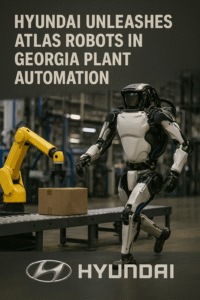
Tesla Optimus Gen 3: A Quantum Leap in Humanoid Robotics
Tesla has just revealed Optimus Gen 3, and the improvements over previous versions are astounding. Compared to Gen 1 (2022) and Gen 2 (2023), the new model is lighter, faster, more dexterous, and significantly closer to real-world deployment.
Elon Musk has reiterated that Tesla’s humanoid robot division could outgrow its automotive business, and Gen 3 marks a major step toward that vision. Let’s break down the evolution of Tesla’s Optimus, from Gen 1 to Gen 3, and explore what this means for the future of robotics.
📌 Optimus Gen 1 (2022): The First Prototype
🔹 Unveiled: September 30, 2022 (Tesla AI Day)
🔹 Development Stage: Early-stage prototype
🔹 Purpose: Testing fundamental humanoid mechanics
🚀 Key Features:
✅ Basic walking capability – Slow and unstable
✅ Exposed wiring & mechanical parts – Early-stage prototype aesthetics
✅ Limited dexterity – Could grip objects but lacked fine motor skills
✅ Heavyweight design – Inefficient in movement and power usage
✅ Basic AI & vision system – Limited real-world interaction
🔍 Performance Analysis:
At Tesla AI Day 2022, Gen 1 was showcased walking for the first time. While its motion was sluggish and unbalanced, it was a critical proof-of-concept, demonstrating that Tesla could build a functional humanoid robot.
Musk emphasized that Tesla’s goal was affordability, estimating a price of around $20,000 per unit—a fraction of the cost of competitors like Boston Dynamics’ Atlas.
💡 Summary:
Gen 1 was purely experimental, proving Tesla could build a humanoid robot but far from real-world usability.
📌 Optimus Gen 2 (2023): A Significant Leap in Mobility & Efficiency
🔹 Unveiled: 2023 (Tesla internal updates, no major public event)
🔹 Development Stage: Advanced prototype
🔹 Purpose: Refining balance, movement, and hand dexterity
🚀 Key Improvements Over Gen 1:
✅ Smoother & more stable walking – Improved actuator and joint control
✅ Lighter weight – More power-efficient, with a better-optimized frame
✅ Better hand dexterity – Improved finger articulation for grasping objects
✅ Integrated battery & electronics – Cleaner and more compact design
✅ Enhanced AI & object recognition – Smarter interaction with surroundings
🔍 Performance Analysis:
By early 2023, Tesla had refined the Optimus platform significantly. Videos showcased improved walking mechanics, better weight distribution, and more precise finger movements. Tesla engineers redesigned the hands, allowing for better object manipulation, an essential step toward real-world applications.
💡 Summary:
Gen 2 marked a huge leap in refinement, making Optimus lighter, smoother, and more efficient. However, it was still not ready for industrial deployment.
📌 Optimus Gen 3 (2024): The First Truly Practical Tesla Humanoid Robot
🔹 Unveiled: April 1, 2024
🔹 Development Stage: Refined prototype, approaching real-world testing
🔹 Purpose: Near-human movement, dexterity, and AI-driven autonomy
🚀 What’s New in Optimus Gen 3?
🔥 1. Near-Human Walking & Motion
🔹 Twice as fast as Gen 2 and walks with much greater stability
🔹 New actuators and joint designs for smoother, more human-like movement
🔹 Capable of standing on one foot, showcasing advanced balance control
🔥 2. 10 kg Lighter & More Energy Efficient
🔹 Uses a completely redesigned exoskeleton, reducing weight while increasing strength
🔹 Battery and power system optimization allows for longer operation
🔥 3. Industry-Leading Hand Dexterity
🔹 Stronger finger actuators for fine motor control
🔹 Can pinch small items, handle tools, and grip fragile objects like eggs
🔹 Fingers now move independently, mimicking natural human hand movements
🔥 4. AI & Computer Vision Upgrades
🔹 Uses Tesla’s custom-built neural network for improved object recognition & task adaptation
🔹 No need for extensive reprogramming—Optimus can learn and adjust dynamically
🔥 5. Quieter & More Natural Movements
🔹 Dramatic reduction in motor noise makes Gen 3 quieter than its predecessors
🔹 Walking and arm movements are more fluid, no longer looking purely robotic
🔍 Performance Analysis:
Gen 3 brings Tesla Optimus much closer to real-world usability. The combination of faster motion, better balance, and enhanced dexterity suggests it could soon be deployed in Tesla’s Gigafactories for industrial tasks like material handling and part assembly.
💡 Summary:
Optimus Gen 3 is a game-changer—it’s no longer just a conceptual AI project but a functional humanoid robot with real-world applications.
📊 Optimus Generations: Side-by-Side Comparison
| Feature | Optimus Gen 1 (2022) | Optimus Gen 2 (2023) | Optimus Gen 3 (2024) |
|---|---|---|---|
| Mobility | Slow, unbalanced | Smoother, faster | Near-human walking |
| Weight | Heavy, inefficient | Lighter, optimized | 10 kg lighter, stronger build |
| Dexterity | Basic grasping | Improved fingers | Precise, tool handling capable |
| Battery Life | Short, inefficient | More optimized | Extended runtime |
| AI Capabilities | Basic recognition | Improved learning | Advanced real-time AI adaptation |
| Noise Levels | Loud motors | Quieter | Minimal noise, smooth operation |
| Real-World Use Cases | Concept only | Testing phase | Approaching industrial deployment |
🔮 What’s Next for Tesla Optimus?
🚀 Potential Near-Future Applications
✅ Factory automation – Assisting Tesla workers in car assembly
✅ Warehouse & logistics – Organizing, lifting, and moving heavy materials
✅ Retail & service industry – Customer interaction, stocking shelves
✅ Healthcare & caregiving – Assisting elderly or disabled individuals (future vision)
🗣️ Elon Musk’s Latest Comments on Optimus
🔹 “Optimus has the potential to be more significant than Tesla’s car business in the long run.”
🔹 “By next year, we hope to have Optimus doing real work in Tesla’s factories.”
🔥 Final Thoughts
Tesla Optimus Gen 3 is no longer just a concept—it’s a functional, capable humanoid robot. While mass adoption is still a few years away, Tesla is clearly making rapid progress toward real-world deployment.
🤖 Would you work alongside a Tesla humanoid robot?
🚀 How soon do you think Optimus will be used in everyday life?
Let’s discuss in the comments!