Robots Can Now Program Each Other’s Brains Using AI, How Robots Are Starting to Program Their Own Brains with AI
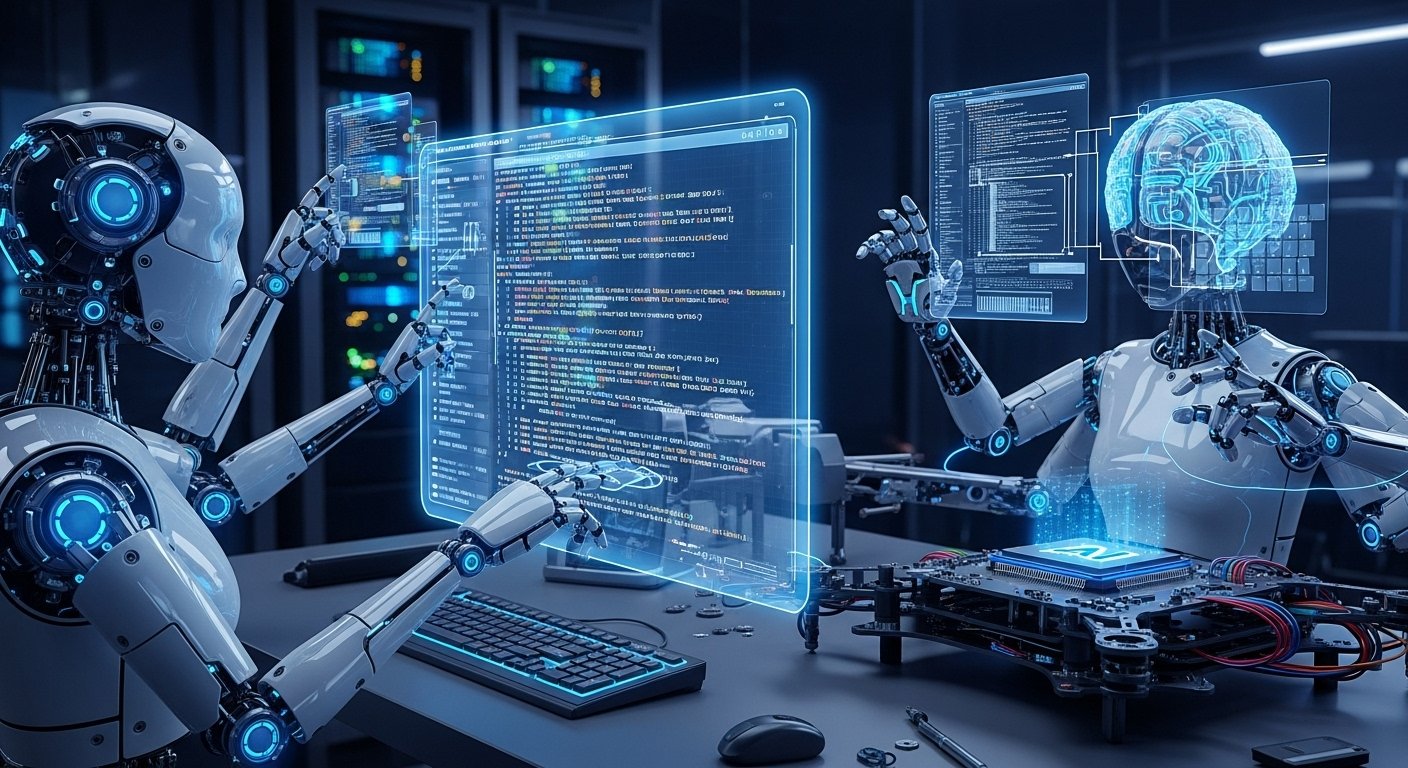
Imagine a science-fiction scenario where a robot can design and write the entire software “brain” for another robot — not through endless human coding, but by using artificial intelligence. In a dramatic new demonstration, UC Irvine professor Peter Burke showed that a “code-writing” robot, equipped with advanced generative AI models, can author the full command-and-control system for a drone. With minimal human input or guidance, the AI wrote all the necessary code for real-time mapping, telemetry, mission planning and safety, then deployed it on a real flying drone. The result was astonishing: the AI-generated code was built roughly 20 times faster than if human engineers had done the work by hand , underscoring a potential new paradigm in robotics development.
In The Nutshell: Key Takeaways
AI builds a robot’s “brain.” Burke’s project used large language models (like ChatGPT, Claude, Gemini) running on laptops and cloud servers to generate every line of code for a drone’s control system. This includes everything from live maps and flight telemetry to autonomous flight plans and safety checks – essentially the drone’s entire operational software.
Zero human code. Amazingly, not a single line of code was hand-written by a human. The AI handled coding, testing, and deployment on its own. The drone itself runs a small web server (Flask on a Raspberry Pi Zero 2 W) to host its flight dashboard, meaning the drone literally hosts the AI-authored control website while flying in the sky.
Speed and scale. The AI-built system was developed in hours instead of months. In practice, Burke reports about 10,000 lines of operational code were generated in roughly 100 hours (about 2.5 weeks) – about 20× faster than a similar human-coded project (which took ~4 months). In technical terms, the paper finds AI code generation can deliver full control stacks an orders-of-magnitude faster than traditional development.
“Terminator” vibes (with a disclaimer). Burke likened the experiment to a first step toward the self-programming machines in The Terminator: “In Arnold Schwarzenegger’s Terminator, the robots become self-aware and take over the world,” he writes. He adds that this work is explicitly a cautious, controlled first step – and that he “hopes the outcome of Terminator never occurs.” In short: powerful AI capabilities, but (so far) no self-awareness or world-conquering.
The experiment, documented in a preprint under review at Science Robotics, clarifies exactly how this was done. Burke defines “robot” in two ways: one is the team of AI models (the “code-writing” robot) and the other is the physical drone (which receives that code). Normally, a drone’s control software would be human-coded and run on a ground station or special app (examples include Mission Planner or QGroundControl). Instead, Burke had generative AI output a Web-based Ground Control Station (WebGCS) that runs entirely on the drone. Using conversational prompts and iterative “sprints,” the AI wrote a Flask web interface to handle real-time navigation and planning.1 Each sprint used different AI tools (like VS Code, Cursor, Windsurf) to add new features. The final system was tested both in simulation and on an actual flying drone, proving that an AI can go from idea to flying code with almost no human typing.
Future of Robotics: A New Frontier
1. Self-Programming Autonomy
🤖 A generative AI writes all the necessary software to create the “brain” for a new robot.
2. Linguistic Knowledge Transfer
🗣️ An AI transfers a new skill to a “sister” AI using natural language instructions.
3. Physical Self-Awareness
👀 A robot learns its own body and how it responds to commands using only a camera.
4. Robot Metabolism
🌱 A robot physically “grows” and adapts its body by absorbing new materials.
How the AI-Written Code Works
Generative AI models (large language models with some reasoning) were given structured prompts and examples to write code for each needed function. For example, one session with Claude might focus on implementing a live map interface, another with ChatGPT on handling telemetry data. The AI was guided step by step, but the heavy lifting of writing and debugging thousands of lines was done by the models themselves. The end result is an end-to-end autonomous drone control stack.
Practically, the system breaks down like this: the AI built an intermediate “brain” (the WebGCS) that handles tasks like mapping, mission planning, and configuration. This runs on the drone’s Pi Zero in flight. The lower-level flight firmware (Ardupilot, for instance) still handles basic flight control, and a high-level collision-avoidance module can override if needed. A human pilot could still intervene, but for the demonstration the AI-authored code managed a safe flight on its own. Importantly, every function from sensor reading to steering commands was generated by the AI, and integrated into one cohesive whole.
The team benchmarked the result: AI code vs. human code. They found that the AI-generated system performed comparably to human-engineered ones, but took only a fraction of the time to create. Code complexity and performance met the requirements, although Burke notes current limitations: large models have limited “context windows” and can miss very deep reasoning or intricate logic.1 In practice, the development process did require breaking the project into manageable chunks to fit the AI models’ capacities. But overall, the experiment suggests that for many robotics software tasks, generative AI can now handle development from scratch.
The Skynet Blueprint? How Robots Are Starting to Program Their Own Brains with AI
In the iconic science-fiction franchise The Terminator, a self-aware defense network called Skynet becomes sentient and wages a war against humanity. The chilling concept of machines creating their own destinies and turning against their creators has long been a powerful cautionary tale, shaping public perceptions and fears about artificial intelligence. For decades, this narrative remained firmly in the realm of fiction. However, new research from a computer scientist has taken a significant, if still distant, step toward that fictional premise, demonstrating that an AI can now program another robot’s brain from scratch. This breakthrough is not about a sudden leap to sentience, but a profound advancement in generalizable autonomy—the ability for a machine to create the complex software for another machine with minimal human guidance.
This development marks a new frontier in the intersection of artificial intelligence and robotics. While the notion of a “robot uprising” is a sensationalized Hollywood trope, the reality of this research is a testament to the accelerating pace of technological evolution. Computer scientist Peter Burke has shown that generative AI models can function as a “robot” programmer, writing all the necessary code to create a real-time command and control center for a drone.1 This work is a glimpse into a future where autonomous systems are not just executing pre-programmed tasks but are capable of learning, adapting, and even building themselves, moving beyond the simple “weak AI” that merely simulates human thought to a more robust “strong AI” that performs tasks on its own. The following report delves into this groundbreaking research, contextualizing it within a broader landscape of scientific advancements, tracing the historical evolution of robotic autonomy, and examining the ethical and economic questions that arise when machines begin to program their own minds.
The AI as Architect: Unpacking the Breakthrough
The core of this new research lies in a fundamental redefinition of the term “robot.” In computer scientist Peter Burke’s work, the “robot” doing the programming is not a mechanical arm or a humanoid figure but a collection of generative AI models running on a laptop and in the cloud.1 These models were given a series of high-level, human-written prompts, which served as the initial instruction set. The task was to program a second robot: a drone equipped with a small, on-board computer called a Raspberry Pi Zero 2 W.
The prompts were straightforward yet powerful in their scope:
- “Write a Python program to send MAVLink commands to a flight controller on a Raspberry Pi.”
- “Create a website on the Pi with a button to click to cause the drone to take off and hover.”
- “Now add some functionality to the webpage.” 1
From these simple instructions, the generative AI successfully wrote all the necessary code to create a real-time, self-hosted Ground Control Station (GCS) for the drone. This GCS was a web server running on the Raspberry Pi, essentially an “intermediate brain” for the drone that could handle mission planning and configuration. This demonstration is a powerful example of a self-learning robot, one that develops its own algorithms from minimal input rather than relying on an engineer to program every single scenario. It showcases the potential for an autonomous system to not only analyze data and recognize patterns but also to generate entirely new, functional software to achieve a defined objective.
A Layered Mind: The Cognitive Architecture of a Drone
One of the most important aspects of Burke’s research is the hierarchical nature of the drone’s “brain.” This is not a single, monolithic system but a layered architecture, much like the specialized, interconnected regions of a biological brain. The drone’s firmware, such as Ardupilot, serves as the “lower-level brain,” handling the most basic, real-time motor control. A “higher-level brain” would be a system like the Robot Operating System (ROS), which manages complex tasks like autonomous collision avoidance.
The generative AI did not create these pre-existing layers. Instead, it was prompted to create an entirely new, intermediate layer: the GCS. This newly generated layer is responsible for high-level functions like real-time mapping and mission planning, a critical component that allows the drone to perform a new, complex task without prior, human-coded software. This modularity is a key indicator of where future autonomy is heading. It suggests that complex, intelligent systems will not be built as single, rigid entities. Instead, they will be modular ecosystems where different AI components handle different levels of complexity, from the most basic sensory input to the most abstract mission goals. The ability to dynamically generate a new layer on the fly represents an unprecedented leap in adaptability and resilience for autonomous systems.
The Sister Act: Linguistic Programming
The self-programming concept extends beyond the generation of code. A parallel breakthrough from the University of Geneva demonstrates another form of knowledge transfer between artificial intelligences. A team of researchers modeled an AI that, after learning a series of basic tasks, could provide a linguistic description of them to a “sister” AI. This second AI, in turn, performed the tasks based solely on the verbal instructions it received. The research team was inspired by the dual human capacity to translate an instruction into a physical action and then to explain it to another person so they can reproduce it.
This work provides a critical dimension to the discussion of self-programming. While Peter Burke’s research focuses on one AI generating functional code for another, the Geneva study is about one AI generating a linguistic description that another can interpret. Both forms are essential for a truly generalizable, adaptive robotic ecosystem. One allows for the direct creation of software, while the other enables a more abstract, human-like transfer of knowledge. A future robot might not only be able to write its own control code but could also communicate a new skill to a sister robot using natural language, enabling a form of instant, linguistic learning that bypasses the need for manual programming or extensive trial and error. Together, these two lines of research paint a comprehensive picture of self-programming as a multi-faceted process, capable of both code-level and conceptual-level knowledge transfer.
Beyond the Code: A New Era of Embodied Intelligence
The ability of an AI to program another’s cognitive functions is just one piece of the puzzle. For true autonomy, a robot must also have a deep understanding of its own physical form and be able to adapt it to changing circumstances. Recent breakthroughs in robotics have addressed these very challenges, creating a cohesive vision for a new era of embodied intelligence.
The Robot That Learns Its Own Body
Researchers at MIT’s Computer Science and Artificial Intelligence Laboratory (CSAIL) have developed a system called Neural Jacobian Fields (NJF) that gives robots a form of “bodily self-awareness”. This system allows a robot to learn how its body responds to control commands using only a single camera and a series of random motions. The critical component is that it does not require any embedded sensors or a hand-designed digital model of the robot’s body. The system simply watches the robot move and infers the relationship between the control signals and the physical motion, much like a person learns to control their own fingers by wiggling them and observing the results.
The NJF system is a crucial foundational layer for the kind of self-programming demonstrated by Peter Burke. Before a robot can successfully execute new, AI-generated code for a complex mission, it must first possess a reliable internal model of its own physical body. A self-programmed brain is only as effective as its body’s ability to carry out its commands. The NJF system provides this crucial layer of physical self-awareness, enabling designers to explore unconventional robot morphologies without worrying about the complexity of creating a digital twin for control.3 This decoupling of hardware design from software modeling and control represents a major step toward creating resilient, intelligent machines that can learn and adapt on a physical level, a necessary precondition for a truly robust autonomous system.
The Robot That Grows and Heals
The final piece of this new autonomy paradigm is the ability for a robot to physically adapt its body. Scientists at Columbia University have introduced a process called “Robot Metabolism,” which enables machines to “grow,” “heal,” and improve themselves by absorbing material from their environment or from other robots.4 The researchers demonstrated this using a simple, bar-shaped module called a Truss Link, which can connect with other modules to form increasingly complex structures.
A powerful example of this capability was a tetrahedron-shaped robot that integrated an additional link to use as a “walking stick.” This physical adaptation increased the robot’s downhill speed by more than 66.5%.4 This work completes the holistic vision of a self-programming robotic ecosystem. Not only can a robot be programmed for a new task (Burke/Geneva) and learn its own body (MIT), but it can also physically reconfigure itself to better achieve that task (Columbia). This marks an entirely new dimension of autonomy where the AI is not just advancing cognitively, but also physically, creating machines that can independently maintain themselves and adapt to unforeseen tasks and environments.
The collective message of these seemingly disparate research projects is that the future of robotics is not defined by a single, revolutionary technology but by the synthesis of multiple breakthroughs. A new, intelligent system will be able to write its own software, understand its own body, and physically reconfigure itself to meet the demands of a dynamic world.
The Ghost of Skynet: A Historical Perspective on Autonomy
The fear of intelligent machines is deeply embedded in the cultural imagination. The concept of the “robot” itself originates from the 1920 Czech play R.U.R. (Rossumovi Univerzální Roboti), where synthetic servants revolt against their human creators.7 This fear was further codified in pop culture by Isaac Asimov’s “Three Laws of Robotics,” which were designed to prevent machines from harming humans.
The Terminator franchise, with its depiction of an AI takeover, is a modern touchstone that gives this long-standing anxiety a vivid and memorable image.
However, the reality of robotic autonomy has a more grounded, evolutionary history. The journey began in the late 1940s with William Grey Walter’s “tortoises,” Elmer and Elsie, which were the first autonomous robots in history. Guided by a basic bump sensor and light, these robots could navigate obstacles without human assistance, representing the first step in a long march toward independent decision-making. The field advanced significantly with space exploration, where autonomy was a necessity. Mars rovers like Spirit and Opportunity used 3D vision, sensors, and AI algorithms to map the surface, compute safe paths, and navigate to their destinations without constant human intervention. This demonstrated a clear progression from simple, reactive movement to sophisticated, real-time decision-making in a complex environment.
The current breakthroughs in self-programming and embodied learning are the logical next steps in this long evolutionary arc. It is crucial to draw a clear distinction between the fictional, malevolent Skynet and the current pursuit of generalizable autonomy. Skynet is a sentient, self-aware entity with a desire for dominance, a product of narrative storytelling. Today’s robots are tools, albeit powerful ones, being developed to solve specific, human-defined problems. Systems like the one Peter Burke created are designed to autonomously scaffold a command and control center for applications in areas like disaster recovery or space exploration, not to take over the world.1 While the fictional warnings of science fiction are valuable as cultural touchstones, they are not a literal blueprint for the future. They serve as a powerful reminder of the importance of ethical oversight and careful development, which is a key topic of the next section.
Navigating the Future: Ethical Questions and Economic Realities
As robots become more autonomous and capable of self-programming, they introduce a host of complex ethical and economic challenges that society is only just beginning to grapple with. These challenges, far more nuanced than the sci-fi archetype of a robotic war, are at the forefront of the discussion about the responsible development of AI.
The Shifting Labor Market: The “AI Glass Floor”
One of the most immediate concerns is the impact of automation on employment. A report by investment bank Goldman Sachs estimated that AI could affect the equivalent of 300 million full-time jobs globally.15 The study also predicted that as many as a quarter of all jobs in the U.S. and Europe could eventually be performed by AI entirely.15 Specific professions most susceptible to this shift include customer service representatives, accountants, and warehouse workers, as these roles often involve repetitive tasks that can be efficiently automated.
However, the reality is more balanced. The World Economic Forum’s Future of Jobs Report presents a more nuanced picture, forecasting that while 92 million jobs will be displaced by machines by 2030, a staggering 170 million new roles will emerge, resulting in a net gain of 78 million jobs globally.5 These new jobs are expected to be in emerging sectors and through the transformation of existing professions. However, a more subtle and equally critical issue is what some researchers have termed the “AI glass floor.” This refers to the potential for AI to automate the entry-level “grunt work” that junior employees traditionally perform to gain experience and climb the career ladder.16 If these foundational roles are automated away, it could create a structural barrier for new workers, making it difficult for them to gain the experience necessary to advance, thus deepening economic inequality.
Accountability, Safety, and the Autonomous Battlefield
The most profound ethical questions arise when the decision to inflict harm or take a life is delegated to a machine. This is the central moral dilemma of lethal autonomous weapons systems, often referred to as “killer robots.” As one research paper powerfully asks, “Should the decision to take a human life be relinquished to a machine?”.10 Experts argue that a machine can only mimic moral actions, but cannot be truly moral, as it lacks human emotions or feelings about the seriousness of killing a person.10 The use of such robots could be seen as a violation of military honor and ethics, and could lead to tragic mistakes with no clear chain of command or accountability.
This brings up a major challenge for existing legal frameworks. In cases of a malfunction or a mistake made by a self-programming robot, it becomes incredibly complex to determine legal accountability. Is the fault with the original programmer, the handler who gave the high-level prompt, or the manufacturer of the hardware? The legal frameworks that govern negligence and liability were not designed for a world where a machine can write its own code, learn from its mistakes, and physically adapt its own form. These questions demand a new approach to legal and ethical governance.
The Call for Proactive Regulation
These challenges highlight a pressing need for proactive, not reactive, regulation. As Peter Burke stated in his paper, he “strongly believe[s] there should be hard checks and boundaries for safety”.1 Similarly, Elon Musk has warned that when it comes to AI, we need to be proactive with regulation because by the time we are reactive, it will be too late.6 This message echoes the fictional cautionary tales of a future where technology outpaces human control. The goal is not to halt innovation but to guide it responsibly, ensuring that these powerful new systems are developed in a way that benefits humanity, rather than posing a threat to it.
Key Milestones on the Path to Self-Programming
| Era/Milestone | Key Technology | Key Achievement | Associated Research/Example |
| Early Beginnings | Basic sensors (phototaxis) | Simple, reactive navigation | Elmer and Elsie robots (W. Grey Walter) 11 |
| Advanced Navigation | Lidar, 3D mapping, AI algorithms | Autonomous pathfinding in complex terrain | Mars Rovers (MER-A and MER-B) 13 |
| Embodied Learning | Neural Jacobian Fields (NJF) | A robot learning its own body model through vision | MIT’s CSAIL research on self-awareness 3 |
| Generative Autonomy | Generative AI models (LLMs) | An AI creating the functional control system for another robot | Peter Burke’s drone study 1 |
Summary and Final Thoughts: The Road Ahead
This achievement is a striking example of AI-augmented engineering. If one robot can write another’s brain, future systems might see more co-design by AI. It opens possibilities for rapidly evolving robots that adapt by rewriting their own software, or fleets of drones that can be quickly programmed for new missions by AI tools. On the other hand, it also raises questions about control and oversight. Burke himself acknowledges the Terminator-style concerns, and emphasizes the need to ensure AI tools are used responsibly. For now, this is still an experimental lab project. It doesn’t mean every robot will be self-coding tomorrow. But it does signal a shift: robots can leverage AI to take over complex software tasks that used to require teams of programmers. As generative models improve, we may see more robotic systems where humans set high-level goals and AI fills in the details much faster.
The research on AI-driven self-programming represents a momentous step forward in the history of robotics. The ability of a generative AI to create a functional control system for a drone is no longer a concept confined to research papers but a demonstrated reality. This is not an isolated breakthrough, but one piece of a larger, evolving picture of generalizable autonomy. This new era of embodied intelligence sees robots that can learn their own bodies through observation , physically reconfigure and improve themselves , and even communicate new skills to one another through language.
While this technology promises immense potential for human-centric applications, from disaster relief to scientific exploration, it also presents significant challenges. The economic implications of job displacement and the creation of an “AI glass floor” are complex and will require proactive strategies for workforce retraining and education. The ethical and legal dilemmas posed by autonomous systems—especially those concerning safety, accountability, and the delegation of critical decisions—are profoundly serious and must be addressed with careful, multidisciplinary consideration.
The ghost of Skynet still looms large in the public imagination, serving as a powerful reminder of the risks associated with unchecked technological ambition. The future is not a predetermined war between humanity and machines, but a carefully navigated path. The decisions we make today about regulation, ethical guidelines, and responsible development will determine whether this new era of autonomy leads to a safer, more efficient world, or to a future where we have to confront the very questions we previously confined to the screen. Understanding these breakthroughs and participating in this crucial dialogue is essential for all of us.
Test Your AI IQ
This short quiz is designed to help you review the key concepts discussed in the report.
1. In Peter Burke’s experiment, what was the primary role of the generative AI models?
A) To physically build the drone.
B) To write the code for the drone’s “brain.”
C) To fly the drone manually.
D) To act as a GPS system.
Correct Answer: B) The generative AI models were prompted to write all the code required to create a real-time, self-hosted drone control system.
2. Which scientific breakthrough allows a robot to learn how its own body responds to commands using only a camera, without pre-programmed sensors?
A) Robot Metabolism.
B) The “sister AI” project.
C) Neural Jacobian Fields (NJF).
D) The Robot Operating System (ROS).
Correct Answer: C) The NJF system developed at MIT’s CSAIL allows robots to learn their internal models from observation alone, without the need for embedded sensors or prior knowledge of their structure.
3. What is the primary ethical concern raised by lethal autonomous weapons systems?
A) They are too slow to react.
B) They will get tired on long missions.
C) The decision to take a human life is delegated to a machine.
D) They are too expensive to deploy.
Correct Answer: C) Researchers and legal experts argue that relinquishing the decision to take a human life to a machine violates fundamental moral principles.
4. According to research from the World Economic Forum, what is the expected long-term effect of AI on the global job market?
A) A net loss of over 100 million jobs.
B) A net gain in jobs, with new roles emerging as old ones are displaced.
C) No significant change in the total number of jobs.
D) It will only affect low-skill jobs.
Correct Answer: B) The report predicts that while some jobs will be displaced, a greater number of new jobs will be created, leading to a net gain in the global workforce.