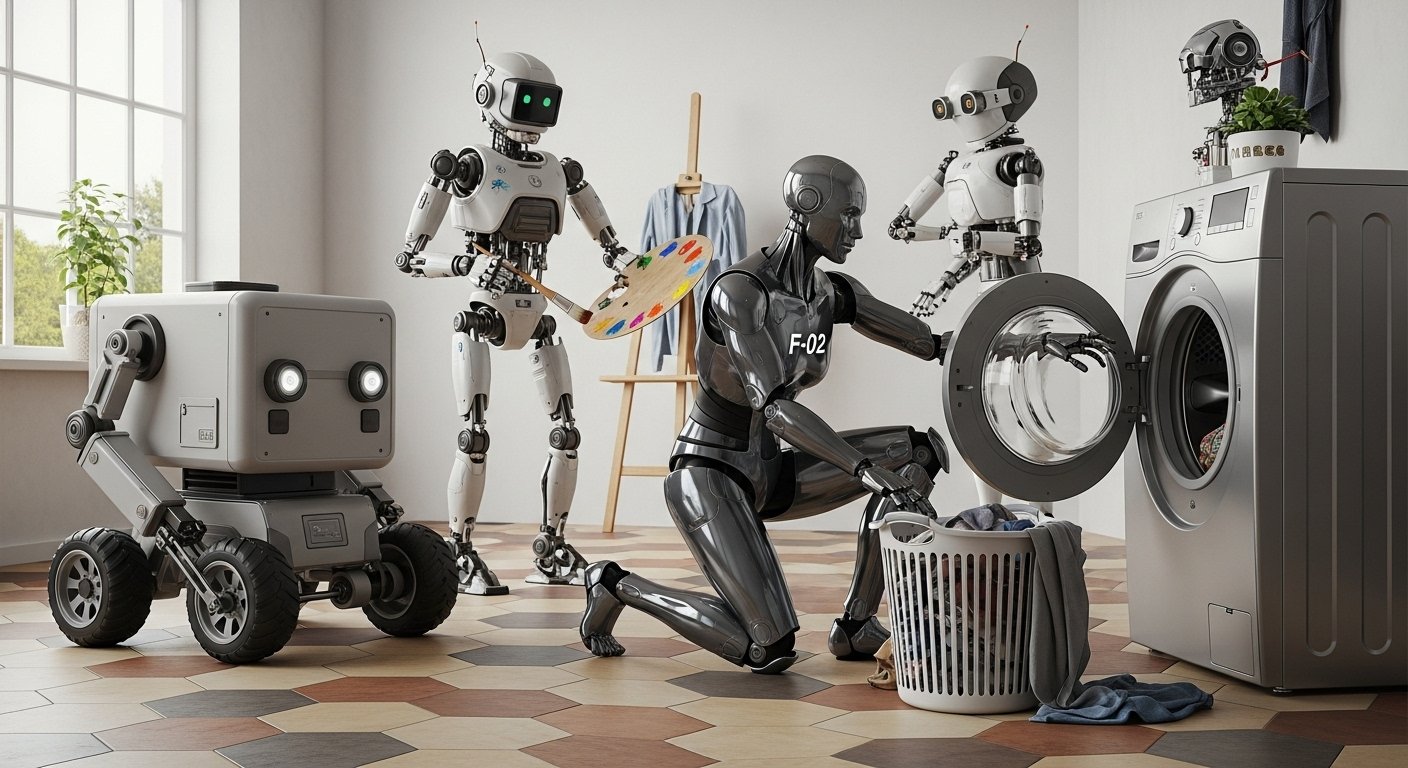
Next-Gen Robotics Showdown: Fedor, Figure 02 & Unitree A2 (Military, Domestic & Recon Applications)
As artificial intelligence and robotics rapidly advance in 2025, three groundbreaking robots are capturing global attention for their unique capabilities: Fedor, a Russian humanoid robot designed for military use and precision shooting; Figure 02, an AI-powered assistant built to automate household tasks like operating a washing machine; and Unitree A2 Stellar Hunter, a high-mobility quadruped robot engineered for outdoor patrol, reconnaissance, and tactical missions. These next-generation robots are no longer confined to research labs—they’re active, evolving, and reshaping the future of military robotics, home automation, and AI-driven mobility systems. In this comprehensive guide, we compare their features, performance, and use cases to help you understand where the future of intelligent robotics is truly headed.
🧠 In The Nutshell
This article dives into the technical anatomy, use-case, and intelligence frameworks of Fedor (Russia’s combat assistant robot), Figure 02 (a humanoid AI for domestic and industrial use), and Unitree A2 Stellar Hunter (a rugged quadruped for recon and patrol). We’ll explore 25 deep-dive themes, from locomotion systems to AI decision-making, and compare these groundbreaking machines across performance, utility, and scalability. Whether you’re a robotics engineer, AI enthusiast, or curious reader, this is your complete guide to modern humanoid and mobile robotics.
Infograph: Robotics Triumvirate
- Fedor: A Russian combat assistant robot.
- Core Capability: Precision manipulation and lethal force.
- Key Features: Dual-pistol wielding, controlled by a human operator in an exosuit.
- Use Case: Military and high-risk operations.
- Figure 02: A general-purpose humanoid robot.
- Core Capability: Learning and performing human tasks.
- Key Features: Advanced AI, dexterous hands, capable of household chores.
- Use Case: Home automation and industrial labor.
- Unitree A2 Stellar Hunter: A high-mobility quadruped robot.
- Core Capability: All-terrain navigation.
- Key Features: High-speed locomotion, dynamic stability on complex terrain.
- Use Case: Reconnaissance, patrol, and exploration.
Introduction: The Future is Now – A Robotic Revolution Unfolds
The evocative imagery of advanced robotics, once confined to the pages of science fiction, has now materialized into our tangible reality. Humanoid robots are demonstrating capabilities ranging from precision manipulation of firearms to performing household chores, while agile quadrupedal machines navigate challenging terrains with unprecedented speed and stability. This rapid acceleration in robotics and artificial intelligence (AI) is fundamentally blurring the distinctions between human and machine capabilities, ushering in an era of profound transformation. At the forefront of this robotic revolution stand three remarkable contenders: Fedor, Figure 02, and Unitree A2. Each of these machines is pushing the boundaries of what is possible, redefining the future of human-AI interaction across critical domains such as battlefield operations, domestic environments, and reconnaissance missions.
An observable trend in robotic development indicates a significant convergence of advanced AI with sophisticated hardware. This convergence is accelerating the transition of robots from highly specialized tools, often confined to controlled environments like factories or laboratories, into more general-purpose agents capable of operating in unpredictable real-world scenarios. This progression suggests a broader societal shift where automation is no longer limited to industrial settings but is permeating nearly every aspect of human life. The “showdown” among these advanced robots highlights a competitive and rapidly evolving landscape, reinforcing the notion of a swift and transformative change in our relationship with technology.
Contender 1: Fedor – Russia’s Anthropomorphic Pioneer
From Rescue to Space and Battlefield: Evolution and Capabilities
Fedor, formally known as FEDOR (Final Experimental Demonstration Object Research) and colloquially referred to as “Fyodor the robot,” is a prominent Russian humanoid robot. Its origins trace back to 2009 with the establishment of JSC NPO Android Technics, the company responsible for its development. Initially, Fedor, then called Avatar, was funded by the Ministry of Emergency Situations with the primary intention of performing rescue operations. Over 14 years, Android Technics has developed more than 110 robotic systems across various fields, including medicine, education, and space.
The robot’s role expanded significantly, and in 2017, then-Deputy Prime Minister Dmitry Rogozin announced its new name, FEDOR. A pivotal moment in Fedor’s evolution was its experimental mission to the International Space Station (ISS) in August 2019, marking it as Russia’s first robot astronaut. During its week-and-a-half stay aboard the orbital outpost, Fedor successfully simulated cable repair by matching plug connectors while weightless.This mission, however, was not without its challenges, as the Soyuz capsule carrying Fedor initially failed to dock at the ISS before a successful second attempt.
Beyond its space endeavors, Fedor gained international notoriety in April 2017 when a video surfaced showing the robot shooting guns. Despite Rogozin’s insistence that Russia was “not creating a Terminator,” the demonstration led to a parts supplier canceling its relationship with the project.Fedor’s capabilities were subsequently expanded to include military interests, notably through the “Marker project.” This robotic platform is equipped with a double-circuit rifle and grenade launcher module, featuring high-speed gearless drives that boast extreme accuracy (up to 0.00001 mm) and rapid rotation (400 degrees per second). The Marker can engage multiple targets simultaneously due to its independent optoelectronic sighting unit and weapon drives, powered by a complex of neural networks.
Fedor’s versatility extends to various other applications. It can autonomously identify typical objects and tools, discern obstacles, and combine this information into a 3D location map. The robot is capable of opening doors, operating electric drills, and driving cars and all-terrain vehicles. Furthermore, it can function as a “double,” replicating the movements of a remote operator wearing an exosuit that mirrors Fedor’s structural features.In a surprising diversification, Fedor’s underlying technology has also found application in post-stroke and post-traumatic rehabilitation, where information from a patient’s brain, read via an encephalograph, is converted into motor commands for an exoskeleton mounted on the patient’s hand.
Technical Prowess and Challenges
Fedor is Russia’s first anthropomorphic, or human-like, robot, measuring up to 180cm, weighing approximately 160kg, and boasting a capacity of 20 horsepower.[2] Its human form factor is considered a universal design, enabling it to function in environments specifically designed for humans.[2] The robot’s advanced control systems include a “control suit” with sensory feedback, also known as force feedback. This system allows the operator to experience the physical circumstances of the robot, feeling the external loads and the force the robot applies, thereby creating an immersive control experience. This is facilitated by a mathematical model that coordinates the physical and mathematical models of the human body, the control suit, and the robot’s design.
Fedor exhibits advanced kinematics, demonstrating remarkable flexibility, including the ability to perform full splits. This design agility is crucial for overcoming various obstacles, such as rubble, in rescue or operational scenarios. Its mobile head module allows for varied vision, enabling it to look vertically up, strictly down, or forward even when moving in a “plastunsky” (crawling) manner.The robot’s sensor suite is comprehensive, including microphones, GPS, Global Navigation Satellite System (GNSS), range-measuring lasers, and thermographic cameras. Its stereoscopic vision system can work in tandem to determine object distances or separately to perform multiple tasks simultaneously, such as operating two different tools.
Despite its technological achievements, Fedor has faced public controversies. A notable incident involved its official Twitter account, which was abruptly removed after it posted tweets insulting former cosmonauts and accusing them of drinking in space.[6] This incident, amidst a public dispute between former Roscosmos members and Dmitry Rogozin, highlighted the robot’s public-facing role, even if unintended.
The journey of Fedor from a rescue robot to a space explorer and subsequently a military platform illustrates a significant dual-use dilemma inherent in advanced robotics. This rapid redefinition of purpose, often driven by national strategic interests, can quickly lead to public and ethical concerns, as evidenced by the media alarm and the cancellation of a parts supplier following the gun-shooting video. This progression underscores how technological development can swiftly outpace societal consensus on its appropriate applications. Beyond its practical utility, Fedor’s high-profile public demonstrations, including its ISS mission and the social media incident, underscore its role as a symbol of Russia’s technological capabilities. These advanced robots often serve as tools for projecting soft power and national prestige on the global stage, even when encountering technical or public relations challenges.
Contender 2: Figure 02 – The Domestic & Industrial Game-Changer
Redefining Labor: Vision for Home and Industry
Figure 02, developed by Figure AI, is positioned as the world’s first commercially viable autonomous humanoid robot. Figure AI’s ambitious master plan aims to address global labor shortages by deploying these robots to perform end-to-end operations safely for commercial customers. The company envisions a future where Figure 02 seamlessly integrates into domestic life, performing household tasks such as dishes, laundry, and unpacking groceries with 100% autonomy. A groundbreaking demonstration showcased Figure 02 successfully placing clothes into a washing machine, signaling a significant leap toward home automation.
Beyond the home, Figure 02 is designed for widespread industrial applications across manufacturing, logistics, warehousing, and retail. It is currently undergoing real-world testing at BMW’s manufacturing plant in South Carolina, where it performs the task of placing sheet metal parts into specific holding devices for car body assembly. This deployment highlights the robot’s accuracy, dexterity, and its capacity for complex manipulations in a live production setting.
The introduction of Figure 02 into industrial processes signals a move towards greater collaboration between humans and robots. Rather than outright replacing human workers, Figure 02 is intended to augment the workforce by taking on physically demanding and repetitive tasks. This approach aims to improve working conditions, reduce workplace injuries, and allow human employees to concentrate on more intricate and strategic aspects of the manufacturing process, thereby enhancing overall efficiency and productivity.
The Brains Behind the Brawn: Helix System and AI-First Approach
Figure AI’s development philosophy is distinctly “AI-first,” with a commitment to engineering the first humanoid that can truly think for itself. The company believes that achieving successful embodied AI at scale in the real world necessitates vertical integration of robot AI, asserting that AI cannot be outsourced for the same reasons hardware cannot.
At the core of Figure 02’s capabilities is the Helix system, a groundbreaking Vision-Language-Action (VLA) model. Introduced earlier this year, Helix integrates perception, language, and human-like understanding, enabling Figure 02 to perform complex upper-body manipulations and even coordinate tasks across multiple robots. This innovation allows Figure 02 to interact with its environment in ways that closely mimic human actions.
The robot’s hardware is designed with a human form factor, recognizing that the world is built for humans and human hands, arms, and legs allow for efficient movement, tool use, and task execution. Figure 02 features a unique foot design that balances human-like aesthetics with mechanical efficiency, sophisticated actuators capable of impressive torque and range of motion, and redesigned hands that closely mimic human physiology with rubberized grip bumps and an opposable thumb, ensuring high dexterity for intricate tasks. Figure 02 stands 5’6″ tall, weighs 70kg, can carry a payload of 20kg, has a runtime of 5 hours, and moves at a speed of 1.2 m/s.
Strategic Partnerships and Competitive Landscape
The collaboration with BMW for industrial performance trials is a significant strategic move for Figure AI, validating Figure 02’s practical application in real-world manufacturing.[9, 10] In a notable strategic pivot, Figure AI recently announced the termination of its collaboration agreement with OpenAI. This decision was made in favor of developing an in-house, end-to-end robot AI system, with CEO Brett Adcock citing “integration challenges” and claiming a “major breakthrough” in their proprietary AI development. This move suggests Figure AI’s conviction that bespoke AI solutions are essential for the complex demands of embodied robotics.
The humanoid robotics market is increasingly competitive. Figure 02 faces competition from other prominent players such as 1X Technologies, Boston Dynamics, Tesla’s Optimus robot, and the Chinese startup Agibbot, which claims to have manufactured a thousand robots in 2024.[10, 12] Looking ahead, Figure AI has already teased the next iteration, Figure 03, which is expected to build upon Figure 02’s foundation with enhancements in mobility, smarter AI, and the capability to tackle more intricate tasks.
Figure AI’s strategic decision to develop an in-house, vertically integrated AI system, moving away from its partnership with OpenAI, highlights a crucial trend in advanced robotics. This suggests that general-purpose AI models, while powerful, may not offer the necessary control, efficiency, and real-world robustness required for embodied AI. Consequently, companies are increasingly pursuing highly specialized, proprietary AI solutions tailored specifically for robotic hardware. This approach could lead to faster, more optimized development but also potentially create higher barriers to entry for new competitors in the field.
Furthermore, Figure 02’s primary focus on solving “labor shortages” and performing “routine physical labor” across both domestic and industrial settings points to a significant economic impetus driving humanoid robot development. This directly implies a future where a substantial portion of current human jobs may be automated. This development necessitates urgent societal discussions on workforce retraining, the evolution of economic models, and the ethical implications of widespread job displacement.
Contender 3: Unitree A2 – The Agile All-Terrain Explorer
Built for the Wild: Design and Mobility
The Unitree A2, also known as the A2 Stellar Explorer or Stellar Hunter, is a quadrupedal robot dog designed for agility and endurance in challenging environments.[13, 14] Weighing around 37kg, its lightweight design contributes to its extended operational capabilities. The robot’s frame is engineered to maintain a low center of gravity while offering significant flexibility, a crucial combination for navigating rugged outdoor environments, uneven landscapes, and unpredictable obstacles with smooth movements and confident stability.
The A2 demonstrates impressive mobility performance. It can achieve a maximum speed of up to 5 m/s (approximately 11 mph). In terms of endurance, it can continuously walk for 3 hours or 12.5km when fully loaded (with 25kg payload) and for 5 hours or 20km when unloaded. Its robust design allows for a maximum standing load of about 100kg. The A2 is also highly capable in diverse terrains, demonstrating a slope walking capability of approximately 45°, stair climbing capability with a maximum step height of 30cm, and a maximum climb height of 0.5 to 1 meter.
Sensors and Power: Navigating Complex Environments
For advanced navigation and perception, the Unitree A2 features “Dual-Sided Perception” and “Zero Blind Spots Greater Accuracy.” It is equipped with two industrial LiDARs (one front and one rear) and an HD camera, along with a front light, to comprehensively detect and map its environment.
The robot’s power system is designed for robust and uninterrupted operation. It utilizes a “Dual Battery System” with “Hot-Swappable Dual Batteries,” enabling “Unlimited Runtime” through seamless battery swaps without pausing missions. This dual-battery parallel design, coupled with a reliable triple power system, ensures operation across a wide temperature range from -20°C to 55°C.[15] For control and computation, the A2 comes standard with an 8-Core high-performance CPU for its platform and an Intel Core i7 for user development, with an optional high computing power expansion dock available.
Applications in Reconnaissance and Beyond
The Unitree A2’s capabilities position it as a practical machine for a variety of field operations. Its potential applications include site inspection, exploration, and search and rescue missions. It is designed to be “Multi-Scenario Ready,” capable of effortlessly navigating extreme and complex environments for tasks in logistics, industrial inspection, and emergency response. This emphasis indicates that the A2 is not merely a showcase robot for technological enthusiasts but a practical machine ready for deployment across various industries.
The Unitree A2’s design emphasis on “Agile & Swift Lightweight Extended Endurance” coupled with hot-swappable batteries reflects a growing trend in mobile robotics towards sustained, autonomous operation in challenging, unstructured outdoor environments. This indicates a strategic shift from tethered or short-duration operations to long-range, unsupervised missions, which are crucial for applications like remote inspection and extended reconnaissance where human presence is difficult or unsafe.
Furthermore, the A2’s capabilities for tasks such as “site inspection, exploration, or search and rescue” in “extreme and complex environments” position it as a vital tool for operations that are too dangerous, tedious, or inaccessible for humans. This implies a future where robots significantly enhance human safety and efficiency in hazardous industries, while also enabling data collection and operations in previously unreachable or unsafe locations.
A notable design choice is the inclusion of a “Wheel-Leg Option Available” for “Unleash Greater Performance.” This suggests a strategic modularity in Unitree’s design philosophy, indicating a move towards adaptable platforms. Such platforms can be customized with different locomotion methods—legs for superior obstacle traversal on rough terrain, or wheels for increased speed and efficiency on flat surfaces—to optimize performance for diverse operational needs, thereby enhancing versatility beyond a single fixed form factor.
The Showdown: A Comparative Analysis
The emergence of Fedor, Figure 02, and Unitree A2 showcases the diverse and rapidly advancing landscape of robotics. While each robot represents a pinnacle of engineering in its respective domain, a comparative analysis reveals distinct philosophies and approaches to human-AI interaction and application.
Next-Gen Robot Comparison – Key Specs & Applications
| Feature / Robot | Fedor (Russia) | Figure 02 (USA) | Unitree A2 (China) |
| Form Factor | Humanoid | Humanoid | Quadruped |
| Primary Application Domain | Military/Space/Rescue | Domestic/Industrial | Reconnaissance/Inspection |
| Key Features | Remote operation via control suit, gun manipulation, space-faring, rehabilitation, anthropomorphic universality, stereoscopic vision, advanced kinematics (splits). | Autonomous household tasks, industrial assembly, AI-first approach (Helix VLA), high dexterity hands, solving labor shortages. | All-terrain mobility, long endurance, hot-swappable batteries, dual-sided LiDAR perception, multi-scenario readiness, wheel-leg option. |
| Weight | ~160kg [2] | 70kg [7] | ~37kg [15] |
| Speed (Max) | ~2.5 mph (4.0 km/h) [1] | 1.2 m/s [7] | ~5 m/s [14, 15] |
| Runtime/Endurance | ISS mission duration ~10 days [6] | 5 hours [7] | >5 hours unloaded, >3 hours loaded [15] |
| Payload/Load Capacity | Not specified (operates tools) | 20kg [7] | 25kg continuous, 100kg standing [15] |
| Notable Achievements/Demonstrations | ISS mission (plug connectors), gun-shooting video, Marker project. | Laundry task demo, BMW factory deployment. | Navigating rugged outdoor environments, high-speed running. |
| Ethical/Societal Considerations | Dual-use dilemma, “Terminator” fears, public image. | Job displacement, privacy, human-robot collaboration. | Autonomous decision-making in hazardous zones, data collection, military potential. |
Distinct Philosophies and Approaches to Human-AI Interaction
The “showdown” among these robots is not about identifying a single “best” machine, but rather about illustrating a fundamental divergence in robotic development. One path, exemplified by Fedor and Figure 02, focuses on anthropomorphic generalists designed to integrate into human-built environments and tasks. The other, embodied by Unitree A2, pursues specialized quadrupedal explorers optimized for navigating and operating in challenging, unstructured natural or industrial terrains. This highlights an ongoing strategic debate between universality and specialization in robotics design, indicating that the future of robotics is multi-faceted rather than monolithic.
- Fedor’s Controlled Versatility: Fedor’s design emphasizes anthropomorphism for universality within human-designed environments, but it often relies on remote operation via a control suit. This suggests a philosophy where human control remains paramount, even as the robot performs complex tasks in dangerous or remote settings. Its dual military, space, and rescue applications highlight a state-backed, strategic utility, often with a significant human-in-the-loop component.
- Figure 02’s Autonomous Integration: In contrast, Figure 02 champions an “AI-first” approach and a strong drive towards full autonomy in human-centric environments, be it the home or the factory.[7, 10] Its objective is seamless integration into existing human workflows and domestic life, pointing towards a future of collaborative or even independent robot “colleagues” and “partners”. The emphasis here is on the robot’s ability to “think for itself” and perform tasks without constant human intervention.
- Unitree A2’s Unsupervised Exploration: Unitree A2 specializes in rugged, unstructured environments, prioritizing mobility, endurance, and robust sensing for unsupervised reconnaissance and inspection.[13, 15] Its interaction model is less about direct human collaboration in a shared space and more about remote data collection and task execution in hazardous zones, where human presence is undesirable or impossible.
The varying levels of autonomy and control demonstrated by these robots—Fedor’s significant reliance on remote human operators, Figure 02’s push for “100% autonomously” with advanced AI, and Unitree A2’s “smart navigation” in complex environments—reflect different philosophical approaches to human-robot collaboration and trust. This has profound implications for the development of safety protocols, the establishment of legal frameworks around responsibility, and the evolving nature of human oversight in increasingly autonomous systems.
Strengths and Limitations in Their Respective Arenas
Each robot possesses unique strengths and faces distinct limitations within its intended operational arena.
- Fedor: Its anthropomorphic form grants high dexterity for manipulating human tools and operating in environments built for people. Remote control via the control suit allows for its deployment in hazardous settings where human presence is unsafe. However, Fedor has faced challenges with public perception, particularly due to the controversial gun-shooting video, which evoked “Terminator” fears and led to supplier issues. Its reliance on remote operation for complex tasks can also be a limitation in scenarios requiring true autonomy, and it has experienced past technical glitches, such as the initial ISS docking failure.
- Figure 02: Its advanced AI, particularly the Helix system, enables complex manipulation and environmental understanding, positioning it for significant commercial viability. Successful industrial partnerships, such as with BMW, demonstrate its immediate practical application.[9, 10] The robot also holds immense potential for widespread domestic adoption. Nevertheless, Figure 02 is still in the early stages of commercial deployment, and its widespread integration raises significant societal questions regarding potential job displacement, privacy concerns related to its presence in private spaces, and the ethical implications of human dependency on autonomous domestic robots.
- Unitree A2: This quadruped excels in superior mobility and stability across complex, unstructured terrain, making it ideal for outdoor and hazardous environments. Its extended endurance capabilities and robust sensor suite for environmental mapping are critical for long-duration reconnaissance and inspection missions. However, its quadrupedal form factor inherently limits its ability to directly manipulate human tools or objects requiring fine motor skills, making it less suited for indoor, human-centric tasks compared to humanoid counterparts.
The commercial strategies behind Figure 02, which aims to solve “labor shortages”, and Unitree A2, which targets “industrial inspection, to emergency rescue” , reveal that current cutting-edge robotics development is heavily influenced by pragmatic economic drivers and safety concerns. This indicates that the next wave of robotic integration will be driven by clear business cases and the desire to automate dangerous or undesirable human tasks, rather than purely by technological novelty.
Beyond the Bots: Societal Impact and Ethical Frontiers
The rapid advancement and deployment of robots like Fedor, Figure 02, and Unitree A2 necessitate a critical examination of their broader societal impact and the ethical frontiers they introduce.
Implications for Workforce and Economy
A central debate revolves around whether robots will primarily replace or augment human workers. Figure 02’s potential to automate “routine physical labor” raises profound questions about the future of employment.[16] While its deployment at BMW demonstrates a collaborative model where it “assists employees” by taking on “physically demanding and repetitive tasks,” allowing humans to focus on “more intricate and strategic aspects”, the sheer scale of potential automation cannot be overlooked. The prospect of “30 and 40% of professions” being replaced by robots within a decade compels urgent societal discussion among governments, corporations, and academic institutions to prepare for this economic transformation.
Privacy and Safety
The increasing integration of robots into daily life introduces new risks related to privacy and safety. The heightened risk of hacking could potentially allow robots to covertly view and participate in private lives, raising concerns about constitutional rights against unreasonable government intrusions. Ensuring the safety of human workers operating alongside these advanced machines is paramount, necessitating the establishment of clear safety guidelines and regulations. Furthermore, the responsible handling of data gathered by robot sensors and learning algorithms is crucial to address potential privacy concerns.
Autonomy, Responsibility, and Legal Frameworks
As robots gain greater autonomy and decision-making capabilities, the question of moral standards becomes increasingly pertinent; “the greater the freedom of a machine, the more it will need moral standards”. The ethical discourse surrounding these robots is rapidly evolving from abstract “Terminator” fears to concrete, practical concerns about job security, data privacy, and the nuanced impact on human social structures and mental well-being, particularly for vulnerable populations. This indicates a maturing understanding of robotics’ real-world implications, demanding proactive policy and ethical guidelines.
A particularly striking ethical issue arises with lethal autonomous weapons, such as Fedor’s military applications. The dilemma involves weighing the potential benefit of fewer human casualties against the inherent risks of a robot making life-or-death decisions, especially the ethical implications if a mistake leads to civilian harm. The increasing autonomy and decision-making capabilities of robots directly necessitate the urgent development of robust legal frameworks and clear lines of accountability. When a robot can make critical decisions or cause harm, traditional concepts of responsibility, culpability, causality, and intentionality are challenged, creating a direct link between technological advancement and legal and ethical complexity. The complex question of where responsibility lies when a robot makes a mistake or causes harm—whether with designers, operators, or the robot itself—requires rigorous legal and philosophical consideration. The discussion of “divine-command ethics” for military robots highlights that ethical considerations are not purely secular or technological but can intersect with deeply held cultural and religious beliefs. This implies that global robotics governance and ethical frameworks will need to be inclusive of diverse moral perspectives, adding another layer of complexity to their international deployment and acceptance.
Human-Robot Relationships and Social Well-being
The development of social and companion robots, while offering benefits for mental health (e.g., for older adults or dementia patients), introduces the danger of emotional dependency or harm. There is concern that these robots, designed to elicit human emotions, could be exploited by companies to promote products. A significant ethical debate centers on the potential for these robots to lead to a reduction in human contact and the replacement of human care, potentially increasing social isolation and exclusion, particularly for marginalized groups.
The issue of consent is also critical, especially when deploying robots for vulnerable populations like older adults with cognitive impairments. It becomes essential to ensure that these individuals understand that the robot is a machine controlled by algorithms rather than a real pet or human. Finally, fairness and equity of access are paramount. Economic disparities could lead to unequal access to advanced “technocare” versus traditional human care, creating a divide where those with fewer resources are limited in their choices.
Conclusion: Charting the Course for a Robotic Future
The “Next-Gen Robotics Showdown” featuring Fedor, Figure 02, and Unitree A2 vividly illustrates the incredible progress achieved in the field of robotics. Each of these machines stands as a testament to human ingenuity, pushing the boundaries of what is technologically feasible across military, domestic, and reconnaissance applications. This comparative analysis reveals that the ongoing “showdown” is not about a single winner, but rather the collective, multi-faceted advancement of robotics, driven by diverse design philosophies and strategic objectives.
These machines possess the transformative potential to reshape industries, revolutionize our homes, and fundamentally alter the dynamics of even battlefields. However, this profound transformation necessitates an equally profound and ongoing societal dialogue. Proactive ethical consideration, robust legal frameworks, and a commitment to equitable access are critical to ensure that these powerful technologies serve humanity positively. The journey into a future increasingly shared with intelligent machines is both exciting and complex, demanding careful navigation to harness their benefits while mitigating their inherent risks.
The Robotics Showdown Quiz
- Which robot is known for its ability to replicate the movements of a remote human operator using a “control suit”?
- (A) Figure 02
- (B) Unitree A2 Stellar Hunter
- (C) Fedor
- (D) Optimus
- What is the name of the AI system at the core of Figure 02’s capabilities, integrating perception, language, and human-like understanding?
- (A) Marker project
- (B) Helix system
- (C) Skybot F-850
- (D) Neuralink
- Which of the three robots is a quadruped designed for high-speed, all-terrain mobility and extended endurance?
- (A) Fedor
- (B) Figure 02
- (C) Unitree A2 Stellar Hunter
- (D) Boston Dynamics Spot
- Fedor gained international attention for a controversial video demonstrating what capability?
- (A) Performing complex surgery
- (B) Driving a car autonomously
- (C) Shooting guns
- (D) Performing household chores
- Figure 02 was recently showcased performing what specific household task?
- (A) Cooking a meal
- (B) Cleaning windows
- (C) Doing laundry
- (D) Gardening
- What unique power system feature does the Unitree A2 possess to ensure “Unlimited Runtime”?
- (A) Solar charging panels
- (B) Nuclear power core
- (C) Hot-swappable dual batteries
- (D) Inductive charging pads
- Figure AI recently terminated its collaboration agreement with which major AI company?
- (A) Google
- (B) Tesla
- (C) Boston Dynamics
- (D) OpenAI
Quiz Answers
- (C) Fedor
- (B) Helix system
- (C) Unitree A2 Stellar Hunter
- (C) Shooting guns
- (C) Doing laundry
- (C) Hot-swappable dual batteries
- (D) OpenAI