Meta’s AI Wristband: The Future of Wearable Tech That Reads Your Mind (and Transforms Interaction)
🧩 In a Nutshell
What if you could type, swipe, and control apps — all without lifting a finger? With Meta’s AI wristband, this sci-fi fantasy is turning into reality. It’s not just wearable tech — it’s wearable telepathy.
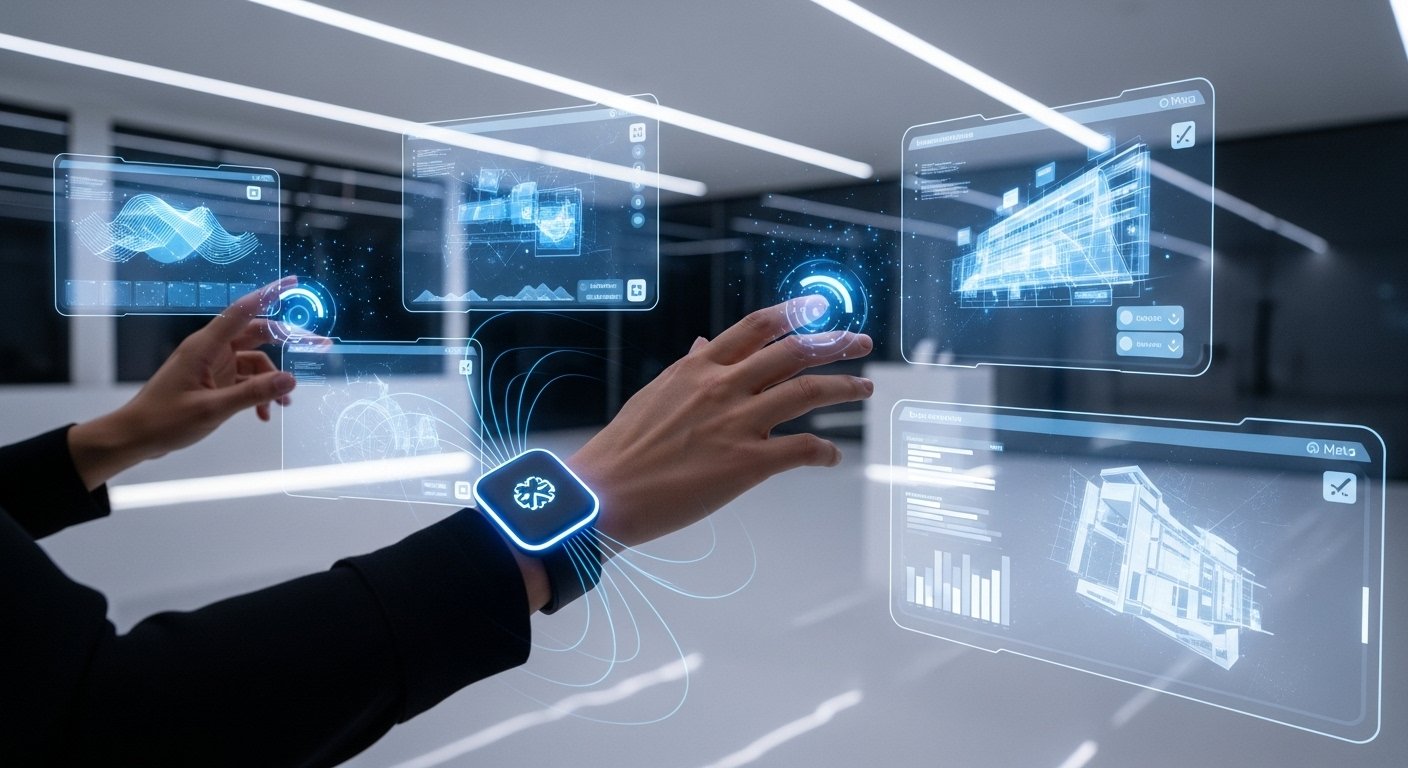
Meta’s AI wristband uses electromyography (EMG) and advanced AI to convert neural signals from your wrist into digital commands. Designed to pair with AR glasses and smart devices, it lets you interact with technology using thought-driven gestures and micro-movements. It’s the missing link between your brain and the metaverse.
Meta’s AI wristband doesn’t just enhance technology — it redefines how we interface with it. By tapping into our body’s electrical language, it creates a seamless bridge between thought and action. Whether for productivity, gaming, accessibility, or augmented reality, this device represents the next leap in human-computer interaction.
The future isn’t touchless — it’s thought-driven.
I. Introduction: The Sci-Fi Dream Becomes Reality
Imagine a world where interacting with technology feels as natural as thinking. A future where you could type, swipe, and control applications without a single overt movement, much like the futuristic interfaces seen in films such as “Minority Report”.1 This captivating vision, once confined to the realm of science fiction, is rapidly turning into reality with Meta’s groundbreaking AI wristband. This device is not merely another piece of wearable technology; it is poised to usher in the “next paradigm shift” in human-computer interaction (HCI), fundamentally altering how individuals engage with digital environments.2
While the concept might evoke thoughts of “wearable telepathy” or “mind-reading,” Meta has been precise in clarifying its true functionality. The wristband does not literally read thoughts or complex cognitive processes. Instead, it meticulously translates the subtle intention to move, capturing the neural signals sent from the brain to the muscles before any visible action occurs.5 This careful distinction is crucial. By initially framing the technology with a captivating, almost fantastical concept like “mind control,” Meta effectively generates significant public interest and media attention.6 However, this initial intrigue is then grounded in a more accurate technical explanation of “intent decoding” via muscle signals. This dual narrative allows the company to maximize initial engagement while simultaneously building trust by clarifying the actual mechanism at play. This balance highlights the delicate line between futuristic vision and scientific reality in the development of emerging technologies.
II. Unpacking the “Mind-Reading” Magic: How sEMG Works
The core of Meta’s AI wristband lies in its ability to interpret the body’s own electrical language. This is achieved through a sophisticated, non-invasive technology known as Surface Electromyography (sEMG). Unlike invasive brain-computer interfaces (BCIs) that require surgical implantation, such as those being developed by Neuralink, Meta’s approach is entirely external and discreet.3 The wristband employs surface electrodes placed on the skin to detect the minute electrical signals, or muscle action potentials, generated by the skeletal muscles in the wrist and forearm.1 These signals are the natural output of the brain, sent to command hand and finger movements, even if those movements are too subtle to be seen physically.5
The magic truly begins as these detected signals are translated into precise digital commands. The system allows users to perform a wide array of actions, including swiping, clicking, and even typing in the air, all without any overt physical movement.1 Meta has demonstrated various specific gestures: users can write individual characters on a surface using their index finger, which are then converted into digital text; rotate their hand at the wrist to control a one-dimensional cursor; swipe their thumb against the side of their index finger; or tap and pinch their thumb and index finger for tap/click actions.1
The seamless interpretation of these complex and often noisy sEMG signals is made possible by advanced artificial intelligence and machine learning models, particularly neural networks.1 A significant investment has been made in training these models on extensive datasets, with Meta collecting data from thousands of consenting research participants.1 This vast amount of training data is pivotal, enabling the system to generalize to new users “out of the box” without the need for individual calibration, a common hurdle in traditional sEMG applications.2 This capability to work immediately for new users, without extensive setup, represents a significant advancement. Traditional sEMG systems often require laborious, per-user calibration due to the inherent variability of muscle signals and noise.13 Meta’s investment in large-scale data collection and advanced AI training directly addresses and overcomes this challenge, which is critical for consumer viability and mass adoption. While these generalized models perform well initially, even a small amount of personalization based on limited individual data can further improve accuracy, for instance, boosting handwriting recognition accuracy by up to 16%.1 This adaptability ensures the wristband can deliver better performance over time as it learns a user’s unique motor intricacies.
The following table illustrates how subtle human intentions are translated into digital commands:
| Gesture/Intention | Detected Signal | Digital Command/Action |
| Subtle finger tap / Pinching | Minute electrical signals | Click/Tap, Select |
| Swiping thumb against index finger | Neuromuscular patterns | Swipe/Scroll |
| Writing in air with index finger | Muscle action potentials | Text Entry/Writing |
| Hand rotation at wrist | Electrical muscle signals | Cursor Control |
| Pinching and “pulling” horizontally/vertically | Intentional muscle activation | Horizontal/Vertical Navigation |
III. Beyond the Screen: A New Era of Seamless Interaction
Meta’s AI wristband is envisioned as a foundational component of its ambitious augmented reality (AR) ecosystem. It is primarily designed as the input device for the prototype Orion AR glasses, which are engineered to resemble contemporary eyeglasses rather than bulky headsets, projecting holographic displays directly into the user’s field of view.2 This integration aims to eliminate the need for traditional, often cumbersome, controllers or visible hand gestures that can disrupt the immersive experience of AR.2 Furthermore, the wristband is anticipated to launch alongside simpler Head-Up Display (HUD) glasses, codenamed Hypernova and potentially named Meta Celeste, with a release expected later this year.12 Meta Connect 2025, scheduled for September 17, is projected to be the platform for announcing Celeste and opening preorders for an October shipping date.12
This technology promises to unlock a new realm of real-world applications. Users could silently type and send messages without a physical keyboard, navigate menus, and control interfaces without a mouse.2 Critically, these actions can be performed with hands comfortably at their side or even in their pockets, making interaction discreet and unobtrusive.3 This is particularly useful in situations where voice interactions are impractical or undesirable, such as sending a private message in a public space.2 The ultimate goal is to allow users to engage with digital content while maintaining full situational awareness and natural eye contact, eliminating the need to look down at a phone.2 The strategic choice of a wristband form factor, akin to wearing a watch or bracelet, was made to enhance social acceptability and comfort, thereby facilitating its mass adoption.1 This design philosophy underpins the vision of “effortless HCI on the go,” removing bulky accessories that might distract from real-world interactions.2
The development of unobtrusive human-computer interaction is a critical factor for the mainstream adoption of AR and VR technologies. Current input methods, such as handheld controllers or voice commands, can be cumbersome or socially awkward in many real-world scenarios. The sEMG wristband, by enabling control with hands at rest and facilitating silent, discreet interaction, directly addresses these friction points. This advancement is not just about controlling devices; it is about making computing “disappear” into the background, fostering a more natural and less distracting engagement with digital information. This aligns with a broader industry trend towards “ambient computing,” where technology is seamlessly integrated into the environment.
Beyond its primary integration with AR/VR, the wristband’s potential extends to controlling virtually any device 2, including smartphones, laptops, and PCs.1 Specific use cases include gaming, such as playing Pacman-like games or interacting with virtual environments.1 For professional productivity, it could enable seamless switching between applications, rearranging tabs, and editing documents.1 The technology also holds promise for smart home control.8
The following table provides a comparative overview of traditional input methods versus Meta’s sEMG wristband:
| Input Method | Pros | Cons | Typical Use Case |
| Keyboard/Mouse | High precision, tactile feedback | Requires surface/space, visible, less portable | Desktop computing |
| Touchscreen | Direct interaction, portable | Requires physical contact, visible, can be distracting | Smartphones/Tablets |
| Voice Commands | Hands-free, quick | Impractical in public/noisy areas, privacy concerns | Smart speakers, car navigation |
| Handheld Controllers | Immersive for VR gaming | Bulky, breaks immersion, often requires line of sight | VR gaming |
| Meta sEMG Wristband | Hands-free, discreet, always-available, precise intent detection | Still in prototype, learning curve, privacy concerns (neural data) | AR glasses, silent communication, accessibility |
IV. A Leap Towards Inclusivity: Transforming Lives
One of the most profound implications of Meta’s sEMG wristband lies in its potential to revolutionize accessibility. The technology is designed to be inherently inclusive, capable of working effectively for people with diverse physical abilities and characteristics.2 This makes it a potentially life-changing tool for individuals facing motor disabilities, conditions such as hand tremors, those with missing digits, or even full paralysis.1
A critical aspect of this inclusivity is the system’s ability to interpret the intention to move, even when overt physical movement is impossible. Meta’s research indicates that participants who are unable to produce visible hand movements can still generate the subtle muscle signals that the system can use to control virtual hands or navigate interfaces.3 This means that the technology can bridge the gap between a person’s desire to interact and their physical capacity to do so. Meta is actively collaborating with external research labs, including Carnegie Mellon University, to explore and validate the device’s utility for individuals with severe motor impairments, such as those with spinal cord injuries.4 Early results from these collaborations are highly promising, showing that users with spinal cord injuries can control computer-based activities, including gaming and screen navigation, from their very first training session.16 The underlying algorithms are based on a person’s neuromotor signals rather than their physical ability to move, which makes the system robust for varying conditions, including hand tremors.16
The consistent emphasis across multiple sources on the wristband’s “inherent inclusivity” and its significant benefits for individuals with motor disabilities suggests that accessibility is not merely a secondary application but a core design principle from the outset.1 The fundamental nature of sEMG, which decodes intention regardless of physical movement, directly leads to its powerful accessibility benefits. This human-centric approach can significantly enhance Meta’s public image and potentially open new markets. It also positions their non-invasive approach as a more ethical and practical solution for many assistive technology needs compared to highly invasive brain implants 4, fostering a more human-centered view of advanced neural interfaces.
Beyond the technology itself, Meta has demonstrated a commitment to advancing accessibility more broadly by publicly releasing a substantial dataset. This dataset contains over 100 hours of sEMG recordings from more than 300 research participants across various tasks.2 This open data release provides a “blueprint” for the broader scientific community to develop their own neuromotor interfaces, fostering a collaborative approach to accessibility technology globally.2 Meta is also actively inviting proposals focused on developing optimal and responsible strategies for continuous motor learning to achieve high-bandwidth, expressive, and personalized EMG-based input.2 This proactive stance in fostering open research and developing generalized models further amplifies the positive impact of this technology, positioning Meta as a leader in inclusive technology.
V. The Road Ahead: Prototypes, Potential, and Practicalities
Currently, both the Orion AR glasses and the sEMG wristband remain in the prototype phase.3 However, Meta has made significant strides towards commercialization. At Meta Connect 2024, the company publicly demonstrated a more “productized” version of the wristband, codenamed Ceres, which is intended as the primary input device for the Orion AR glasses.12 Furthermore, leaked information strongly suggests that the wristband will also launch alongside simpler HUD glasses, codenamed Hypernova and potentially named Meta Celeste, with an anticipated release later this year.12 Meta Connect 2025, scheduled for September 17, is expected to be the platform for officially announcing Celeste and opening preorders for an October shipping date, assuming no delays.12
Regarding cost and market positioning, reports from Mark Gurman indicate that the Hypernova package, which includes the wristband, is estimated to cost between $1000 and $1400.12 This price point positions it firmly as a premium device, potentially limiting initial widespread adoption, especially when compared to more affordable AI wristbands like Amazon’s Bee, which focuses on voice-activated assistance and is priced at $49.99.11 This pricing strategy suggests that Meta is prioritizing a sophisticated, integrated AR/VR experience and advanced sEMG technology over immediate mass-market affordability.19 The ambitious technical goals and the complexity of the sEMG technology drive up development and production costs, which in turn results in a high retail price. This economic barrier limits initial market penetration, suggesting a more gradual adoption curve for this transformative technology. The success of Meta’s wristband will depend not just on its technical capabilities but on demonstrating a compelling value proposition that justifies its premium cost.
Meta’s contribution to the broader scientific community is noteworthy. The company has publicly released a significant dataset comprising over 100 hours of sEMG recordings from more than 300 research participants across various tasks.2 This open approach is a strategic investment. Releasing this valuable dataset accelerates external academic and commercial research in neuromotor interfaces, fostering a broader ecosystem around sEMG technology. This ecosystem development can lead to unforeseen applications, improved algorithms, and broader market acceptance that ultimately benefit Meta’s own platform and solidify its leadership in the field. Meta is also actively inviting proposals focused on developing optimal and responsible strategies for continuous motor learning to achieve high-bandwidth, expressive, and personalized EMG-based input.2 This “open science” approach can help establish sEMG as a de facto industry standard for non-invasive neural interfaces.
Despite the immense promise, practical challenges and limitations remain. Current performance metrics, such as typing speed, are still slower than traditional input methods. For instance, users achieved approximately 21 words per minute with the wristband, compared to an average of 36 words per minute on a smartphone keypad, though improvement is expected with practice and personalization.1 Research in sEMG also faces challenges such as “intersession concept drift,” where changes in muscle tone or spasticity can occur across different days for stroke survivors, making consistent signal interpretation difficult.15 General instability and interindividual variability of sEMG signals also pose challenges for practical, real-world applications.13 Furthermore, complex body motions can generate random or unidentified signals, potentially hindering precise recognition by the system.21
VI. Navigating the Ethical Landscape: Privacy and Responsibility
The advent of neural interface technologies like Meta’s AI wristband brings with it significant ethical considerations, particularly concerning neural data privacy and security. Neural data, derived directly from brain or nervous system activity, is uniquely sensitive because it can reveal deeply personal insights, including an individual’s emotional, cognitive, and even behavioral states.22 The collection, storage, and use of such data raise substantial concerns about privacy violations, potential abuse, pervasive surveillance, and even manipulation.22 Risks such as “brainjacking” – unauthorized control over neural implants or devices – and unauthorized data access have been demonstrated by past data breaches in neuroimaging firms, highlighting the vulnerability of this sensitive information.22 Meta’s existing history with data privacy concerns further amplifies public scrutiny regarding their handling of this new, highly sensitive data type.25 The current lack of comprehensive legal measures specifically protecting neural data means that ethical rules alone may not be sufficient to prevent its sale or sharing without adequate safeguards.22
The rapid pace of neurotechnology development often outpaces the establishment of robust ethical guidelines and legal protections. This regulatory vacuum creates an environment ripe for potential misuse, privacy violations, and public distrust. For Meta, navigating this ethical minefield is paramount for public acceptance and long-term success. Proactive measures in transparency, robust data security, and clear consent mechanisms are not just best practices but essential for building trust and avoiding significant public backlash or future regulatory penalties.23
To mitigate these risks, explicit and informed consent from users is paramount before any neural data is collected, processed, or shared.23 Transparency in privacy notices, data minimization (collecting only data necessary for stated purposes), and strict retention limits are crucial for responsible data governance.23 Moreover, neural data must be protected with enhanced security measures, comparable to those applied to health or biometric information.23 The reusability of neural data over time, as contexts like mood or health can change, presents a new ethical consideration for data management and necessitates careful consideration of data lifecycle.22 California’s proactive SB 1223, passed in 2024, expanded data protections to include neural data, granting consumers rights to access, delete, and restrict its use.24 This legislative shift aligns with a growing global movement to establish “neurorights,” recognizing mental privacy, cognitive freedom, and protection against the exploitation of brain data.24
Despite its profound accessibility benefits, the anticipated high cost of Meta’s wristband, estimated between $1000 and $1400 12, could exacerbate the digital divide. This gap disproportionately affects vulnerable populations, including the disability community that the technology aims to serve.19 The digital divide reflects and amplifies existing social, economic, and cultural inequalities.26 This creates a paradox: a technology designed to empower those with physical limitations might paradoxically become inaccessible due to cost, amplifying existing socioeconomic inequalities despite its inherent technical design for inclusivity. While Meta is making commendable strides in technical inclusivity, the economic aspect of accessibility remains a major challenge. To truly democratize this transformative technology, future strategies might need to involve subsidies, partnerships, or the development of more affordable versions, ensuring it doesn’t become a luxury for the privileged few but a tool for widespread empowerment. Public perception of neural interfaces, while generally positive, includes significant fear related to ethical dilemmas like privacy and “mind control,” underscoring the need for careful public engagement and education.6
VII. Conclusion: A Glimpse into Tomorrow’s Interface
Meta’s AI wristband, powered by sophisticated sEMG technology and advanced artificial intelligence, stands as a pivotal development poised to redefine human-computer interaction. It promises a future of silent, seamless, and intuitive control for augmented and virtual reality environments, extending its utility to a wide array of other digital devices. The technology’s ability to interpret subtle intentions, rather than overt movements, represents a significant leap forward in making computing more natural and less intrusive.
A key benefit of this innovation is its profound impact on accessibility. By enabling interaction through mere intention, the wristband holds immense potential to empower individuals with motor disabilities, hand tremors, or paralysis, significantly enhancing their quality of life and digital independence. This focus on inclusivity, coupled with Meta’s commitment to open science through the release of extensive sEMG datasets, fosters a collaborative environment for broader scientific advancement and the development of assistive technologies.
However, it is important to maintain a balanced perspective. While the technology is groundbreaking, it remains in its prototype phase, with ongoing technical refinements needed to improve aspects like typing speed and signal stability. Moreover, the ethical landscape surrounding neural data is complex and rapidly evolving. Concerns regarding privacy, data security, and the potential for misuse necessitate robust safeguards, transparent policies, and informed consent. The anticipated premium price point also raises questions about equitable access, highlighting the challenge of ensuring that transformative technologies do not inadvertently widen existing digital divides.
The future of human-computer interaction, as envisioned by Meta’s AI wristband, holds immense promise. Realizing this potential hinges on a delicate balance: pushing the boundaries of innovation while simultaneously ensuring responsible, ethical development that prioritizes user privacy, security, and equitable access for all.