Lights, Camera, AI: How Artificial Intelligence is Reshaping Filmmaking’s Future
“The next Oscar-winning short film might not have a human director.”
That’s not a prediction — it’s already happening.
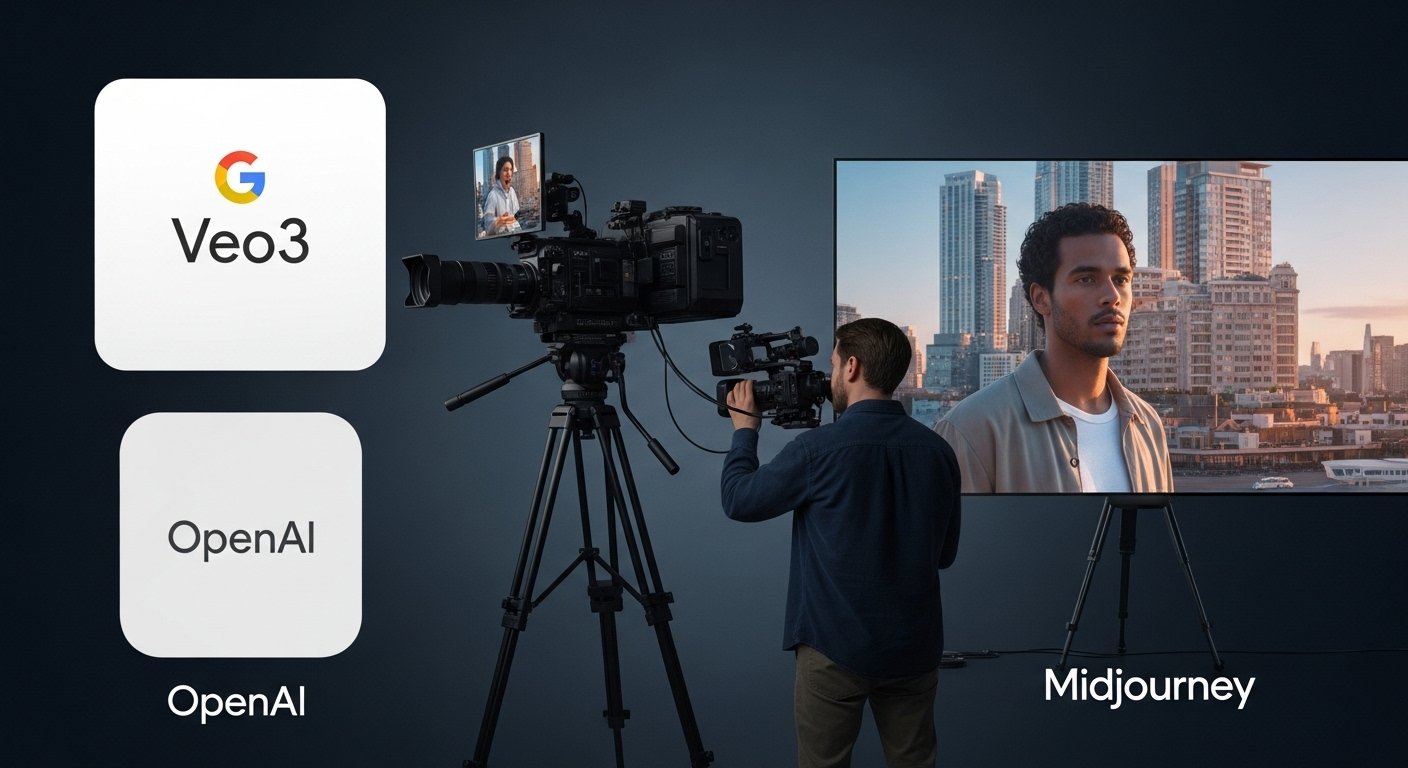
In 2025, a wave of AI-generated films has taken over festivals, social media, and production studios, thanks to cutting-edge tools like Google’s Veo3, OpenAI’s Sora, and Midjourney. These platforms empower creators to craft entire cinematic experiences — from scripts and visuals to sound design — with little more than text prompts and creative direction.
This seismic shift isn’t just about faster workflows. It’s about rethinking what it means to “create” a movie.
How AI Tools Like Veo, Sora & Midjourney Are Disrupting the Film Industry Forever
Imagine a world where blockbusters are crafted in weeks, not years, and indie films rival Hollywood spectacles on a shoestring budget – welcome to the AI-driven future of filmmaking. Artificial intelligence is no longer a futuristic concept; it is deeply rooted in everyday life and has become a central part of content creation.1 Filmmakers are now leveraging powerful AI tools like Google’s Veo3, OpenAI’s Sora, and Midjourney to create entirely AI-generated short films, marking a significant shift in how content is conceived and produced.
This technological leap presents a dual narrative: on one hand, it promises unprecedented efficiency, drastically reducing costs and production timelines. On the other, it ignites complex ethical and legal debates concerning copyright ownership, fair compensation for human artists, and the very nature of creative authenticity. The current excitement surrounding “entirely AI-generated films” may be a temporary phase, as AI technology today is exhibiting a “novelty effect” that is exploitable but likely to fade.4 As AI tools become more integrated into workflows, their perceived revolutionary impact may normalize, much like computer-generated imagery (CGI) evolved from a groundbreaking novelty to an expected component of filmmaking. This suggests that the long-term value of AI in filmmaking will stem from its practical, integrated utility rather than its initial “wow” factor, prompting filmmakers and studios to strategize beyond short-term exploitation and focus on sustainable integration and consistent workflow optimization.
The AI Toolkit: Powering a New Era of Production
The rapid evolution of artificial intelligence has equipped filmmakers with an array of powerful tools, each designed to streamline different aspects of content creation. These tools are not merely incremental improvements but represent a fundamental shift in how visual and auditory elements are conceived and produced.
AI Video Generators: Bringing Visions to Life
Google Veo3 stands out as Google’s latest AI video generation model, announced at Google I/O 2025. It transforms text or image prompts into high-definition videos.5 A standout feature is its native audio output, capable of generating synchronized dialogue, ambient sounds, and background music directly within the video clip.5 This capability sets it apart from competitors like Runway or Sora, positioning it as a step ahead in producing remarkably lifelike clips.5 Veo3 creates high-quality, 8-second videos, optimized for speed 6, and is capable of generating “hyper-realistic, full-audio cinematic videos in just seconds”.7 Its effectiveness has been demonstrated in short films such as “My Robot And Me”.9 Google emphasizes the importance of clear, descriptive prompts for effective use 5, and for safety, all generated videos are marked with a visible watermark and SynthID, a digital watermark embedded in each frame.6
OpenAI Sora, a text-to-video model, aims to understand and simulate the physical world in motion.10 It excels at generating complex scenes with multiple characters, specific types of motion, and accurate details of the subject and background.10 Sora’s deep understanding of language enables it to accurately interpret prompts and generate compelling characters that express vibrant emotions.10 It can also create multiple shots within a single generated video, maintaining character consistency and visual style.10 Sora generates videos ranging from 5 to 20 seconds, with a maximum resolution of 1080p.8 This tool is a game-changer for content creators, drastically cutting down production times from days or weeks to minutes, making high-quality video creation accessible to a broader audience.13 However, Sora still struggles with object permanence, interactions, and dynamic movements, often resulting in “weird” or “uncanny” human and animal movements, though landscapes often appear stunning.11 Sora operates on a credit-based system, integrated with ChatGPT Plus ($20/month for 5-second, 720p videos) or Pro ($200/month for 20-second, 1080p videos), with credits not rolling over monthly.11
AI for Visuals and Pre-Production: Beyond Video
Midjourney functions as an independent research lab dedicated to exploring new mediums of thought through AI art generation.15 It utilizes generative adversarial networks (GANs) to create elaborately detailed and stunningly realistic original images from simple text prompts.15 Key features include text-to-image capabilities, the ability to generate multiple options for each prompt, and the capacity for iteration and refinement.15 Midjourney is widely applied in filmmaking for concept art, character design, and creating mood boards to define a project’s aesthetic.15 For example, a set designer utilized Midjourney to create reference photos for a Netflix show.18 A significant limitation of Midjourney is its inability to break down scripts or maintain character consistency across different frames, often requiring strong prompting skills to achieve specific visual outputs.17
The AI filmmaking ecosystem extends beyond these primary generators, demonstrating that AI tools are specializing rather than simply generalizing. While initial perceptions might group these tools as general-purpose AI, a closer look reveals distinct, often complementary, capabilities. Veo3’s unique selling proposition, for instance, is its native audio, a feature not prominently highlighted for Sora. Sora excels at generating complex scenes and maintaining character consistency within a single generated video, but it has known limitations with object permanence across longer sequences. Midjourney, on the other hand, is explicitly an image generator, powerful for concept art but not designed for video or character consistency across frames.
This specialization is further evidenced by the mention of other tools that fill specific niches within the filmmaking pipeline. Tools like Runway offer advanced features for stylized videos and can convert Midjourney images into video.8
Synthesia specializes in professional videos with AI avatars and multi-language dubbing.8
LTX Studio provides AI-powered storyboarding features.8 For pre-production,
Filmustage offers AI script breakdown and scheduling capabilities.17
ChatGPT 4o can assist in generating images and maintaining character consistency for prompts.8 Post-production benefits from tools like
Suno for music, Elevenlabs for sound effects and voice 8,
Topaz for video upscaling, and Capcut for editing.8
Descript allows video editing by editing the script, while Wondershare Filmora integrates AI tools into traditional editing workflows.11 This diverse array of tools confirms that the AI landscape is not about one tool doing everything; rather, it is an evolving ecosystem where different AIs fulfill specific, specialized roles within the filmmaking process. This implies that the future of AI-driven filmmaking will likely involve a modular workflow, where filmmakers integrate a suite of AI tools, each selected for its specific strengths. This necessitates the development of new skill sets for creatives, such as “AI-Human Collaboration Specialists” and “Prompt Engineers,” who can effectively orchestrate these diverse technologies.23 The traditional, linear filmmaking workflow is transforming into a more interconnected, AI-augmented process.8
A persistent challenge for AI video generation, particularly for realism, is the “uncanny valley” effect. Reports repeatedly highlight “weird” movements, “non-existent lipsyncing,” and struggles with “object permanence, interactions, and dynamic movements” when AI generates human or animal figures.11 While AI excels at creating stunning landscapes 11 or stylized animation 11, its current limitations in replicating nuanced human performance and realistic physics for complex, narrative-driven content are significant. This is not a minor issue; it points to a deep challenge in replicating the subtle complexities of human behavior and interaction. This fundamental limitation directly impacts the types of films AI can truly generate “entirely” and gain widespread acceptance. While short, experimental, or animated films might thrive 11, feature-length, live-action dramas that rely on deep emotional connection and nuanced performances will continue to heavily depend on human actors and traditional filmmaking techniques.27 This also suggests a potential market segmentation, where AI is leveraged for rapid prototyping, conceptualization, or stylized content, while human-driven production remains essential for emotionally resonant, complex narratives.
Table 1: Key AI Video & Image Generation Tools Compared
| Tool Name | Primary Function | Key Features | Max Video Length | Max Resolution | Cost/Pricing Model | Best For |
| Google Veo3 | Text-to-Video Generation | Native audio integration (dialogue, ambient sounds, music), high-quality, character consistency across shots, optimized for speed, SynthID watermark. | 8 seconds | 720p | $19.99/month (Google AI Pro/Ultra) | Amazing, cinematic videos with sound; high-res videos with great physics. |
| OpenAI Sora | Text-to-Video Generation | Complex scenes with multiple characters, specific motion types, accurate details, deep language understanding, character consistency within single generated video. | 5-20 seconds | 1080p | $20-$200/month (ChatGPT Plus/Pro credit-based) | Longer videos when realism isn’t a priority; amazing videos with simple prompts. |
| Midjourney | Text-to-Image Generation | High-quality image generation from text prompts, multiple options, iteration & refinement, wide range of art styles, concept art, character design, mood boards. | N/A | N/A | $10-$120/month | Concept art and mood boards; expanding imagination and creativity. |
Unlocking Efficiency: Cost and Time Savings in Filmmaking
The integration of AI into filmmaking workflows has precipitated a profound transformation, not merely by offering incremental improvements but by fundamentally reshaping the economic and operational landscape of content creation.
Dramatic Cost Reduction
AI video generation offers remarkable cost savings compared to traditional production methods, potentially reducing costs by 50-90%.27 The quantifiable savings are staggering: a 1-minute product video can drop from $5,000-$20,000 to $5-$10 with AI, and a 5-minute training video from $10,000-$50,000 to $6-$12.30 For a monthly content series comprising four 2-minute videos, traditional production might cost $20,000-$80,000, while AI could reduce this to $20-$40.30 Furthermore, revision costs, which can amount to thousands of dollars in traditional production, are often free with AI.30 A short film that would typically cost between $300,000 and $500,000, require a team of 70 people, and take 2 months to complete, was reportedly made for just $600 by one person in 2 weeks using AI.21 Even a complex scene, such as the $40 million “Burly Brawl” sequence from
Matrix Reloaded, could be produced for a “fraction of the cost” with contemporary AI tools.18
This dramatic reduction in expenses stems from the diminished need for traditional resources. AI significantly reduces the reliance on large physical sets, expensive camera equipment, and extensive CGI.28 It automates tasks like motion capture, object removal, and the creation of realistic CGI elements, thereby cutting the cost and time associated with complex visual effects.24 The shift enables “no camera filmmaking” 18 and eliminates the need for large crews, dedicated studios, or physical filming locations.30 AI makes special effects considerably more affordable.18
Accelerating Production Timelines
AI tools dramatically shorten production timelines 27, making video creation faster and cheaper.30 Production time can be reduced from 2-8 weeks to as little as 5 minutes to 1 hour.30 Studios implementing AI workflows report a 40% faster completion rate for projects.23
The impact on pre-production is substantial: AI algorithms can evaluate draft directions, foster video ideas, suggest plot improvements, and create shot lists.20 They can optimize shooting schedules, predict potential delays, and manage resources effectively by combining factors such as weather conditions and actor availability.20 Tools like Filmustage analyze scripts to identify elements and build efficient plans in minutes.17 AI-powered storyboarding tools, such as LTX Studio 8 and Boords 17, further accelerate visualization.
On-set production also benefits significantly: AI has advanced to the point where it can generate synthetic footage.20 On set, filmmakers can utilize automated camera systems, AI for visual effects, and facial recognition technology.20 AI cameras can monitor various aspects of the shoot, including lighting conditions, camera angles, and actor performances, providing real-time feedback to improve video quality.20 AI-powered cameras and drones are capable of autonomously adjusting their positions, tracking subjects, and stabilizing footage in real-time, ensuring smooth and cinematic shots without manual intervention.24
The post-production phase receives a huge boost from AI.20 Tasks like editing, color correction, and sound design, which once took hours or even days, can now be completed in a fraction of the time.24 AI offers advanced editing capabilities, such as automated scene detection, motion tracking, and intelligent cutting.20 It excels in sound editing, with features for audio isolation and enhancement, background noise removal, and soundtrack syncing.20 AI automates color balance and applies complex grading techniques.20 Furthermore, AI can repurpose videos for different platforms, such as social media and TV, with a single click.20
Democratizing the Art of Filmmaking
AI is making high-quality filmmaking more accessible to independent filmmakers and smaller studios.13 It allows anyone to generate high-quality videos from text prompts.13 This means that “zero-budget films will look expensively mounted” 18, and an individual with a laptop could potentially “give Marvel a run for its money” with GenAI-created special effects.18
The sheer scale of cost reduction and time savings indicates more than just efficiency gains; it points to a structural transformation of the filmmaking industry. The ability to achieve “no camera filmmaking” 18 and reduce team sizes from dozens to a single person 21 fundamentally alters the economic model. It shifts from a capital-intensive, large-crew-dependent process to a software-centric, lean-team approach. This “democratization” 13 suggests a new era of content creation where financial barriers are significantly lowered. This shift will likely lead to an explosion of diverse content from independent creators, potentially challenging the dominance of traditional studios and production houses. However, it also raises questions about market saturation and the perceived value of content when production costs are so low. Traditional studios will need to either embrace these AI-driven efficiencies or focus on content types where the “human touch” 27 remains irreplaceable, potentially leading to a bifurcation of the industry.
While post-production is explicitly noted as receiving a significant boost 20, the evidence clearly demonstrates AI’s pervasive influence across all stages of filmmaking. In pre-production, AI assists with script analysis, storyboarding, and scheduling.17 On-set, AI-powered cameras and drones offer real-time feedback and autonomous control.20 This comprehensive integration 24 means AI is not merely an add-on tool for editing; it is becoming an integral part of the entire filmmaking workflow, from initial concept to final distribution. This holistic integration suggests that future filmmakers will require a broad understanding of AI’s capabilities across the entire production pipeline, not just specialized knowledge in one area. It could also lead to a blurring of traditional departmental roles within filmmaking, fostering more streamlined, integrated workflows. This demands a re-evaluation of educational curricula for aspiring filmmakers and new training programs for existing professionals to adapt to these interconnected, AI-augmented processes.
The Ethical Crossroads: Copyright and Fair Compensation
The rapid integration of AI into filmmaking, while offering unprecedented efficiencies, has simultaneously opened a complex ethical and legal Pandora’s box, particularly concerning intellectual property and labor rights.
The Copyright Conundrum: Who Owns AI-Generated Art?
Under current U.S. law, AI art generally “cannot be copyrighted” because it is not considered the work of a human creator.32 The U.S. Copyright Office consistently reaffirms that copyright protection “requires human authorship” 34 and has denied registrations for purely AI-generated artwork.34 The “traditional elements of authorship” must be executed by a human for copyright to apply.33
However, copyright protection may be granted if a work, even with AI-generated material, contains “sufficient human authorship”.36 The “arrangement of AI-generated media can be copyright-able as a ‘compilation'” 38, emphasizing the human’s creative selection and arrangement. Human control and influence over AI outputs are crucial in determining copyrightability.33 “Assistive uses that enhance human expression,” such as de-aging actors or removing unwanted objects, generally do not affect copyright protection.37 This determination, however, requires “fact-specific consideration” and “documentary proof of human creativity”.38
A significant legal issue arises because AI models are often trained on “vast datasets that include copyrighted works”.33 This creates a “legal gray area,” particularly if AI outputs closely resemble and compete with original works.33 High-profile lawsuits, such as Getty Images suing Stability AI for copying millions of copyrighted images without permission or compensation, highlight these tensions.33 The U.S. Copyright Office has indicated that using copyrighted works to train models that generate “expressive content that competes with” original works goes “beyond the scope of the fair use doctrine”.33 Further ambiguities exist regarding the “sufficient human input” threshold and inconsistent enforcement due to a lack of proper labeling.36 This also complicates traditional work-for-hire agreements, where the ownership of AI-assisted content becomes unclear.36 Additionally, the “right of publicity” is a growing concern, involving the unauthorized use of a person’s likeness, voice, image, or persona, with California law providing extensive protections.39
The legal framework is lagging behind technological advancements, creating significant uncertainty. The U.S. Copyright Office’s firm stance against copyright for purely AI-generated work contrasts sharply with the rapid evolution of AI tools and their increasing integration into creative processes. The ambiguity surrounding what constitutes “sufficient human input” for copyrightability creates a legal quagmire. This uncertainty is exacerbated by ongoing, high-stakes lawsuits and the Copyright Office’s evolving interpretations of fair use. The added complexity of “right of publicity” further illustrates that existing laws were not designed for the nuances of AI-generated likenesses and performances. This is not a static legal issue; it is a dynamic, contested space where legal precedent is still being formed. Filmmakers and studios operating in this space face substantial legal risks related to ownership, potential infringement, and liability. This necessitates proactive measures, including developing robust internal policies for AI use, meticulously tracking AI tools and inputs, and revising contractual agreements to mitigate future disputes.36 The lack of clear legal boundaries could either stifle innovation due to fear of unprotectable work or lead to a scenario where content is freely appropriated, impacting the economic viability of human creators.
Protecting Human Talent: Fair Compensation and Job Security
The simultaneous strikes by the Writers Guild of America (WGA) and the Screen Actors Guild – American Federation of Television and Radio Artists (SAG-AFTRA) in 2023 marked a historic moment, securing landmark deals that directly addressed the ethical and labor implications of emerging AI technologies.40 These unions successfully pushed for provisions ensuring creative workers are informed about how their contributions are utilized within AI systems.40
Key protections secured include stipulations that studios cannot use digitized images, voices, or performances of actors without their “explicit prior consent”.40 Any use of digital doubles or synthesized voices must be “fairly compensated” 40, often requiring separate negotiations and a day rate for “employment-based digital replicas”.41 Crucially, AI-generated scripts cannot replace human screenwriters; if an AI-generated draft is used, writers must be compensated for their revisions and edits, ensuring their active participation and recognition as authors.40 Unions are also advocating for broader policies that require employers to eliminate bias in AI systems, ensure accountability for AI-driven decisions, and promote job equity by making new roles accessible to all workers.43
AI is projected to “disrupt over 204,000 jobs” in the entertainment industry within three years, with 118,500 specifically in film, television, and animation.23 Concerns range from AI making future generations “lethargic” and stifling creativity 1 to replacing “entry-level jobs” and “pathways to becoming an expert”.44 However, the narrative is not entirely negative. Many view AI as an “opportunity” to blend human efforts with technology and learn new skills.1 New specialist roles are emerging, such as AI Animation Supervisors, Prompt Engineers, and AI-Human Collaboration Specialists.23 Experienced animators who master AI tools can become more productive and in-demand for higher-level creative decision-making roles.23 Unions like The Animation Guild are actively developing resources for members to upskill in these emerging areas.23
Labor unions are proactively shaping AI regulation in the absence of comprehensive government policy. The WGA and SAG-AFTRA strikes were not merely traditional labor disputes; they were historic deals specifically addressing the ethical and labor implications of emerging technologies. By securing concrete provisions for consent, compensation for digital replicas, and human credit for scripts, these unions have effectively become de facto regulators of AI use within their respective creative industries. This proactive stance is particularly significant given the current absence of comprehensive state or federal AI policies.45 They are setting precedents that influence how AI is deployed and how its economic benefits are distributed. The success of these Hollywood unions establishes a powerful precedent for other creative industries and even non-unionized workers.4 It suggests that collective bargaining and worker advocacy will play a crucial role in shaping the responsible adoption of AI, pushing for ethical AI frameworks that prioritize human contribution, fair economic distribution 40, and protection against job displacement. This could lead to a more balanced and equitable integration of AI, potentially mitigating some of the most severe negative impacts on creative labor.
The Authenticity Debate: Can AI Truly Create?
Despite AI’s advancements, significant concerns persist regarding its capacity for genuine creativity. Critics point to “generic” and “hacky” outputs 3 and the risk of content lacking emotional depth due to over-reliance on AI.3 Fundamentally, AI “cannot actually think or understand things” 44 or “grasp the context of ideas”.29 It cannot understand or follow culture, nor can it take risks that result in true novelty.29 The emotional resonance of human performance is often cited as irreplaceable: “Watching AI faces cry will never equal seeing an actual actor’s tears”.29 AI lacks “true creativity and originality” because it primarily analyzes patterns from existing data rather than creating genuinely new narratives.28 Human imagination, experience, and artistic vision remain irreplaceable.3 Audiences seek “relevance,” “fresh context,” and stories that serve as “social currency” 29—elements AI struggles to consistently deliver. Ultimately, AI “cannot be a mirror to us individually or collectively” in the way human art can.29
The “death of creativity” argument is nuanced, highlighting a shift in creative value. While some prominent voices express concern that AI “kills creativity” and fosters “lethargy” 1, others argue it is merely a “tool” and an “opportunity”.1 The core understanding here is that AI’s limitations in understanding human emotion, culture, and generating truly novel narratives 29 mean it cannot replace the essence of human creativity. Instead, it seems poised to automate “generic” or “entry-level” tasks.44 This implies a re-evaluation of what constitutes “creative value” in the AI era: the emphasis shifts from manual execution to strategic direction, prompt engineering, and the unique infusion of human experience, emotional depth, and cultural context. This redefines the role of the human creative. Rather than fearing outright replacement, artists and writers are encouraged to “blend their efforts with AI” 1 and focus on higher-order creative tasks that AI cannot perform. This could lead to a bifurcation of content: mass-produced, “generic” AI content 3 versus human-led, authentic narratives that command higher value. The ability to infuse “fresh context” and create “social currency” through stories 29 will become a key differentiator, potentially leading to new forms of content certification or labeling that highlight human authorship.
Navigating the Future: Best Practices for Filmmakers
As AI continues to embed itself deeper into the fabric of filmmaking, navigating this evolving landscape requires a strategic approach that balances technological adoption with the preservation of human artistry and ethical considerations.
Embracing AI as a Powerful Collaborative Tool, Not a Replacement
Filmmakers should view AI as a “creative partner” that “enhances creativity” 3, rather than a threat.1 AI excels at handling “monotonous, robotic tasks,” thereby freeing human creatives to focus on the broader work of storytelling and artistic vision.25 The most effective approach for businesses often involves blending traditional production methods with AI tools.27 The future of filmmaking will likely be a “collaboration between human creativity and AI innovation”.28
Understanding and Adhering to Evolving Legal Frameworks and Union Guidelines
It is crucial for filmmakers to engage in “thoughtful deliberation and adherence to ethical standards” when using AI.20 This includes staying informed about policy changes from bodies like the U.S. Copyright Office 46 and implementing internal policies for AI tool usage, meticulously tracking inputs and outputs.36 Compliance with union agreements, particularly regarding consent and fair compensation for digital replicas and AI-assisted work, is paramount.40
Prioritizing Unique Human Creativity and Narrative Depth to Stand Out
While AI can generate content rapidly, “human creativity and emotional intelligence will likely remain irreplaceable”.3 To distinguish themselves in a potentially saturated market, filmmakers must prioritize creating “original and deeply creative narratives”.28 In a world potentially flooded by AI films, “new authentic stories are our only lifeline”.29 Audiences crave “relevance,” “fresh context,” and stories that serve as “social currency”—elements that AI currently struggles to provide.29 The key to success lies in “finding the right balance between leveraging AI’s capabilities and maintaining the creativity and authenticity that set human-generated content apart”.3
The value proposition of “human-authored” content will likely increase. As AI rapidly increases the volume of “generic” 3 and easily replicable content, the market will naturally seek out and value what AI cannot easily produce: genuine human creativity, emotional depth, and unique artistic vision.3 The legal emphasis on human authorship for copyright protection 33 further reinforces the economic and legal value of human input. If AI can make everything cheap and fast, true differentiation will come from the irreplaceable human element. This implies that filmmakers and content creators should strategically emphasize and market the human element in their work. This could lead to new industry standards, certifications, or even audience preferences for “human-crafted” or “human-augmented” media.29 For content visibility and monetization, this translates to focusing on creating “unique and relevant content” that provides genuine “value to users” 47, moving beyond mere keyword stuffing to deliver authentic, people-first content.49 This shift could empower independent creators who leverage AI to enhance their unique vision, rather than simply automate it.
Conclusion: A Collaborative Future for Cinema
The integration of AI tools like Google Veo3, OpenAI Sora, and Midjourney has undeniably ushered in a new era for filmmaking, offering unprecedented efficiencies in cost and production time while simultaneously raising profound questions about copyright, fair compensation, and the essence of human creativity. This technological evolution is not static; AI in filmmaking will continue to advance rapidly 1, demanding continuous adaptation from the industry.
Despite the initial enthusiasm around “entirely AI-generated films,” the evidence consistently points to AI functioning as a tool or assistant that augments human capabilities, rather than a complete replacement.3 Even the most impressive AI-generated shorts still involve significant human input in script, editing, sound design, and prompt engineering.22 The inherent limitations of AI in replicating nuanced human emotion, cultural context, and complex narratives 11 suggest that a purely AI-driven blockbuster, devoid of human artistic vision, is neither feasible nor likely desired by audiences in the long term. The “most effective approach for most businesses” is a blend of traditional and AI methods.27 This implies that the industry will likely settle into a “hybrid” model where AI handles repetitive, resource-intensive, or experimental tasks, while human creatives retain ultimate control over narrative, emotional depth, and final artistic vision. This means that training programs, industry standards, and even film festivals 50 will need to adapt to this collaborative paradigm. Success will depend on a filmmaker’s ability to intelligently integrate AI into their workflow, using it to amplify their unique human storytelling capabilities rather than abdicate creative control.
The future of filmmaking lies not in AI replacing human ingenuity, but in a synergistic partnership. By embracing AI as a powerful collaborative tool, understanding its limitations, navigating the evolving legal and ethical landscape, and relentlessly prioritizing unique human storytelling, filmmakers can ensure that cinema continues to evolve, pushing creative boundaries while keeping its authentic, human core intact.