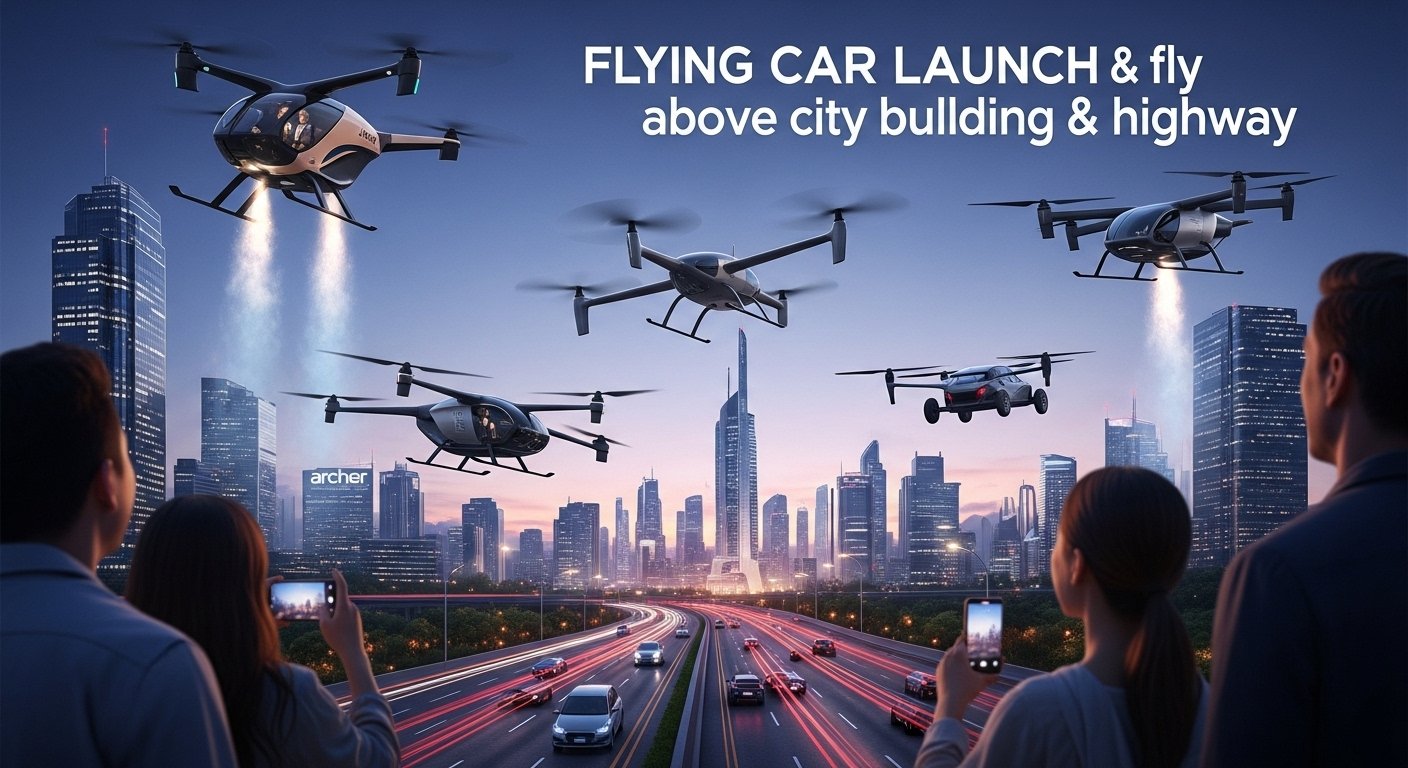
Flying Car Technologies Set for Commercial Launch in 2025: Reality or Dream?
Introduction: The Sky’s the Limit?
The enduring allure of flying cars has captivated humanity for decades, promising a future free from traffic congestion and offering unprecedented mobility. This vision, once confined to the realm of science fiction, appears to be drawing closer to reality as 2025 approaches, intensifying the discourse around their “commercial launch.” This report delves into the current state of flying car and electric Vertical Take-Off and Landing (eVTOL) technologies, examining what “commercial launch” truly means in this nascent industry. The analysis will explore the advancements, identify key players, and highlight the significant hurdles that remain before widespread adoption.
It is important to understand that the term “commercial launch” in this context carries a nuanced meaning, often differing from the public’s expectation of widespread availability. While some activities in 2025 involve public displays, pre-sales, limited demonstrations, or very early, geographically restricted operations , this does not signify mass-market availability or the proliferation of air taxi services across major cities, particularly in highly regulated markets such as the United States. This distinction between marketing aspirations and the realities of regulatory and infrastructural development is a critical theme that shapes the current trajectory of the industry.
Pioneers Taking Flight: Who’s Leading the Charge?
The landscape of aerial mobility is characterized by diverse approaches, with some innovators focusing on road-legal flying cars for personal ownership, while others develop eVTOL aircraft primarily for commercial air taxi services. Understanding these distinctions provides essential context for the varied pathways to aerial mobility.
The Road-Legal Flyers: Pal-V Liberty & AirCar
Two prominent examples of vehicles designed for both road and air travel are the Pal-V Liberty and the AirCar.
The Pal-V Liberty, developed by a Netherlands-based company, is positioned as the “world’s first true flying car,” officially classified as a ‘FlyDrive vehicle’. This unique machine integrates a gyroplane into a conventional car design, featuring a two-blade rotor that spans 36 feet and folds for road transportation. The vehicle has already received certification to operate as both a car and a gyroplane. For 2025, the Pal-V Liberty is set for a commercial display in Monaco from March 12th to 16th, coinciding with the Monaco International Investment Forum (MIIF). While currently in the pre-production stage, series production is planned near the company’s Netherlands headquarters. Prospective buyers will be invited to the Pal-V FlyDrive Academy for a five-day training course to become certified on the Liberty.
The AirCar, a Slovakian invention by Klein Vision, is styled like a sleek sports car and distinguishes itself from vertical takeoff rivals by requiring a short runway, approximately 300 meters, for takeoff. Once airborne, it cruises at 155 miles per hour, powered by a petrol engine and propeller system. The AirCar has undergone extensive flight testing, accumulating over 170 hours and more than 500 takeoffs and landings, and has received airworthiness certification. Klein Vision anticipates the AirCar will be available for purchase by early 2026, with a price ranging between $800,000 and $1 million, depending on specifications. A production-ready successor, the AirCar 2, is already in development, with its first flight scheduled for September 2025, boasting a 300-horsepower engine and a 600-nautical-mile range. While certified in Slovakia, its operation in other countries will depend on local regulatory approvals. Potential buyers must possess both a licensed driver’s and a certified pilot’s license.
The approaches taken by Pal-V and AirCar highlight a fundamental divergence in the market’s early development. These vehicles are explicitly designed for individual purchase and dual road/air use, emphasizing the “car” aspect for affluent early adopters. This contrasts sharply with other players who are developing eVTOLs primarily for commercial passenger services, often without a road-driving component. This distinction is crucial for understanding the varied commercialization timelines and target markets, as the regulatory and infrastructural requirements for personal flying vehicles differ significantly from those for shared air taxi services.
Japan’s SkyDrive: Soaring Towards Expo 2025
SkyDrive Inc., a leading eVTOL aircraft manufacturer based in Japan, is making significant advancements with its SD-05 model. The company successfully conducted a remotely piloted demo flight of the SKYDRIVE SD-05 on April 9th, 2025, as part of the Media Day event at Expo 2025 Osaka, Kansai. During this demonstration, the aircraft flew at an altitude of approximately 5 meters for about 4 minutes above the EXPO Vertiport.
To foster public acceptance and familiarity with this nascent technology, SkyDrive unveiled a full-scale mockup of its SD-05 model at Expo 2025. This display, part of the Advanced Air Mobility Station, allows visitors to see and even board the life-size model, offering a tangible sense of what future air mobility could feel like. This interactive approach serves a strategic purpose beyond mere technical validation; it is a critical component of building the “social license to operate” by addressing potential public anxieties regarding noise, safety, and integration into urban environments. By allowing people to experience the concept firsthand, even through mockups or remotely piloted flights, SkyDrive is proactively shaping public perception, which is a vital, often underestimated, hurdle for widespread commercialization.
Production of the SD-05 began in March 2024 at a Suzuki Motor Corporation facility, and SkyDrive is actively pursuing certification efforts in both Japan and the United States. The company, established in July 2018, performed the first public flight demonstration of its SD-03 eVTOL in August 2020 and was the first in Japan to fly a crewed eVTOL in 2019.
Hyundai’s Supernal: Building an Advanced Air Mobility Ecosystem
Supernal, Hyundai Motor Group’s Advanced Air Mobility (AAM) company, is developing the S-A2, a five-seat, battery-powered eVTOL aircraft for commercial passenger journeys. Their ambitious roadmap targets a 2028 Entry into Service (EIS), with the certification application slated for 2026.
The S-A2 features a unique design with eight tilting rotors, engineered for efficiency, redundancy, and a smoother flight experience, all powered by all-electric motors. Safety is a core design philosophy, with the aircraft built to meet stringent FAA and international aviation safety standards, including Instrument Flight Rules (IFR) capability for safe operation at night and in poor visibility.
Supernal’s strategy extends beyond merely developing the aircraft; it emphasizes a complete, end-to-end AAM solution that includes the necessary clean-energy ecosystem to integrate seamlessly into existing transportation frameworks. The vision includes vertiports as ultimate mobility hubs, connected to autonomous robotaxis and public transit, aiming to transform a 45-minute drive into a 10-minute flight. This comprehensive approach signifies a mature understanding of the complex, multi-faceted challenges facing AAM. It suggests that companies taking a holistic view, investing not just in vehicle research and development but also in the surrounding operational, regulatory, and public acceptance environments, are more likely to achieve long-term success.
Supernal is actively forging relationships with policymakers, municipalities, infrastructure partners, and other companies to lay the groundwork for this new era of flight. Key partnerships include collaborations with Urban-Air Port for agnostic vertiport technology and infrastructure, CHC Helicopter and Heli-One to develop AAM networks, Clay Lacy Aviation to prepare FBO networks, Blade Urban Air Mobility to explore operator and network models, and Sigma Air Mobility for AAM market development. Backed by Hyundai Motor Group, Supernal leverages its parent company’s vast resources, world-class automotive smart manufacturing capabilities, aftermarket and financial expertise, and advanced battery and alternative energy source research.
Joby Aviation: Paving the Way for Air Taxis
U.S.-based Joby Aviation has made significant strides, becoming the first eVTOL firm to receive the FAA’s Part 135 Air Carrier Certification in July 2025. This certification is a crucial step towards commercial operations. Backed by major players like Toyota and Delta Airlines, Joby’s vehicle is designed for on-demand air taxi networks and is notably near-silent at 100 feet. The company is actively undergoing real-world passenger trials in key urban centers such as New York and Los Angeles. Joby plans to commence commercial flights as early as 2026, contingent on receiving final type certification for its aircraft.
Archer Aviation: United Airlines Partnership
Archer Aviation is another prominent eVTOL developer, with its Midnight eVTOL aircraft central to a $1 billion agreement with United Airlines. This partnership aims to provide air taxi services, specifically transporting passengers from city centers to major airports. The Midnight eVTOL is designed to carry four passengers, has a range of approximately 100 km, and boasts a rapid recharge time of 10-15 minutes. In June 2025, United Airlines confirmed three initial air routes for testing in Chicago, marking one of the most advanced airline-integrated Urban Air Mobility (UAM) projects globally.
Volocopter: Eyeing European Skies
The German firm Volocopter is actively preparing for commercial operations, building on its successful test demonstrations during the Paris 2024 Olympics. As of July 2025, Volocopter is finalizing its European Aviation Safety Agency (EASA) approval for its VoloCity air taxi. The company has completed over 2,000 test flights, demonstrating its extensive development and safety validation efforts. Public demo rides are scheduled for later this year in Paris and Rome, indicating a strong push towards public engagement and early commercialization in Europe. Volocopter’s compact, all-electric craft is particularly well-suited for dense European cities, and the company has already established integrated vertiport partnerships.
Tesla: Elon Musk’s Aerial Ambitions (or Lack Thereof)
While the concept of a “Tesla flying car” frequently arises in discussions about futuristic transportation, current information indicates no concrete product development, official roadmap, or dedicated project from Tesla in the flying car or eVTOL space. Speculation often centers on hypothetical designs, such as integrating the Tesla Roadster design with rocket thrusters from Starship or exploring concepts similar to Klein Vision’s AirCar or Xpeng’s drone-like car. These remain theoretical discussions rather than announced products or active development initiatives.
Tesla’s primary strategic focus in advanced mobility remains firmly on electric vehicles and autonomous ground transportation. This is further underscored by Hyundai’s multi-year strategic partnership with Waymo (a Google/Alphabet company, not Tesla) to integrate Waymo’s sixth-generation fully autonomous technology into Hyundai’s all-electric IONIQ 5 SUV for robotaxi services, with initial on-road testing with Waymo-enabled IONIQ 5s slated to begin by late 2025. The broader flying car and eVTOL stock market is active with significant players such as Joby Aviation, China’s EHang, and Archer Aviation, but Tesla is notably absent from this list of direct competitors actively developing or commercializing flying vehicles. This highlights a significant disconnect between public perception, often fueled by Tesla’s innovative brand image and Elon Musk’s ambitious rhetoric, and the company’s actual product development in the aerial mobility sector.
Key Flying Car/eVTOL Players & Their Commercialization Outlook
The following table provides a concise overview of the key players discussed and their respective approaches to commercialization, highlighting the diverse pathways and varying levels of readiness in the industry.
| Company/Vehicle | Vehicle Type | Key Feature/Design | Stated Commercialization/EIS Target | Current Status/Reality Check | |
| Pal-V Liberty | Road-legal Flying Car (Gyroplane) | Foldable rotors, gyroplane integration | March 2025 (display/pre-prod) | Pre-production, certified as car & gyroplane | |
| AirCar | Road-legal Flying Car (Aircraft) | Requires runway, petrol engine | Early 2026 (purchase) | Certified in Slovakia (local regs apply) | |
| SkyDrive (SD-05) | eVTOL Air Taxi | Remotely piloted demo, compact size | Expo 2025 (demo/plans) | Production started, pursuing certification | |
| Hyundai Supernal (S-A2) | eVTOL Air Taxi | 8 tilting rotors, ecosystem approach | 2028 (EIS) | Certification application 2026, building ecosystem | |
| Joby Aviation | eVTOL Air Taxi | Near-silent, on-demand network | Early 2026 (commercial flights) | FAA Part 135 certified (July 2025), trials underway | |
| Archer Aviation | eVTOL Air Taxi | 4-passenger, rapid recharge | United Airlines partnership (testing 2025) | United Airlines routes confirmed (June 2025) | |
| Volocopter | eVTOL Air Taxi | Compact, all-electric, 2000+ test flights | Public demo rides (late 2025) | Finalizing EASA approval, Paris Olympics demos | |
| Tesla | N/A | N/A | No concrete product | No direct flying car product development |
Navigating the Skies: The Hurdles to Widespread Adoption
Beyond technological advancements, the widespread commercialization of flying cars and eVTOLs faces significant non-technical challenges that will ultimately dictate their true market penetration. These hurdles span regulatory frameworks, infrastructure development, and public acceptance.
Regulatory Realities & Certification Pathways
Many eVTOL companies had initially set a self-imposed deadline of 2025 for entering commercial service, aiming to ramp up mass production and begin carrying passengers or cargo. The U.S. Federal Aviation Administration (FAA) has indeed made significant progress in updating its regulations for “powered-lift” aircraft, which encompass many eVTOLs, to operate safely within the National Airspace System (NAS). A final rule for pilot and instructor certification requirements and operational rules for powered-lift operations was issued in October 2024, providing a comprehensive framework for certifying the initial cadre of powered-lift instructors and pilots.
Despite these foundational regulatory updates, the reality of widespread US air taxi certification is likely pushed to 2027, with some experts even suggesting a timeline of 2028-2030. This delay stems primarily from the extensive and rigorous testing required for new aircraft categories; results from critical testing series are not anticipated until mid-2027. This indicates that while regulatory
frameworks are being established, the actual certification process for new and complex aircraft, particularly eVTOLs, is inherently lengthy and complex, prioritizing safety above all else through a data-driven approach. This makes regulation the primary pacing factor for widespread commercialization.
The regulatory landscape is also global, requiring international coordination. While Slovakia has already certified the AirCar, its use in other countries depends on local regulators. Japan’s SkyDrive is actively pursuing certification efforts in both Japan and the United States. Concurrently, the European Union Aviation Safety Agency (EASA) is also developing regulations, including efforts to prevent mid-air collisions through electronic conspicuity (ADS-L).
Infrastructure: Building the Vertiports of Tomorrow
The widespread adoption of flying vehicles necessitates a complete overhaul of urban and aerial infrastructure. This includes establishing “roads in the sky”—defined airborne routes and sophisticated systems to manage the anticipated level of air traffic, which currently do not exist.
Dedicated takeoff and landing facilities, known as “vertiports,” are essential for the seamless transition between ground and air. These facilities will need to be strategically sited with land use compatibility in mind, ensuring ample buffers to minimize the impact of operations, particularly noise, on surrounding properties. Companies like Supernal are actively partnering with vertiport developers such as Urban-Air Port to build out this crucial infrastructure, recognizing its foundational role in enabling Advanced Air Mobility.
The energy demands of flying vehicles present significant infrastructure hurdles. If flying cars were to run on high-octane fuel, the current refinery capacity would be insufficient, requiring major capital investment for conversion. For electric eVTOLs, while eco-friendly, the weight of batteries limits lift and range, and the recharging infrastructure would need to be reimagined for locations very different from today’s roadside EV charging stations. The introduction of flying vehicles will also require rethinking basic urban facilities. Existing parking garages, for example, may become obsolete as they likely won’t accommodate flying vehicles, meaning new structures or outdoor solutions will be needed. The challenge lies in seamlessly integrating these new mobility options into dense urban environments without causing undue disruption. This implies that the industry’s success hinges on a multi-sector collaborative effort involving aerospace manufacturers, urban planners, energy providers, and regulatory bodies. Infrastructure development is as foundational and complex as aircraft development itself, and delays in one will directly impact the other, making it a critical bottleneck for mass commercialization.
Public Perception & Practicalities
Public acceptance is a critical, often underestimated, factor for the widespread adoption of flying vehicles. A significant concern for communities is noise annoyance. A study by Eve Air Mobility found that the visibility of eVTOLs increases how people perceive noise levels, particularly during take-off, which generates higher annoyance than flyovers. While eVTOLs are expected to be quieter than traditional helicopters, their introduction into urban environments will bring new sensory experiences. Strategies to mitigate noise concerns include optimizing flight paths, minimizing low-altitude operations near residential areas, and educating communities about eVTOL sound profiles. Routing aircraft over existing transit corridors, such as roads, interstates, and rail lines, is also suggested to avoid noise-sensitive areas. This indicates that public acceptance isn’t just a technical problem (reducing noise) but a complex psychological and experiential one, where the visual presence and context of the sound play significant roles.
Safety concerns are paramount for public acceptance. A study revealed that safety is the public’s foremost concern, with other issues like noise being secondary. Investor confidence, crucial for the sector’s growth, is also strongly tied to the public’s belief in the safety and reliability of eVTOLs, with 76% of investors identifying professional pilot involvement as crucial for increasing public confidence.
Affordability also remains a significant barrier. Initially, flying cars are likely to be a luxury, accessible only to the affluent, with vehicles like the AirCar priced between $800,000 and $1 million. This high entry cost will limit early adoption to a niche market. Beyond cost, consumers will have practical concerns about adapting to new licensing requirements, safety procedures, and air traffic laws. The shift from ground-based to aerial mobility will require significant societal adaptation.
Major Hurdles to Flying Car Commercialization
The following table summarizes the complex and interconnected challenges facing the widespread commercialization of flying cars and eVTOLs.
| Hurdle Category | Specific Challenge | Impact on Commercialization | |
| Regulatory & Certification | Lengthy FAA certification (US 2027-2030) | Delays widespread rollout, limits operational scale | |
| Infrastructure | Need for vertiports & air traffic management systems | Limits operational scale, impedes seamless urban integration | |
| Public Acceptance | Noise perception (visibility impact), safety concerns | Affects community integration, crucial for trust & adoption | |
| Affordability | High initial cost ($800k-$1M+) | Restricts early adoption to luxury market, limits mass appeal | |
| Safety | Ensuring safety in transitions/adverse weather | Paramount for public trust and regulatory approval | |
| Cybersecurity | Protecting automated systems from cyber threats | Essential for secure and reliable operations |
The Market Takes Off: Growth Projections and Emerging Trends
Despite the formidable hurdles, the market for flying cars and eVTOLs is projected for substantial growth, reflecting strong investor confidence and a long-term vision for urban air mobility.
The broader flying car market is projected for explosive growth, surging from an estimated $243 million in 2025 to over $4.2 billion by 2035, representing an eye-popping 34% annual growth. Specifically, the urban air mobility sector alone is forecasted to soar from $1.9 billion in 2024 to $12 billion in 2035. More broadly, the global eVTOL aircraft market, valued at approximately $3.5 billion in 2024, is forecasted to reach nearly $27 billion by 2034, demonstrating a robust Compound Annual Growth Rate (CAGR) of around 23.5% from 2025-2034. Another credible estimate projects the eVTOL market from $422.2 million in 2024 to $2,959.9 million by 2034, with a 21.5% CAGR. While the base values differ across sources, the consistent theme is one of significant, rapid growth.
This apparent contradiction between immediate regulatory friction and aggressive market growth projections resolves into a picture of a market with immense long-term potential, but a slower, more deliberate initial ramp-up. The high Compound Annual Growth Rates (CAGRs) reflect the “hockey stick” growth expected after foundational challenges (certification, infrastructure, public acceptance) are substantially addressed, likely in the late 2020s and early 2030s. This long-term vision suggests sustained investment and development, even if the “2025 launch” is more symbolic or limited in scope than universally widespread.
Several key market trends are driving this optimistic outlook:
- Strategic Partnerships: A notable and accelerating trend in the eVTOL space is the formation of strategic partnerships, especially between aerospace firms and urban infrastructure planners. Supernal’s extensive collaborations with vertiport developers, operators, and mobility partners exemplify this crucial trend, recognizing that the success of AAM requires a collaborative ecosystem.
- Technological Advancements: The market is experiencing rapid growth driven by continuous advancements in electric propulsion and autonomous flight technology, which enhance both safety and operational efficiency. Autonomous systems, in particular, are expected to rise in prominence as regulatory confidence and AI technologies mature.
- Eco-Friendly Solutions: The eVTOL’s eco-friendly profile positions it as a significant contributor to the broader global transition toward sustainable and low-impact modes of transportation, aligning with efforts to reduce carbon emissions.
- Addressing Urban Congestion: A primary driver for demand is the surge in urban population and the resulting congestion in cities. eVTOLs offer a compelling solution to alleviate traffic and provide faster, more convenient alternatives to traditional transport.
In terms of aircraft types and market share, multirotor aircraft currently hold the largest share (approximately 50%) due to their simpler design and high adaptability, making them ideal for initial deployments, particularly in applications like emergency response and short-distance transport. Lift + Cruise eVTOLs are emerging as strong contenders, offering improved speed and range, making them particularly attractive for air taxi services as infrastructure and urban planning evolve. Hybrid eVTOLs, while representing a smaller market share currently, hold long-term promise by integrating electric propulsion with conventional engines. Advancements in battery and fuel cell technology are anticipated to drive their adoption, though current regulatory complexities pose development hurdles.
Regionally, North America is poised for exceptional growth, accounting for a 27.6% market share in 2024, driven by demand in the United States and Canada. East Asia is also anticipated to exhibit substantial progress, with a 31.2% market share in 2024, and China emerging as a key player commanding a significant 81.7% share within that region.
Who Will Win the Race to the Sky?
From Asia to the U.S. to Europe, the race for air mobility dominance is intensifying. Tesla’s stealthy moves add intrigue, but Hyundai, SkyDrive, Joby, and Archer are leading with certification-ready tech and government backing. The real winners, however, may be consumers, as these innovations reshape how we travel, live, and even think about cities.
Conclusion: A New Era of Mobility is Lifting Off
By the end of 2025, flying cars will no longer be “the future” — they will be the present. With infrastructure, AI, and regulations aligning, the world’s biggest automakers and aviation disruptors are poised to make air taxis and personal aerial vehicles part of daily life. Whether you’re flying across Tokyo or zipping above LA traffic, the skies are about to get a lot more crowded — and exciting.