China’s $1,370 Humanoid Robot That Went Viral — And Neo Enters the Market- Started a Humanoid Revolution
🧠 In a Nutshell
Last Sunday morning, a delivery driver in Shenzhen posted a short video on Douyin.
He’d just dropped off a small cardboard box labeled “Humanoid Prototype – Handle With Care.”
Curious, he filmed as the customer — a young teacher — unboxed what looked like a mini person in a silver suit.
Thirty seconds later, the robot blinked, stood up, and said:
“Good morning, Mr. Li. I am ready to learn.”
The clip exploded overnight. Within 24 hours, it had 6.7 million views and over 120,000 comments.
Half the comments were pure disbelief — “This can’t be real.”
The other half? People asking where they could buy one.
Turns out, this wasn’t CGI. It was China’s new $1,370 humanoid robot — officially the world’s cheapest “real” human-shaped robot.
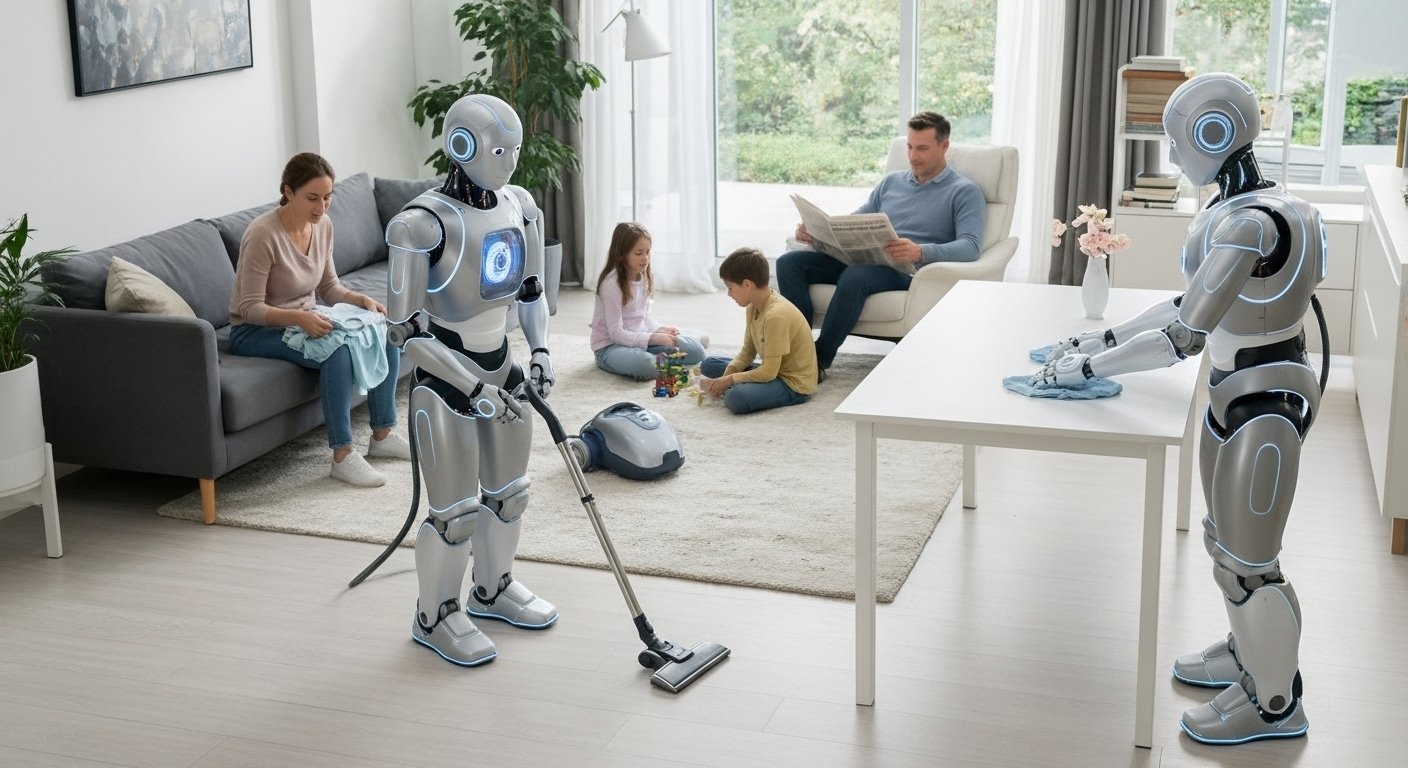
And right as the internet started buzzing, another name entered the conversation: Neo, a global humanoid model priced at $20,000, built not for labs, but for everyday homes.
Two robots. Two prices. One turning point.
The race to bring humanoids into real human lives has officially begun.
The Humanoid Revolution: Latest Video Demos
Bumi (The $1,370 Disruptor): ((https://www.youtube.com/watch?v=8QEXhcaDNkY))
- Official Dance Demo (Bumi Launch): (https://www.youtube.com/shorts/4xQp-rxshoU)
NEO (The $20,000 Home Helper):
- Official Product Introduction (TED Talk): ((https://www.youtube.com/watch?v=p3uBMqCPSDk))
- At-Home Training Update (AI Model/Chores): ((https://www.youtube.com/watch?v=M2O8GkBoQFU))
I. The Zero Hour: A Seismic Shift in Consumer Robotics
For generations, the concept of a humanoid robot assisting in daily life has been confined to the realm of science fiction and high-cost industrial research. These sophisticated machines, capable of bipedal locomotion and complex interaction, typically cost hundreds of thousands, if not millions, of dollars—accessible only to university labs or well-funded industrial giants. The idea of acquiring a general-purpose bipedal robot for personal use was a distant dream.
That landscape shifted dramatically with a market announcement from a relatively unknown Chinese startup, Noetix Robotics. The Beijing-based company unveiled a humanoid robot named Bumi, priced aggressively at approximately $1,370, or under ¥10,000. This price point is not merely competitive; it is utterly disruptive. For the cost of a premium smartphone or a high-end laptop, consumers could, for the first time, purchase a walking, dancing humanoid platform. Noetix Robotics boldly declared this launch a “milestone in bringing humanoid robots from labs to everyday life”.
This move instantly created a massive dichotomy in the emerging consumer robotics market. On one side stands Bumi, representing accessibility and democratization. On the other side is the established premium class, epitomized by the American-Norwegian firm 1X Technologies’ humanoid, NEO. NEO is marketed as the world’s first truly consumer-ready humanoid for home use, designed to automate complex chores. However, the access price for NEO is significantly higher, requiring an upfront purchase of $20,000 or a minimum $499 per month subscription.
The central conflict now facing the industry is clear: Does the future of robotics depend on achieving rapid, low-cost accessibility, fostering widespread development and experimentation—the Bumi approach? Or must the focus remain on high-performance utility, delivered at a luxury price point that necessitates constant human supervision and investment in complex infrastructure—the NEO model? This profound price differential is more than a simple comparison of components; it is the defining factor in determining how quickly consumer AI and physical automation will scale globally. The sub-$1,400 price tag reclassifies the humanoid robot from a specialized capital investment into a consumer electronic device, a crucial inflection point in market strategy.
II. Viral Intermission: Witnessing the New Generation of Low-Cost Physical AI
While the $1,370 price point of Bumi focuses heavily on affordability and scale, it is crucial to understand the high level of sophistication now achievable in low-cost bipedal locomotion, largely driven by advancements in reinforcement learning (RL) and imitation learning frameworks.
The technological foundations that enable a budget-friendly robot to walk and dance stably are rooted in AI-driven control systems that have been dramatically accelerated by intense competition, particularly within the Asian market. Viral demonstrations frequently showcase the rapid evolution of this control capability. For instance, footage of contemporary, affordable Chinese humanoid platforms, such as the Unitree G1, captures widespread attention by demonstrating impressive physical resilience and acrobatic skills. These robots, trained through advanced RL, display near ‘anti-gravity’ balance recovery, complex movements, and remarkable physical stability under external duress.
This visual context is essential for setting expectations. While Bumi, at 3.1 feet tall, is positioned primarily as an educational and entertainment platform, the underlying research in China emphasizes making robust bipedal control systems accessible. The successful deployment of RL frameworks allows developers to solve challenging, high-dimensional motion tasks—like maintaining upright posture or recovering from a dynamic push—by learning from optimized or “task-relevant” trajectories, reducing the need for painstaking manual programming. This focus on physical control (via imitation and reinforcement learning) is the precursor technology that will ultimately allow these low-cost frames to evolve into capable, manipulating systems.
III. The Bumi Bot: Architectural Constraints and the Democratization of Bipedalism
Noetix Robotics’ Bumi is an audacious technical statement demonstrating the power of mass production and strategic component selection. The robot stands 94 centimeters (about 3.1 feet) tall and weighs just 12 kilograms (approximately 26 pounds). This miniature size is instrumental in achieving the remarkably low price tag, as it significantly reduces material costs and complexity compared to a full-sized adult humanoid.
Cost Engineering and Strategic Compromises
The sub-$1,400 price is not an accident; it is the result of aggressive cost engineering and vertical integration. Noetix utilized lightweight composite materials for construction and developed its motion control system entirely in-house. Furthermore, the company relies extensively on locally sourced components, which insulates it from the high-cost, specialized supply chains that typically burden Western robotics startups. The ability to design, build, and source components domestically allows Noetix to plan for massive scale, with production targets aiming for 1,000 units per month by late 2025.
However, the affordability necessitates immediate trade-offs in functionality. The size and weight of Bumi impose limitations on its physical utility; its light frame and low payload capacity mean it cannot lift heavy objects or perform physically demanding household chores. Critically, Bumi reportedly lacks dexterous fingers, opting instead for simpler manipulation tools or grippers. While the robot includes necessary sensory equipment like RGB cameras, an Inertial Measurement Unit (IMU), force sensors, and ultrasonic sensors, the overall component quality and actuator lifespan remain unverified by independent performance benchmarks or teardowns.
Platform over Product: A Developer Ecosystem Strategy
The most crucial distinction for Bumi is its strategic focus. It is not designed to be a competing home housekeeper alongside models like NEO; it is designed to be an accessible platform for development and education.
By pricing Bumi similarly to a development kit, Noetix effectively lowers the barrier to entry for students, developers, and researchers. The robot features an open programming interface and integrates into broader ecosystems, such as JD.com’s Joy Inside 2.0. This deliberate open strategy positions Bumi to capture a massive market volume, confirmed by its initial success of selling 500 units within two days of launch.
This volume-driven approach has a deeper, long-term implication: Noetix is outsourcing crucial research and development to the global developer community. Every developer who purchases a Bumi and programs it is generating data, feedback, and novel algorithms for bipedal control and task feasibility. This method accelerates the collection of foundational reinforcement learning and imitation learning data points without requiring the hundreds of millions of dollars in internal R&D infrastructure required by premium competitors like 1X and Tesla. The ability to rapidly scale production and deployment using cost-effective materials creates a powerful positive feedback loop: volume drives down costs, and low costs accelerate the velocity of AI development, making the budget strategy a formidable long-term competitor in the quest for real-world autonomy.
IV. 1X NEO: The Luxury Class and the Quest for Supervised Autonomy
In stark contrast to Bumi’s strategy of mass accessibility, 1X Technologies positions its NEO robot in the premium market as a high-utility, dedicated home assistant. As an American-Norwegian company, 1X aims to move humanoids firmly out of the industrial prototype phase and into the high-end consumer space.
The Price of Performance and Safety
The pricing structure of NEO—a $20,000 outright purchase or a $499 monthly subscription—reflects the significant investment in advanced hardware necessary for safe and capable domestic operations. This cost places NEO substantially above most traditional home automation devices, targeting early adopters seeking comprehensive chore assistance.
NEO’s physical architecture is engineered for utility around humans. Weighing 30 kilograms (66 pounds), it is considerably larger and more capable than Bumi, designed to handle serious physical loads, boasting the ability to lift up to 68 kg (150 lbs) and carry 25 kg (55 lbs). For delicate domestic tasks, NEO is equipped with high-precision hardware, including 22-degree-of-freedom (DoF) hands, essential for complex manipulation like folding laundry, tidying spaces, and fetching items. The robot employs 1X’s patented Tendon Drive high torque-density actuator system, specifically chosen for gentle motion and quiet operation (22 dB), crucial factors for acceptance within the residential environment. Furthermore, NEO integrates a built-in Large Language Model (LLM) to enable sophisticated conversational interaction and personalized assistance, allowing it to recognize objects (like ingredients on a counter) and suggest actions.
The Human-in-the-Loop Problem: Teleoperation as the AI Training Wheels
Despite its impressive specifications and high price tag, NEO highlights the current technological limitations in achieving true, unsupervised autonomy in complex, unstructured environments like a home. The robot is capable of basic autonomous tasks upon delivery (fetching, opening doors, turning on lights), but for specific or complex tasks it has not yet encountered, 1X relies on a mechanism known as teleoperation.
1X CEO Bernt Børnich explained that the AI neural network driving NEO must learn from real-world experiences to improve its underlying models (such as the Redwood AI and 1X World Model). The company requires early adopters to agree that human teleoperators—referred to as “1X Experts”—will remotely control the robot and view the home environment through its camera to teach it new skills. This process is essential because, as Børnich admitted, “If we don’t have your data, we can’t make the product better”.
The necessity of relying on supervised human control for initial task learning confirms a critical point: the cost of bridging the “100,000-year data gap”—the massive quantity of real-world interaction data needed to gain general physical skills—is currently enormous. The $20,000 price tag effectively covers the high-precision hardware and the expensive human infrastructure (the teleoperation workforce and secure data collection pipeline) required to train the robot. This expenditure suggests that the first practical “jobs” created by advanced consumer robotics are not those performed by the robots themselves, but the highly specialized human roles dedicated to remotely teaching and guiding them.
Managing Privacy and Trust
The teleoperation model presents significant ethical and security challenges, forcing a confrontation with domestic privacy. 1X has implemented several controls to mitigate these risks: owners must approve when a teleoperator takes control, they can schedule specific windows for training, and they can designate “no-go zones” that operators cannot enter. Furthermore, the system includes the capability to blur people in the camera feed, preventing remote operators from seeing residents. While these measures aim to respect privacy, the inherent requirement for an external human presence to observe the domestic environment remains a major hurdle for widespread consumer adoption and trust.
V. Apples and Oranges: A Strategic Comparison of Two Futures
The comparison between Bumi and NEO is less a direct competition for the same customer, and more an exhibition of two divergent, yet equally necessary, paths for advancing the humanoid robotics ecosystem. The differences are quantified not just in size, but in strategic intent and technological compromise.
The table below highlights the fundamental schism defined by price and capability:
A Strategic Comparison of Consumer Humanoids
| Feature | Noetix Bumi ($1,370) | 1X NEO ($20,000) | Key Driver/Difference |
| Primary Price Model | Ultra-Low Cost Purchase | Premium Purchase or Subscription ($499/mo) | Economic Barrier to Entry |
| Target Market | Education, Developers, Entertainment | High-End Home Automation, Chore Assistance | Functionality/Expectation |
| Height/Weight | 3.1 ft (94 cm) / 12 kg | Approx. 5.2 ft / 30 kg (66 lbs) | Scale and Load Capacity |
| Manipulation/Hands | Limited, likely non-dexterous | Highly Dexterous (22-DoF Hands) | Utility for Complex Chores |
| Actuator System | Low-Cost, Composite Materials | Tendon Drive, High Torque-Density | Cost of Precision and Power |
| Autonomy Training | Open Interface, Developer-Driven RL | Human Teleoperation (1X Experts) & LLMs | Solution for the “Data Gap” |
The Cost Chasm Explained
The vast $18,630 price difference between these two machines can be largely attributed to the Actuator and End-Effector Gap. Full-scale humanoids like NEO must use industrial-grade, custom actuators (motors) to generate the necessary power for human-scale lifting (like carrying 25 kg of groceries) while maintaining the precision and compliance required for safety around people. These components are prohibitively expensive.
Bumi, conversely, achieves its low price by sacrificing payload and dexterity, utilizing cost-effective, high-volume production components and lightweight composite materials suitable for motion demonstration but insufficient for heavy domestic utility.
Volume vs. Utility: Competing Market Trajectories
These two strategies represent distinct approaches to commercializing robotics. Bumi’s low-cost, open platform strategy prioritizes Volume and Velocity. By flooding the market with accessible bipedal hardware, Noetix aims to quickly accelerate algorithm development (specifically reinforcement learning and imitation learning) for bipedal systems in a highly distributed manner. The rapid demand for this accessible platform suggests that this market strategy is successfully building the crucial developer foundation necessary for widespread technical breakthroughs.
NEO’s premium approach prioritizes Utility and Control. It aims to deliver a functional, albeit expensive, chore-performing product today. This approach requires 1X to maintain tight control over the training data and supervision, necessitating the expensive infrastructure of teleoperation to ensure the robot performs reliably enough to justify the $20,000 investment.
Ultimately, the Chinese strategy of prioritizing rapid volume, low-cost domestic component sourcing, and engaging a vast developer base is optimized for speed and market capture. The Western premium approach, focusing on specialized, expensive utility, risks placing a financial barrier on the very experimentation and training data collection necessary to achieve the ultimate goal of autonomous general-purpose robotics.
VI. The Bigger Picture: Social, Ethical, and Economic Ripple Effects
The simultaneous emergence of ultra-low-cost and high-end consumer humanoids brings complex socio-economic and ethical challenges that extend far beyond hardware specification sheets.
The Challenge of Real-World Autonomy
The struggle faced by the most sophisticated robotics companies validates the warnings issued by leading academic roboticists. Researchers, such as those at UC Berkeley, cite the “100,000-year data gap”—the immense difference between training language models (LLMs) on existing text data and training physical robots on real-world, high-dimensional interaction data. Every physical task a robot attempts—from standing upright without falling to opening an air fryer—exists within an extremely narrow feasible region in a complex space.
The fact that NEO, a premium, $20,000 machine, requires human teleoperation (supervision by 1X Experts) to learn tasks underscores this reality. It is definitive proof that current AI ‘world models’ and generalized reinforcement learning frameworks still struggle acutely with novelty and require constant human correction to bridge the gap between simulation and the unpredictable real world. While the concept of a fully autonomous robot is appealing, the current stage of development is defined by supervised learning and human integration.
Economic Restructuring and the Acceleration of Displacement
The sudden accessibility of bipedal robotics, exemplified by the $1,370 price point of Bumi, carries profound implications for labor markets. Historically, the introduction of industrial robots has correlated with significant job displacement and depressed wages, particularly impacting workers engaged in routine, repetitive tasks. Studies found that for every robot added per 1,000 workers in the US, wages declined by 0.42 percent, and employment-to-population ratios dropped by 0.2 percentage points.
The development acceleration enabled by Bumi’s low cost intensifies this risk. If its open-source developer base rapidly finds efficient, basic control methods for bipedal locomotion, the technical blueprint for displacing low-skill manual labor—such as basic logistics or shelving tasks—could be widely distributed and implemented faster than anticipated. When the marginal cost of a capable bipedal frame approaches the cost of raw materials (as suggested by the $1,370 price), the economic imperative for automating routine jobs increases exponentially, threatening rapid economic restructuring, especially for those without advanced training.
Ethical Governance and the Crisis of Trust
The deployment of humanoids in domestic and sensitive settings raises novel ethical dilemmas related to autonomy, responsibility, privacy, and emotional attachment.
NEO’s reliance on human teleoperators introduces an explicit privacy challenge: users must consent to human experts seeing inside their homes via the robot’s cameras for training purposes. While 1X provides controls like scheduling and designated ‘no-go zones’ to mitigate this, the required sacrifice of domestic privacy remains a major hurdle for widespread consumer adoption and trust.
For low-cost, mass-produced robots like Bumi, the concern shifts to accessibility for misuse. A $1,370 price point lowers the barrier for deploying these machines in high-volume, potentially sensitive roles in education or elder care, leading to questions about emotional attachment and the development of social biases toward machines. Furthermore, the lack of independent performance standards and component verification for low-cost systems like Bumi, whose component quality is noted as “murky,” introduces risks regarding safety, malfunction, and long-term maintenance costs that could offset the initial cheap purchase price. The overall narrative reveals a key tension between different regulatory and market approaches: the Western market (NEO) demands transparency about its lack of autonomy and the necessary supervision, while the Eastern market (Bumi) prioritizes rapid market penetration and volume over explicit long-term component transparency.
VII. Robotics IQ Test: Quiz & Answers
Test your understanding of the two defining humanoid robotic platforms and the strategic challenges facing the industry.
Robotics IQ Test: Quiz
- What is the name of the $1,370 humanoid robot introduced by the Chinese startup Noetix Robotics?
- What is the primary technical method 1X Technologies relies on to teach the NEO robot complex, new household chores in the short term?
- What is the approximate height of the budget-friendly Bumi robot?
- Besides an outright purchase, what is the monthly subscription price offered for the 1X NEO humanoid robot?
- Robotics experts often cite this challenge as the primary barrier preventing general-purpose robots from quickly gaining real-world skills, distinguishing robotics from language models.
Robotics IQ Test: Answers
- Bumi
- Human teleoperation (or human-in-the-loop training/1X Experts)
- 3.1 feet (or 94 centimeters)
- $499 per month
- The “100,000-year data gap”