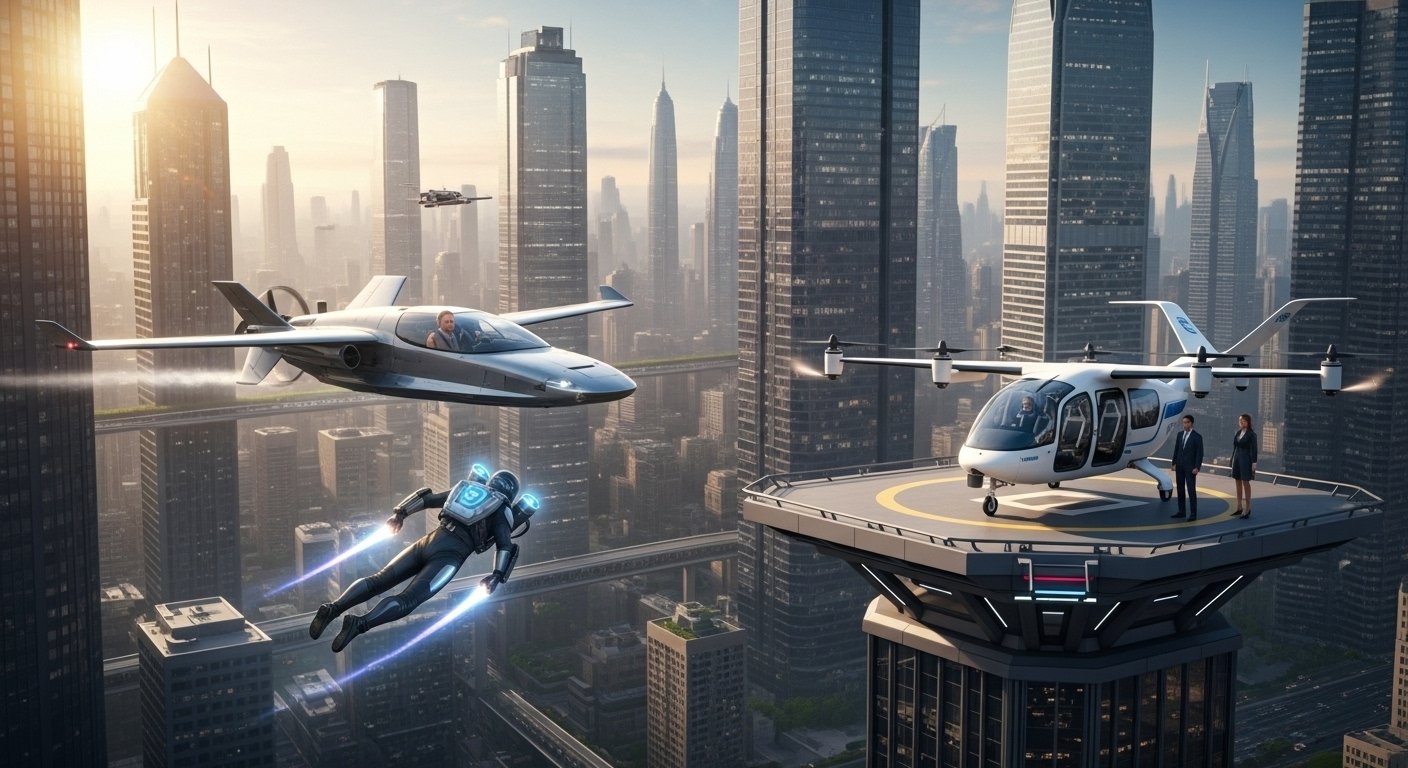
How Close Are We to Sky Commuting? The Real Jetpacks and Flying Cars & eVTOL
✨ In The Nutshell
Picture this: it’s 7:45 a.m., and the sun has just broken through the skyline. Instead of sitting in bumper-to-bumper traffic, you step into a suit of humming turbines or swing your leg over a sleek flying bike. A soft whine builds into a roar, your driveway blurs beneath you — and then, for the first time today, you’re above it all.
This is not a scene from a sci-fi blockbuster or a tech billionaire’s fantasy. It’s the reality unfolding right now in hangars and workshops across the globe. Engineers, dreamers, and daredevils are turning decades of fantasy into functioning prototypes — and in some cases, actual products with price tags and “Preorder Now” buttons.
For over a century, humans have chased the same dream: to fly freely. From Da Vinci’s sketches to the Wright brothers’ wings, from the Jetsons’ skyways to Tony Stark’s jet suit — we’ve always been looking up. But 2025 marks a turning point. The machines are real, the technology works, and the question is no longer if we’ll commute in the sky, but how soon.
Welcome to the dawn of personal aviation — where jetpacks, hover bikes, and flying cars are no longer “coming soon.” They’re here.
🌤️ The Dream That Refused to Die
Every generation has its skyward dreamers. The 1960s promised rocket belts and bubble cars; the 2000s teased us with drone taxis. But something was always missing — the power-to-weight ratio, the safety systems, or simply the laws to let them fly.
Fast-forward to today: miniaturized jet turbines, lightweight carbon composites, and high-efficiency batteries have rewritten the rules. Startups have replaced sketches with flight-ready prototypes, and test pilots have swapped movie scripts for flight logs.
Let’s meet the machines leading this airborne revolution.
The Skies Are Opening Up: Recent Buzz and Breakthroughs
The idea of personal flight has been buzzing more than ever, with incredible advancements and viral moments making headlines. The true story of 2025, however, is the pivot from engineering marvels to grueling regulatory and financial reality.
Viral News: The Market Turbulence
In November 2025, the reality of the regulatory runway hit the eVTOL market hard. News circulated that Joby Aviation’s highly anticipated certification process in the United Arab Emirates (UAE) was delayed until Q3 2026, pushing back planned passenger services. This immediately spooked investors, causing shares of both Joby and rival Archer Aviation to fall sharply. This was a viral lesson: the biggest hurdle to sky commuting isn’t technology, but the strict, painstaking process of proving absolute safety to global regulators. Separately, Eve Air Mobility, Embraer’s air taxi spin-off, continues to make strides in global expansion, recently finalizing agreements to broaden its presence in the Middle East.
- Link to a recent news article: https://eplaneai.com/news/jobys-uae-certification-delay-raises-concerns-over-air-taxi-timeline-weighs-on-evtol-stocks
YouTube Sensation: Dissecting the Designs
Videos circulating widely online have moved beyond simple promotional clips to detailed breakdowns of real performance metrics. Enthusiasts are now comparing the quiet tiltrotor design of Joby to the smart split-lift designs of Archer Midnight, acknowledging the practical engineering trade-offs each firm has made for certification and urban integration. Beyond the big air taxis, real-life “Iron Man” Richard Browning of Gravity Industries continues to captivate millions, showcasing his turbine-powered Jet Suit in spectacular flight demonstrations, proving that true personal vertical flight is a reality, albeit one with a very short flight time.
- Link to a popular YouTube video:(https://www.youtube.com/watch?v=nR7XOfQtPcA)
Meet the Sky Commuters of Tomorrow (and Today!)
From purpose-built air taxis designed to replace regional airlines to ultralight personal fliers you can buy right now, these are the categories leading the charge to the sky.
1. eVTOLs (Electric Vertical Take-Off and Landing) – The Air Taxis of the Future
These electric aircraft are designed to take off and land vertically, like helicopters, but with multiple propellers and quieter electric propulsion. They are poised to revolutionize urban mobility, acting as air taxis or personal commuting vehicles for licensed operators.
| Model | Description & Key Specs | Website/Preorder Status |
| Joby Aviation S4 | The Market Leader: Known for its quiet tiltrotor design, allowing it to transition between vertical lift and winged flight. Joby is currently valued at $13.1 billion and is furthest along in the FAA Type Certification process, recently beginning power-on testing of its first conforming aircraft. Services are projected to launch between 2027–2028. | Website: https://www.jobyaviation.com/ |
| Archer Aviation Midnight | The Airline Partner: This split-lift aircraft is designed for rapid, back-to-back urban flights, focusing on short hops (e.g., airport transfers). Archer is partnered with United Airlines to launch commercial service in major cities. | Website: https://www.archer.com/ |
| Eve Air Mobility eVTOL | The Global Player: A spin-off of Brazilian aerospace giant Embraer, Eve is making significant global inroads, focusing on international expansion and fleet sales. | Website: https://eveairmobility.com/ |
2. Flying Cars – The Road-Air Hybrids
The ultimate dream: a vehicle that drives on the road and flies in the sky. These machines are legally complex, having to satisfy both airworthiness and automotive safety standards, making them high-end, niche vehicles.
| Model | Description & Key Specs | Website/Preorder Status |
| Klein Vision AirCar | The Transformer: A refined fixed-wing aircraft that converts into a road-legal car in under two minutes by retracting and folding its wings. It has completed over 170 flight hours and can fly up to 155 mph with a range of around 620 miles. Price Range: $800,000 to $1 Million, with a target shipment date as early as 2026. | Website: https://www.kleinvision.com/ |
| Alef Model A | The Futurists’ Car: Marketed as a clean energy roadable eVTOL, this vehicle features a unique design that allows for vertical takeoff and landing while keeping a car-like silhouette. Expected Price: $299,999. | Website/Preorder: https://alef.aero/preorder.html – Preorder available for a place in the queue. |
| Samson Switchblade | The DIY Sports Car: This roadable aircraft operates as a high-performance three-wheeled sports car on the ground, converting to a fixed-wing aircraft capable of 200 mph in the air. Estimated Price: From $200,000 to $330,000 (Special Edition). Note: Requires a private pilot license and builder assistance for completion. | Website: https://www.samsonsky.com/models/ – Reservations available. |
3. Personal Ultralights and Jetpacks – The Ultimate Personal Flight
For thrill-seekers and specialized missions, these devices are the closest to the consumer market now. Their primary limitation is flight endurance, typically restricted to under 20 minutes due to battery/fuel constraints and strict ultralight vehicle regulations.
| Model | Description & Key Specs | Website/Preorder Status |
| Jetson One | The Flying Speeder: A single-seat, electric eVTOL that is intentionally designed to fit under the FAA’s Part 103 Ultralight Vehicle rules, meaning no pilot’s license is required to fly. It weighs only 235 pounds and offers an average flight time of about 20 minutes. Current Price: $128,000. | Website: https://jetson.com/preorder/payment?method=card – Preorder available. Initial shipments planned for 2028. |
| Pivotal Helix | The Ultralight Companion: Another consumer-focused ultralight eVTOL weighing 348 pounds. It is designed for simple operation with built-in flight controls and software, allowing non-pilots to fly for recreation. | Website: https://pivotal.aero/ |
| Gravity Industries Jet Suit | The Real Iron Man: This system uses multiple turbojet engines worn on the back and arms, allowing for speeds over 120 mph. It is the pinnacle of personal flight but has an extremely limited endurance of about 8 minutes. Estimated Price: $440,000 to $490,000. | Website: https://gravity.co/ – Inquire for purchase. Primarily sold to private clients and government/military groups. |
🚧 The Final Miles: Challenges to the Sky Commute
While the hardware is spectacular, the widespread reality of sky commuting hinges on solving three major issues:
- Regulation and Air Traffic Management (ATM): The FAA and EASA are still finalizing the rules for integrating thousands of quiet, low-altitude aircraft into the national airspace without creating chaos. This involves creating a new, automated ATM system.
- Infrastructure (Vertiports): eVTOLs need specialized landing and charging hubs—vertiports—in cities, near airports, and in suburbs. Building this network, especially on top of existing buildings, is a massive logistical and financial undertaking.
- Cost and Accessibility: Initial air taxi rides and personal aircraft purchases will be premium-priced, likely appealing only to high-end users. The “Uber in the sky” dream won’t be fully realized until battery technology and mass production drive costs down to be competitive with ground transport.
Conclusion: The Sky’s No Longer the Limit
We are witnessing the birth of a new industry. While you won’t be jetting to work tomorrow morning, the underlying technology is solid, the early products are flying, and the world’s most innovative companies are placing massive bets on this future. The age of flying cars is no longer a future to anticipate—it’s a revolution that’s already taking off.
Test Your Knowledge: The Sky Commuter Quiz
- What is the main regulatory framework that allows ultralight vehicles like the Jetson One to be operated without requiring the pilot to hold a full license?
- Which major eVTOL company began power-on testing of its first FAA-conforming aircraft in November 2025, marking a critical step toward commercial certification?
- The most advanced flying car, the Klein Vision AirCar, has an estimated price range between what two figures?
- What is the primary physical constraint that limits personal aerial vehicles (jetpacks and ultralights) from being practical daily commuting tools?
- Which international market’s certification delay caused a sharp drop in the stock prices of both Joby Aviation and Archer Aviation in late 2025?
Quiz Answer Key
- FAA Part 103 Ultralight Vehicle rules.
- Joby Aviation.
- Between $800,000 and $1 Million.
- Extremely limited flight endurance (typically 8 to 20 minutes).
- The United Arab Emirates (UAE).