The Quantum Tightrope: How Entanglement Could Turn Clumsy Robots Into SuperHumans
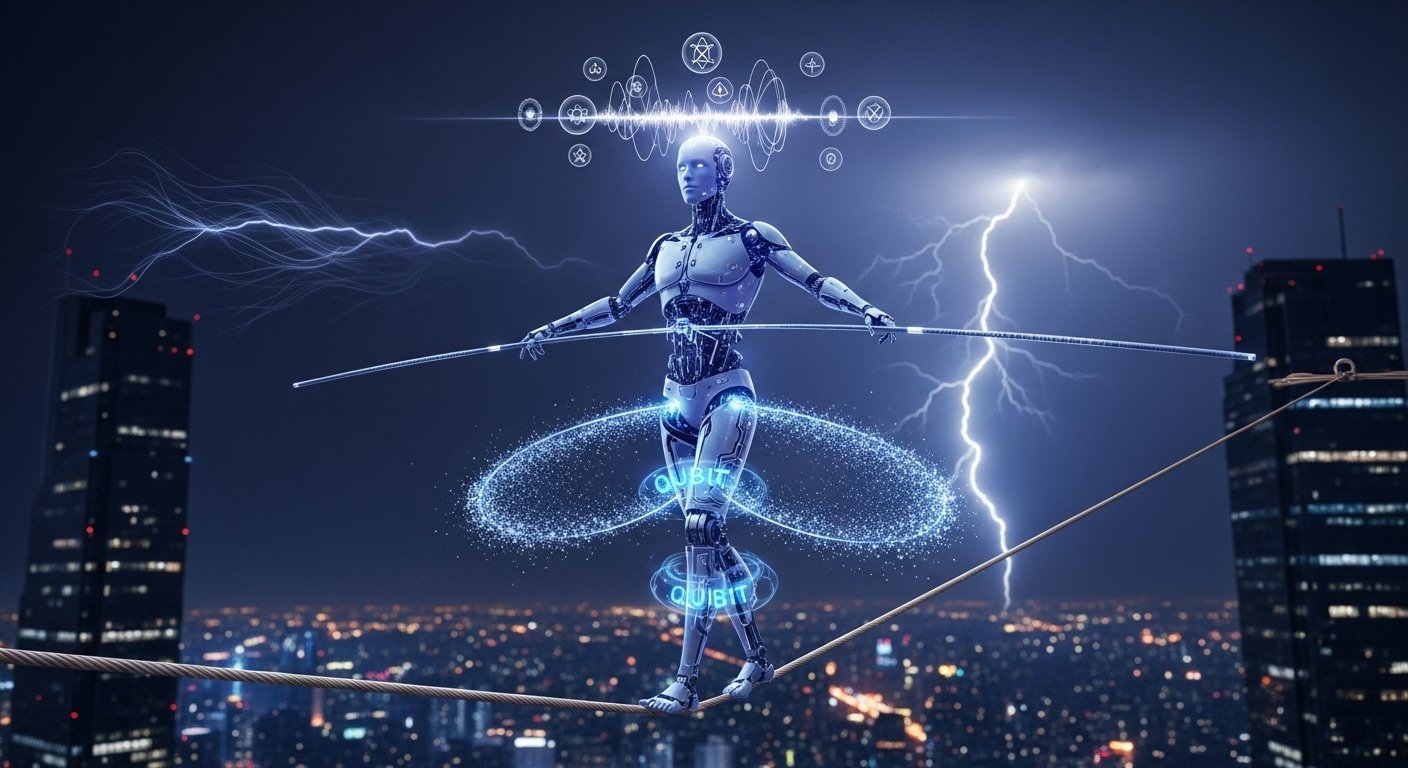
Imagine a silent figure poised atop a taut cable stretched between two skyscrapers. City lights blur below, the wind howls—and yet this isn’t a human acrobat but a gleaming humanoid robot. Instead of wobbling, it holds itself in perfect stillness, dancing almost with gravity. In our era of viral videos of robots stumbling on flat ground, such composure would be nothing short of miraculous. But a new wave of research suggests this quantum tightrope walker could soon be reality: by weaving quantum physics into robot control, clumsy machines might attain superhuman balance.
In the Nutshell
Classical robots are unstable. Today’s humanoids solve balance through step-by-step, classical computations on each joint. They use gyros and accelerometers to detect tilt, then a CPU crunches millions of equations to adjust angles. That slight processing delay means real-time disturbances (a gust of wind, a shifting load) make them topple. Quantum posture control. Researchers now encode each joint’s pose into qubits and entangle them so the robot’s whole body becomes one quantum system. In effect, when one “parent” joint moves, its “child” joints automatically update their states via entanglement.1 This lets the robot “know” its optimal posture instantaneously, cutting calculation overhead. In trials on a quantum simulator, this approach halved posture error – a 43% error reduction with far fewer iterations compared to classical methods. Atomic precision sensing. Future robots will carry quantum sensors instead of just silicon gyroscopes. Cold-atom interferometers and related devices measure acceleration and rotation by exploiting atomic “wave” patterns with extreme sensitivity. Industry analysts predict miniaturized quantum accelerometers and gyros (once bulky lab gear) will appear in devices within a few years. Quantum AI & networks. Quantum computing also turbocharges the robot’s “brain.” Quantum algorithms can optimize walking and decision-making far faster than classical code. And entangled quantum links could tie multiple robots together: if one shifts weight, its partner could react instantaneously via a quantum channel. Experts see quantum computers, sensors, and controls as the fulcrum of next-gen robotics. Together, these advances promise a revolution: clumsy toddlers become elegant acrobats, with robots that adjust their balance faster than any human reflex.
Watch the Action
- YouTube Livestream: A Quantum Entanglement: Spooky Action At a distance
- YouTube LIvestream: Quantum Computing Revolutionizes Robot Controls
- News Coverage: The breakthroughs will be featured on news outlets
Introduction: The Ascent of Machines
The modern era of robotics has produced mechanical marvels of staggering complexity and capability. Humanoid and multi-joint robots from leading innovators such as Agility Robotics and Boston Dynamics are now commercially deployed, performing complex logistics tasks in manufacturing and warehouses. Yet, despite these remarkable strides, a fundamental “clumsiness” persists. It is a clumsiness not of mechanical design, but of computation.
At the heart of this challenge lies a critical bottleneck in the information processing that governs a robot’s every move. Classical control algorithms, including adaptive, robust, and artificial intelligence-based schemes, must operate at extremely high frequencies—often between 100 Hz and 1,000 Hz—to ensure a robot’s stability and safe interaction with its environment. However, these systems are constrained by latency, the unavoidable time delay between a command being issued and its physical execution. For a fast-moving robot, this delay can be significant, leading to positional errors of up to 20 centimeters, which are unacceptable in delicate or high-stakes applications. While advanced hardware like the NVIDIA Jetson Thor provides immense on-device processing power to accelerate AI workloads, the algorithms themselves still struggle to overcome the fundamental limitations of sequential, classical computation.
This predicament presents a critical juncture, a “tightrope” between what is physically possible and what is computationally achievable. The answer may lie not in a faster classical processor, but in a paradigm shift: the convergence of robotics with quantum mechanics. This nascent field, known as quantum robotics, proposes that by harnessing quantum phenomena such as superposition, interference, and, most critically, entanglement, we can unlock a new class of robotic capabilities. This integration promises to address the very issues that render even the most sophisticated robots imperfect, paving the way for a generation of machines with truly “superhuman” abilities.
The Computational Tightrope: Why Robots Are Clumsy
To understand the core computational problem, one must first grasp the concept of inverse kinematics (IK). Kinematics is the study of motion without regard to the forces causing it. In a robot, forward kinematics is the relatively straightforward process of calculating the position of a robot’s end-effector (e.g., a hand or foot) given the angles of its joints. Inverse kinematics, however, is the opposite and far more complex problem: given a desired end-effector position, what are the precise joint angles required to achieve it?. This is the foundational challenge for any robot performing a task that requires precise, targeted motion, such as picking up an object or placing a foot.
For a robot with a small number of joints, such as a simple industrial arm, a direct analytical solution can sometimes be found.9 However, for multi-joint, redundant robots like humanoids, which may have 17 or more joints to model a full-body system, the number of possible joint angle combinations is astronomically large. A direct, closed-form analytical solution is often impossible, forcing developers to rely on complex numerical methods. These methods, such as Newton’s method or heuristic algorithms like cyclic coordinate descent (CCD), are iterative. They guess at a solution, calculate the error, and then slowly adjust the angles to minimize the discrepancy.10 This process is computationally intensive and slow, and it often results in motion that is jerky, unstable, or not energy-efficient. Even with cutting-edge processors, a robot’s decision-making loop is constrained by the time it takes to solve these complex, non-linear equations, a fundamental limitation of sequential computation. This is the root cause of robotic clumsiness: the robot’s hardware may be lightning-fast, but its decision-making is hobbled by the inherent difficulty of its own mathematical problem set.
The Superhuman Leap: Entanglement as a Digital Skeleton
A groundbreaking development from a collaboration between Fujitsu, Waseda University, and Shibaura Institute of Technology offers a powerful new approach to this challenge.3 Their research demonstrates an innovative hybrid quantum-classical method designed to solve the inverse kinematics problem more efficiently and accurately than classical methods alone. The core of their approach is a complete re-conceptualization of the robot’s structure, replacing the traditional geometric model with a quantum one.
The Mechanism of “Quantum Kinematics”
The method is centered on two key principles. First, the orientation and position of each robot part or “link” are represented by a single qubit. The state of this qubit can be visualized as a point on a Bloch sphere, a geometric representation of a single qubit’s state in three-dimensional space. The joint movements, such as rotations, are simulated by applying corresponding quantum gates—the quantum equivalent of classical logic operations—to these qubits.
The second and most profound aspect of the research is the use of quantum entanglement.Entanglement is not being used here for “spooky action at a distance,” but rather as a computational resource to model physical relationships. The researchers used two-qubit entangling gates, such as
, , and , to reproduce the structural influence of a parent joint on its child joint.1 This is a direct parallel to how a human body is structured: the movement of your upper arm (a parent link) directly influences the position of your forearm (a child link) in a way that is non-sequential. In a classical model, this relationship requires a chain of calculations. The quantum-entangled model, by its very nature, captures this relationship instantaneously and holistically. The state of a child link’s qubit is fundamentally “linked” to its parent’s qubit, allowing the system to model the entire arm’s configuration as an inseparable whole, similar to a physical body.
This is a crucial conceptual shift. Instead of performing a sequential, step-by-step calculation from the base of the robot to its end-effector, the quantum model encodes the geometric and physical relationships directly.3 This allows a classical optimizer, such as the COBYLA algorithm, to work in tandem with the quantum circuit, adjusting the joint angles in an iterative loop that converges to the optimal solution much more quickly.
Tangible Results and Implications
The results from this hybrid approach are compelling. When tested on a simulated two-link robot arm, the entangled quantum circuit converged to an accurate solution in just eight iterations, whereas the non-entangled version still had a significant error after 30 iterations.3 In a trial calculation on a full-body model with 17 joints, the method executed motion calculations in approximately 30 minutes, a task that is computationally prohibitive for conventional direct methods.1
Furthermore, verification on a real 64-qubit quantum computer demonstrated its viability on current “Noisy Intermediate-Scale Quantum” (NISQ) devices.3 Despite the inherent noise of the hardware, the entangled circuit still reduced the total positional error by 43% compared to the non-entangled version, proving the method’s effectiveness beyond simulation.3 This indicates that the method provides a conceptual and computational “shortcut” to finding optimal configurations, transforming a slow, cumbersome problem into one that is more rapid and accurate.
| Classical Numerical IK | Hybrid Quantum-Classical IK | |
| Core Principle | Iterative approximation based on gradients or heuristics. | Entanglement-assisted modeling of physical relationships. |
| Computational Load | High, scales exponentially with joints; often requires large computational resources. | Significantly reduced due to holistic modeling; fewer iterations needed. |
| Suitability | Best for simple problems or low-DoF robots. | Superior for high-DoF, multi-joint robots like humanoids. |
| Accuracy | Can be imprecise; susceptible to local minima and non-smooth motion. | Demonstrated error reduction of up to 43% and faster convergence. |
The New Superpowers: Perception and Coordination
The convergence of quantum mechanics and robotics extends far beyond computational control. It promises to grant robots new “superpowers” in perception and coordination, addressing the other major sources of their inherent clumsiness.
Navigation Beyond GPS: The Power of Quantum Sensors
A robot’s ability to navigate and interact with its environment is only as good as its sensors. Today, most autonomous systems rely on GPS and classical inertial measurement units (IMUs) to determine their position and orientation.4 However, these systems have critical vulnerabilities. GPS signals can be lost in urban canyons or tunnels, and are susceptible to jamming or spoofing.4 Classical IMUs, which use microelectromechanical systems (MEMS) accelerometers and gyroscopes, are prone to “drift,” where tiny errors accumulate over time, leading to significant positional inaccuracies.
Quantum sensors offer a powerful solution to these problems. Atom interferometers, for example, use the wave-like nature of atoms to produce interference patterns that can measure minute changes in gravity, linear acceleration, and rotation with unprecedented precision.14 Unlike classical sensors, they are not susceptible to the same kind of cumulative drift or external signal jamming. For a robot, this provides a new level of environmental awareness: a quantum gravimeter or magnetometer on a robot can effectively turn the Earth itself into a map, reading gravity or magnetic variations as natural, unjammable signposts for localization.
While this technology is still maturing, companies like AOSense and Safran Sensing Technologies are actively working to commercialize and miniaturize these devices for practical use. Emerging platforms, such as artificial diamonds with nitrogen-vacancy (NV) defects, are particularly promising because they are compact, robust, and can operate at room temperature.
| GPS | Classical MEMS IMU | Quantum Sensor (Atom Interferometer) | |
| Core Principle | Satellite signal trilateration. | Classical inertia (bulk silicon elements). | Atom-wave interference using cold atoms. |
| Strengths | Ubiquitous, high-level positioning. | Compact, affordable, readily available. | Extremely high precision and stability, immune to jamming. |
| Weaknesses | Susceptible to jamming, spoofing, and signal loss in obstructed environments. | Prone to cumulative positional drift and noise. | Currently large and expensive; requires precise environmental control. |
| Suitability | General-purpose navigation. | Industrial and consumer applications with limited precision needs. | GPS-denied environments, critical applications (e.g., surgical, defense). |
The Invisible Thread: Entanglement for Swarm Coordination
For a fleet of autonomous vehicles or a swarm of delivery drones to operate cohesively, they must be able to communicate and coordinate in real time. Classical communication systems, however, are inherently prone to latency, especially in multi-access scenarios where multiple robots are vying for network bandwidth. A hacked or spoofed message could be catastrophic, leading to accidents or gridlock.
Quantum networks offer a path to a more secure and efficient form of coordination. By using entanglement-assisted communication, multi-robot systems can share sensor data and coordinate their actions with minimal latency.4 This approach provides a level of security guaranteed by the laws of physics: any attempt at eavesdropping on the quantum channel is immediately detectable.Beyond security, quantum networks enable a new mode of coordination, where a fleet of drones, for example, could be linked via entanglement-assisted channels, sharing sensor data with a level of synchronicity and speed not possible with classical methods. The culmination of this would be a fleet of platforms acting as a single, giant sensor, a concept known as distributed quantum sensing. The development of free-space quantum communication between mobile platforms, demonstrated with drones and vehicles, is laying the groundwork for this paradigm-shifting capability.
Crossing the Tightrope: Challenges and the Road Ahead
While the scientific breakthroughs are undeniable, the journey to a future of “superhuman” robots remains a formidable one. The most significant hurdle is the immaturity and physical constraints of quantum hardware.
Quantum states are exquisitely sensitive to environmental disturbances like noise and electromagnetic interference, creating immense difficulty in maintaining operational stability in the chaotic, dynamic environments where robots must function. Furthermore, the physical requirements for most quantum processors, such as extreme cryogenic cooling, make direct, on-board integration with a mobile robot an impossibility for the foreseeable future. The “tightrope” is the fundamental engineering challenge of bridging the gap between the pristine laboratory environment required for quantum hardware and the messy, real-world conditions where robots must operate.
The pragmatic, near-term path is a hybrid one. As demonstrated by the Fujitsu research, the quantum processor acts as a co-processor in the cloud or a nearby server, with the classical robot offloading its most computationally demanding tasks to it. This “computational offloading” will be the norm for some time, as it allows robots to leverage quantum speed without having to carry the bulky, fragile hardware with them.
The commercialization timelines for both quantum computing and advanced robotics align in a way that suggests a powerful synergy in the coming decade. Quantum computing roadmaps from companies like IQM and Alice & Bob project a timeline from the current NISQ era (2025-2026) to the development of fault-tolerant systems in the years leading up to and after 2030. In parallel, Morgan Stanley predicts that the cost of humanoid robots will fall significantly, and mass production will ramp up, with widespread adoption in industrial and commercial sectors by the mid-2030s. This indicates that the technologies are maturing at a similar pace, setting the stage for their eventual, and inevitable, fusion.
Conclusion: The Future is a Hybrid
The “clumsiness” of today’s robots is not a fatal flaw but a symptom of their fundamental computational and sensory limitations. By addressing these bottlenecks with quantum technologies, we are not simply making robots a little bit better; we are fundamentally redefining what is possible. From a digital skeleton modeled with entanglement that enables fluid motion, to a new class of resilient quantum sensors that provide infallible navigation, to entanglement-assisted networks that enable seamless swarm coordination, the future of robotics is one of powerful synthesis.
The journey from a clumsy automaton to a superhuman companion is a tightrope walk—a careful balancing act of groundbreaking science and practical engineering. The first steps have been taken, and the path forward is a hybrid one, promising a future where our mechanical companions are not just tools, but genuinely intelligent and capable partners, seamlessly integrated into our world.
Quiz: Test Your Quantum Robotics Knowledge
- What is the primary computational bottleneck that makes modern multi-joint robots “clumsy”?a) High-frequency motor vibrations
b) Latency in wireless communication
c) Solving complex inverse kinematics problems
d) Lack of sufficient on-board memory
- In the Fujitsu/Waseda/Shibaura research, how was quantum entanglement used to model a robot’s structure?a) To teleport commands from the classical computer
b) To replicate the influence of a parent joint on a child joint
c) To secure communication between the robot and the quantum computer
d) To perform a quantum search for the optimal path
- The Fujitsu-led research on inverse kinematics used a hybrid approach. What does this mean?a) It used both electric and hydraulic motors in the robot’s joints.
b) It combined a classical numerical method with an AI learning algorithm.
c) It offloaded some calculations to a remote quantum computer while the robot used a classical processor.
d) It utilized both analytical and numerical solutions simultaneously.
- According to the report, what is a key advantage of using a quantum gravimeter for robot navigation?a) It allows the robot to levitate over uneven terrain.
b) It provides an unjammable, natural map based on the Earth’s gravity field.
c) It can measure distances with millimeter-level precision.
d) It enables faster motor control by reducing computational load.
- What is a significant challenge to the near-term, on-board integration of quantum processors into mobile robots?a) The need for large amounts of electricity
b) The inability to write algorithms for quantum processors
c) Their extreme sensitivity to noise and their need for cryogenic cooling
d) The high cost of producing quantum chips in bulk
- The use of a quantum network for a fleet of robots could enable which of the following?a) Faster battery charging times
b) A new mode of distributed sensing
c) The ability to ignore all classical communication signals
d) A faster and more secure internet connection for the robots
Quiz Answers
- c) Solving complex inverse kinematics problems
- b) To replicate the influence of a parent joint on a child joint
- c) It offloaded some calculations to a remote quantum computer while the robot used a classical processor.
- b) It provides an unjammable, natural map based on the Earth’s gravity field.
- c) Their extreme sensitivity to noise and their need for cryogenic cooling
- b) A new mode of distributed sensing