Content List
- In a Nutshell: An Overview of the Robot Revolution
- In the News & On YouTube: Robot Dogs in Action
- Part I: The Quadrupedal Companion vs. The Bipedal Threat
- Part II: The Geopolitical Divide: Two Paths to Automation
- Part III: The Future of Work: A Look at 2030
- Part IV: A Forecast in Flux: The Numbers and the Narrative
- Quiz
- Quiz Answers
Inside the Factory of the Future: Robot Dogs, Human Technicians, and Real-Time AI by 2030
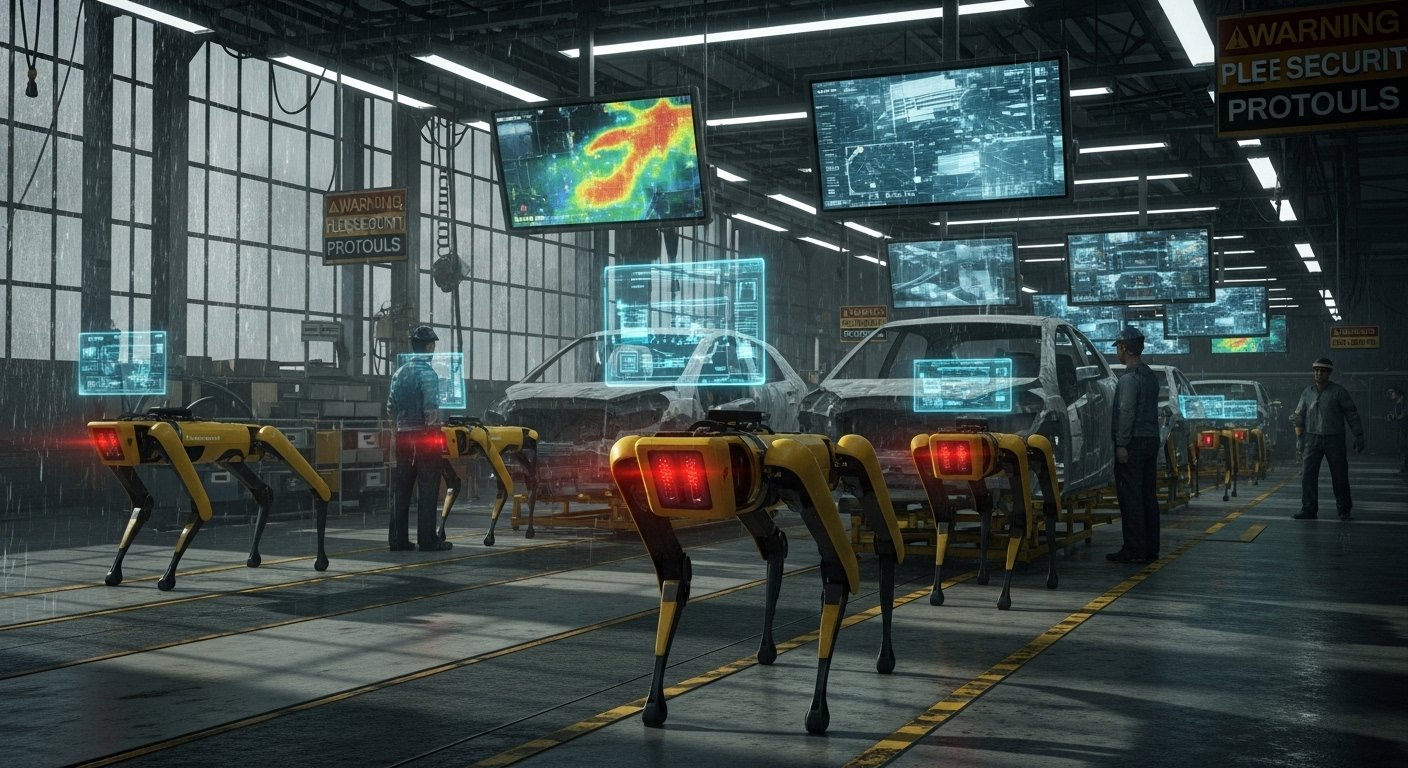
In the hushed, cavernous spaces of a modern automotive factory, the air is thick with the scent of metal and machinery. For decades, the landscape has been dominated by the rhythmic choreography of industrial robots, fixed in their stations, welding and assembling with a balletic precision. But recently, a new figure has appeared, not on a gantry or within a cage, but walking the floor on its own four legs: the robot dog. It is a silent sentinel, a tool-in-motion. Its presence is met with a quiet curiosity, an acknowledgment of its utility as a high-tech assistant.
Yet, a different kind of robot looms on the horizon—the humanoid. Clunky, slow, and still a laboratory curiosity for the most part, its presence, even in prototype form, evokes a starkly different reaction. Its shape, so jarringly familiar, carries with it an existential weight, sparking debates about the future of work and the very nature of human labor. This is the story of two distinct robotic forms and the two profoundly different futures they represent on the factory floor.
In a Nutshell: An Overview of the Robot Revolution
The integration of advanced robotics into the global manufacturing sector is a tale of two trajectories: the collaborative and the disruptive. In Western automotive plants, four-legged robots, or “robot dogs,” are being adopted as specialized tools for non-confrontational tasks such as maintenance patrols, equipment inspection, and data collection. Their non-humanoid form factor and specific, non-competitive roles have fostered a narrative of augmentation and human-robot collaboration.
In contrast, the arrival of humanoid robots like Tesla Optimus and Figure 01 brings a more complex set of questions. Reactions from workers and the public are a spectrum of cautious curiosity, excitement, and deep-seated fear of job displacement. This sentiment is particularly pronounced in regions with strong labor unions, where the technology is viewed not just as a tool but as an economic instrument that could erode labor power and wages.
Meanwhile, a profound geopolitical divergence is shaping the landscape. China’s robotics strategy, driven by a national mandate and a climate of limited labor protections, is more aggressive. Companies like BYD, GAC, and Nio are moving rapidly from prototypes to factory deployment, often with less public scrutiny. The West, by contrast, is proceeding with more caution, emphasizing human-centric design, regulatory “guardrails,” and union considerations.
By 2030, a clear division of labor is anticipated. Humanoid robots are poised to handle repetitive, physically hazardous, and ergonomically challenging tasks. However, jobs requiring human judgment, creativity, and complex, multi-factor problem-solving will remain resistant to automation. The market for humanoid robots is predicted to grow significantly, but market forecasts vary wildly, from a conservative USD 4.04 billion to an optimistic USD 49.23 billion, reflecting different assumptions about the speed of technological maturity and the scope of application beyond the factory floor. The true trajectory is not yet written, as it will be determined by the complex interplay of technological, economic, and social forces.
In the News & On YouTube: Robot Dogs in Action
The following links provide direct visual and journalistic evidence of robot dogs being utilized in car factories and other industrial settings.
- BYD Robot Dog Patrol Video 1
- BYD Robot Dog Patrol Video 2
- Hyundai Factory Visit:
- Hyundai Spot in Singapore
- BMW SpOTTO
- Unitree B2 SAIC Factory
- Unitree Go2 Review
Part I: The Quadrupedal Companion vs. The Bipedal Threat
The Rise of the Robot Dog: A Collaborative Sentinel
On the factory floor, the acceptance of a new technology is often determined not by its function alone, but by its form and the narrative surrounding it. The integration of four-legged robots, a trend gaining traction across the global automotive industry, serves as a powerful case study in this principle. These robots, often referred to as “robot dogs,” are being deployed not to replace human workers but to assist them in a clearly defined, non-competitive capacity.
The year 2023, in particular, proved to be a pivotal moment for the public perception of these machines. In December 2023, the Hyundai Motor Group Innovation Center in Singapore opened its doors, showcasing a new kind of manufacturing plant where nearly 70% of its assembly and inspection processes were automated. A key figure in this new setup was “Spot,” a robotic dog from Boston Dynamics. Spot’s role was to assist human technicians with “highly error-prone” inspection work. The robot would follow the technician, take pictures, and send them to a command center, where an algorithm would compare them with good and bad assemblies.4 This use case highlighted the robot’s value in providing “consistency” and “accuracy” that human inspection would find difficult to match.4 The British automotive publication
Top Gear highlighted its use of robot dogs, declaring that the story was “not your normal, dull ‘bizness to bizness’ industry story”.
Similarly, in 2023, a four-legged robot named “SpOTTO,” also a Boston Dynamics “Spot,” joined the team at BMW Group Plant Hams Hall in the UK. SpOTTO’s mission was to act as a maintenance watchdog, using its visual, thermal, and acoustic sensors to monitor equipment temperatures and detect leaks in compressed-air lines. The robot also played a pivotal role in creating a “fully connected digital twin” of the plant by collecting valuable data.5 BMW’s decision to name the robot SpOTTO, a tribute to one of the company’s founders, further underscored its integration as a positive and seamless extension of the existing workforce. These deployments marked a key turning point, shifting the narrative around robot dogs from a novelty to a practical, commercially viable industrial tool.
However, a different approach to the robot dog is emerging from Chinese manufacturers. Companies like Unitree and Deep Robotics are focusing on raw performance and agility, showcasing their quadrupedal robots in grueling public tests that emphasize their acrobatic prowess and ability to navigate all-terrain environments. Videos of Unitree’s B2 model performing side flips and whirlwind jumps while handling heavy payloads demonstrate a focus on pure mechanical capability. This emphasis on speed and load capacity positions these robots not just as assistants, but as robust, multi-functional industrial platforms capable of tackling heavy-duty tasks in warehouses, construction sites, and even search and rescue operations.
The fundamental difference in public and worker reaction to these robots, particularly in Western contexts, seems to be a function of their form factor. A quadrupedal robot is perceived as a specialized tool, akin to a mobile sensor platform, a digital pet, or a mechanical beast of burden. Its non-human shape does not directly challenge a human worker’s role or sense of self-worth on the factory floor. Its existence is not perceived as a direct threat to a human’s job, and it is largely seen as a valuable tool for reducing hazardous exposure and improving efficiency.
The Humanoid Question: Friends or Foes?
The introduction of humanoid robots on the factory floor immediately changes the conversation. With their two arms and two legs, they embody a far more direct and complex set of questions about the future of work. Companies like Tesla and Figure AI are at the forefront of this new push, with their Optimus and Figure 01 prototypes respectively. While the technology is still in its nascent stages—with videos of Figure 01 placing parts in “precision jigs” likely being filmed on a test rig rather than a live production floor —the public and worker reaction is already a complex mix of emotions.
On social media and in forums, a clear divide exists. Some express a nervous curiosity and excitement, seeing the technology as a cool and inevitable advancement that will improve society. Others are more skeptical, framing the robots as a direct threat to employment and a vehicle for corporate greed. The most pronounced and organized opposition comes from labor unions. The UAW (United Auto Workers) has adopted a public and clear stance of hostility toward companies like Tesla, viewing CEO Elon Musk as a “billionaire who represents everything that is wrong with the global economy”. The union’s grievances are not about the technology itself, but about the corporate policies behind it. The UAW recognizes that technological advances can lead to economic progress. However, they demand that companies provide ample advance notice of new technology and negotiate with the union to protect “job security and the integrity of their bargaining unit”.
This suggests that the core conflict is not a simple binary of man versus machine, but a deeper negotiation of labor versus capital. Workers’ fears are not just of a robot taking a job, but of an economic system that uses automation to erode labor power and suppress wages without sharing the benefits of increased productivity. The humanoid form factor, so intimately connected to the human self-image, only amplifies these anxieties. A Reddit user’s comment that a robot can work “with no wage, no benefits, no workers comp, no late, no call outs or no call no shows” 16 perfectly encapsulates this sentiment. The robot is merely the physical manifestation of a pre-existing tension between management, which may view “grunt work” as disposable 20, and a workforce that feels threatened.
The following table provides a high-level comparison of the two robot types.
| Category | Robot Dog (e.g., Spot, SpOTTO) | Humanoid Robot (e.g., Optimus, Figure 01) |
| Form Factor | Quadrupedal (four-legged) | Bipedal (two-legged, two-armed) |
| Primary Function | Specialized inspection, maintenance, data collection, and all-terrain patrol. | General-purpose manipulation, assembly, quality control, and logistics in human-designed spaces. |
| Key Advantages | Navigates stairs and uneven terrain with ease; stable platform for sensor payloads. | Can use human-centric tools and operate in existing workflows without extensive retooling. |
| Worker Perception | Seen as a collaborative tool or assistant; non-threatening and non-competitive. | Evokes a spectrum of reactions from cautious curiosity to deep-seated fear of job displacement. |
| Notable Examples | Boston Dynamics Spot, BMW SpOTTO, Unitree Go2/B2. | Tesla Optimus, Figure 01, GAC GoMate, Nio/UBtech robot. |
Part II: The Geopolitical Divide: Two Paths to Automation
China’s Vanguard Strategy: An Industrial Revolution on a Deadline
The global race for robotics leadership is not a uniform sprint but a contest defined by divergent strategies. While Western companies are moving cautiously, a powerful, top-down push for robotics leadership is underway in China. This is not a speculative corporate venture but a national plan with a clear deadline: to build a world-class humanoid industry by 2027.
Chinese automakers are at the vanguard of this movement. Companies like BYD, which has already surpassed Tesla as the world’s top seller of electric vehicles, are making significant investments in humanoid robotics, with plans to create a new “Embodied Intelligence Research Team” to automate tasks like assembly and inspections. Other major players, including GAC, Xpeng, Nio, Zeekr, and Changan, are also actively deploying or developing humanoid robots for factory roles ranging from quality control to affixing badges on vehicles.
A key factor enabling this rapid deployment is a culture of unpolished development and a different relationship with public perception. While Western companies are known for their gradual, formal rollout and a preference for avoiding brand-damaging public demos, Chinese companies are more willing to test their prototypes in the public eye. This willingness to embrace and learn from failure is demonstrated by the viral video of a humanoid robot from a Chinese lab going “berserk”. Rather than halting development, such incidents are seen as part of the process, a byproduct of an “escalating technological arms race”.
The speed of adoption is also accelerated by economic and regulatory factors. China is already home to 52% of the world’s humanoid robotics companies , and its government has established a “structured regulatory framework” to guide development. Crucially, resistance to robot labor from the workforce is “unlikely to be a major barrier,” as Chinese auto workers have “limited protections” compared to their unionized counterparts in Germany or the U.S.. This combination of top-down policy, a culture of rapid deployment, and a favorable labor environment creates a powerful engine for a swift and widespread industrial revolution.
The Western Collaborative Approach: A Cautious Evolution
In contrast to China’s aggressive, top-down approach, the West is pursuing a model of automation tempered by a focus on collaboration, human well-being, and structured regulatory oversight. Rather than aiming for immediate displacement, the Western philosophy centers on Human-Robot Collaboration (HRC), which seeks to make jobs “more fulfilling and productive” while improving “workplace safety” by having robots handle “hazardous tasks”. This includes roles that are physically demanding, ergonomically challenging, or expose workers to repetitive strain injuries. The goal is to augment human capabilities, not simply replace them.
This human-centric approach is reinforced by robust legal and ethical guardrails. The European Union, for instance, has emphasized that new technology must be developed and deployed in a manner that respects human values and fundamental rights. Regulations are designed to address not just physical safety, but also psychological stress, ensuring that closer human-robot interaction does not lead to increased surveillance or a deterioration of the social environment.
The presence of strong unions, particularly in the automotive industry, provides a significant check on the pace of automation. The UAW, as noted, does not oppose technology but views it as a matter for negotiation. They demand “ample advance notice” and “full discussion” before new robotic equipment is introduced. This necessitates a more collaborative approach, as companies must work with labor partners to manage the transition, including training workers for new roles that emerge from the use of advanced systems.
This geopolitical divergence in the approach to automation demonstrates a profound choice: a society can prioritize unencumbered technological development and efficiency, or it can choose a path that balances technological progress with human-centric values, worker protections, and social stability. The path chosen by each nation will ultimately determine not just the number of robots on the factory floor, but the very nature of work itself.
Part III: The Future of Work: A Look at 2030
Realistic Tasks for Humanoid Robots: The Five-Year Horizon
As the technological maturity of humanoid robots accelerates, a clearer picture of their realistic roles by 2030 begins to emerge. Their primary value proposition is their ability to operate in human-designed workspaces and use human tools without requiring costly re-engineering of the entire factory floor. This capability makes them ideal for the “dirty, dangerous, and dull” jobs that are both hard to staff and pose a long-term risk to human health.
Specifically, humanoid robots are expected to excel at a range of tasks that currently cause repetitive strain injuries or are simply monotonous:
- Quality Control: Humanoids are already being deployed for tasks that require consistency and accuracy, such as inspecting seat belts and door locks.23 Their ability to use multi-modal sensors and machine vision will enable them to perform precise, repeatable checks that are often tedious and error-prone for humans.
- Material Handling and Logistics: The physically demanding aspects of factory work, such as lifting heavy loads, stacking pallets, and transporting materials, are a perfect fit for humanoids. They can perform these tasks without tiring, reducing the risk of musculoskeletal injuries and improving operational flow.
- Assembly and Production: With their multi-articulated arms and advanced dexterity, humanoids are poised to perform detailed assembly tasks, including
highly accurate pickup, orientation, placement, attachment, and wiring. Their ability to navigate complex, tight spaces and handle small parts with intricate grips will make them invaluable for jobs that require fine motor control.
The economic case for this transition is powerful. With an estimated 50 million people missing from the global workforce, the demand for automation is undeniable. A humanoid robot, which can be rented for an estimated $100,000 annually, becomes a cost-effective solution for industries grappling with labor shortages and the high costs of human health and safety.17 The automation of these strenuous, high-risk tasks allows human workers to be freed from the most physically demanding parts of their jobs, enabling them to transition into new, higher-value roles that supervise and maintain the new robotic workforce.
The Automation-Proof Workforce: The Uniquely Human Element
Despite the rapid advances in robotics, a significant portion of the workforce will remain resistant to automation. The jobs that are least susceptible to being replaced by robots are those that require uniquely human attributes: judgment, creativity, adaptability, and complex problem-solving. These roles are not limited to the creative or service industries; they are an essential and growing part of the modern manufacturing sector.
The following table provides a detailed analysis of specific manufacturing jobs that are likely to remain human-centric, explaining why they are uniquely resistant to automation.
| Job Title | Why It’s Automation-Resistant |
| Industrial Machinery Mechanics & Millwrights | Repairing complex, interconnected machinery requires hands-on diagnostic skills, tracing intermittent faults, and making rapid situational judgments that current machine-vision systems cannot replicate. |
| Industrial Electricians | This role involves high-level problem-solving that defies automation, such as tracing complex faults and programming safety-rated PLC logic to protect workers. Regulations also require a licensed human to verify safety procedures. |
| Logisticians / Supply-Chain Managers | While AI can forecast demand, human logisticians are essential for interpreting and responding to “volatile real-world shocks” like hurricanes or port strikes. Their role is to mitigate risk and orchestrate complex, multimodal flows. |
| Industrial Engineers | These professionals are not just focused on efficiency. They must weigh multiple factors, including ergonomic limits, supplier cadence, and downstream inventory impacts, before approving changes to production lines.31 This requires a holistic, multi-factor decision-making process. |
| Welders, Cutters, & Brazers | While some welding is automated, many high-precision tasks still require human adaptability. Master welders can instinctively toggle amperage and travel speed in under a second to compensate for impurity streaks unseen by sensors in unpredictable environments. |
| Occupational Health & Safety Specialists | This role is critical for ensuring compliance and safeguarding workers in increasingly complex and automated factory environments. It requires human oversight to navigate new safety challenges and regulatory demands. |
| Calibration Technologists | While robots can perform basic checks, human experts are needed to interpret anomalous readings, decide when instrument drift becomes a risk, and adjust environmental controls for temperature and vibration. |
The jobs that are safe from automation are those that rely on dynamic problem-solving and the ability to interpret nuance from a multitude of unpredictable variables. The modern factory is not a simple assembly line; it is a complex, interconnected system that will continue to require highly skilled human professionals for design, oversight, and strategic management. Paradoxically, as automation takes over the most repetitive tasks, it creates a demand for a more cognitive, skilled, and adaptable human workforce within the factory.
Part IV: A Forecast in Flux: The Numbers and the Narrative
The Forecasts in Conflict: An Exercise in Speculation
A central question in the public discourse on humanoid robots is the speed at which they will be adopted. While predictions abound, an analysis of the available market forecasts reveals a striking and profound discrepancy. A single, definitive number for the number of humanoid robots in factories by 2030 is misleading, as the projections themselves are a study in different assumptions about the future.
The following table presents a snapshot of the various market forecasts, revealing a wide range of estimates for the humanoid robot market size by 2030.
| Source | Projected 2030 Market Size | CAGR (2025-2030) |
| Grand View Research | USD 4.04 billion | 17.5% |
| MarketsandMarkets | USD 15.26 billion | 39.2% |
| Future Market Insights | USD 27 billion | 37.0% |
| Stratview Research | USD 49.23 billion (by 2029) | 65.3% |
This massive variance is not a data error but a reflection of the different methodologies and scopes of each analysis. The more conservative estimates, such as that from Grand View Research, likely focus on the high initial cost of humanoid robots and the significant investments needed for research and development. This view assumes that the technology’s application will be limited and that adoption will be slow, especially for small and medium-sized businesses.
In contrast, the more optimistic forecasts, like those from Stratview and MarketsandMarkets, are driven by a much broader vision that extends beyond the factory floor. They anticipate widespread adoption across sectors such as personal assistance, caregiving, education, and entertainment. They assume that technological advancements, particularly in AI, and a decline in hardware costs will make these robots affordable and accessible for a wide range of applications. The number of humanoid robots in factories is therefore directly proportional to the rate of decline in cost and the speed of adoption in these other, higher-volume sectors.
Driving Factors and Hurdles: The Road to 2030
The path to widespread humanoid robot adoption is a complex interplay of powerful economic drivers and significant technological and social hurdles.
Key Drivers:
- Labor Shortages: A major economic force propelling the adoption of humanoid robots is the estimated shortage of
50 million people missing from the global workforce. Industries are increasingly turning to automation to fill labor gaps and maintain production continuity. - Technological Advancements: The rapid evolution of AI, particularly foundation models like Nvidia’s Isaac GR00T, is enabling robots to learn, reason, and perform tasks with greater precision. The integration of large language models and other AI capabilities is poised to make robots more intelligent and capable of complex interaction and manipulation.
- Decreasing Hardware Costs: The cost of essential components, such as sensors and actuators, is projected to decline, particularly in countries like China, making the technology more affordable and accessible for widespread deployment.
Major Hurdles:
- High Initial Cost and R&D: The development and manufacturing of a fully functional humanoid robot remains a capital-intensive undertaking, a significant barrier to expansion, especially for smaller companies. The cost of repair and maintenance also adds a layer of complexity.
- Regulatory Compliance and Public Resistance: Ethical concerns, data privacy risks, and safety questions remain significant challenges. As the technology becomes more pervasive, companies must navigate a complex regulatory landscape and address public anxiety about job displacement and the societal impact of advanced automation.
Conclusion: A Collaborative Future or a Displaced Workforce?
The narrative of robots on the factory floor is evolving at a breakneck pace. The seemingly simple arrival of a robot dog on a production line serves as a powerful symbol of today’s approach to automation: a collaborative, assistive tool, specifically designed to augment human work and enhance safety. The robot dog’s non-human form factor and specialized purpose have allowed it to be integrated with minimal social friction, paving the way for a human-centric model of collaboration.
However, the future is not so clear-cut. The ongoing development and deployment of humanoid robots from companies like Tesla and Figure AI, as well as Chinese manufacturers, present a new set of challenges. Their human-like form immediately raises complex, existential questions about the value of human labor and the potential for widespread job displacement. The path of this technological revolution will not be determined by the technology alone. It will be an outcome of deliberate choices made by companies, governments, and society at large.
The two distinct paths to automation—one, a cautious evolution guided by human-centric design and labor protections, and the other, a rapid, government-backed push for technological supremacy—showcase a profound geopolitical divergence. The future of the global workforce will be determined by which of these two models prevails. The challenge for the next decade is to ensure that the march of automation, which promises to make us more productive, efficient, and safe, does not come at the cost of our economic security and well-being. The conversation has already begun; the outcome is still unwritten.
Quiz
Question 1: What is a key difference in the worker perception of robot dogs versus humanoid robots in factories?
A. Robot dogs are seen as a direct threat to employment, while humanoids are viewed as collaborative tools.
B. Both are viewed with the same level of suspicion and fear of job displacement.
C. Robot dogs are perceived as specialized, non-threatening tools, while humanoids raise anxieties about job displacement due to their human-like form.
D. Humanoids are only used for dangerous tasks, while robot dogs handle all other jobs.
Question 2: According to the report, what is a primary concern of labor unions regarding the use of humanoid robots in factories?
A. Unions are against any form of automation and technology in the workplace.
B. Unions are concerned that humanoid robots will be used to erode labor power and suppress wages.
C. Unions believe the robots are not yet advanced enough to be useful.
D. Unions are only concerned with the physical safety of workers around the robots.
Question 3: Which of the following tasks are humanoid robots realistically expected to take over by 2030?
A. Complex, multi-factor problem-solving and strategic planning.
B. Jobs requiring human creativity and nuance, such as design.
C. Physically demanding, repetitive, and ergonomically challenging tasks.
D. Roles that involve human-to-human interaction, like supervision and training.
Question 4: According to the provided table, why is the job of an Industrial Electrician resistant to automation?
A. They are too expensive to replace with robots.
B. The job requires high-level problem-solving and regulatory compliance that defies automation.
C. Robots are not yet capable of working with high-voltage machinery.
D. It is a creative role that requires artistic judgment.
Quiz Answers
Question 1: C. Robot dogs are perceived as specialized, non-threatening tools, while humanoids raise anxieties about job displacement due to their human-like form.
Question 2: B. Unions are concerned that humanoid robots will be used to erode labor power and suppress wages.
Question 3: C. Physically demanding, repetitive, and ergonomically challenging tasks.
Question 4: B. The job requires high-level problem-solving and regulatory compliance that defies automation.