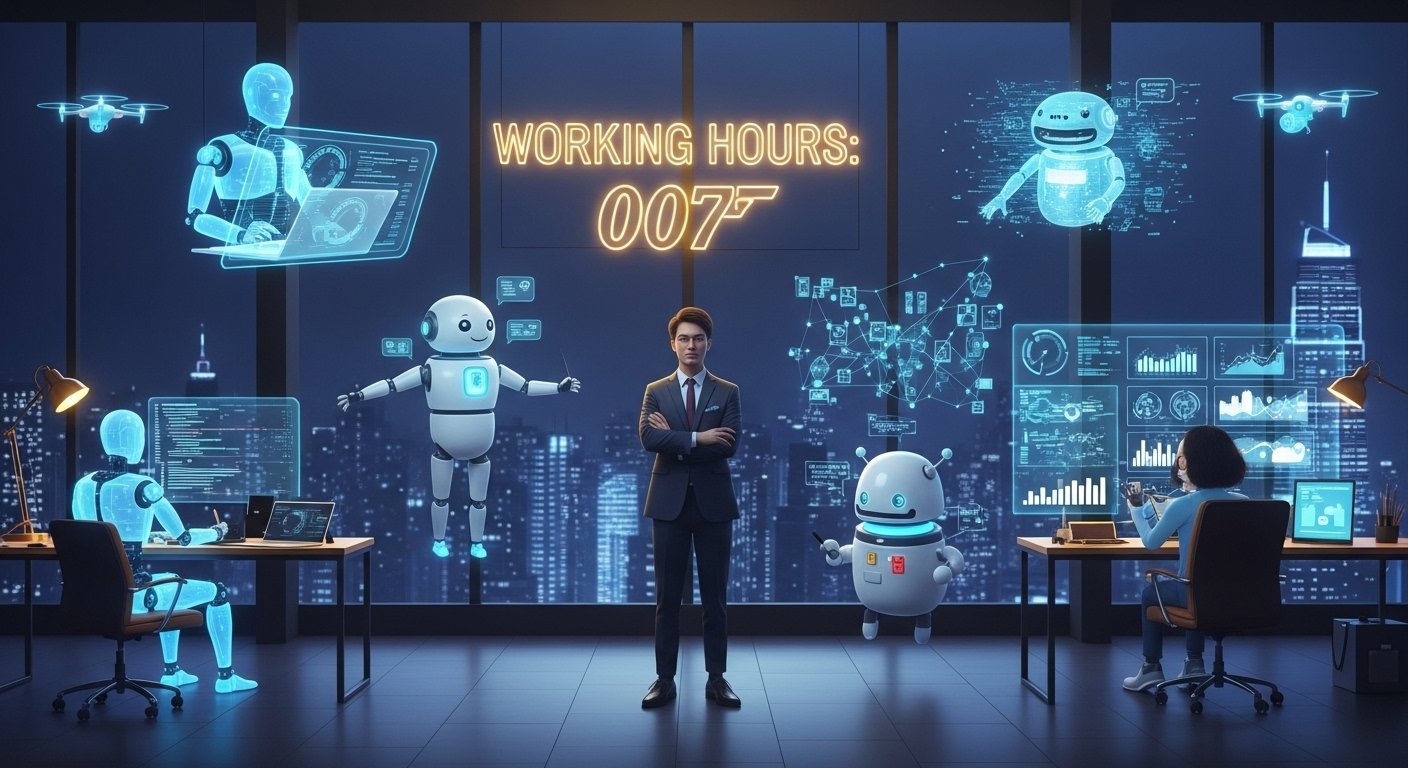
Solo Entrepreneurship(One-Person Unicorn): Employees are AI, Working Hours are 007 — Startup Trends in the AI Era
The One-Person Empire
A year ago, a founder named Alex sat in a small studio apartment, an idea for a business swirling in their head. The concept was ambitious: to build a global platform that could analyze and optimize social media marketing campaigns for small businesses. Traditionally, this would have required a team of data scientists, marketing strategists, and software engineers—a multi-million-dollar undertaking with a prolonged development cycle. But Alex didn’t have a team. They didn’t have venture capital funding. They had a laptop, an unwavering vision, and a subscription to a suite of new AI services.
Instead of writing a single line of code, Alex used an AI-powered UI generator to create a stunning, responsive front-end in a single day.1 Their marketing copy, ad campaigns, and social media content were all generated, personalized, and managed by AI. A sophisticated AI sales agent handled lead qualification and follow-up emails, while an AI chatbot managed customer support tickets with zero human intervention. Alex’s role was not to execute these tasks, but to orchestrate them—to act as the central nervous system for a workforce of digital agents. In just months, the platform launched, found product-market fit, and began generating substantial revenue. The era of the “one-person unicorn” had begun.
In a Nutshell
The narrative of solo entrepreneurship is undergoing a profound and irreversible transformation. AI is no longer a mere tool for productivity; it is the core infrastructure upon which a new class of businesses is being built. This report explores how artificial intelligence is fundamentally redefining the entrepreneurial archetype, enabling individuals to achieve unprecedented scale, productivity, and profitability. This shift, however, is not without its complexities. It is giving rise to new work cultures and pressures, such as the hyper-intense “007” work ethic and the “Dormitory Startup” phenomenon, which are shaping the future of innovation in the AI era.
📺 Watch the Action
News Article
- Medium: “One-Person Empires: How AI is Powering the Solo Entrepreneur Boom” highlights how founders are building profitable companies without co-founders or large teams by leveraging AI platforms as a 24/7 go-to-market team.
YouTube Videos
- Sam Altman’s Solo Founder Prediction: This video explores the feasibility of a one-person, billion-dollar company, a concept made possible by AI agents that can handle business functions like engineering, design, marketing, and sales.
- Building a Solo AI Business: This video provides a blueprint for how a solo founder can create a successful AI business, outlining the key elements needed, from a solid business model to the right AI tools.
The AI Toolkit: Employees are AI
The Dawn of the Digital Co-founder
The most significant shift in modern entrepreneurship is the redefinition of the “solo” founder. The term has become something of a paradox. The solo founder is no longer an individual forced to handle every single task alone, from support tickets to running ads and pushing code. That approach is unsustainable and leads to burnout.7 Instead, the modern solo founder is a chief executive, a visionary orchestrator who leverages a digital workforce to do what once required an entire team.3 AI platforms now act as a 24/7 GTM (go-to-market) team, handling content creation, ad management, finance, and product prototyping.2 This provides an individual with “enterprise-level firepower” at their fingertips, a level of capability once reserved for established companies with significant capital and human resources.
This new paradigm elevates the solo founder’s role from a simple task executor to a strategic leader. The true value proposition is no longer the founder’s ability to personally write a blog post or handle a sales call, but their skill in directing and curating an AI workforce. The challenge has shifted from manual execution to strategic orchestration. This is a higher-order skill that fundamentally changes the mindset required for success. It demands that an individual delegate repetitive tasks early on to protect their “cognitive bandwidth,” which is now their most valuable resource. By embracing this delegation, a solo founder is not working alone but is, in effect, managing a lean, scalable, and tireless team of digital co-founders.
The Solo Entrepreneur’s AI Arsenal: A Categorical Deep Dive
A solo entrepreneur’s business is now built upon a lean tech stack, a curated arsenal of AI tools that act as a surrogate team. These applications are selected not just for their individual capabilities but for their ability to integrate and automate key business functions, allowing an individual to compete with larger firms. The following table provides a strategic overview of the essential tools that form the modern solo founder’s digital arsenal.
| Category | Key AI Tools | Core Function for a Solo Entrepreneur |
| Content & Marketing | ChatGPT, Jasper AI, Copy.ai | Drafts blog posts, brainstorms titles, and creates copywriting in a range of tones and styles, acting as a creative collaborator. |
| Grammarly, Hemingway App | Edits content for grammar, clarity, and readability, ensuring professional communication is maintained. | |
| Canva, Midjourney, Beautiful.ai | Generates professional social media graphics, logos, thumbnails, and presentations, providing a full design studio in one app. | |
| Surfer SEO, ContentShake AI | Optimizes content for search engines, analyzes competitors, and provides keyword research, enabling content to rank better and attract organic traffic. | |
| Operations & Productivity | Notion AI | Blends note-taking, task management, and AI writing in one seamless interface, serving as a “digital HQ” to organize a scattered digital life. |
| Calendly | Automates appointment scheduling, eliminating the back-and-forth of emails and syncing availability like a personal assistant. | |
| Zapier, n8n | Serves as a “no-code automation powerhouse” to connect and build workflows between thousands of different systems, saving time and promoting efficiency. | |
| Dext | Acts as a paperless bookkeeping assistant for efficient financial management. | |
| Customer & Sales | Tidio, Chatfuel | Provides AI-powered chatbots for 24/7 customer support, lead qualification, and booking meetings, a capability once viable only for large enterprises. |
| HubSpot Sales Hub | Automates repetitive sales tasks such as email follow-ups and meeting scheduling, helping solo founders maximize efficiency and focus on closing deals. | |
| Reply.io’s AI Sales Email Assistant | Assists with email replies and automates sales outreach. |
These tools represent a fundamental change in the entrepreneurial landscape. They allow an individual to build and scale a business without needing a full-time staff, proving that the right mix of AI tools is more critical than the size of the team.
The Verticalized Revolution: A Strategic Edge
While general-purpose AI tools like ChatGPT and Canva have democratized access to powerful capabilities, a reliance on these broad-use platforms can make a startup’s differentiation “tough”. This has led to the emergence of a new strategic trend: the rise of “vertical AI”.
Vertical AI solutions are not general-purpose tools. They are purpose-built to address specific challenges within a designated industry, or “vertical sector”. They are founded on deep, industry-specific expertise and are finely tuned with datasets that are relevant to their targeted field, such as financial, legal, or medical data. This level of specialization allows them to solve complex problems that a broad-spectrum AI cannot tackle with the same level of precision, offering a significant competitive edge.
This trend marks the next frontier for solo entrepreneurs. The first wave of successful solo founders leveraged general-purpose, “horizontal” tools to launch their businesses quickly. The next generation, however, is building their businesses around verticalized, domain-specific AI to create a lasting competitive advantage. This shifts the focus from simply using a tool to building with it. A solo founder could, for example, build a niche service like an AI-powered legal assistant to analyze and summarize legal documents, a real estate deal finder to identify undervalued properties, or a personal finance coach that provides expert-level advice at a fraction of the cost of a human advisor. These specialized solutions are difficult for general-purpose AI to replicate and thus create a durable “moat” that protects a business from a hyper-competitive market.
The Rise of Agentic AI: The Ultimate Digital Employee
The evolution of AI is moving beyond simple, single-task tools to a new era of “Agentic AI”. Unlike traditional chatbots or copilots that require a prompt to get started, these advanced systems can initiate, plan, and complete complex, multi-step tasks with minimal human intervention. This is the true embodiment of a “virtual coworker”.
An agentic AI system doesn’t just draft an email; it can research a prospect, draft a personalized email, send it at the optimal time, monitor engagement, and follow up based on the replies. It can analyze marketing performance and autonomously reallocate a budget to more effective channels. This level of autonomy is not an incremental improvement; it is a profound game-changer that enables a solo founder to achieve unprecedented efficiency and scalability.
The adoption of agentic AI elevates the solo entrepreneur’s role from a tool user to a system architect. Their primary skill becomes not just using a tool but designing and overseeing complex, interconnected workflows. A solo founder is no longer just using an app to schedule a meeting; they are designing an automated workflow that connects their CRM, email, and calendar to handle client onboarding from initial contact to welcome emails and a scheduled call. This represents a qualitative leap in the skills required for solo entrepreneurship. The future belongs to those who can build and manage a network of autonomous agents that work together to run their business.
The New Work Ethic: The “007” and the “Dormitory Startup”
Decoding “007”: An Exploration of Extreme Work Culture
The rise of the AI-powered entrepreneur has created an ironic juxtaposition with emerging work cultures. One such culture, originating in China, is the “996” system, which mandates a work schedule from 9:00 am to 9:00 pm, six days a week. Its more extreme counterpart, “007,” implies working from midnight to midnight, seven days a week. These schedules are a reflection of a high-pressure environment, often referred to as “involution,” which traps individuals in an endless, self-perpetuating cycle of competition.
Despite being deemed illegal by the Supreme People’s Court in China, this culture of “working for long hours with few breaks” has been known to increase the occurrence of mental and physical problems. The persistence of this work ethic, even in the face of legal challenges and widespread criticism, highlights the intense pressure felt by individuals in certain tech sectors.
The ‘Dormitory Startup’ Phenomenon: A Crucible of Ambition
In cities like San Francisco, a similar high-pressure culture has given rise to the “Dormitory Startup” phenomenon. This trend involves young, ambitious founders who are bypassing traditional college or career paths to launch ventures in the city’s tech hubs. They are drawn to the dense networks of venture capital and the proximity to major AI labs like OpenAI and Anthropic, which have made the city the epicenter of a $50 billion AI boom.
This influx of talent has had significant social and economic consequences. The AI boom has contributed to soaring rents and a rapidly dwindling housing stock, creating “eye-watering” housing costs. As a result, many startup workers are forced to “bunk up in small but costly rooms,” living in conditions that are the modern equivalent of flophouses. This high-cost, high-pressure environment becomes a crucible of ambition, where founders and employees are living and working in intense, communal settings to stay afloat and ahead in the fiercely competitive AI landscape.
The Sustainability Question: A Nuanced Discussion
There is a profound irony in the convergence of AI tools, which promise to automate and simplify work, with a work culture that demands extreme, unsustainable hours. The “Dormitory Startup” isn’t merely a lifestyle choice; it is, in many ways, a forced adaptation to a hyper-competitive, high-cost market created, in part, by the very AI boom they are chasing.
The analysis of AI tools consistently highlights their primary benefit: freeing up humans from repetitive tasks to focus on strategic growth. The logic dictates that a solo founder who saves 13 hours per week through AI implementation would reinvest that time into leisure, skill development, or strategic planning. However, in a market where rivals are equally leveraging AI, that saved time is not a luxury; it is a necessity for survival. The intense competition and high operational costs in places like San Francisco mean that the “saved time” is not used for rest, but for more work to stay ahead. The AI tool, in this context, does not lighten the load; it enables a founder to “work to death” more effectively than their non-AI-using counterparts. This is a critical psychological and economic contradiction that must be addressed for the long-term sustainability of the AI-powered startup ecosystem.
The Human-AI Partnership: ‘AI is my Coworker’
From Creation to Curation: A Fundamental Role Shift
In a world increasingly infused with AI, the nature of work is fundamentally changing. For a solo founder, the relationship with their AI “coworker” is not one of replacement but of role transformation. Human workers are shifting away from manual creation and towards curation and direction. The AI handles the pattern recognition, processing power, and execution, while the human provides the context, strategic judgment, and creative direction.
This evolution makes skills like “AI prompting” a core workplace competency. The ability to effectively use and guide an AI system is becoming increasingly valuable across numerous professions. This transition is not about eliminating human input but about offloading the mundane and time-consuming tasks to allow humans to focus on areas where their expertise adds the most value.
Augmentation, Not Replacement: Dispelling the Myths
One of the most persistent myths about AI is the fear that it will replace human jobs entirely. The reality, however, is far more nuanced. AI is best understood as a tool that automates specific, narrowly defined
tasks, not entire jobs. A study on the rollout of conversational AI tools in call centers, for example, showed that AI disproportionately benefited lower-performing workers, lifting the productivity of the entire team. AI handles the administrative, data-heavy tasks, freeing up humans to focus on strategic, creative, and empathetic work.
The economic impact of this transition is the subject of ongoing debate. Goldman Sachs researchers estimate that generative AI could boost labor productivity in the US and other developed markets by approximately 15% when fully adopted. This would translate into a temporary, modest increase in unemployment as displaced workers find new roles. However, other economists present a more conservative view. An MIT study suggests a much more “modest” effect, with a projected GDP boost closer to 1% to 1.8% over a decade. This more cautious forecast points to “adjustment costs” and a significant “mismatch” between where AI is developed (primarily in large companies) and where it could be most effective (small and medium-sized enterprises).
This discrepancy is a crucial point for a solo entrepreneur. The gap between AI’s technological potential and its actual, often limited, real-world impact is an opportunity. This is because the promised productivity gains are not automatic; they require a bridge to overcome implementation hurdles such as poor data quality and a lack of technical skills. The solo founder can build a business that specializes in helping other SMEs navigate this gap, offering services that make AI adoption a reality. The challenge becomes the opportunity.
Beyond the technical challenges, the human element of this partnership is complex. A study found that humans sometimes have an “aversion” to adhering to the recommendations of algorithms, even when the AI has been shown to outperform a human. While an AI system might provide a black box output that a human cannot explain, other algorithms, like a decision tree, can be interpreted and understood. Some see AI as a “junior engineer” whose lack of ability to write good code is outweighed by its enthusiasm, with the human’s role being to take the AI’s suggestions and find the idea within them, a process that is “clumsy and brittle” like the early internet.
The Human Advantage: Beyond the Algorithm
In a world saturated with AI, the value of uniquely human skills becomes even more pronounced. While AI excels at logic and data processing, it lacks the emotional intelligence, ethical judgment, and creative vision that are essential for long-term success.25 These are the skills that will set a solo entrepreneur apart.
AI-driven tools can personalize customer experiences at an unprecedented level, but a human’s emotional intelligence is required to build a genuine relationship and a loyal customer base. AI can analyze customer data, but it is a human’s empathy and intuition that will foster deep connection. Similarly, while AI can generate new ideas, it is a human’s creative perspective and ability to forge unique concepts that will bring an idea to life. A solo founder’s role is not to be a machine, but to be the human element that brings authenticity and ethical oversight to the entire operation.
The Macro-Economic View: Trends, Data, and Real-World Impact
The Numbers Tell the Story: A Data-Driven Picture
The shift to solo AI entrepreneurship is not anecdotal; it is a global trend supported by compelling data. The numbers demonstrate that a new era of innovation and economic growth is taking hold, led by lean, AI-powered ventures.
| Metric | Data | |
| Global AI Market Value | Valued at $196.6B in 2024, projected to surpass $1.8T by 2030, with Asia-Pacific being the fastest-growing region.32 An alternative forecast projects the market to reach $407B by 2027. | |
| Small Business AI Adoption Rates | 77% of small businesses worldwide have adopted AI tools in at least one function. 89% of small businesses are leveraging AI to automate repetitive tasks and improve efficiency. | |
| Projected Time & Cost Savings | SMEs save an average of 13 employee hours and 13 owner hours per week through AI, translating to approximately $7,500 in annual savings for median-sized operations. | |
| Small Business Investment & ROI | 71% of small businesses plan to increase their AI investment in the coming year, with 85% of those already using AI expecting a clear return on their investment. | |
| Solo-Led Startup Success | Solo-led exits now account for 52.3% of successes. AI startups are reaching $1 million in annual revenue four months faster than SaaS startups, and 38% have no VC funding. | |
| Cost of Starting an AI Company | A lean SaaS launch with off-the-shelf tools can cost as little as $200-$2,000. | |
| Projected Productivity Gains | Generative AI is estimated to raise the level of labor productivity in developed markets by around 15% when fully adopted. |
A Look to the Future: The One-Person Unicorn
The convergence of AI, lean business models, and a global, digital-first mindset is making the “one-person unicorn” a tangible reality. The term, once a thought experiment, is now seen as feasible due to autonomous AI agents that can handle complex business functions across marketing, customer service, and operations. As these agents become more sophisticated, they will enable individual entrepreneurs to build and scale companies of unprecedented size and value while maintaining a lean operational structure.
However, the future is not without its challenges. The hyper-competitive landscape, fueled by a new wave of founders, means that differentiation remains difficult for those who rely on general-purpose tools. The success of the “one-person unicorn” will hinge on a founder’s ability to not just use AI, but to understand its ethical implications, its limitations, and its potential to be a creative collaborator rather than just a tool.
The Solo Founder’s Blueprint for Success: A Real-World Case Study
The path to building a profitable AI-powered solo venture is paved with a set of new rules. The founder of PhotoPacks.AI, Jeremy Gustine, a successful AI-powered headshot startup, shared key lessons learned the hard way that have become a new blueprint for success.
- Start with a Focused, Singular Use Case. The temptation to build for everyone is a trap that leads to a vague product with zero conversions.7 Gustine’s business initially offered a wide range of services, including pet portraits and fantasy scenes, which led to zero conversions because the product’s purpose was unclear. By narrowing the focus to professional headshots, the value became obvious, and sales followed.20 The most successful ventures begin by solving one clear, underserved problem for a specific audience. The value is obvious, traction is faster, and the business can always expand later.
- Price with Confidence, Not Fear. Underpricing a product can attract low-intent customers, increase refund requests, and make the product feel cheap. Gustine started with a low price of $9.99, but when he raised the price, sales improved and refunds decreased because customers took the product more seriously. When a product solves a real problem, its value should be reflected in a confident price point. Higher prices often lead to better sales, a more serious customer base, and higher revenue.
- Delegate Repetitive Tasks Early. A “solo” founder’s job is not to “do it all”. Gustine initially managed everything, from support tickets to running ads, and found it unsustainable. The most successful solo founders delegate time-consuming tasks to AI early on. This frees up their cognitive bandwidth to focus on high-value activities that AI cannot replicate, such as strategic vision, customer relationships, and product development.
- Build Stable, Lasting Value. The AI landscape evolves at a blistering pace. What seems groundbreaking one month can be outdated the next. Gustine learned this lesson, stating that he was still surprised by the rapid pace of development even after being immersed in the industry for a year. To avoid burnout and obsolescence, a founder must build their business around a stable, lasting value proposition—a clear problem that is consistently being solved—rather than chasing every new AI trend.
- Prioritize a Data-Driven Approach. AI is only as good as its data. The most successful solo founders will use AI to make data-driven decisions at every stage of their business, from testing pricing models and predicting customer behavior to identifying new market gaps.
- Embrace Augmentation, Not Replacement. A solo founder’s greatest competitive advantage is their unique perspective and ability to use AI as a collaborator, not a crutch. The future belongs to those who understand that human creativity and authenticity, augmented by AI, will always outperform technology alone.
Quiz: Are You Ready for the AI Era?
Test your knowledge of the key concepts from this report.
1. What is the key difference between a traditional tool and an “Agentic AI” system?
A. A traditional tool can handle multiple tasks, while an agentic system is for a single task.
B. A traditional tool requires a prompt for every task, while an agentic system can initiate, plan, and complete multi-step tasks autonomously.
C. A traditional tool is powered by a large language model, while an agentic system is not.
D. A traditional tool is more expensive than an agentic system.
2. What is the fundamental change in the solo founder’s role in the AI era?
A. The solo founder is now responsible for all technical details, including coding and server maintenance.
B. The solo founder’s role has shifted from a task executor to a strategic orchestrator of a digital workforce.
C. The solo founder now works 80 hours a week to compete with larger firms.
D. The solo founder’s job is to build a complex, horizontal AI platform for multiple industries.
3. What is the primary benefit of a “Vertical AI” solution over a general-purpose tool?
A. It is significantly cheaper than a horizontal tool.
B. It can solve complex, industry-specific problems with a high degree of precision and create a lasting competitive edge.
C. It is designed to be used by large teams rather than solo founders.
D. It is easier to train and implement, requiring no technical background.
4. What is the core irony of the “007” work culture in the age of AI?
A. That it is an outdated practice that has no place in a modern startup.
B. That AI tools are used to work smarter, but the culture demands extreme, unsustainable hours to stay ahead of the competition.
C. That AI has eliminated the need for human labor, yet people are still expected to work long hours.
D. That it is a trend unique to the AI industry and does not exist in other sectors.
Answer Key
- B. An agentic system represents a significant leap from traditional tools by operating with a higher degree of autonomy.
- B. The modern solo founder’s value lies in their ability to direct and curate a digital workforce, not in their ability to perform every single task.
- B. Vertical AI creates a competitive advantage by leveraging deep, industry-specific data and expertise to solve problems that general-purpose AI cannot.
- B. This is a central irony of the AI era, where efficiency gains are reinvested into more work to maintain a competitive advantage in a hyper-competitive market.