Tesla Optimus Humanoid Robot New Viral Demo: Folding Laundry, Walking Smoothly, and Packing Luggage
Tesla Optimus New Demos and Original Viral Video/News Coverage
- Optimus Popcorn Serving Demo
- Optimus Object Sorting Demo
- Optimus Smooth Walking Demo
- Original Viral Laundry Folding Video
- News Coverage of Original Laundry Video
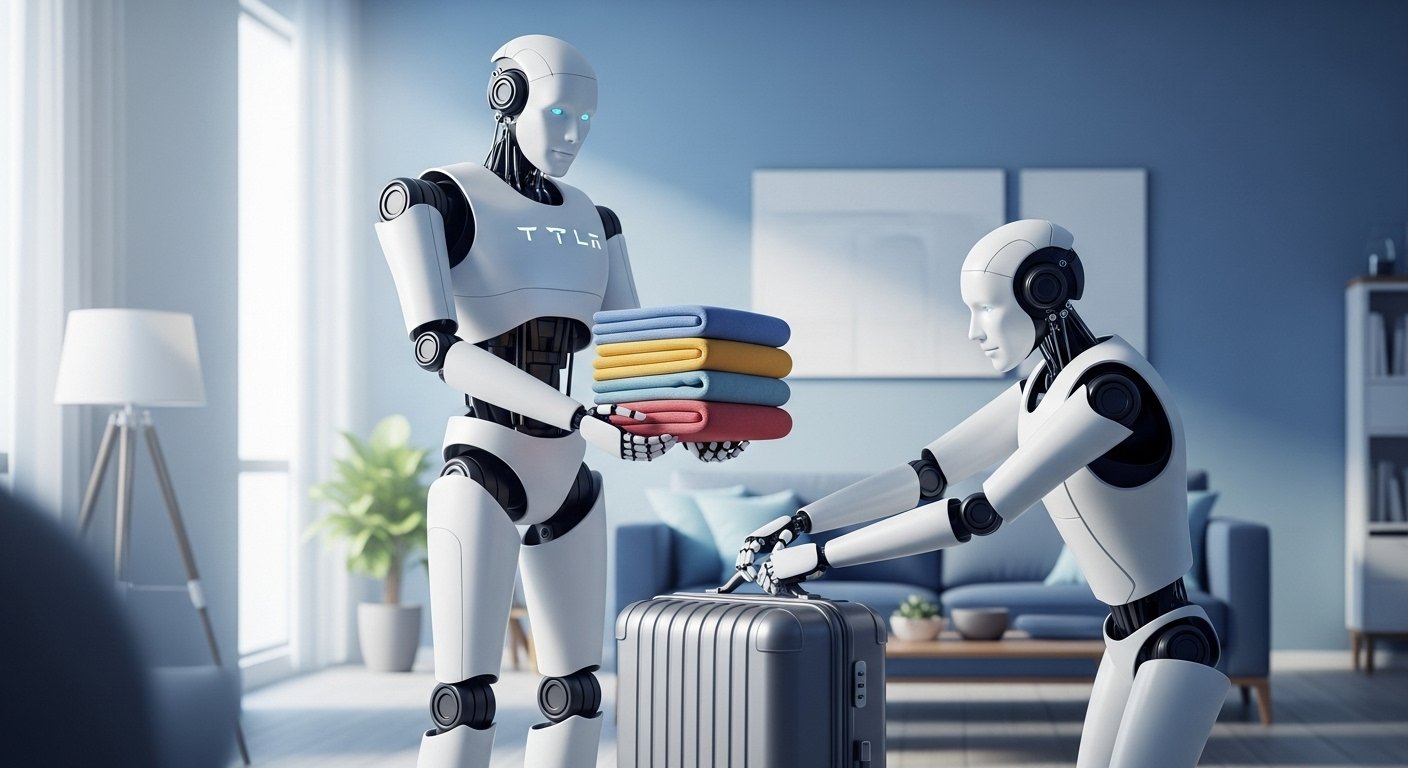
🌟 It’s the end of a long workday. You drop your backpack by the door, toss a wrinkled pile of laundry onto the couch, and sigh. But instead of rolling up your sleeves, you say: “Optimus, can you take care of that?” From the corner of the room, a humanoid figure comes to life. Its joints move with uncanny smoothness, not the jerky stiffness we’re used to from robots. It approaches a counter, grabs a bucket of popcorn, and with a polite thumbs-up and a friendly wave, gently pours it into a packet for a human guest.9 Later, as you finish a task, the same robot sorts a variety of objects autonomously, demonstrating a quiet, focused intelligence.
This isn’t the opening scene of a sci-fi film. It’s Tesla’s latest Optimus demo, and it has gone viral because for the first time, a humanoid robot isn’t just walking or waving… it’s doing something useful. And as it navigates inclines and declines with a natural gait 5, it’s clear that the gap between lab demo and real-world assistant is closing fast.
📝 In a Nutshell
Tesla has shifted the global conversation about humanoid robots. Optimus, unveiled in its most polished demos yet, shows off a set of skills that resonate with real life: sorting objects, serving popcorn, and walking with natural balance. These aren’t just tricks; they’re technical milestones.
Why does serving popcorn matter? Because it requires a gentle, precise touch—a test of fine motor control. Why object sorting? Because it demonstrates the robot’s perception and its ability to act autonomously in its environment. And smooth, human-like walking is what makes the difference between a robot that looks like a lab prototype and one that could realistically share a workspace—or a home—with us.5 This is why the demo struck a chord.
Unlike Figure AI’s humanoid, which made headlines for its own autonomous laundry folding , Apptronik’s Apollo (powerful but built for warehouses) , or 1X’s Neo (nimble but less of a generalist in this context) , Tesla is showing a humanoid that feels directly relevant to everyday tasks. And that’s why it’s trending everywhere: it’s not about robots existing—it’s about robots finally doing something we actually need.
Humanoid Robot Timeline
| Year | Milestone | Company | Robot | |
| 2021 | Tesla Bot announced at AI Day event | Tesla | Optimus | |
| 2022 | Optimus prototype shown | Tesla | Optimus | |
| 2025 | Neo Gamma in-home trials with users begin | 1X Technologies | Neo Gamma | |
| 2025 | Figure 02 demonstrates autonomous laundry folding | Figure AI | Figure 02 | |
| 2026 | Tesla aims to begin commercial sales | Tesla | Optimus |
🤖 Tesla Optimus: Inside the Viral Demo
- Popcorn Serving → A showcase of advancements in fine motor control and the robot’s ability to interact with humans without error.
- Object Sorting → An autonomous demonstration of the robot’s perception and manipulation capabilities as it methodically sorts objects on its own.
- Smooth Walking → No wobbling or jerky motions; gait improvements suggest a design philosophy aimed at versatility in dynamic and unpredictable scenarios.
- Overall Vibe → Less “robot on display,” more “future assistant” — a robot that feels like it belongs in your daily routine.
It is important to note that the public conversation around Optimus has not been without controversy. The original clothes-folding video that “caught the world’s attention” was later clarified by Elon Musk to have relied on human teleoperation, a fact that led to social media scrutiny and accusations of a misleading demonstration. By showing gradual, genuine progress, such as the autonomous object sorting and popcorn serving, Tesla appears to be working to establish credibility in the robotics space.
⚔️ Rival Robots in the Spotlight (Storytelling Comparisons)
🔹 Figure AI (Figure 02)
Imagine a runway model robot—tall, sleek, and photogenic.18 Figure AI’s humanoid is impressive to look at and can walk smoothly, but its real claim to fame is its autonomous laundry-folding demo, a task that directly contrasted with Tesla’s earlier teleoperated demo.11 Figure AI has focused on a purpose-built AI, the Helix neural net 8, and is working to be a general-purpose robot for both industry and home.20
🔹 Apptronik (Apollo)
If Optimus is your household helper, Apollo is the warehouse worker.12 Apptronik’s Apollo is strong, sturdy, and designed for logistics—lifting up to 55 lbs (25 kg) 21, stacking shelves, and handling industrial work.12 It can work alongside humans as a “collaborative robot” and is optimized for industrial endurance with hot-swappable batteries that allow for a 22-hour continuous operation.21
🔹 1X’s Neo
Neo feels like the agile little sibling in the humanoid family. It is remarkably lightweight at 66 lbs (30 kg) 18 and can run up to 7.5 mph.22 Instead of a flashy lab demo, 1X is taking a pragmatic, data-first approach: sending its robots into real homes for trials where their actions are “still guided by humans behind the scenes”.15 This allows the company to gather the immense, diverse data of a real home that is impossible to replicate in a lab.15
The Viral Sensation: Tesla’s Optimus and the Burden of Hype
Tesla Optimus, also known as the Tesla Bot, has been a centerpiece of the public conversation around humanoid robotics since its initial announcement in 2021. The project’s public-facing image is heavily influenced by a series of periodic video updates and demonstrations shared by the company, which show incremental improvements in the robot’s functionality and movement. These demonstrations are strategically important, as they serve as a primary means of communicating progress to a global audience.
The more recent demonstrations have focused on a range of increasingly complex tasks. For instance, a video released by the company showed Optimus autonomously sorting objects, a clear indication of advancements in its perception and manipulation capabilities. Another demonstration that went viral was the robot calmly serving popcorn to a human guest. While this might seem like a simple, lighthearted task, it was a methodical showcase of the robot’s fine motor control and its ability to engage in user interaction without a misstep or spill. The movements were described as “deliberate and slightly slower than a human’s,” which indicates a focus on precision and control over speed. Beyond fine motor skills, other videos have highlighted significant improvements in Optimus’s gait and balance. The robot has been shown to navigate uneven terrain, inclines, and declines, which suggests a design philosophy aimed at making the robot versatile enough for dynamic and unpredictable scenarios, not just flat, lab-like environments.
However, the current public perception of Optimus cannot be fully understood without acknowledging the history of its demonstrations. The discussion of its new capabilities is often contextualized by the infamous original clothes-folding video. That initial demo, while it “caught the world’s attention” , was later revealed to have relied on “teleoperation,” a process of human control behind the scenes. This created a significant public credibility challenge, with many on social media scrutinizing the video and accusing Tesla of misrepresenting the robot’s current functionality. While the video was a “proof-of-concept for something ‘some ways off in the future’” , the omission of its non-autonomous nature was seen as misleading.17 The company’s subsequent demos, like the popcorn-serving clip, appear to be a strategic pivot. By showing gradual, genuine progress, such as the ability to track tasks and manipulate objects methodically, Tesla seems to be working to establish credibility in the robotics space, a critical step given the high burden of proof created by its past ambitious claims.
The Unspoken Reality: Lab Demos vs. Unstructured Environments
The excitement generated by a new viral video often masks a fundamental challenge facing every robotics company: the chasm between a controlled lab demonstration and reliable operation in an unstructured, real-world environment. Almost every impressive demo, including the ones from Figure AI and Tesla, takes place in what can be described as a “clean room” or a “home lab”. In these settings, the lighting is good, objects are neatly laid out, and the variables are strictly controlled to ensure the robot’s success. While these demos are crucial for validating new capabilities, they do not provide much information about the robot’s limitations when faced with the chaos of a real home, factory, or public space.
The transition from a controlled lab to a chaotic, unpredictable environment is the single biggest hurdle for commercial viability. This challenge is often referred to as the “data problem” because it requires training an AI on the infinite variations of the real world—the diversity of homes, the unique shapes of objects, and the constantly changing arrangements of clutter. A robot that can fold a neatly arranged towel on a lab table may fail completely when faced with a pile of clothes stuffed into a dark grocery bag, as would happen in a real-world scenario.
This problem reveals a fascinating divergence in strategic approaches among the leading competitors. While others are focused on building a fully autonomous robot in a lab setting, 1X Technologies has adopted a pragmatic solution to this very data problem. The company is sending its ‘Neo’ Gamma humanoid robots into real homes for in-home trials with a few hundred to a few thousand users. It is important to note that most of ‘Neo’s’ actions in these early trials are “still guided by humans behind the scenes”. On the surface, this might appear to be a sign of technological immaturity, similar to the criticism faced by Tesla’s original demo. However, a deeper analysis reveals a brilliantly pragmatic solution to the fundamental challenge of data acquisition. The human operators effectively act as a real-time, on-the-ground data collection and labeling service. This allows 1X to gather the immense, diverse, and messy dataset of a real home that is impossible to replicate in a lab environment. By doing so, 1X is betting that the race to market is not just about who can build the best robot, but who has the most effective long-term strategy for acquiring the real-world data necessary for true autonomy.
The Contenders: A Comparative Deep Dive
The field of humanoid robotics is far from a one-horse race. While Tesla often dominates headlines, a look at its key competitors reveals a diverse and highly-specialized ecosystem of innovation.
Figure AI: The Autonomous Prodigy
Figure AI has emerged as a formidable competitor, making a bold statement with its Figure 02 robot. The company demonstrated its robot folding laundry “autonomously using its advanced Helix neural net,” directly addressing the controversy of Tesla’s earlier demo. The demonstration of the same task, but this time with full autonomy, was a clear and powerful statement that Figure had achieved a significant technological milestone.
The core of Figure’s innovation lies in its AI, the Helix neural net. This system is a purpose-built vision-language transformer that helps the robots understand and carry out complicated tasks using everyday language and live visual information. A key capability of Helix is its ability to handle a variety of tasks by simply introducing new data without modifying the model’s architecture or training parameters. The robot also demonstrates a multimodal understanding, allowing it to interpret multiple sensory inputs, which enables “common-sense reasoning” and “real-time interaction” with humans. This allows the robot to make decisions based on contextual understanding, such as anticipating that dirty dishes will be placed in a drying rack for cleaning. The robot’s hands also possess “fine motor skills, resembling those of human hands, for precise object manipulation”.
From a business perspective, Figure AI is pursuing an aggressive, dual-market approach. The company is actively working to solve labor shortages by deploying robots for “end-to-end operations” for its first commercial customers, while also planning to enter the home market with capabilities like doing dishes and laundry. Figure has made the ambitious claim of being the “world’s first commercially-viable autonomous humanoid robot” and has announced a plan to produce 100,000 robots.26 A key strategic decision was to end its collaboration with OpenAI to “internalize AI development,” a move that Figure believes will allow it to expedite innovation cycles and maintain greater control over its technological trajectory.
Apptronik: The Industrial Powerhouse
Apptronik, an innovative startup from Texas, has taken a distinct and highly pragmatic approach with its Apollo robot. Unlike the general-purpose ambitions of others, Apptronik has positioned Apollo as a “collaborative robot” (cobot) designed for specific, high-payload industrial tasks like “case picking” and “machine tending”. This human-centric approach is intended for Apollo to work alongside humans, serving as a tool that “expands and complements human skills” rather than replacing them.
A detailed technical breakdown of Apptronik’s design reveals a key differentiator: its use of linear actuators instead of conventional rotary actuators. This innovative technology is a crucial aspect of the Apollo design, as linear actuators are designed to mimic human muscles more precisely by creating a straight movement. This design choice is also noted for its potential advantages in terms of mass manufacturability, cost, and the ability to lift significant weight. This approach is in contrast to the torque-controlled actuators used by Figure AI, which are more tailored for “delicate handling” and nuanced interactions.
Apollo’s design is also optimized for industrial endurance and versatility. Its hot-swappable battery packs, each with a four-hour runtime, allow for “22-hour continuous operation” with simple battery changes, a critical feature for industrial environments that require uninterrupted work over multiple shifts. The robot’s modular design means it can be mounted to any mobility platform, from a stationary position to a fully mobile bipedal form. Apptronik’s strategy is centered on achieving commercial success and market dominance in a specific, high-value market niche where the value proposition is clear, a strategy that may see them achieve profitability long before the generalized robots are ready to compete.
Core Technologies & The Business of Robotics
The competition in humanoid robotics is not just about who has the most impressive viral video; it is a battle of technological paradigms and business strategies. The core choices each company has made—from their AI architecture to their actuator design—directly correlate to their demonstrated capabilities and their path to commercialization.
The Engine of Action: A Technical Comparison
The foundational AI philosophy of each company is a key differentiator. Tesla’s approach is to leverage its extensive experience with its Full Self-Driving (FSD) neural networks, applying the same techniques used for its “four-wheeled robot” to the humanoid “robot with arms and legs”. This transfer learning model benefits from the billions of miles of real-world data logged by the Tesla fleet, giving it a potential edge in learning and adaptability.10 However, a key question remains: can an AI trained for a car’s mobility and perception fully adapt to the complexities of a bipedal robot with fine motor skills?
Figure AI’s strategy is a direct counterpoint. The company is focused on its purpose-built Helix neural net, which it believes is the specialized AI required for general-purpose autonomy. Meanwhile, 1X Technologies is using its “Redwood AI” system, a vision-language transformer that is among the first to control “locomotion jointly with manipulation”. This integrated approach enables sophisticated behaviors like whole-body manipulation and allows the robot to learn from both successful and failed attempts, which is critical for real-world adaptation.
The choice of actuators also reveals strategic intent. As previously mentioned, Apptronik’s use of linear actuators is optimized for strength and mass manufacturability, making it a strong candidate for industrial handling. In contrast, Figure AI’s torque-controlled actuators are specifically tailored for “fluid humanlike movements” and “delicate handling” , suggesting a focus on precision tasks that may be required in a home or retail setting.
This analysis shows there is no single “best” technology or AI model. Each company has made a series of interdependent choices—from their AI to their hardware design—that reinforces its specific strategic goal. The race is a fundamental contest between different technological paradigms: transfer learning (Tesla), a purpose-built AI (Figure), a pragmatic hardware-first approach (Apptronik), and integrated whole-body control (1X). The market will ultimately determine which paradigm is most effective for a given application.
From Prototype to Production: The Commercial Race
The race to commercialize humanoid robots is as fierce as the technological competition. Each company has a distinct business model and timeline for bringing its product to market. Tesla, with its vertically integrated model, aims for limited production in its own factories in 2025. CEO Elon Musk has stated that Optimus will be used in Tesla facilities before being made available for commercial sales in 2026, with an estimated price point of around $30,000. Tesla’s key advantage in this regard is its vast expertise in scalable mass production.27
Figure AI has an even more ambitious plan, claiming to be “commercially viable” now and announcing a goal of producing 100,000 robots in the coming years.26 The company is targeting a price point of about $20,000, which puts it in direct competition with Tesla.18 This aggressive production roadmap signals that Figure is thinking on the scale required for mass-market adoption.
Apptronik’s commercialization strategy is centered on generating revenue from immediate, high-value industrial applications, a more conservative and potentially more profitable path in the near term. This approach may allow them to generate the capital and experience needed to expand into other markets later. Finally, 1X Technologies is taking a domestic-first approach, using its early in-home trial program as a long-term data collection strategy to refine its product for the consumer market.15
The ultimate success of these companies will depend not just on their technology, but on their ability to successfully mass-produce these complex machines and lower the price point to make them accessible to a mass market. Tesla, with its gigafactory experience, appears uniquely positioned to accomplish this, but Figure’s aggressive production goals and competitive price point show that it is a serious contender in this regard.
Synthesis and Outlook
The current landscape of humanoid robotics is a dynamic and multi-faceted competition. Each of the major players—Tesla, Figure AI, Apptronik, and 1X Technologies—brings a unique set of strengths and a distinct strategic vision to the table. To fully understand the state of the art, it is necessary to look beyond the surface-level demos and compare the core technical specifications and strategic decisions that define each robot’s path to market.
Humanoid Robot Specifications & Capabilities Matrix
The following table provides a comprehensive, at-a-glance comparison of the key specifications and capabilities of the four leading humanoid robots. It is important to note that some of these specifications, particularly for prototypes, are subject to change. For instance, there are multiple reported weights for Optimus, with some sources listing it as 73 kg (160 lbs) while others mention 57 kg (125 lbs).
| Attribute | Tesla Optimus | Figure AI (Figure 02) | Apptronik Apollo | 1X Technologies Neo |
| Height | 5’8″ (173 cm) | 5’6″ (168 cm) | 5’8″ (173 cm) | 5’4″ (162 cm) |
| Weight | 125-160 lbs (57-73 kg) | 60 kg (132 lbs) | 160 lbs (73 kg) | 66 lbs (30 kg) |
| Payload | 45 lbs (20 kg) | 20 kg (44 lbs) | 55 lbs (25 kg) | 44 lbs (20 kg) |
| Speed | 5 mph (2.24 m/s) | 1.2 m/s (2.7 mph) | N/A | 2.5-7.5 mph |
| Battery/Runtime | 2.3 kWh, 1 full workday | 5 hours | 4 hours per swappable pack | N/A |
| Primary AI | FSD Neural Net | Helix Neural Net | Force Control Arch. | Redwood AI System |
| Core Capabilities | Object sorting, popcorn serving, improved gait | Autonomous laundry folding, human interaction, common sense reasoning | Case picking, machine tending, high payload, continuous operation | Natural gait, whole-body control, in-home trials, conversational AI |
The Humanoid Robot Ecosystem: A Strategic Map
The competition is not a single race but a multi-front contest for different market niches and technological paradigms. The strategic positions of each company can be mapped out to understand their unique value propositions.
- Tesla (Hybrid/AI-First): Tesla’s strategy is a top-down, vertically integrated model. It is leveraging its existing AI and production expertise to create a general-purpose robot for both industrial and domestic applications. Its primary focus is on the AI, betting that a scalable, fleet-trained neural network can be adapted for a wide range of tasks.
- Figure AI (Hybrid/AI-First): Figure AI is perhaps the closest competitor to Tesla in terms of ambition. It is also targeting both industrial and domestic markets with its robot, but its strategy is centered on a purpose-built AI that it believes is necessary for true general-purpose autonomy.20 Figure is aggressively pursuing this goal with significant funding and a bold production roadmap.
- Apptronik (Industrial/Hardware-First): Apptronik has adopted a more pragmatic, hardware-first approach. Its design choices, such as linear actuators and hot-swappable batteries, are hyper-optimized for specific, high-payload industrial tasks. Apptronik is seeking to be a collaborative tool in a defined market, which may allow it to achieve commercial success and market dominance long before the generalized robots are ready to compete.
- 1X Technologies (Domestic/Data-First): 1X Technologies is carving out a unique niche by focusing on the domestic market. Its strategy is a data-first approach, using early in-home teleoperated trials as a method for gathering the immense, diverse, and messy dataset required for true autonomy in a home environment. The company is building a domestic companion from the ground up, with a focus on a human-centered design and conversational AI.
The current demos, while impressive, are just the starting line. The true test for all of them will be scalability and robustness in a truly unstructured environment. Musk’s claim that Optimus could be the “biggest product ever” and Figure’s plan to produce 100,000 units are not near-term promises but long-term bets on a future trillion-dollar market. The “winner” in the long run will be the company that can solve the immense, interdependent challenges of building the hardware, creating a robust, general-purpose AI, and successfully mass-producing the final product at an accessible price point. The race is a marathon, and we are only in the very first mile.
For investors, a clear understanding of each company’s specific niche and timeline is critical. The investment thesis for Apptronik, with its focus on immediate industrial applications, is fundamentally different from the long-term, speculative bet on Tesla’s or Figure’s general-purpose vision. For consumers and industry professionals, it is prudent to maintain a degree of skepticism toward flashy demonstrations. Instead, the focus should be on the practical, real-world progress each company is making in overcoming the “uncontrolled environment” problem. The coming years will reveal which strategic path—be it a pragmatic, industrial-first approach or a bold, all-in bet on a general-purpose robot—is the most effective way to bring these machines into our world.
Quiz: The Humanoid Race
1. Question: Which company’s viral laundry-folding demo was later clarified to have been controlled by a human, not performed autonomously?
2. Question: What is the estimated price point for a Tesla Optimus robot when it becomes available for commercial purchase?
3. Question: Apptronik’s Apollo robot uses a unique type of actuator to mimic human muscles more precisely. What is this type of actuator called?
4. Question: What is 1X Technologies’ primary strategy for solving the “data problem” in home environments?
5. Question: What is the name of the AI neural net developed by Figure AI that is central to its robot’s autonomous capabilities?
Quiz Answers
- Tesla
- Around $30,000
- Linear actuators
- It is sending its ‘Neo’ robots into real homes for trials, where their actions are “still guided by humans behind the scenes” to collect real-world data.
- Helix