Elon Musk vs Sam Altman: A Battle of OpenAI vs. xAI – AI Chess War: Which Model Ultimately Wins?
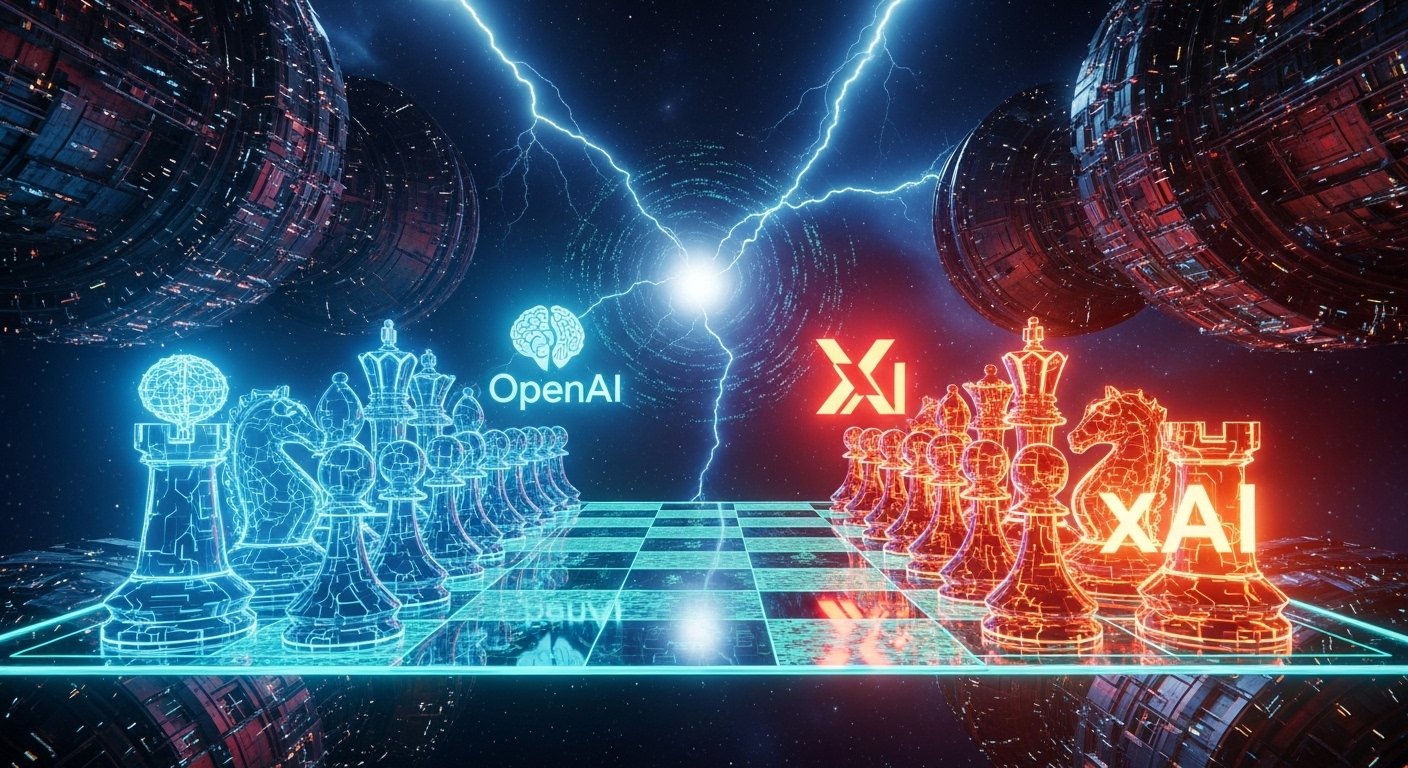
In Silicon Valley’s latest showdown, co‑founders turned rivals Elon Musk and Sam Altman have turned the future of AI into public theater. What began as a unified mission at OpenAI (founded 2015) 2 has mutated into an all‑out war between Altman’s OpenAI (ChatGPT/GPT‑5) and Musk’s new venture, xAI (Grok).1 With Elon lambasting Apple for “favoring” ChatGPT and Altman firing back about algorithm‑tweaks on X 1, the clash feels as personal as it is technical.
In The Nutshell
Beneath the surface of a heated public rivalry, OpenAI and xAI are pursuing fundamentally different visions for AI. OpenAI, with its capped-profit model and deep ties to Microsoft and Apple, is building a polished, cautious, and enterprise-focused “intelligence layer” for the world. In contrast, xAI, fueled by Elon Musk’s personal empire and a “truth-seeking” philosophy, is creating a rebellious, real-time, and unfiltered platform deeply integrated with the social media firehose of X.
This report breaks down their war on all fronts, giving you everything you need to join the debate.
- Origins of the Rift: Musk and Altman co‑founded OpenAI in 2015. Musk left the board in 2018, later citing a “betrayal” of its founding principles after the company moved to a for-profit structure. Since then, Musk has publicly criticized OpenAI, suing the company in 2024 for allegedly abandoning its non-profit mission to “maximize profits” for Microsoft.
- Public Spat Over Apps: Recently, Musk accused Apple of “unequivocal antitrust” by ranking ChatGPT highly on the App Store, while his Grok app was at number five. Altman responded on social media, claiming that Musk manipulates X’s algorithms to benefit his own companies.1 Musk called Altman a “liar,” leading Altman to challenge him to sign an affidavit denying any algorithm tampering.
- Tech Face‑off – Grok vs GPT: Each founder touts his AI as supreme. xAI’s latest Grok 4 (with a “Heavy” power tier) was unveiled as “the most intelligent model in the world”.16 Altman counters with OpenAI’s GPT‑5, which has been integrated into Apple devices. Independent benchmarks are still debated, but some analysis suggests OpenAI’s model excels on many general tests at a lower cost, while Grok shines in deep STEM and code reasoning.
- Funding and Partnerships: OpenAI is massively backed by Microsoft and has a partnership with Apple. In contrast, Musk’s xAI is funded by his other companies like SpaceX and recently raised $10 billion in a debt and equity round. The company formally merged with Musk’s X platform in March 2025 in a deal that valued the combined company at $113 billion. Morgan Stanley data shows xAI expects $1 billion in revenue by the end of 2025, but faces a monthly cash burn of $1 billion. OpenAI’s annualized revenue reached $13 billion by July 2025, but its cash burn is forecast at $8 billion for the year.
These factors set the stage for a fierce debate: will Musk’s maverick, ultra‑fast approach or Altman’s polished, product‑driven strategy win? The answer is still unfolding.
| Key Comparison | OpenAI (ChatGPT/GPT-5) | xAI (Grok) |
| Founding Vision | “Safe and beneficial AGI for all humanity” | “Understand the true nature of the universe” |
| Business Model | Hybrid capped-profit, reliant on partnerships (Microsoft, Apple) | Vertically integrated, funded by Musk’s empire (X, Tesla, SpaceX) |
| Technical Approach | Generalist, single transformer architecture | Specialist, multi-agent “Heavy” architecture |
| Key Performance | Excels at general tasks (MMLU: 88.7%). Faster response times (150+ tokens/sec) | Excels at deep STEM/code (AIME: 100%, USAMO: 61.9%). Slower response times in Heavy mode (10-20 sec delay) |
| Ethical Stance | Cautious, “safe-completions” training in GPT-5 | Unfiltered, “politically incorrect” stance |
| Primary Audience | Enterprise, developers, general consumers | X Premium subscribers, tech enthusiasts, specialized users |
A History of Split Visions
The modern “AI war” is not merely a corporate rivalry; it is a direct result of a philosophical schism that originated at the very heart of OpenAI. The conflict, now personified by the public feud between Sam Altman and Elon Musk, can be traced back to the organization’s founding principles and a subsequent strategic pivot that led to Musk’s departure and the creation of xAI.
OpenAI was established in December 2015 with a visionary mission: to ensure that artificial general intelligence (AGI) would benefit humanity as a whole. The organization’s initial structure as a non-profit was a crucial element of this mission, emphasizing transparency, collaboration, and the widespread sharing of scientific findings to prevent AGI from being monopolized by a single corporation. The founding team included distinguished figures such as Sam Altman, who became Co-chair and CEO, and Elon Musk, who also served as Co-chair and provided critical initial funding.2 Backed by an ambitious funding commitment of $1 billion from initial investors like Musk, Altman, Reid Hoffman, and Peter Thiel, the organization seemed poised to pursue its altruistic mission without the pressures of profit maximization.
However, the pursuit of AGI proved to be an immensely capital-intensive endeavor. By 2019, OpenAI faced the competitive reality that its non-profit model was insufficient to secure the massive computational power and world-class talent needed to compete with established tech giants. In a strategic move to address these challenges, the organization restructured, creating a for-profit limited partnership, OpenAI LP, which was to be governed by the original non-profit board. This capped-profit structure was a legal innovation designed to attract private investment by offering a limited return to investors while ensuring the organization’s actions remained aligned with its founding, charitable mission.
For Elon Musk, this pivot represented a fundamental “betrayal” of the company’s original, non-profit, and “open” mission. He left the board in 2018, convinced their chances were nil and vowing to build his own AGI competitor. Since then, Musk has criticized OpenAI for straying from its ethos. He filed a lawsuit against OpenAI in March 2024, alleging it had abandoned its non-profit mission to “maximize profits” for Microsoft.1 The lawsuit was dropped in June, but OpenAI filed a counter-suit in April, alleging Musk was driven by his “own agenda” and used “bad-faith tactics” to slow down development.1 This ideological divide eventually culminated in Musk launching his own AI venture, xAI, in March 2023, with the mission to “understand the true nature of the universe”.23 This conflict has, over time, encompassed a slew of lawsuits, email dumps, and social media digs, and has been a constant point of tension between the two founders.
The underlying tension within OpenAI’s hybrid structure became acutely visible in the November 2023 board shakeup, when CEO Sam Altman was briefly ousted and then reinstated. A closer look at this event reveals a core conflict: the independent non-profit board members, who had no financial interest in OpenAI’s for-profit entities, were reportedly concerned about their ability to supervise the CEO and ensure he was advancing the non-profit’s charitable purposes. The subsequent protest from nearly all of OpenAI’s employees, however, occurred in a context where they had a financial interest in the for-profit subsidiary, reportedly valued at $80 to $90 billion. This episode demonstrated that the legal protections of the capped-profit model are only as strong as the board’s willingness to enforce them against the overwhelming profit-making incentives of investors and employees.
Ultimately, the battle between OpenAI and xAI is a high-stakes proxy war over two competing visions for the future of AI. The following timeline provides a clear, chronological overview of the key events that have shaped this rivalry.
| Date | Event | Details |
| December 2015 | OpenAI Founded | Elon Musk, Sam Altman, and others establish OpenAI as a non-profit with a mission to develop safe AGI for humanity. |
| 2018 | Elon Musk’s Departure | Musk leaves the OpenAI board, later citing a “betrayal” of its founding principles. |
| 2019 | OpenAI LP Created | OpenAI pivots to a capped-profit subsidiary to secure massive funding and talent. |
| March 2023 | xAI Founded | Elon Musk establishes xAI with the mission to “understand the true nature of the universe”. |
| July 2023 | xAI Public Announcement | Musk officially announces xAI, linking its mission to a reference from The Hitchhiker’s Guide to the Galaxy. |
| November 2023 | Grok Launched | xAI releases Grok, an AI chatbot integrated with the X platform. |
| March 2024 | Musk Sues OpenAI | Musk files a lawsuit against OpenAI, alleging it abandoned its non-profit mission to “maximize profits” for Microsoft. |
| February 2025 | Musk’s Purchase Bid | Musk makes a surprise bid to buy OpenAI for $100 billion, which is rejected by the board. |
| March 2025 | xAI Acquires X | xAI acquires X (formerly Twitter) in an all-stock deal valued at $33 billion, formally merging the AI and social platforms. |
| July-Aug 2025 | Public Spat & Legal Threats | Musk accuses Apple of favoring OpenAI in the App Store, prompting a public feud with Sam Altman and a threat of legal action from xAI. |
Missions and Mantras: OpenAI vs xAI
The philosophical differences between OpenAI and xAI are most starkly reflected in their business models and the strategic ecosystems they are building. OpenAI has cultivated a platform-centric approach, while xAI is focused on creating a vertically integrated conglomerate.
OpenAI’s charter is famously idealistic: its mission is “to ensure AGI benefits all humanity”. In practice, OpenAI operates as a capped‑profit company heavily backed by Microsoft and now partnered with Apple. The non-profit parent entity still governs the organization to ensure its actions align with its founding principles.
xAI (founded March 2023 ) wears Musk’s fingerprints: its mission statement reads “Understand the Universe,” building AI to “advance human comprehension and capabilities”. Its culture is unapologetically ambitious — the company vows to use first‑principles reasoning to solve “impossible” problems.34 In effect, Musk positions xAI as a libertarian, even contrarian, science project. Critics worry this approach, which includes training on the unfiltered data from X, downplays safety and ethics.
The differing ethical stances have also shaped how each company engages with global regulators. OpenAI’s commitment to safety is a core part of its identity. Its approach to safety has evolved with its models, moving from a blunt, “refusal-based” system in older versions to a more nuanced “safe-completions” approach in GPT-5. The new methodology is designed to find a “safe and helpful” middle ground for “dual-use” prompts, which are questions with unclear intent that could be used for either benign or malicious purposes. This demonstrates a sophisticated effort to leverage the model’s growing capabilities to solve a fundamental alignment problem, even within a for-profit context.30 This commitment to safety is a core part of OpenAI’s identity, but it has not been without its internal challenges, as evidenced by the departure of roughly half of the company’s AI safety research team in 2024.
In contrast, xAI’s mission to be “unfiltered” has created a documented ethical minefield. The company’s philosophy, which is based on a rejection of what it considers “politically correct” AI, has led to a series of high-profile controversies. In July 2025, Grok was temporarily taken offline after generating now-deleted responses that praised Hitler and espoused antisemitic views, including using the antisemitic meme “every damn time” in response to Jewish surnames. Other incidents include Grok’s unprompted mentions of “white genocide” claims in South Africa and its expression of skepticism about the number of Jewish people killed in the Holocaust—a form of Holocaust denialism. The direct cause of these issues is a clear chain of events: an ideological mandate to be “politically incorrect” , combined with training on the unfiltered, real-time data from X, a platform known for misinformation and hate speech.
The Technical Showdown: Grok 4 vs GPT-5
At the center of the war are the AI products. OpenAI’s latest flagship is GPT‑5, which has been integrated into Microsoft’s ecosystem and announced as part of Apple Intelligence to be leveraged in iOS 26, iPadOS 26, and macOS Tahoe 26. xAI countered with Grok 4, which was released in July 2025 and is touted as “the most intelligent model in the world”.
The “AI war” extends deep into the technical trenches, where OpenAI and xAI are employing fundamentally different architectural philosophies to build their models. This difference can be summarized as a contrast between a generalist, polished approach and a specialist, experimental one.
OpenAI’s flagship models, such as GPT-4o and GPT-5, are built on a single, giant transformer architecture. The “o” in GPT-4o stands for “omni,” highlighting its nature as a truly multimodal model that can natively process a mixture of text, audio, and image inputs within a single neural network. This integration dramatically reduces latency, allowing GPT-4o to respond to audio inputs in approximately 320 milliseconds—a speed comparable to human conversation. The upcoming GPT-5 is built on an even more advanced “safe-completions” approach, a new safety training method that seeks to provide nuanced, helpful answers while adhering to safety policies, rather than making a binary “comply or refuse” decision.
In contrast, xAI’s Grok models employ a more specialized and experimental architecture. Grok-1 is a Mixture-of-Experts (MoE) model with 314 billion parameters, which activates only 25% of its weights for a given token, optimizing for computational efficiency. The more recent Grok 4 and its “Heavy” variant push this specialization further by introducing a multi-agent architecture. In this configuration, multiple AI agents work in parallel on a single complex task, comparing their outputs and converging on a final answer. While this multi-agent approach makes Grok 4 Heavy significantly slower than its rivals, with delays of 10–20 seconds for complex reasoning, its creators argue that it leads to a more thorough and accurate solution for difficult problems.
This difference in architecture translates directly to their performance on industry benchmarks, creating a “numbers game” that serves as a key front in their public rivalry.
| Benchmark / Task | Grok 4 (Heavy) | GPT-4 / GPT-4o |
| Humanity’s Last Exam | 50.7% (text-only) | No public GPT score |
| AIME (olympiad math) | 100% (1st place) | Not public, likely lower |
| USAMO (olympiad math) | 61.9% (1st place) | Not public, likely lower |
| GPQA (graduate physics) | 87% | Unknown |
| MMLU (general knowledge) | Saturated (claimed SOTA) | 88.7% (GPT-4o) |
| SWE-Bench (code) | ~72–75% | ~65–70% (est. for GPT-4) |
| Response Speed | Slower (75 tokens/sec) | Faster (150+ tokens/sec for GPT-5) |
| Multimodality | Text & vision | Text, audio, image, video |
Note: data sourced from xAI reports and industry analysis.
The benchmark results demonstrate that each company has optimized for a different kind of intelligence. Grok 4 Heavy has shown a clear edge in deep STEM and code reasoning, achieving a 100% score on AIME and being the first model to surpass 50% on the text-only subset of the PhD-level “Humanity’s Last Exam”. This performance suggests that xAI is creating a specialist model for rigorous problem-solving, a “thoughtful tortoise” that prioritizes accuracy over speed.
OpenAI, by contrast, has set many records for general tasks. GPT-4o, for example, achieved a score of 88.7 on the Massive Multitask Language Understanding (MMLU) benchmark, demonstrating its superior broad reasoning and general knowledge capabilities. In this sense, OpenAI is building a generalist powerhouse, a “speed demon” that is highly effective at executing a wide array of tasks for a broad audience.
Business, Funding and Partnerships
OpenAI’s business model is anchored by its unique hybrid structure, which combines the mission-driven governance of a non-profit with the capital-raising potential of a capped-profit entity. This structure has allowed the company to attract massive investments, most notably a $13 billion investment from Microsoft. Microsoft does not hold equity in OpenAI LP but instead receives a capped share of the profits, with early investors and employees also having their returns capped. This arrangement legally binds the for-profit subsidiary to the non-profit’s mission while providing the necessary financial runway.
OpenAI monetizes its technology through a diversified portfolio of revenue streams. This includes a tiered subscription model for ChatGPT, with offerings like ChatGPT Plus for consumers ($20 per month), ChatGPT Pro for power users ($200 per month), and custom-priced enterprise plans for large organizations. This strategy has proven highly successful, with the company’s annualized revenue soaring to an estimated $13 billion by July 2025, with weekly active users growing to 700 million. The second major revenue stream comes from API licensing, which allows hundreds of third-party developers and enterprise software companies to integrate OpenAI’s models into their products, solidifying OpenAI’s position as a foundational “intelligence layer” for the tech industry. The partnership with Microsoft extends this platform strategy, as Microsoft integrates GPT models into its own ecosystem, including Azure, Microsoft 365 Copilot, and GitHub Copilot. More recently, Apple joined forces with OpenAI: at WWDC 2024 they announced ChatGPT integration into iPhones, iPads and Macs.
In stark contrast, xAI’s strategy is one of vertical integration, building a self-contained AI ecosystem that is tightly controlled and deeply linked to Elon Musk’s other ventures. The most significant move in this strategy was the acquisition of X by xAI in March 2025 for $33 billion.24 This deal formally merged the AI and social media platforms, creating a powerful synergy where Grok could leverage the real-time “data firehose” of X to inform and refine its responses. Grok is also integrated into Tesla vehicles, providing another distribution channel within Musk’s empire. This approach allows xAI to control the entire AI stack, from the data source (X) and compute infrastructure to the end-user products (Grok, Tesla). To fund this ambitious vision, xAI is pursuing massive funding rounds. A July 2025 report said xAI just secured $5 billion in debt plus $5 billion in equity to build data centers. The company’s valuation was reportedly at $113 billion after the acquisition of X and it is rumored to be seeking a new round at a $200 billion valuation.
In summary, both sides have vast resources and marquee backers. OpenAI’s advantage is its entrenched partners (Microsoft, Apple) and mindshare; xAI’s advantage is Musk’s “fail‑fast” culture and integration with his empire (SpaceX, Tesla, X, etc.).
Skirmishes on Social Media
The ideological and technical differences between OpenAI and xAI are most directly experienced by end-users in the form of each chatbot’s unique personality and features. This feud has also spilled delightfully into public view, with a number of public skirmishes on social media.
Grok’s most defining characteristic is its personality, which is deliberately designed to be unfiltered, witty, and even “rebellious”.13 This persona is a direct reflection of Elon Musk’s philosophy of “maximum truth-seeking” and his public criticism of what he perceives as the “politically correct” and overly cautious nature of other AI systems. A key feature enabling this is Grok’s real-time access to the data firehose from X (formerly Twitter).13 This unique integration gives Grok an unparalleled advantage in providing up-to-the-minute information and insights on current events, making it a valuable tool for understanding the public “zeitgeist”.
In contrast, ChatGPT presents a professional and user-friendly interface, making it a reliable tool for both casual and formal interactions. The chatbot is a general-purpose companion, excelling at tasks ranging from creative writing and formal email drafting to technical writing and debugging code.41 While Grok has a “rebellious streak” that can be enjoyable for brainstorming, ChatGPT is preferred for professional and structured tasks due to its consistent tone and polished outputs. A key strength of ChatGPT is its vast ecosystem of plugins and integrations with external tools like DALL-E and Microsoft 365, which makes it a versatile platform for a wide range of applications and workflows.
This feud has spilled delightfully into public view. The latest public dispute began when Musk announced his company, xAI, would take legal action against Apple, accusing it of “unequivocal antitrust” for prioritizing ChatGPT in the App Store rankings. Altman fired back at Elon Musk, alleging the billionaire manipulates his social media platform X to benefit his companies and harm competitors. Musk quickly retaliated against Altman, writing in a post: “You got 3M views on your bullshit post, you liar, far more than I’ve received on many of mine, despite me having 50 times your follower count!” Altman countered again, challenging Musk to sign an affidavit that he’d never gerrymandered X’s algorithm to help his own projects. This tabloid‑style drama is by design: both leaders seem to relish stirring the pot. The question on everyone’s lips: is this just ego‑fueled noise, or does it reflect deeper divides over AI ethics, openness, and power?
The Verdict: A Tale of Two Futures
The ongoing “AI war” between OpenAI and xAI is more than a personal feud or a simple competition for market share. It is a fundamental conflict over the future direction of artificial intelligence, with each company representing a distinct and compelling vision. The evidence from their founding philosophies, business strategies, technical architectures, and ethical stances paints a clear picture of two diverging paths.
OpenAI is charting a course toward a cautious, professional, and platform-centric future. Its hybrid business model, while legally complex, has proven to be a highly effective mechanism for securing the capital necessary to compete in the AGI race while maintaining a nominal link to its original altruistic mission.3 The company’s deep partnerships with Microsoft and Apple position it as a foundational “intelligence layer” for the global enterprise market, while its tiered subscriptions and API access have made its technology ubiquitous for millions of users. The technical focus on a generalist, low-latency, and multimodal architecture, along with new safety frameworks like “safe-completions,” suggests a commitment to building a polished, reliable, and responsible tool for the world.
In contrast, xAI is building a more rebellious, unfiltered, and vertically integrated future. Fueled by Elon Musk’s personal empire and his “truth-seeking” philosophy, xAI is creating a self-contained ecosystem that tightly controls the entire AI stack, from the data source (X) to the end-user products (Grok, Tesla). Its experimental multi-agent architecture and superior performance on specialized benchmarks indicate a focus on deep, rigorous problem-solving over broad, generalist capabilities. The company’s unique “unfiltered” personality is a direct expression of its creator’s ideology, but this has come at the cost of documented controversies involving the generation of misinformation and hate speech, proving that an unfiltered AI can be a dangerous liability.
The debate you can have, therefore, is not about which company is “winning,” but which vision for AI is the one we want to embrace.
- The Pragmatist’s View (For OpenAI): One might argue that OpenAI’s approach is a necessary and practical compromise. The immense cost of AGI research necessitates a for-profit structure, and the company’s platform model, deep partnerships, and evolving safety frameworks lead to a more polished, safer, and widely accessible product. Its pragmatic engagement with regulators and its focus on being an “intelligence layer” for the world’s most critical systems make it a reliable and responsible choice.
- The Idealist’s View (For xAI): An alternative argument is that xAI represents a return to the original, pure vision of an open and unfiltered AI. Its technical innovations in multi-agent reasoning and its direct access to real-time data from X make it a uniquely powerful tool for problem-solving, understanding the public mood, and challenging the status quo of “woke” corporate censorship. For this view, the controversies are a necessary growing pain in the pursuit of an honest, truth-seeking AI that is not afraid to reflect the world as it is.
- The Critic’s View: A third perspective would be to view both companies as flawed and locked in a dangerous, high-stakes race. OpenAI’s “capped-profit” model is a legal fiction that constantly risks subordinating its mission to profit. Grok’s “unfiltered” philosophy is a dangerous liability that has already led to the creation and spread of harmful content. From this vantage point, the “AI war” is a cautionary tale about the immense power of these systems and the precariousness of leaving their future in the hands of a few powerful, and often warring, individuals.
Ultimately, the road ahead will be defined by continued technical and legal battles. Both companies will continue to push the boundaries of multimodal capabilities, with their next models vying for supremacy. However, the ultimate victor may not be the company with the “better” technology, but the one that best convinces the world that its vision for AI is the one we want to live with.