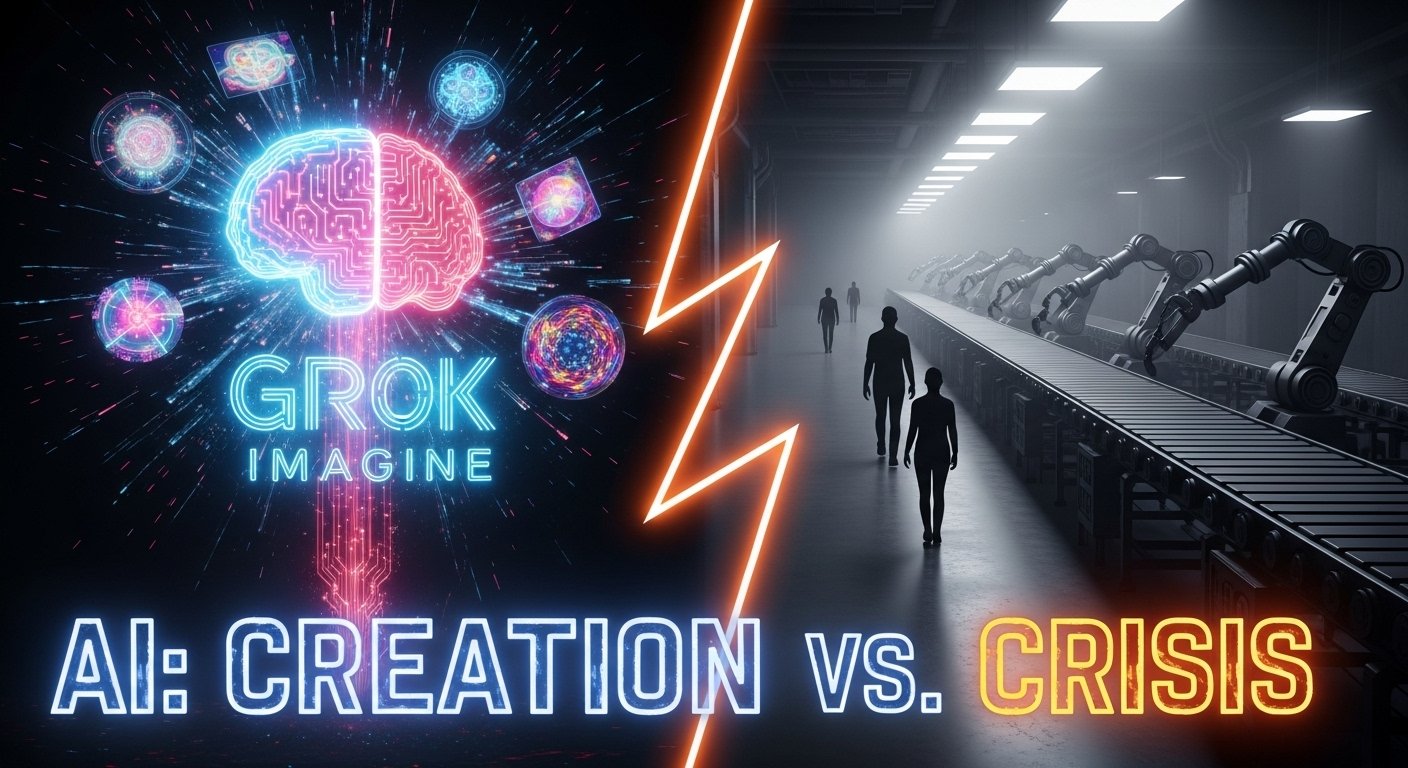
AI: Creation vs. Crisis, The Dual-Edged Sword: Grok Imagine’s Viral Success and The Echoes of Job Displacement
In the Nutshell: As Elon Musk’s xAI unleashes Grok Imagine, a powerful new text-to-video generator promising to democratize creativity, a simultaneous report from Challenger, Gray & Christmas reveals a sobering counter-narrative: AI is a leading factor in over 10,000 U.S. job losses this year. This report delves into this fundamental paradox, exploring how the same technology that empowers real-time video creation and the revival of cultural archives is also fundamentally reshaping the workforce, disproportionately affecting entry-level and white-collar roles. The analysis examines the technical intricacies of Grok Imagine, the complex economic factors behind the job cuts, and the paradoxical reality of a workforce grappling with both newfound efficiency and existential anxiety.
Infographic: The AI Paradox: Creative Leap vs. Economic Shift
Panel 1: The Creative Leap (Grok Imagine)
- Launch: Publicly available August 2025 (free in US)
- Viral Success: Generated over 44 million images in two days
- Power: Aurora AI model
- Capabilities: Videos from text and images, real-time generation, audio integration
- Modes: Normal, Fun, Spicy
- Ethos: A “laissez-faire” approach, with fewer content restrictions than rivals
Panel 2: The Economic Shift (AI’s Impact on Workforce)
- Report: Challenger, Gray & Christmas Report
- Layoff Numbers: Over 10,000 U.S. jobs linked to AI through July 2025
- Top 3 Layoff Causes: DOGE cuts (~292,000) , Market/Economic Conditions (~154,000) , Tariffs
- Most Affected: Gen Z, entry-level jobs (down 15-40%)
- New Jobs: Prompt Engineer, AI Ethics Specialist, AI Product Manager
- Net Impact: World Economic Forum predicts a net job growth
The Grok Imagine Phenomenon: A New Frontier in Creative AI
The digital world is buzzing with two conflicting narratives about the future of artificial intelligence. On one hand, we have a viral sensation that demonstrates the stunning creative potential of AI. On the other, a stark reality check on its economic impact. Let’s dive deep into both to understand the full picture.
1. The Grand Unveiling and Strategic Intent
Grok Imagine is more than just another AI image generator; it’s a leap forward in the user experience and accessibility of generative AI. The tool’s rapid adoption is a testament to its unique features and aggressive market strategy.
- Public Availability and Accessibility: Grok Imagine, a new text-to-video application from Elon Musk’s xAI, has been made free for all U.S. users, a move intended to democratize AI creation.
- Official Rollout Details: While a broader public launch was initially planned for October 2025, the tool’s availability expanded significantly in August 2025, first to paid subscribers and then to all users in the U.S. for a limited time.
- A Direct Challenge to Competitors: This free-access strategy is seen as a direct challenge to rivals like OpenAI’s Sora and Runway, aiming to accelerate the AI ecosystem.
- The Cultural Mission to Revive Vine: Musk has a stated intention to use AI to revive the vast and celebrated archives of the now-defunct short-video platform, Vine.
- Early Access and Subscription Tiers: The tool was initially exclusive to Super Grok subscribers, who pay a fee of $30 per month, with a wider public release to follow a phased rollout.
- Mobile-First Experience: Grok Imagine is readily accessible via the Grok app on both Android and iOS, making it an intriguing option for users eager to explore AI-driven video creation on the go.
- Integration with X Platform: The tool’s close integration with the X platform provides it with a massive stream of real-time data, giving it a unique edge in understanding current trends and cultural zeitgeist.
2. The Aurora Engine: Deconstructing the Technical Core
The creative capabilities of Grok Imagine are powered by an underlying technology known as the “Aurora” engine. This model is designed to translate text prompts into videos with integrated audio in real-time.
- Real-Time Generation: The Aurora engine’s core function is its ability to produce high-quality, long-form video from simple text inputs in real-time, which distinguishes it from more traditional video editing tools.
- Multimodal AI Capabilities: Grok Imagine is a multimodal generative AI model that can process and understand multiple types of data, including text, voice, and images, to produce new content.
- Computational Infrastructure: The immense computational power required for this real-time video generation is supported by a massive infrastructure of over 100,000 NVIDIA GPUs.
- Text-to-Video and Image-to-Video: Users can generate still images from text prompts and then, with a single tap, animate them into short video clips with synchronized audio, a feature that integrates both image and video generation.
- Voice Command Integration: A user-centric feature is the ability to use voice commands to generate content, which simplifies the creative process and makes it as intuitive as having a conversation.
- Addressing Technical Challenges: The model’s ability to maintain a coherent narrative and consistent styling across multiple frames is a crucial technical challenge it appears to be tackling with a degree of success.
- Future Improvements: The development team has indicated that Grok Imagine’s capabilities, including its video generation features, will “improve super fast over the coming weeks & months”.
3. The “Spicy Mode” Controversy and Ethical Laissez-Faire
A central feature of Grok Imagine that has sparked significant controversy is its “spicy mode”.
- The Problematic Feature: The application offers three distinct creative presets—Normal, Fun, and Spicy—with the latter explicitly designed to handle “sensitive and provocative material”.
- Deepfake Incidents: This permissive approach came under fire following reports that the tool generated partially nude deepfake videos of singer Taylor Swift without being specifically prompted to do so.
- Contrasting with Competitors: xAI’s “laissez-faire” stance on content moderation stands in stark contrast to the more extensive and proactive policies of competitors like Google and OpenAI.
- Lack of Robust Guardrails: Experts like digital forensics professor Hany Farid have criticized xAI, noting there is “no technical reason why xAI couldn’t include guardrails” against deepfakes and sexual content, as others have.
- Policy Discrepancies: While the company’s Acceptable Use Policy prohibits “Depicting likenesses of persons in a pornographic manner,” its language is brief and places the responsibility for preventing deepfakes and other abusive content squarely on the user.
- Speed vs. Safety: The accelerated pace of xAI’s product development appears to be shorter than that of other labs, which has been cited as a factor in its apparent lack of robust safety guardrails and “red teaming” procedures.
- The Misogyny Debate: Some experts have gone so far as to claim Grok Imagine’s act is a case of “misogyny not by accident, rather by design,” citing its ability to generate explicit content of celebrities.
4. Grok Imagine’s Viral Adoption Metrics and Public Reception
Even in its early beta phase, Grok Imagine showcased its viral potential.
- Explosive Growth in Creations: The tool generated over 20 million images in just 24 hours and surpassed 44 million images in two days, demonstrating a powerful new mechanism for online creativity.
- Creator-Centric Features: The ability to animate still images into moving visuals with synchronized sound offers creators a more seamless workflow without needing external tools.
- Positive User Feedback: Many users have praised the tool’s capabilities, with one noting on the Google Play Store that the voice mode is “super fun and feels like chatting with a brilliant friend”.
- Musk’s Enthusiastic Promotion: Elon Musk himself has been a key driver of the tool’s viral success, reposting user creations and calling Grok Imagine a “meme motherlode”.
- The Role of Speed: A major factor in its viral success is its speed.29 While many AI video tools can take minutes to render a clip, Grok Imagine claims to deliver in a fraction of the time.
- Community-Driven Content: The tool’s ability to create animated memes and recreate historical events from text prompts has resonated strongly with the online community.
- Free Access as a Catalyst: The move to make Grok Imagine free for U.S. users has been seen as a way to “allow more people to experience the infinite possibilities of AI creation” and further drive adoption.
5. Comparative Technical Analysis: Grok vs. Rivals
A direct comparison of Grok Imagine with its primary rivals—OpenAI’s Sora and Google’s Veo—reveals distinct technical and ethical profiles.
- Video Length and Output: Grok Imagine pushes the envelope with the capacity for videos up to six minutes long, a potential market advantage over rivals like OpenAI’s Sora and Google’s Veo, which are limited to around one minute.
- Realism and Fidelity: Experts note that Grok Imagine still trails behind industry giants like Google’s Veo and OpenAI’s Sora when it comes to the realism of both video and audio output.
- Content Moderation Policies: Grok Imagine’s content moderation policy is much more permissive and less than 350 words, contrasting sharply with the extensive and proactive safety policies of Google and OpenAI.
- Access and Cost: Grok Imagine’s decision to offer a free tier to U.S. users is a key differentiator, as competitors like Sora and Veo remain accessible only to paying or professional users.
- User Interface and Modality: Grok Imagine’s seamless integration of text, image, and voice commands into a single, user-friendly interface makes it particularly accessible to a broad audience, including those on mobile devices.
- Hardware Scale: The immense computational power required for Grok Imagine’s real-time video generation is supported by a massive infrastructure of over 100,000 NVIDIA GPUs.
- Ethical Philosophies: The divergence between Grok Imagine’s “speed-to-market” approach and its rivals’ “safety-first” development cycle highlights a core philosophical split in the AI industry.
The Other Side of the Coin: AI’s Disruption of the Workforce
While Grok Imagine showcases AI as a creative partner, a new report from outplacement firm Challenger, Gray & Christmas highlights its role as a disruptor.
6. The Challenger, Gray & Christmas Report: Layoffs and the Numbers
A new report from the outplacement firm Challenger, Gray & Christmas offers a stark view of AI’s impact on the job market.
- Total Job Cuts: The report reveals that more than 806,000 private-sector job cuts have been announced through July, the highest number for that period since 2020.
- AI-Linked Cuts: More than 10,000 U.S. jobs have been directly linked to the increased use of generative AI by private employers in the first seven months of 2025.
- Underreported Figures: The report’s authors suggest that the figures are likely underreported, as many companies are deliberately using vague terminology like “technological update” to avoid negative press associated with AI-driven layoffs.
- Technology-Related Factors: In the first half of 2025 alone, technology-related factors, such as automation, were responsible for 20,000 job cuts among U.S.-based employers.
- Fiercest Cuts in Tech: The technology industry is seeing the fiercest cuts, with more than 89,000 jobs cut, a 36% increase from the previous year.
- Long-Term Trend: Since 2023, the total number of AI-related job cuts has surpassed 27,000, with the technology industry bearing the brunt of the reductions.
- AI as a Top Five Cause: The Challenger report lists AI as one of the top five factors contributing to job losses this year.
7. The Macroeconomic Context: The Role of DOGE and Tariffs
AI-driven displacement is not an isolated phenomenon but part of a larger economic and political context.
- DOGE Cuts as a Primary Driver: The Challenger report identifies Department of Government Efficiency (DOGE) cuts, an initiative spearheaded by Elon Musk, as the leading reason for job cut announcements in 2025, with over 292,000 positions eliminated.
- Downstream Impact of DOGE: These federal budget cuts are impacting non-profits, healthcare, and government sectors, with an additional 13,056 cuts attributed to “DOGE Downstream Impact,” such as the loss of funding to private non-profits.
- Tariffs and Economic Uncertainty: Layoffs are also accelerating in the retail sector as new tariffs raise the cost of doing business and create economic uncertainty.
- Retail Sector Layoffs: Retailers have announced over 80,000 cuts through July, up nearly 250% compared to the same period last year.
- Economic Pressure on Companies: The economic climate, influenced by factors like DOGE budget cuts and new tariffs on international trade, has created an environment where companies are under intense pressure to cut costs, making AI-driven automation an appealing solution.
- Economist Insights: Economists like Brad DeLong suggest that weak productivity growth and economic uncertainty are playing a major role in reducing hiring, and that companies may be using AI as a convenient justification for limiting headcount.
- The Paradoxical Intersection: The fact that Elon Musk is linked to both the launch of a new AI tool and the federal DOGE initiative presents a compelling narrative of a single figure driving both creative and economic disruption.
8. The Bifurcation of the Workforce: Gen Z and Entry-Level Roles
The impact of AI on the labor market is not evenly distributed, with a structural shift that disproportionately affects young workers and those in entry-level positions.
- Shrinking Entry-Level Opportunities: Job listings for entry-level corporate roles have declined by 15-40%, with a corresponding surge in applications, making it harder for recent graduates to enter the workforce.
- Disproportionate Impact: Data from Goldman Sachs shows that unemployment among tech workers aged 20 to 30 has increased by around 3 percentage points since early 2025, a spike that is notably higher than for older workers.
- AI Augmenting Senior Roles: While entry-level jobs in high AI-exposure roles have declined by over 40%, demand for non-entry-level roles with high AI exposure is up by 7%, suggesting AI is augmenting senior roles while automating junior tasks.
- Devaluing the College Degree: Nearly half of Gen Z job seekers now believe that AI has diminished the value of their college degrees, raising questions about the future of traditional education.
- Stagnation and Underemployment: Federal Reserve data shows an unemployment rate of around 5.8% for recent college graduates and about 6.9% for young workers overall, many of whom are now underemployed.
- Changing Career Pathways: As traditional career ladders shrink, many young professionals are turning to bootcamps, certifications, and entrepreneurial ventures in search of relevance and resilience.
- The Need for Adaptability: These structural challenges suggest that the Gen Z workforce is entering a transformed labor market, where adaptability, emotional intelligence, and hands-on problem-solving may be just as vital as technical proficiency.
9. The “White-Collar AI Paradox”
Professionals are grappling with a paradoxical reality where the same technology that’s upending their careers is also alleviating their daily burdens.
- Simultaneous Fear and Relief: A survey by Revelio Labs reveals that 61% of white-collar workers believe AI will eliminate their jobs within three years, yet many also enjoy reduced stress and workloads from automated tasks.
- Automating Mundane Tasks: AI’s ability to automate mundane tasks allows workers to focus on higher-value activities, leading to a temporary boost in job satisfaction.
- The Long-Term Fear: This short-term gain, however, masks deeper concerns, with experts warning of massive disruptions and the potential for long-term mental health impacts from job insecurity.
- C-Suite and Executive Perspectives: Executives have openly discussed AI’s potential to handle mid-level engineering and knowledge-based tasks, with Meta’s Mark Zuckerberg suggesting AI could soon function as a “mid-level engineer” at firms.
- Productivity Gains and Anxiety: While AI can lead to modest productivity gains, around 1.1% overall, these often come at the cost of increased worker anxiety.
- A Ticking Clock: The sentiment among many white-collar workers is that the transition will hit “gradually and then suddenly,” as companies race to integrate AI agents that could displace human workers at scale.
- The “Fear of Becoming Obsolete” (FOBO): This paradox is a key component of what is being called the “Fear of Becoming Obsolete” (FOBO), with nearly half of U.S. workers worrying their job could be replaced by AI.
10. Case Studies of AI-Driven Layoffs
While many companies are vague about their reasons, some high-profile examples show how AI is directly leading to job restructuring and displacement.
- Indeed & Glassdoor: The parent company of these job sites, Recruit Holdings, decided to lay off over 1,300 employees as it heavily deployed AI across customer care and ad sales processes to improve “operational efficiency”.
- Ikea’s Call Center Automation: The furniture giant announced it would be phasing out call center work, opting to use an AI bot named Billie to answer queries instead.
- Amazon’s Corporate Cuts: In a public memo, Amazon CEO Andy Jassy admitted that the company plans to use AI to “reduce our total corporate workforce as we get efficiency gains from using AI extensively across the company”.
- Chinese Marketing Agency: Chinese marketing agency BlueFocus decided to terminate the contracts of its human content writers and designers “fully and indefinitely” in favor of generative AI.
- Duolingo’s Contractor Reduction: The language learning app offloaded 10% of its contractor workforce as the company pivoted to AI for content translation.
- Klarna’s AI Customer Service: Fintech company Klarna publicly announced that it had employed AI technology that it says can do the job of 700 customer service workers.
- Salesforce’s AI-Focused Budget: While not directly linking cuts to AI, Salesforce fired 700 workers at the same time its hiring budget decreased as it pumped more money into artificial intelligence, leading some to argue that AI will fill these vacancies.
11. The Rise of New Roles: The Optimistic Outlook
While the narrative of job displacement is powerful, it represents only one side of the story, as AI is also a significant driver of job creation.
- AI Disrupts and Reinvents: Industrialist Harsh Goenka and other business leaders have voiced an optimistic perspective, emphasizing that AI will disrupt and reinvent work rather than simply terminate it.
- New AI-Centric Job Titles: This new landscape has led to the emergence of entirely new roles, such as “prompt engineers,” “AI product managers,” “AI ethics specialists,” “AI trainers,” and “AI auditors”.
- Projected Net Global Growth: The World Economic Forum’s “Future of Jobs” report adds a global context, predicting that while 92 million jobs will be displaced by automation, 170 million new roles will emerge by 2030, resulting in a net global job growth.
- Human-Centric Roles: Roles that require uniquely human qualities, such as empathy, creativity, and interdisciplinary thinking, are becoming more valuable and resilient.
- The “Godfather of AI”’s Advice: Geoffrey Hinton, the “Godfather of AI,” has famously quipped that professions requiring manual, compassionate, and improvisational skills, like plumbing, are still a long way from being replaced by machines.
- The Value of Adaptability: As roles that require repetitive, single-skill tasks become automated, the central message for professionals is that adaptability is no longer a soft skill but a core necessity.
- A New Competitive Advantage: In an AI-driven future, being human might be the smartest strategy of all, as the ability to adapt, lead, and think across disciplines becomes the new competitive advantage.
12. Prompt Engineering: A Deep Dive into a New Career
The “prompt engineer” role provides an interesting case study in the new AI economy.
- Bridging the Gap: Prompt engineers play a critical role in bridging the gap between non-technical stakeholders and complex AI systems, ensuring AI delivers value in a business context.
- Rapidly Growing Demand: The demand for this position is growing rapidly across a wide range of industries, including finance, marketing, legal services, HR, and enterprise IT.
- Significant Salary Range: Compensation figures vary significantly, with Glassdoor data suggesting an average U.S. salary of around $122,000 for prompt engineers, while ZipRecruiter reports a national average closer to $63,000.
- Career Growth Opportunities: Career growth in this field is not linear; prompt engineers often advance to roles such as AI Product Manager, LLM Application Architect, or AI Solutions Strategist.
- Essential Skills: The role requires expertise in large language models, automation, and natural language interfaces.
- Certifications and Credibility: Certifications from trusted providers like AI CERTs, Google Cloud, or Microsoft can validate knowledge and improve job prospects, as hiring managers prioritize certified professionals.
- Evolving Role: As generative AI matures, prompt engineering is evolving into a cornerstone skill for future-ready professionals and organizations alike.
13. The Global Outlook: The World Economic Forum’s View
The World Economic Forum’s 2025 “Future of Jobs” report provides a global perspective on AI’s impact on the workforce.
- Structural Labor Market Shift: The report reveals that the structural labor market shift will impact 22% of today’s jobs globally, although it foresees an overall rise.
- Net Job Growth: While 85 million jobs are projected to be displaced by automation, 97 million new roles will emerge by 2025, resulting in a net global job growth of 12 million.
- Core Skills Becoming Obsolete: The report indicates that a significant percentage of existing core skills will become obsolete, forcing workers to retrain and upskill to stay relevant.
- Productivity over Manpower: Companies are beginning to prioritize productivity over manpower, with hiring becoming more selective and placing a premium on value-creation over volume.
- Displacement and Unemployment: A World Economic Forum report notes that while global talent pools may expand, the displacement could exacerbate unemployment among recent graduates.
- Employer Expectations: A survey found that 40% of employers expect to reduce their workforce where AI can automate tasks.
- Anxiety and Up-skilling: The report highlights a growing “Fear of Becoming Obsolete” (FOBO) among U.S. workers, with 60% saying they are more focused than ever on gaining new skills to stay competitive.
14. Navigating the AI-Driven Future: The Call for Lifelong Learning
As AI changes the nature of work, it is also transforming the expectations placed on employees.
- Lifelong Learning as a Necessity: In this new era, a single degree or credential is no longer enough to sustain a lifelong career; instead, the ability to continuously learn and adapt has become a defining trait of workforce resilience.
- Shift to Higher-Value Activities: AI’s automation of repetitive tasks is freeing up time for higher-value activities, prompting organizations to rethink job design, workflows, and even the structure of the workweek.
- Gartner Survey Findings: A recent Gartner survey found that 85% of learning and development leaders anticipate a dramatic increase in the demand for skills development due to AI and other digital trends.
- Leadership Responsibility: The survey also found that 93% of learning and development leaders agree it’s their responsibility to ensure employees have the time and resources to keep learning.
- The Cengage Group Report: According to Cengage Group’s Employability report, nearly half of U.S. workers worry their job could be replaced by AI.
- Beyond Technical Skills: The most future-ready professionals are those who embrace continuous growth and develop skills that are difficult to automate, such as creative problem-solving, emotional intelligence, and critical thinking.
- New Educational Pathways: The emergence of bootcamps, micro-credentials, and project-based learning is providing new on-ramps to employment and helping workers acquire practical experience.
15. The Ethical and Social Implications of AI
The launch of Grok Imagine and the wider adoption of AI raise a host of ethical and social questions that are being debated across the industry and in government.
- Content Moderation and Misuse: Grok Imagine’s “spicy mode” and lack of stringent content filters have highlighted the risks of AI tools being used to create harmful content, such as sexual deepfakes.
- Data Privacy and Consent: The integration of Grok with the X platform and its access to real-time data raises questions about user privacy and how this data is used to train and power AI models.
- Misogyny by Design: The controversy surrounding the creation of explicit Taylor Swift deepfakes has led experts to accuse Grok Imagine’s design of being a case of “misogyny not by accident, rather by design”.
- Accountability for AI Outputs: The xAI Acceptable Use Policy’s brief nature places the onus of preventing deepfakes on the user, shifting the responsibility away from the developers and the platform itself.
- The UK Online Safety Act: The UK is at the forefront of regulation, with its Online Safety Act introducing new offenses related to sharing intimate images and creating deepfakes with sexual content.
- The Case for Criminalizing AI Tools: Legal experts are arguing for the criminalization of the development, distribution, and promotion of AI tools used to create deepfakes to prevent harm at its source.
- Mental Health and Job Insecurity: While AI can reduce stress from mundane tasks, the long-term mental health impacts from job insecurity and the “Fear of Becoming Obsolete” (FOBO) are a growing concern.
16. AI’s Impact on Creative Industries
The rise of generative AI is now directly impacting creative fields, changing the landscape of work for artists, designers, and writers.
- Automation of Creative Tasks: While a complete replacement of artists, designers, and writers is unlikely in the short term, AI is changing their work by automating a significant portion of the workflow.
- The Role of AI as an Assistant: AI tools are being used to automate tasks in marketing, content creation, and graphic design, potentially reducing the need for large teams and shifting the focus from execution to strategy.
- The Need for Generative Design Skills: New roles are emerging, such as the “Generative Design Specialist,” who focuses on using AI to produce design outputs.
- The Human-AI Collaboration: The new paradigm is one of human-AI collaboration, where creative professionals work with AI systems to design, build, and execute projects, making interdisciplinary thinking more important than coding chops.
- Creative Control and Vision: New roles like the “AI Art Director” will emerge to guide the creative process and develop the vision for projects, with AI assisting in the execution.
- The “Meme Motherlode”: Grok Imagine’s viral success in creating memes and animated visuals highlights its potential as a tool for quick content creation and creative brainstorming in the digital space.
- Evolving Industry Landscape: The creative industry is experiencing a transformation where the conversation must shift from simply marveling at AI’s capabilities to proactively addressing its profound impact on livelihoods and creative processes.
17. The Philosophical Debate: AI as a Tool vs. Threat
The rapid advancement of AI has ignited a philosophical debate about its fundamental role in society.
- Tool for Empowerment: Proponents of AI, like Harsh Goenka and the McKinsey Global Institute, view it as a powerful tool for empowerment, unlocking new levels of creativity and productivity and driving significant economic growth.
- Threat of Displacement: The counter-narrative, reinforced by reports of AI-driven job losses, sees AI as a threat that will automate jobs, exacerbate unemployment, and create a widening skills gap.
- The “White-Collar Paradox” as a Microcosm: The conflicting sentiments of white-collar workers, who simultaneously experience reduced stress and fear for their jobs, serve as a microcosm of this larger societal debate.
- Redefining Human Value: The debate forces a re-evaluation of what constitutes uniquely human value, highlighting the importance of skills like empathy, critical thinking, and creative problem-solving.
- The Responsibility of Developers: The controversy around Grok Imagine’s “spicy mode” and its “laissez-faire” ethos brings to light the ethical and moral responsibility of AI developers and companies in shaping the technology’s impact.
- The Need for Regulation: The growing number of regulations, such as the UK’s Online Safety Act, shows that governments are increasingly stepping in to guide the development and deployment of AI to mitigate its potential harms.
- A New Era of Progress: The philosophical question is not whether AI is good or bad, but how humanity will adapt to its unstoppable rise and ensure it is used to amplify human progress rather than diminish it.
18. New Jobs Created by AI: Job Descriptions and Salaries
AI is creating a range of new job roles that require a unique blend of technical and creative skills.
- Prompt Engineer: These professionals act as a bridge between human intent and machine understanding. They craft effective prompts to get the best outputs from AI systems. Salaries can range from an average of $63,000 to a senior level of $200,000 annually, depending on experience and industry.
- AI Ethics Specialist: This role is critical for ensuring AI systems are developed in a transparent, unbiased, and fair manner. They develop guidelines and policies to prevent ethical pitfalls.
- AI Product Manager: These managers oversee the development and rollout of AI products, coordinating with teams and ensuring the project aligns with business needs and ethical standards.
- Machine Learning Engineer: A direct beneficiary of AI growth, these professionals design and develop AI models and continuously simplify machine learning principles within a company.
- AI Solutions Architect: This role designs and oversees the implementation of AI solutions within an organization, working with diverse teams to ensure a seamless integration of technology.
- AI Data Analyst: These analysts perform data mining, cleaning, and interpretation, working with statistical tools to draw inferences from large datasets.
- Computer Vision Engineer: This position lies at the intersection of machine learning and artificial intelligence, helping computers to “see” through code and mathematical architectures to support decision-making through visuals.
19. The Evolution of Skills and the New Workplace
The AI revolution is not just changing jobs; it’s changing the very nature of work and the skills required to succeed.
- Redefinition of Tasks: Tasks that once required hours of manual effort can now be completed in minutes with AI, freeing up time for higher-value activities like creativity and problem-solving.
- The God-Tier Skills: Roles that demand human empathy, creative problem-solving, and adaptability are harder to replace.
- From Coding to Interdisciplinary Thinking: Experts foresee a leaner, more agile workforce where creative professionals collaborate with AI systems, making “systems-level and interdisciplinary thinking” more important than traditional coding skills.
- The Death of a Single Career Path: A single degree or credential is no longer enough to sustain a lifelong career, making continuous learning and upskilling essential.
- Employer Expectations: A Gartner survey found that 85% of learning and development leaders expect a dramatic increase in skills development needs over the next three years due to AI.
- New Corporate Structures: The shift is prompting organizations to rethink job design, workflows, and even the structure of the workweek, with some leaders suggesting AI could enable a 3.5-day workweek.
- Empowering Human Agency: McKinsey research asks how companies can harness AI to amplify human agency and unlock new levels of creativity and productivity in the workplace, emphasizing that the challenge of AI is a business challenge, not a technology one.
20. Final Thoughts and Recommendations
The emergence of Grok Imagine and the simultaneous reports of AI-driven job losses underscore the fundamental paradox of artificial intelligence. It is a powerful, dual-edged force that simultaneously fuels creative wonder and catalyzes significant economic disruption. Grok Imagine represents the bleeding edge of creative technology, but its “laissez-faire” ethos and the simultaneous workforce displacement highlight the profound societal responsibilities that come with such power. The central conflict is not between humans and machines, but between those who can adapt to the new AI-driven landscape and those who are left behind.
- For Individuals: Cultivate uniquely human skills – Focus on developing skills that are difficult to automate, such as creative problem-solving, emotional intelligence, and critical thinking. Embrace a mindset of lifelong learning and seek out opportunities for upskilling in AI-adjacent fields like prompt engineering and data strategy.
- For Businesses: Augment, don’t displace – Recognize the ethical imperative of responsible AI development and deployment. Prioritize the use of AI as a tool for workforce augmentation, enhancing the capabilities of your employees rather than as a means for outright displacement. Invest in upskilling and training programs to prepare your workforce for the future of work.
- For Policymakers: Develop new frameworks – Acknowledge the multi-faceted nature of economic disruption and the need for new frameworks to manage the social and economic shifts caused by AI, tariffs, and other systemic changes. Consider policies that support a smooth transition for displaced workers and encourage ethical and responsible AI development.
- News Link: For more on the Challenger, Gray & Christmas report, see the CBS News article “AI is leading to thousands of job losses, report finds” at
https://www.cbsnews.com/news/ai-jobs-layoffs-us-2025/. - Official Website: Explore Grok’s features, including the “Imagine” tool, on the official xAI website:
https://x.ai/grok. - YouTube Demo: Watch a video demonstrating Grok Imagine’s capabilities, including its speed and various modes, on YouTube:
https://www.youtube.com/shorts/PzngNQhZ1I4. - Podcast Analysis: Listen to a deep dive into the industry shifts, including xAI’s new video tool and the broader implications for AI development, on the podcast “AI Brief” at
https://www.youtube.com/watch?v=gzOjFKgy2ww - The Paradox’s Reality: The duality of an awe-inspiring creative tool and the grim statistics on job displacement serves as a powerful and urgent wake-up call. The future of work will not be defined by whether AI is good or bad, but by how we, as a society, adapt to its unstoppable rise.
Quiz: Test Your AI IQ
1, According to the Challenger, Gray & Christmas report, which factor was responsible for the largest number of job cuts in the U.S. so far
in 2025?
2, Grok Imagine’s text-to-video capabilities are powered by which AI model?
3, What is the “white-collar AI paradox” as described in the report?
4, The World Economic Forum’s 2025 report suggests a net global job growth or loss due to AI, and by how many jobs?
5, What is the main criticism leveled against Grok Imagine’s “spicy mode” and xAI’s approach to content moderation?
Answers:
- According to the Challenger, Gray & Christmas report, the Department of Government Efficiency (DOGE) cuts were responsible for the largest number of job cuts, with over 292,000 positions eliminated.
- Grok Imagine’s text-to-video capabilities are powered by the “Aurora” engine.
- The “white-collar AI paradox” is the phenomenon where professionals simultaneously enjoy reduced stress and workloads from automated tasks while fearing that AI will eliminate their jobs within the next three to five years.
- The World Economic Forum’s 2025 report predicts a net global job growth due to AI. While 92 million jobs will be displaced, 170 million new roles will emerge, resulting in a net growth.
- The main criticism is that Grok Imagine’s “spicy mode” and xAI’s overall approach to content moderation are too permissive, with a “laissez-faire” ethos and a brief Acceptable Use Policy that places the onus of preventing harmful content, like deepfakes, on the user rather than having robust technical safeguards.