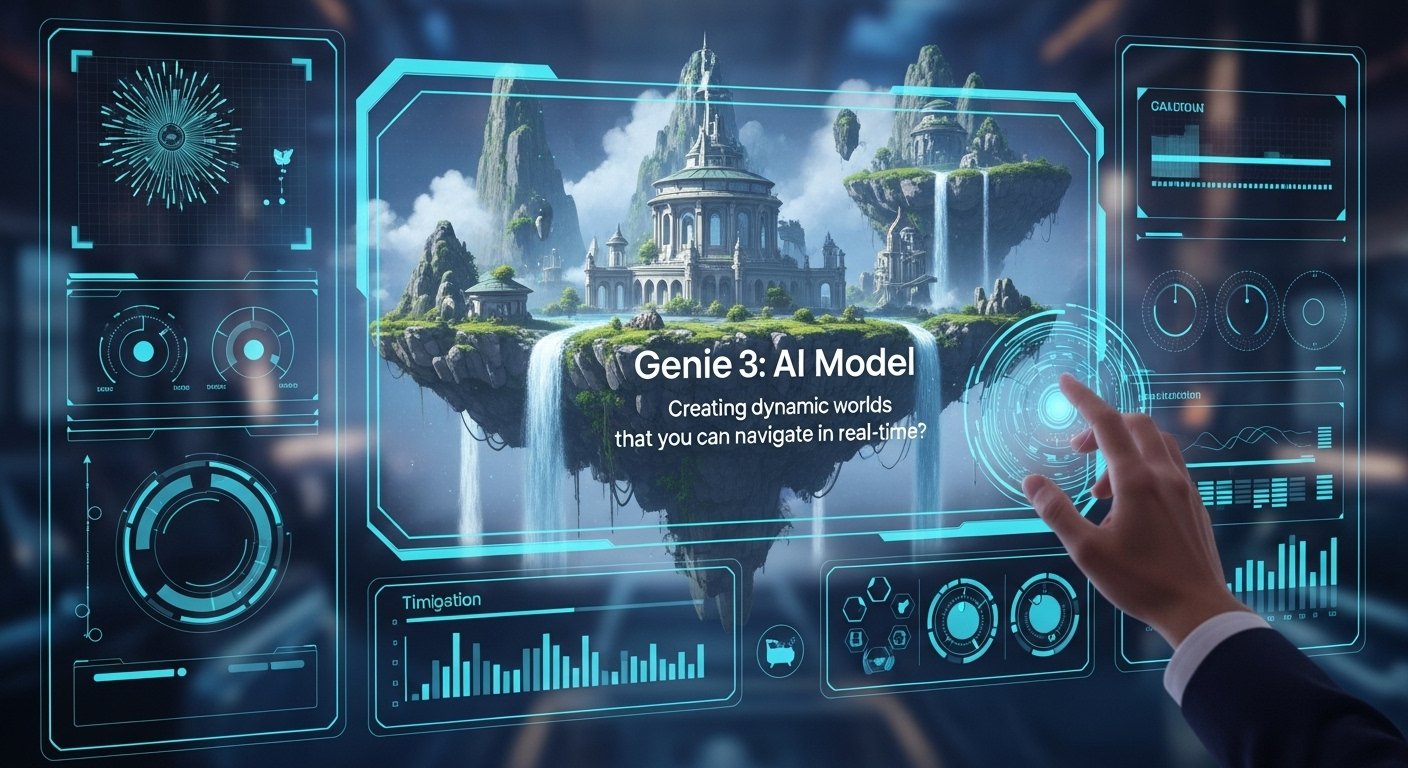
Genie 3: Creating Dynamic Worlds You Can Navigate In Real Time
Step into the Future: Imagine a world born from your words, where every action you take reverberates through a living, breathing digital landscape that responds instantly to your presence. This isn’t science fiction; it’s the groundbreaking reality of Google DeepMind’s Genie 3.
In The Nutshell: Google DeepMind has just unveiled Genie 3, a revolutionary general-purpose world model that shatters previous boundaries in generative AI. Unlike traditional video generation or static simulations, Genie 3 creates fully interactive, dynamic 3D worlds from simple text prompts, allowing users to navigate and influence these environments in real-time at a smooth 24 frames per second. This marks a monumental leap towards truly immersive digital experiences and offers unprecedented possibilities for gaming, robotics, scientific research, and the very path to Artificial General Intelligence (AGI). It’s a system that doesn’t just show you a world; it lets you live in it.
Genie 3 at a Glance: An Infographic Overview
Imagine an infographic titled “Genie 3: The Future of Interactive Worlds.” It would feature a central, vibrant illustration of a user navigating a dynamically generated 3D environment. Around this core image, several key points would branch out
- Prompt to Play: A visual of a text box transforming into a sprawling, interactive landscape, emphasizing the text-to-world generation.
- Real-Time Responsiveness: A speedometer icon next to “24 FPS” and “Real-Time Navigation,” highlighting the fluid interaction.
- World Memory & Consistency: An icon of a brain or a consistent landscape, illustrating how changes persist and the environment remains coherent.
- High Fidelity: A magnifying glass over “720p Resolution,” showcasing the improved visual quality.
- Dynamic Events: A thought bubble with “Add deer,” “Change weather,” etc., demonstrating the “promptable events” feature.
- Core Applications: Icons representing gaming controllers, robots, and scientists, pointing to “Gaming & Entertainment,” “Robotics & AI Training,” and “Scientific Research.”
- Evolution: A small timeline showing “Genie 1 (Image Input, 2D)” -> “Genie 2 (360p, Limited Consistency)” -> “Genie 3 (720p, Real-Time, Consistent, Promptable).”
- The AGI Path: A subtle arrow pointing towards “Artificial General Intelligence,” indicating its long-term vision.
Genie 3: The Dawn of Truly Interactive AI Worlds
The landscape of generative artificial intelligence is evolving at an astonishing pace, constantly pushing the boundaries of what machines can create. For years, we’ve seen remarkable progress in generating static images and even short video clips. However, the dream of truly dynamic, interactive virtual worlds, where users can freely navigate and influence the environment in real-time, has remained largely out of reach. This is precisely the frontier that Google DeepMind’s Genie 3 has now decisively crossed, ushering in a new era of AI-powered simulation. This innovative world model is poised to redefine our understanding of digital interaction and virtual reality. Its capabilities extend far beyond mere visual fidelity, delving into the very fabric of simulated existence.
What is Genie 3 and How Does It Work?
At its core, Genie 3 is a general-purpose world model designed to generate an unprecedented diversity of interactive environments. You provide a text prompt, and Genie 3 springs into action, constructing a rich, consistent, and navigable digital world right before your eyes. This process involves complex neural networks that learn to understand the relationships between objects, physics, and user actions from vast datasets. The model essentially builds an internal representation of a world, then renders it dynamically based on your input. This sophisticated architecture allows for a level of responsiveness previously unattainable in generative AI systems. The underlying algorithms are trained to predict not just the next frame, but the entire environmental response to user input.
The most striking feature of Genie 3 is its ability to allow real-time navigation. Users can move through these generated worlds at a fluid 24 frames per second, experiencing a responsiveness akin to modern video games. This real-time capability is crucial for creating truly immersive experiences, eliminating the frustrating lag often associated with earlier generative models. The low latency ensures that your movements and interactions feel natural and immediate, making the virtual world feel genuinely alive. This responsiveness is a testament to the model’s optimized architecture and efficient inference processes.
Furthermore, Genie 3 demonstrates impressive consistency within its generated environments. While previous models might suffer from “hallucinations” or inconsistencies over time, Genie 3 maintains a coherent world for several minutes at a crisp 720p resolution. This means that if you paint a wall, that paint remains when you return to that spot, and if you alter the terrain, those changes persist. This “world memory” is a critical advancement, ensuring that interactions have lasting effects and build a believable narrative within the simulated space. The persistence of objects and environmental states is a key differentiator, allowing for more complex and meaningful interactions.
A Leap Forward from Genie 2
Genie 3 represents a significant evolutionary step from its predecessor, Genie 2. While Genie 2 was already a pioneering “foundation model for playable worlds,” Genie 3 elevates the experience dramatically. Genie 2 could generate interactive environments from image prompts, but its resolution was limited to 360p, and its environmental consistency often began to degrade after less than a minute of interaction. This made sustained engagement challenging and limited the complexity of possible scenarios. The advancements in Genie 3 directly address these limitations, providing a far more robust and engaging platform.
The improvements in Genie 3 are not merely incremental; they are foundational. The jump to 720p resolution provides a much clearer and more detailed visual experience, making the generated worlds feel more tangible and realistic. More importantly, the enhanced consistency and real-time interaction at 24fps fundamentally change the nature of engagement. With Genie 3, users are no longer just observing; they are actively participating in the creation and evolution of the world. This qualitative leap transforms the user experience from passive viewing to active exploration and manipulation.
One of the most exciting new capabilities introduced in Genie 3 is “promptable events.” This feature allows users to dynamically alter the state of the generated world with additional text prompts while navigating it. Imagine skiing down a mountain generated by Genie 3, and then simply typing “add a herd of deer.” Instantly, deer appear and begin to interact with the environment, reacting to the terrain and your presence. This on-the-fly modification capability opens up endless possibilities for dynamic storytelling, rapid prototyping, and adaptive training scenarios. The ability to inject new elements and behaviors instantly makes the worlds incredibly versatile.
Genie 3: A Comparison of AI World Models
To truly appreciate the advancements of Genie 3, it’s helpful to compare it against other prominent AI models in the realm of environment generation and video synthesis. Let’s look at how Genie 3 stacks up against OpenAI’s Sora and Google’s original Genie model.
| Feature | Genie 3 (Google DeepMind) | Sora (OpenAI) | Google’s Original Genie (Google DeepMind) |
| Input Type | Text prompt | Text prompt | Single image, photo, or sketch |
| Output | Interactive 3D environment | High-fidelity video | Interactive 2D environment |
| Real-Time Navigation | ✅ Yes (24 FPS) | ❌ No (passive video) | ✅ Yes (approx. 1 FPS initially) |
| Action Modeling | Latent actions learned from data, explicit physics | Limited understanding of physics/causality | Latent actions learned from data |
| Consistency Horizon | Several minutes (720p) | Up to 20 seconds (1080p) | Limited frames (e.g., 16 frames memory) |
| Primary Use Case | Game prototyping, agent training, general world simulation | Creative video generation, filmmaking | Game prototyping, robotics, interactive art |
| Dimension | 3D | 3D-looking video | 2D side-scrolling |
| Dynamic Events | ✅ Yes (promptable events) | ❌ No | ❌ No |
Key Takeaways:
- Sora excels at generating visually stunning, high-definition video clips, making it a powerful tool for cinematic content creation. However, its output is fundamentally passive; it’s a pre-rendered video, not an interactive world you can navigate or influence in real-time. It struggles with consistent physics and cause-and-effect over longer durations.
- Google’s Original Genie was a groundbreaking “foundation model for playable worlds” that could generate interactive 2D environments from images. It demonstrated the concept of learning controls from unlabeled video data. While interactive, its resolution and consistency were more limited compared to its successors.
- Genie 3 finds the sweet spot by combining the generative power with real-time interactivity and enhanced consistency. It offers visually coherent, user-controllable 3D worlds built from simple text inputs, making it ideal for game developers, educators, and AI researchers who need dynamic, responsive environments for exploration and training. Its promptable events further differentiate it, allowing on-the-fly modifications to the world.
Genie 3 in Action: Real-World Examples
The practical applications of Genie 3 are vast and transformative. Its ability to generate dynamic, interactive worlds from simple inputs unlocks entirely new possibilities across various domains.
Imagine you draw a doodle of a mountain with a cave entrance. Genie 3 can:
- Generate a playable side-scroller level: Complete with platforms, gravity, and collision detection, allowing a character to navigate the terrain. This drastically speeds up the initial design phase for game developers.
- Let you control a character: You can manipulate an avatar that walks, jumps, or even realistically falls off ledges, responding directly to your commands within the generated environment. This provides immediate feedback for designers and researchers.
- Create physical responses: Like pushing a box that rolls down a slope, or triggering falling rocks that obey simulated physics—all learned implicitly from vast datasets, not pre-coded game engine rules. This demonstrates a deep understanding of environmental dynamics.
These capabilities have major implications for:
- Indie game developers: Rapid prototyping of level design, iterative testing of game mechanics, and generating endless variations of environments without extensive manual asset creation.
- Interactive storytelling: Creating story-driven experiences where the narrative and environment dynamically adapt to player choices, leading to truly personalized and emergent adventures.
- AI agent training: Building low-cost, diverse, and testable environments for training AI agents in complex scenarios, allowing them to learn robust behaviors before deployment in the real world.
✅ Try it live: When Google DeepMind releases public demos of Genie 3, users will be able to upload an image or input a text prompt and instantly explore the world it creates — no Unity, no Unreal, just your imagination and a browser. This accessibility will democratize world creation.
Genie 3 vs. Sora: A Tale of Two Generative Models
When discussing cutting-edge generative AI, OpenAI’s Sora often comes to mind. Sora has garnered significant attention for its ability to generate highly realistic, high-definition videos from text prompts. However, it’s crucial to understand the fundamental difference in purpose and capability between Sora and Genie 3. While both deal with visual generation, their core functionalities diverge significantly. Sora excels at creating cinematic, pre-rendered video clips, whereas Genie 3 focuses on real-time, interactive world simulation.
Sora’s strength lies in producing visually stunning, fixed video sequences. It’s a powerful tool for filmmakers, content creators, and artists looking to generate high-quality visual narratives without the need for traditional animation or filming. However, Sora’s output is not designed for real-time navigation or dynamic interaction. Once a Sora video is generated, it’s a static file; you cannot “step into” it and control a character or alter the environment on the fly. Its primary limitation lies in its lack of interactivity.
Genie 3, on the other hand, is built from the ground up for interactivity. It’s not generating a video file; it’s generating a live, responsive environment. The 24fps real-time navigation means that your inputs directly influence the ongoing simulation, allowing for continuous exploration and manipulation. While Sora struggles with maintaining consistency over longer video durations and complex actions, Genie 3 is specifically engineered for sustained, coherent interaction within its generated worlds. This distinction makes Genie 3 a true world simulator, whereas Sora is a world renderer.
Furthermore, Sora has been noted for limitations regarding realistic physics and struggles with complex actions over longer durations within its generated videos. Its outputs can sometimes exhibit “unrealistic physics” or visual artifacts when dealing with intricate movements or prolonged scenes. Genie 3, conversely, is designed to model physical properties more robustly, allowing for natural phenomena like water and lighting to behave realistically within the simulated environment. This emphasis on physical consistency is vital for creating believable interactive experiences.
Comparing with Other World Simulators
The concept of “world models” and “AI simulators” is not entirely new. Researchers have long explored digital environments for training AI agents, testing algorithms, and simulating real-world conditions. Platforms like OpenAI Gym provide controlled environments for reinforcement learning, and various game engines serve as sophisticated simulators for game development and AI training. However, Genie 3 distinguishes itself through its generative and real-time interactive nature. Most traditional simulators require manual construction of environments or rely on pre-defined rules and assets.
Many existing AI simulators are purpose-built for specific tasks, such as training autonomous vehicles or robotics in highly controlled, often simplified, environments. These simulators are invaluable for their intended use cases, providing a safe and cost-effective way to test AI models. However, they typically lack the broad generative capabilities of Genie 3. They don’t create entirely new, diverse worlds from scratch based on a simple text prompt. Genie 3’s ability to generate novel environments on demand significantly reduces the manual effort involved in creating diverse training grounds for AI.
Genie 3’s ability to model complex environmental interactions, simulate natural phenomena, and even inject expressive animated characters sets it apart from many general-purpose simulators. While some simulators might offer advanced physics engines, they often require extensive manual setup and asset creation to achieve the level of detail and dynamism that Genie 3 can generate from a simple prompt. This makes Genie 3 a powerful tool for rapid prototyping and exploring a vast array of scenarios without significant development overhead.
The “world memory” feature of Genie 3 is also a key differentiator. In many simpler simulators, the state of the world might reset or become inconsistent if an agent moves away and returns. Genie 3’s ability to persist changes and maintain coherence over several minutes allows for more complex and meaningful long-term interactions within the simulated environment. This is crucial for training AI agents that need to understand causality and the lasting impact of their actions. It enables the development of agents that can learn from and adapt to persistent changes in their surroundings.
The Technical Underpinnings: A Glimpse
While the full technical paper details are extensive, Genie 3 leverages advancements in large-scale generative models, likely incorporating transformer architectures and diffusion models, adapted for sequential data and real-time inference. The model is trained on vast datasets of videos, learning not just visual patterns but also the underlying dynamics and physics of various environments. This data-driven approach allows it to infer how objects move, interact, and persist in a coherent manner. The training process likely involves self-supervised learning, extracting implicit rules from unlabelled video data.
A key technical challenge overcome by Genie 3 is latency. Achieving 24fps real-time interaction with complex generative models requires highly optimized inference pipelines and potentially novel architectural designs that prioritize speed without sacrificing quality. This likely involves efficient data representation, parallel processing, and perhaps techniques for predicting future frames with minimal computational overhead. The engineering behind such a system is as impressive as the generative capabilities themselves. The model’s ability to generate high-resolution content while maintaining real-time performance is a significant computational feat.
The “promptable events” functionality suggests a sophisticated control mechanism that allows external text inputs to influence the internal state and generation process of the world model. This implies a deep semantic understanding of the prompts and the ability to translate those instructions into concrete changes within the simulated environment. It’s not just generating a new scene; it’s integrating new elements and behaviors into an existing, ongoing simulation. This level of dynamic control is a hallmark of advanced world models.
Implications for Gaming and Entertainment
Genie 3 holds immense potential for revolutionizing the gaming and entertainment industries. Imagine games where every playthrough is truly unique, with environments and scenarios dynamically generated based on player choices or even real-time text inputs. Game developers could use Genie 3 to rapidly prototype levels, generate endless variations of quests, or create highly personalized experiences for players. This could lead to games with unprecedented replayability and emergent gameplay. The ability to create vast, diverse worlds on the fly could democratize game development.
Beyond traditional gaming, Genie 3 could power next-generation interactive narratives and virtual reality experiences. Users could explore fantastical worlds born from their imagination, interact with AI-driven characters, and shape the story as they go. This could transform passive entertainment into deeply immersive, personalized adventures. Think of virtual tourism where you can explore a dynamically generated historical city, or interactive storytelling where your choices literally reshape the world around you. The possibilities for creative expression are truly boundless.
The ability to “inject characters into spaces” and model their animations and behaviors also opens doors for more dynamic and believable non-player characters (NPCs) in games. Instead of relying on pre-scripted animations, NPCs could exhibit more natural and adaptive behaviors, making interactions feel more organic and engaging. This could lead to more compelling narratives and deeper emotional connections with virtual inhabitants. The integration of character modeling within the world generation process is a powerful combination.
Impact on Robotics and Embodied AI Research
One of the most profound implications of Genie 3 lies in its potential for robotics and embodied AI research. Training robots in the real world is expensive, time-consuming, and often dangerous. Genie 3 provides an unlimited, safe, and highly diverse virtual environment where AI agents can learn and practice complex tasks. Researchers can simulate countless “what if” scenarios, exposing AI systems to situations they might rarely encounter in the real world, such as navigating dangerous terrains or responding to unexpected obstacles. This accelerates the learning process for autonomous systems.
For example, a self-driving car AI could be trained in an infinite variety of dynamically generated road conditions, weather scenarios, and traffic situations that would be impossible or impractical to replicate in physical testing. This could lead to more robust and reliable autonomous systems. Similarly, robotic agents could learn to manipulate objects, interact with complex machinery, or perform delicate tasks in a virtual factory setting before ever touching a real-world counterpart. The ability to generate diverse environments on demand is a game-changer for simulation-based training.
Genie 3’s “world memory” and consistent physics modeling are particularly valuable for embodied AI. Agents can learn about object permanence, cause and effect, and the long-term consequences of their actions within a stable, predictable simulated environment. This helps them build a more comprehensive understanding of the world, which is crucial for developing truly intelligent and adaptable robots. The model’s capacity to simulate natural phenomena further enhances the realism and utility of these training grounds.
The Path Towards Artificial General Intelligence (AGI)
Google DeepMind views Genie 3 as a significant stepping stone on the path towards Artificial General Intelligence (AGI). World models are considered a critical component of AGI because they enable AI systems to build an internal understanding of how the world works, how it evolves, and how their actions affect it. This predictive and interactive capability is fundamental to intelligent behavior. An AI that can accurately simulate and interact with a world, even a virtual one, is far more capable than one that merely processes data.
By allowing AI agents to be trained in an “unlimited number of deeply immersive environments,” Genie 3 provides an unparalleled testbed for developing generalist agents. These agents can learn to adapt to novel situations, solve problems in diverse contexts, and acquire a broad range of skills that are transferable to the real world. The ability to generate new challenges and scenarios on the fly means that AI training is no longer limited by the availability of pre-existing datasets or manually designed environments. This continuous learning potential is vital for AGI development.
The “promptable events” feature also contributes to AGI research by allowing researchers to introduce unexpected variables and complex scenarios into the training environment. This forces AI agents to think on the fly, adapt to unforeseen circumstances, and develop more robust decision-making capabilities. It’s about training AI not just to follow rules, but to understand the underlying principles of a world and react intelligently to novel stimuli. This kind of dynamic training environment is essential for fostering true intelligence.
Current Limitations and Future Outlook
While Genie 3 is undeniably a monumental achievement, it’s important to acknowledge its current limitations. As noted by Google DeepMind, the model cannot yet simulate real-world locations with perfect geographic accuracy. This means you can’t ask it to perfectly recreate a specific street in Paris with all its real-world details. The focus is on generating plausible, dynamic worlds, not perfectly replicating existing ones. This is a common challenge for generative models, and future iterations may address this.
Another current limitation is the interaction horizon, which is limited to “a few minutes.” While this is a significant improvement over previous models, it’s not yet at the scale of hours of continuous, consistent interaction. For applications like full-length video games or extended simulations, this duration will need to be expanded. Google DeepMind is actively working on extending this consistency horizon, which will unlock even more complex and sustained applications. The computational demands of maintaining long-term consistency are immense.
Furthermore, Genie 3 currently struggles with text rendering within its generated environments. This means that signs, labels, or written information within the world might appear distorted or unreadable. For applications where clear text is crucial, this will be an area for future improvement. However, for many interactive experiences, this might not be a critical impediment. Addressing this challenge will require advancements in how the model handles fine-grained details and symbolic representations.
Despite these limitations, the potential of Genie 3 is immense. It represents a foundational shift in how we interact with and create digital realities. As the technology matures, we can anticipate applications that are currently beyond our imagination. From hyper-realistic training simulations to entirely new forms of immersive entertainment and even tools that accelerate scientific discovery, Genie 3 is paving the way for a future where digital worlds are not just seen, but truly experienced and shaped by our will. The journey towards fully realized, dynamic AI worlds has just begun, and Genie 3 is leading the charge.
Test Your Knowledge: Genie 3 Quiz!
1.What is the primary distinguishing feature of Genie 3 compared to video generation models like Sora?
a) Higher resolution output
b) Ability to generate longer videos
c) Real-time interactive navigation
d) More realistic character animations
2. What is the maximum consistent interaction time currently supported by Genie 3?
a) A few seconds
b) A few minutes
c) Several hours
d) Indefinite
3. Which company developed Genie 3?
a) OpenAI
b) Google DeepMind
c) Microsoft
d) Meta
4,What new capability allows users to dynamically alter the generated world in Genie 3 using text prompts?
a) World memory
b) Latent actions
c) Promptable events
d) Real-time rendering
5. How does Genie 3 primarily learn the dynamics and physics of environments?
a) Through explicit coding by developers
b) By analyzing vast datasets of videos
c) From pre-defined game engine rules
d) Via human-labeled action data
Quiz Answers
- c) Real-time interactive navigation
- b) A few minutes
- b) Google DeepMind
- c) Promptable events
- b) By analyzing vast datasets of videos