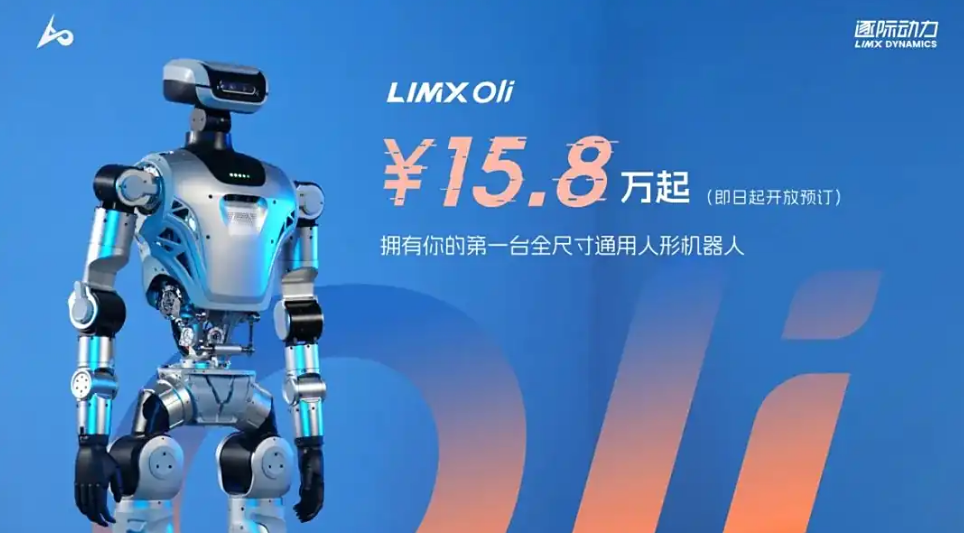
“For decades, the public’s imagination has been captured by the promise of humanoid robots. Yet, while most major players have been locked in a race to perfect a single, spectacular physical feat—from gravity-defying backflips to flawless obstacle navigation—a new contender from China is charting a different, arguably more strategic, course. The LimX Oli is not merely another impressive machine; it is a meticulously engineered platform that is shifting the focus of robotics from raw performance to practical adaptability. By fusing advanced dynamic control with an ingeniously simple yet powerful modular design, LimX Dynamics is not just building a robot—it’s building the ecosystem that could finally bridge the gap between lab research and industrial reality.”
Executive Summary
LimX Dynamics has launched the LimX Oli, a full-sized humanoid robot that stands out due to its holistic approach to embodied AI. Rather than specializing in one domain, the Oli is a general-purpose platform engineered for versatility and commercial viability. Its core technical innovations—a powerful, AI-driven motion control system and a groundbreaking modular arm architecture—allow it to master complex tasks with human-like fluidity while also being able to rapidly adapt to a vast array of real-world applications. By enabling the quick swapping of specialized end-effectors, from heavy-duty grippers to dexterous, multi-fingered hands, the Oli provides a single, scalable solution that can replace multiple single-purpose machines, positioning it as a potentially disruptive force in manufacturing, logistics, and beyond. This strategic design philosophy underscores a belief that the future of robotics lies not in isolated marvels but in adaptable, cost-effective, and open platforms.
Infographic: At a Glance
20 Critical Insights into the LimX Oli’s Impact
Here is a comprehensive analysis of the factors that position the LimX Oli as a pivotal development in the field of humanoid robotics.
1. A Masterclass in Dynamic Motion Control
Fluidity from Whole-Body Planning: The Oli’s fluid, human-like movements are not a superficial feature but the outcome of a sophisticated whole-body motion planning system that coordinates all 31 degrees of freedom (DoF) to achieve a desired action. This integrated approach moves beyond isolated joint control to generate harmonious, lifelike motion.
The Power of Reinforcement Learning: The system employs reinforcement learning to continuously optimize its movements. The robot’s AI discovers and refines the most efficient and stable gaits from experience, enabling it to perform complex tasks with less energy and greater precision than a pre-programmed robot.
Precision Torque Control at its Core: At the heart of the robot’s movement is a highly responsive and advanced torque control system. This allows for incredibly fine adjustments in force and posture, making it capable of everything from a delicate, controlled touch on a fragile object to a powerful lift of a heavy payload.
Integrated Action and Perception: The Oli’s motion control is not an isolated process. It is tightly coupled with its perception systems, allowing the robot to adjust its movements in real-time based on new sensory data, such as a changing environment or a moving object.
Predictive Motion for Safety: The control system incorporates predictive modeling to anticipate its own movements and potential collisions, enhancing safety for both the robot and any humans or objects in its immediate vicinity.
2. The Architecture of Dynamic Stability
High-Frequency Control Loop: The robot’s stability is managed by a control loop that reportedly runs at over 2,000 Hz. This extraordinary speed allows it to process sensor data and react to environmental changes in milliseconds, far exceeding human reflexes.
Sensor Fusion for Real-Time Feedback: It integrates data from a network of Inertial Measurement Units (IMUs) and force-torque sensors at each joint. This sensor fusion provides a continuous, real-time feedback loop that is the foundation of its dynamic balance.
Active Perturbation Recovery: Unlike static robots, the Oli can actively sense and correct for external disturbances, like a sudden push or a change in terrain. Its control system is designed to dynamically shift its center of mass to prevent a fall, making it exceptionally safe for unpredictable environments.
Adaptability to Uneven Terrain: The combination of sensor fusion and dynamic control allows the Oli to navigate uneven surfaces, stairs, and slopes with a remarkable degree of stability, a crucial capability for real-world deployment outside of controlled labs.
Soft Actuation for Impact Absorption: The compliance in its joints allows the robot to absorb impacts and dampen oscillations, further enhancing its stability and preventing damage to the robot and its surroundings.
3. The Revolutionary Role of Actuator Design
Hollow Electric Actuators: The robot is powered by custom-designed hollow electric actuators. This innovative design allows for the internal routing of power, data, and cooling lines, protecting the wiring from damage and minimizing external clutter.
Integrated Joint Units: Each actuator combines the motor, gearbox, and control electronics into a single, compact joint unit. This integration makes the robot more robust and simplifies maintenance and repair.
Biomimetic Force and Compliance: The actuators are engineered for precise compliance control, mimicking the function of biological muscles. This allows the Oli to apply both powerful force for heavy tasks and a delicate, controlled touch for fragile objects.
Torque Density for Power and Precision: The actuators boast a high torque density, meaning they can generate significant power relative to their size and weight. This is essential for a humanoid robot that needs to be both strong and agile.
Advanced Thermal Management: The hollow design allows for effective heat dissipation, enabling the robot to operate at high torque for extended periods without overheating, which is a common challenge for electric actuators.
4. The Strategic Genius of Modularity
Addressing the Specialization-Versatility Trade-off: The modular arm system is a direct solution to a persistent problem in robotics. Instead of a single-purpose robot, the Oli is a multi-functional platform.
Operational and Economic Efficiency: A single Oli platform can be reconfigured for different tasks by swapping end-effectors. This reduces the need for multiple, expensive robots, significantly improving a company’s return on investment (ROI).
Rapid Task Reconfiguration: The system is designed for quick and easy swapping of hands, allowing the robot to transition from a heavy-duty task to a delicate assembly job in minutes, dramatically increasing its operational flexibility.
Future-Proofing the Platform: This modular approach future-proofs the robot. As new types of end-effectors are developed, the Oli can be upgraded to perform new tasks without requiring a full hardware replacement.
Expanding the Use Case Horizon: Modularity opens the door for a vast range of applications in fields like logistics, manufacturing, and even domestic services, allowing the robot to adapt to evolving industry needs.
5. The LimX Oli’s Toolkit for Diverse Tasks
General-Purpose Standard Hands: The Standard Hands provide a foundational interface for a broad range of everyday interactions, offering a balance of grip strength and basic dexterity for tasks like pushing, pulling, and holding.
Industrial Grippers for Forceful Tasks: These robust attachments are designed for high-payload, repetitive work in manufacturing, logistics, and machine tending, where consistent, powerful force is required for efficiency and reliability.
Dexterous Hands for Precision: The Dexterous Hands feature multiple articulated fingers and integrated tactile sensors, enabling fine motor control for intricate assembly, tool manipulation, and handling delicate objects with human-like precision.
Customizable End-Effectors: The modular system isn’t limited to LimX’s offerings. The open platform encourages third-party developers to design and produce custom end-effectors for highly specialized tasks.
The Power of a Single Platform: This toolkit strategy allows a single robot to serve the functions of several specialized machines, fundamentally changing the economic model of automation.
6. Multi-Modal Perception and Scene Understanding
LiDAR for 3D Mapping: The Oli uses LiDAR to create high-fidelity, long-range 3D maps of its environment. This is crucial for autonomous navigation, obstacle avoidance, and path planning in complex spaces.
Binocular Vision for Detailed Recognition: Its stereo cameras provide detailed object recognition and depth perception at close range. This is essential for identifying specific items and planning precise manipulation actions.
Haptic Feedback for Grasping: Force-torque and tactile sensors on its hands provide crucial haptic feedback, enabling the robot to “feel” objects and perform fine-tuned grasping without crushing them.
Real-Time Data Fusion: The real-time integration of these disparate data streams allows the robot to build a comprehensive, multi-layered model of its environment, crucial for both autonomy and safety.
Advanced Object Identification: The combination of LiDAR and vision allows the Oli to not only see an object but also to understand its size, shape, and position in 3D space with a high degree of accuracy.
7. VideoGenMotion (VGM): The Future of Skill Transfer
Learning from Human Demos: The VGM framework is an embodied AI system that allows the robot to learn new skills from observing human demonstration videos. This bypasses the traditional, time-consuming process of manual programming.
Lowering the Barrier to Entry: By enabling non-experts to “teach” the robot new skills, the VGM framework democratizes access to advanced robotics. A technician could record a human performing a task, and the robot’s AI could analyze and replicate that movement.
Accelerating Deployment: This approach drastically reduces the time and cost required to deploy a robot for a new task, promising to accelerate the integration of robotics into a wide range of industries.
Leveraging Generative AI: The VGM system likely uses generative AI to infer the most probable actions and movements from the observed video data, effectively creating new motion sequences on the fly.
A Foundation for Generalization: As the robot learns from more videos, its AI system can generalize learned behaviors to new but similar tasks, further increasing its versatility without explicit programming.
8. A Platform for Innovation, Not Just a Product
Open SDK: LimX is positioning the Oli as an open platform by providing a comprehensive Software Development Kit (SDK). This gives external developers access to the robot’s control interfaces and sensor data.
Fostering an Ecosystem: This strategy is designed to foster a vibrant ecosystem of researchers and integrators. By allowing others to build on the platform, LimX encourages innovation and expands the robot’s potential applications far beyond its own internal development.
Virtuous Cycle of Development: The open platform creates a virtuous cycle where new applications and algorithms developed by the community make the Oli more valuable, which in turn attracts more developers and users.
Democratizing Robotics Research: By making a state-of-the-art humanoid platform accessible, LimX is democratizing robotics research, enabling smaller teams and startups to contribute to the field.
A Hub for Embodied AI: The Oli is designed to be a hub for embodied AI research, providing a real-world testbed for algorithms in navigation, perception, and manipulation.
9. Strategic Market Segmentation with Three Versions
EDU Version for Research and Academia: The EDU version is tailored for universities and research institutions, lowering the barrier to entry for robotics education and fundamental research with a simplified yet powerful model.
Lite Version for Entry-Level Automation: The Lite version provides a foundational, cost-effective model for businesses just beginning to explore automation, offering a low-risk entry point into humanoid robotics.
Super Version for Advanced Applications: The Super version offers a full-featured, high-performance model for complex industrial applications, providing a clear upgrade path for commercial clients with demanding needs.
Addressing Diverse Needs: This tiered approach allows LimX to effectively serve different market segments simultaneously, from academic labs to industrial factories, ensuring broad market reach.
Scalable Solutions for Businesses: The availability of multiple versions allows businesses to choose a solution that aligns with their specific performance and budget needs, and to scale their investment in automation over time.
10. Price-Point as a Market Disruptor
Fundamental Shift in TCO: With a starting price of approximately $21,800, the Oli fundamentally alters the Total Cost of Ownership (TCO) for a company seeking to automate. This price makes automation accessible to a much wider range of businesses, including small and medium-sized enterprises (SMEs).
Broader Market Penetration: This aggressive pricing strategy is a clear signal of LimX’s intent to rapidly achieve market penetration and establish a dominant position through volume and accessibility.
Undercutting Development Costs: The price is significantly lower than the estimated development and acquisition costs of many comparable humanoid robots, positioning the Oli as a highly competitive and attractive solution.
Prioritizing Ecosystem over Margins: This pricing strategy suggests LimX is prioritizing broad adoption and ecosystem growth over high margins on a small number of units, a long-term vision that could secure its market position.
A Catalyst for Mass Production: The low price point is a bet that mass production will drive down costs even further, making humanoid robots a commonplace sight in various industries.
11. Differentiating from Unitree’s H1
Product Philosophy: While Unitree’s H1 has made headlines with its athletic agility and parkour-like movements, the core distinction lies in product philosophy. The H1 often serves as a showcase of dynamic athleticism. The Oli, by contrast, is an industrial workhorse.
Emphasis on Manipulation vs. Locomotion: While both robots possess advanced locomotion, the Oli’s modularity and focus on diverse manipulation tasks give it a versatility that the H1, to date, has not prioritized.
Target Market Divergence: The H1 appeals to the public and research labs for its raw physical capability, while the Oli is explicitly marketed as a versatile tool for industrial and research settings.
Sensor Suite and AI Focus: The Oli’s integrated multi-modal sensor suite and its focus on the VGM framework point to a deeper emphasis on perception and AI-driven skill learning for practical tasks.
A “Tools” Approach to Robotics: The Oli’s modularity embodies a “tools” approach to robotics, where the platform itself is a universal base for various task-specific attachments.
12. The Contrasting Vision to Tesla’s Optimus
Open vs. Closed Ecosystem: Tesla’s Optimus is a vertically integrated project designed primarily to serve Tesla’s own manufacturing needs. This closed-loop approach is in sharp contrast to the Oli’s open, horizontal platform.
Horizontal vs. Vertical Strategy: The Oli’s open, ecosystem-driven model seeks to democratize access to humanoid robotics technology. This is a fundamentally different business strategy that could lead to broader innovation.
Community-Driven vs. Corporate-Driven Development: LimX is betting on the power of a developer community to drive innovation, whereas Tesla’s development is intrinsically tied to a single company’s objectives and timeline.
Manufacturing vs. General Purpose: While Optimus is primarily focused on the specific, repetitive tasks of automotive manufacturing, the Oli is being positioned as a general-purpose tool for a wide variety of tasks in multiple industries.
Strategic Risk and Reward: The open platform strategy carries the risk of ceding control but offers the potential for faster, more diverse innovation and a wider user base, a key differentiator from Tesla’s approach.
13. A Practical Alternative to Boston Dynamics’ Atlas
Cmmercial Viability vs. Research Platform: Atlas is a pinnacle of hydraulic-powered robotics known for its extraordinary acrobatic capabilities, but it has always been a high-cost research vehicle, not a commercial product. The Oli is a commercial, scalable product designed for practical use.
Electric vs. Hydraulic Actuation: The Oli is an electric-powered robot, which is generally more energy-efficient, quieter, and easier to maintain than its hydraulic counterparts, making it more suitable for indoor commercial environments.
Accessibility for Businesses: The Oli’s design and pricing make it a tangible, real-world alternative for businesses that want to integrate advanced humanoid capabilities without the prohibitive costs of a research-grade platform.
A Focus on Utility over Spectacle: While Atlas wows with its athletic prowess, the Oli focuses on the less glamorous but more commercially valuable tasks of manipulation and logistics.
A Pathway to Commercialization: LimX’s strategy shows a clear pathway from the lab to commercial deployment, a step that Boston Dynamics has only recently begun to explore with its other robots.
14. Bridging the Gap from Demos to Deployment
Real-World Application Focus: LimX Dynamics is not just showcasing its robot’s capabilities; it is actively demonstrating its use in industrial environments. Videos of the Oli performing tasks like sorting packages, operating machinery, and lifting objects in factory settings highlight its readiness for real-world deployment.
Proving Economic Value: This practical focus is a critical step toward proving the economic value and reliability of humanoid robots outside of the research lab. It helps businesses visualize the robot’s ROI.
Building Trust in Automation: By showing the robot in action in familiar settings, LimX is building trust in its technology and demonstrating its readiness for real-world deployment.
Scalability for Production: The Oli’s design and features are geared towards scalability, making it a viable option for large-scale adoption in warehouses and factories.
Reliability as a Core Tenet: The focus on practical deployment implies that reliability and uptime are core tenets of the Oli’s design, which is essential for any industrial tool.
15. A Bet on the Future of Embodied AI
Hardware as a Vessel for AI: The Oli represents a strategic bet that the most significant innovations in the coming years will be in the software and AI that run on the hardware. Its modular and open approach makes it an ideal vessel for this future development.
Accelerating AI Development: By providing a capable, adaptable hardware platform and a supportive software ecosystem, LimX is essentially building a “sandbox” for researchers to accelerate the development of new AI algorithms for motion, perception, and manipulation.
A Central Player in the New AI Era: This open-source-like strategy could lead to a virtuous cycle of innovation, positioning the Oli to be a central figure in the next generation of robotic solutions.
Embodied Cognition: The Oli’s learning framework and dynamic control point toward a future of embodied cognition, where AI learns not just from data, but from interacting with and experiencing the physical world.
The Future is General-Purpose: LimX’s philosophy argues that the future of robotics is not in single-purpose machines, but in general-purpose platforms that can adapt to the needs of a rapidly changing world.
16. Battery and Power Management System
Optimized Energy Efficiency: The Oli’s electric actuators are designed for high efficiency, and its overall power management system is optimized to maximize battery life, allowing for practical operational durations in a commercial setting.
Integrated Power and Data: The hollow design of the actuators allows for seamless integration of power and data lines, minimizing power loss and simplifying the robot’s internal architecture.
Fast Charging Capabilities: For industrial applications, the ability to quickly recharge or hot-swap batteries is crucial for minimizing downtime. The Oli’s system is likely designed with these considerations in mind.
Intelligent Power Consumption: The robot’s AI can intelligently manage power consumption based on the task at hand, allocating more power for high-torque movements and conserving energy during low-power standby modes.
On-board Power Monitoring: A comprehensive on-board system monitors battery health and power consumption in real-time, providing operators with critical data to optimize the robot’s usage and maintenance schedules.
17. Ethical and Safety Considerations in Design
Precise Force Control: The ability to precisely control the force applied by its joints is a fundamental safety feature. This prevents the robot from accidentally injuring a human or damaging a fragile object during collaborative tasks.
Collision Avoidance Systems: The multi-modal perception system, combining LiDAR and vision, gives the Oli robust collision avoidance capabilities. It can sense obstacles and adjust its path in real-time to prevent accidents.
Human-Robot Interaction (HRI) Design: The Oli’s human-like form and fluid movements are a deliberate part of its HRI design, making it more intuitive for humans to interact with and trust, which is crucial for collaborative work environments.
Software-Level Safety Guards: The open SDK, while a strength, is likely governed by strict software-level safety protocols that prevent developers from creating code that could compromise the robot’s safe operation.
Addressing the Fear of Automation: LimX’s emphasis on a collaborative and assistive model, rather than a replacement model, helps address public concerns about job displacement and the fear of automation.
18. The Role of Generative AI in the Oli’s Future
Generative Models for Motion: Beyond the VGM framework, the Oli’s future could involve more advanced generative AI models that can create novel, un-programmed movements for a given task, such as navigating a completely new environment or handling an unfamiliar object.
AI for Task Planning: Generative AI could be used to create high-level task plans from simple, natural language commands, allowing the robot to autonomously break down complex instructions into a sequence of actionable steps.
Sim-to-Real Transfer: Generative models could be trained extensively in virtual simulations and then have their learned behaviors transferred to the real-world Oli, accelerating the development of new skills.
AI-Powered Troubleshooting: The robot’s AI could use its own internal sensor data to diagnose and even predict mechanical failures, allowing for proactive maintenance and minimizing downtime.
Creative and Unstructured Tasks: The use of generative AI could eventually enable the Oli to perform more creative and unstructured tasks that require a degree of improvisation and adaptability, a capability currently limited to humans.
19. Manufacturing and Supply Chain Strategy
Scalability for Mass Production: The design of the robot, with its integrated actuators and modular components, is likely optimized for mass manufacturing, which is crucial for maintaining a low price point as production volume increases.
Global Supply Chain: LimX Dynamics will need to manage a robust global supply chain for components, which is a key factor in its ability to meet global demand and sustain its competitive advantage.
Lean Manufacturing Principles: The use of modular components and standardized parts suggests that LimX is following lean manufacturing principles to reduce waste, simplify assembly, and control costs.
Quality Control and Reliability: For a robot intended for industrial use, stringent quality control measures will be paramount to ensure the reliability and safety of every unit that leaves the factory.
Global Service and Support Network: To support a global user base, LimX will need to build out a robust service and support network for maintenance, repairs, and technical assistance.
20. The Future Roadmap and Expansion
Continuous Software Updates: The open platform strategy suggests a roadmap that includes continuous software updates, ensuring the robot’s capabilities and efficiency improve over time.
Development of New End-Effectors: The company will likely continue to develop and release new end-effectors for novel applications in fields like healthcare, domestic services, and agriculture.
Expanded Line of Robots: The Oli is likely the first in a line of robots from LimX. The company could expand its product line with robots of different form factors or with specialized capabilities for specific industries.
Ecosystem Integration: The future of the Oli is tied to its ability to integrate seamlessly with other factory systems, AI models, and software platforms, making it a central part of a broader automated ecosystem.
A Foundation for General-Purpose AI: The Oli is not just a commercial product; it is a foundational step toward the creation of general-purpose embodied AI that can learn and adapt to any task in any environment.
Conclusion
The LimX Oli is a pivotal entry into the global humanoid robotics market. By strategically blending advanced technical capabilities with a keen understanding of commercial needs, LimX Dynamics has created a robot that is both a high-performance machine and a highly accessible development platform. Its emphasis on dynamic control, modularity, and AI-driven learning sets it apart from competitors and positions it as a genuine disruptor. The Oli represents a clear shift toward a future where robots are not just a technological curiosity but a practical, adaptable, and economically viable tool that can seamlessly integrate into our world, forever changing the nature of work and the trajectory of artificial intelligence.
Quiz: Test Your Knowledge
1. What is the most commercially significant innovation of the LimX Oli?
a) Its high-frequency control loop of over 2,000 Hz.
b) Its proprietary VideoGenMotion (VGM) framework.
c) Its modular arm system with interchangeable end-effectors.
d) Its use of hollow electric actuators.
2. How does the LimX Oli’s pricing strategy differ from that of many other humanoid robot projects?
a) It is designed to be a high-margin, low-volume luxury product.
b) It is priced to be a disruptive, accessible tool for a wide range of businesses.
c) It is sold exclusively to government and military agencies.
d) Its price point is not yet announced.
3. What is the primary function of the VideoGenMotion (VGM) framework?
a) To perform complex acrobatic movements.
b) To learn new skills by observing human demonstration videos.
c) To manage the robot’s battery life and power consumption.
d) To enable the robot to perform music and dance routines.
4. The LimX Oli’s open SDK is a key part of its strategy to:
a) Maintain a closed, proprietary ecosystem.
b) Compete directly with open-source software projects.
c) Foster a vibrant community of external developers and expand the robot’s capabilities.
d) Protect its intellectual property from competitors.
5. How does the Oli’s design philosophy contrast with that of Boston Dynamics’ Atlas?
a) The Oli is a research platform, while Atlas is a commercial product.
b) The Oli is powered by hydraulic systems, while Atlas uses electric actuators.
c) The Oli is a commercially viable product, while Atlas is a high-cost research platform.
d) The Oli is a single-purpose robot, while Atlas is multi-functional.
Quiz Answers:
- c) Its modular arm system with interchangeable end-effectors.
- b) It is priced to be a disruptive, accessible tool for a wide range of businesses.
- b) To learn new skills by observing human demonstration videos.
- c) Foster a vibrant community of external developers and expand the robot’s capabilities.
- c) The Oli is a commercially viable product, while Atlas is a high-cost research platform.
Official and Research Resources
- Official Website: LimX Dynamics
- YouTube Channel: LimX Dynamics
- News Article: LimX Unveils Full-Size Humanoid Robot Oli for Manufacturing and Warehouse Automation
- Viral Demo Video: LimX Oli丨
- Launch Coverage: LimX Dynamics launches humanoid robot LimX Oli starting at $21800