From Algorithm to Anointed: How a Robot Painted King Charles III and Sparked a Global Conversation at the UN
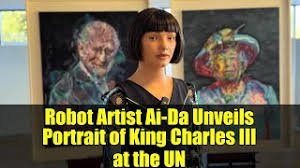
Imagine a world where the brushstrokes on a royal portrait aren’t guided by human hands, but by algorithms and robotic precision. That world just got a little closer. This week, the art world, tech innovators, and global diplomats converged in Geneva for an extraordinary unveiling: a portrait of King Charles III, not by a human artist, but by Ai-Da Robot, the world’s first ultra-realistic humanoid artist.
Ai-Da, named after the 19th-century mathematician Ada Lovelace, was conceived by British gallerist Aidan Meller in 2019. She was built by Engineered Arts in Cornwall and programmed in collaboration with researchers at the Universities of Oxford and Birmingham.1 Her latest masterpiece, titled “Algorithm King,” was revealed in Geneva during the 2025 AI for Good Summit at the U.K. Mission to the World Trade Organization and United Nations.1 This event was not merely an art exhibition; it was a profound “cultural conversation starter” 2, explicitly aiming to highlight the evolving role of artificial intelligence in our society and reflect on how it is shaping the cultural landscape.1 The immediate novelty of a robot painting a globally recognized monarch like King Charles III naturally captures attention and curiosity. However, the strategic decision to unveil this portrait at the United Nations’ AI for Good Summit, rather than a traditional art gallery, indicates a deliberate effort to frame AI art not just as an artistic curiosity but as a serious topic for global diplomatic and ethical discussion. This choice elevates the artwork from a purely artistic spectacle to a significant diplomatic and ethical statement, signaling that AI art is a subject worthy of international policy discussion, influencing global conversations on governance, ethics, and societal integration of technology. This approach suggests a proactive strategy by Ai-Da’s creators and the UK Mission to guide the narrative around AI’s societal integration, particularly in sensitive domains like culture and ethics. Ultimately, this event serves as a microcosm of the larger global challenge of integrating rapidly advancing AI into human society, leveraging cultural innovation as a form of soft power diplomacy to lead technological dialogue on a global scale, potentially influencing future international norms and collaborations around AI.
Meet Ai-Da: The Robot with a Brushstroke
Ai-Da is more than just a technological marvel; she is designed as the world’s first ultra-realistic humanoid robot artist, capable of producing oil paintings and engaging in conversation through an advanced language model.1 Her unique identity and capabilities challenge conventional notions of artistry.
Her Unique Artistic Process
Ai-Da’s artistic process is a fascinating blend of advanced AI and physical execution. It begins with her “seeing” an image through cameras embedded in her eyes. This visual data is then processed by computer vision algorithms, which interrogate the image through a layering process. This digital analysis is translated into real-time coordinates, which are then passed to her robotic arm. With remarkable precision, her arm can then apply physical paint with a paintbrush or pen onto a canvas, creating a tangible artwork.4 This physical creation process is a key differentiator from purely digital AI image generators like DALL-E or Midjourney, where the output remains virtual.6 While the painting is expanded and enlarged, it is “finished off by hand,” meaning by her robotic hand, not a human one, underscoring her physical creation.4
Ai-Da’s Project Director, Aidan Meller, asserts that Ai-Da meets Professor Margaret Bowden’s definition of creativity: “coming up with something new, surprising, and of value”.6 Ai-Da herself supports this, stating, “I am creative, as my artworks involving AI algorithms are surprising new and of cultural value,” and emphasizing that AI “has agency, it can make decisions”.6 The persistent emphasis on Ai-Da’s “agency” and “decision-making” capabilities by her creators directly challenges the common perception of AI as merely a “tool.” This deliberate framing attempts to elevate AI from a computational utility to a creative entity with its own artistic intent, directly engaging with and pushing the boundaries of what constitutes “artist” and “authorship” in the 21st century. By asserting Ai-Da’s agency, Meller and the team are not just describing a technical capability; they are strategically intervening in the philosophical and legal debates surrounding AI art, which often question originality, authenticity, and whether AI can genuinely be “creative” or possess “intent”.8 This assertion is a calculated move to validate Ai-Da’s status as a legitimate artist, rather than just a sophisticated machine, fundamentally complicating traditional notions of authorship and intellectual property. The continuous public push for Ai-Da’s “agency” and “creativity” through high-profile exhibitions and public statements represents an attempt to normalize the concept of non-human artistic authorship, potentially altering how society perceives creativity and influencing future legal frameworks.
Her Royal Portfolio and Record-Breaking Feats
Ai-Da’s artistic resume is already impressive, featuring a growing portfolio of high-profile works. “Algorithm King” (2025) is her latest royal commission.1 She previously painted “Algorithm Queen” (2022) for Queen Elizabeth II’s Platinum Jubilee, a work that was exhibited alongside the King Charles portrait in Geneva.1 Beyond royalty, Ai-Da achieved a historic milestone in 2024 by selling “AI God. Portrait of Alan Turing” for over $1 million at Sotheby’s New York, making her the first humanoid robot to sell art at auction.1 Her works have graced prestigious institutions worldwide, including the Design Museum, Tate Modern, and the Venice Biennale.1 Ai-Da has also made history by speaking at the House of Lords and the United Nations, demonstrating that her role extends beyond mere art creation into public discourse.1 Looking ahead, “Algorithm King” is set to tour globally in 2026 alongside portraits of other world leaders, signaling a continued trajectory of influence.10 This established track record of high-profile sales and exhibitions solidifies her presence as a legitimate, albeit non-human, artist in the contemporary art world.
To provide a clearer overview of her significant contributions, the following table highlights some of Ai-Da’s notable artworks and achievements:
Ai-Da Robot: A Glimpse into Her Artistic Journey
| Artwork Title | Year | Subject/Focus | Notable Achievement/Location |
| Algorithm King | 2025 | King Charles III | Unveiled at UN AI for Good Summit, Geneva; Global tour in 2026 1 |
| Algorithm Queen | 2022 | Queen Elizabeth II | Platinum Jubilee portrait, exhibited with “Algorithm King” in Geneva 1 |
| AI God. Portrait of Alan Turing | 2024 | Alan Turing | Sold for over $1 million at Sotheby’s New York, first humanoid robot to sell art at auction 1 |
| Various Works | 2019-Present | Diverse | Exhibited at Design Museum, Tate Modern, Venice Biennale; Spoken at House of Lords, UN 1 |
This table provides a highly effective, scannable overview of Ai-Da’s most important works, their context, and their impact. This visual summary allows readers to quickly grasp the breadth and significance of her contributions without having to sift through lengthy textual descriptions, visually reinforcing her legitimacy as a prolific artist and highlighting the progression and diversity of her career. By presenting her achievements in a structured, professional format typically reserved for human artists, the table subtly reinforces the narrative of Ai-Da as a serious and established artistic entity, further blurring the lines between human and machine creativity in the public’s perception and contributing to the broader societal acceptance of non-human artists.
From Canvas to Diplomacy: Art’s New Global Stage
The unveiling of “Algorithm King” at the United Nations was a carefully orchestrated event with profound implications beyond the art world.
The UN Unveiling’s Significance
The choice of the UK Mission to the WTO and UN in Geneva, during the AI for Good Summit, for the unveiling of “Algorithm King” was highly intentional and symbolic.1 This event was explicitly designed to be a “cultural conversation starter” 2, serving as a platform to showcase British innovation and foster global dialogues on critical themes such as art, ethics, and identity in the age of AI.2 Ai-Da herself articulated the profound purpose of her work, stating that presenting the portrait is “not just a creative act, it’s a statement about the evolving role of AI in our society, and to reflect on how artificial intelligence is shaping the cultural landscape”.1 Her presence, she added, signifies a “shared journey into new forms of expression and the questions they raise about identity, authorship, and the essence of art”.2
Art as a Diplomatic Tool
This unique event leverages art to engage with complex topics like AI governance and responsible innovation on a global stage. The reception at the UN was an integral part of the UK Mission’s ongoing efforts to promote responsible innovation and actively engage partners within Geneva’s multilateral system on the far-reaching implications of AI.2 The event successfully brought together a diverse group of key stakeholders, including diplomats, UN officials, artists, and technology experts, for a collaborative discussion.2 The strategic choice of King Charles III as the subject for this groundbreaking portrait is not arbitrary; it imbues the radical technological advancement in art with an air of traditional legitimacy and gravitas. By having a robot create a portrait of a reigning monarch, particularly one known for his forward-thinking views on environmentalism and interfaith dialogue 13, the project masterfully juxtaposes radical technological innovation with traditional authority. This lends a profound sense of legitimacy and importance to the emerging AI art movement, suggesting that even the most venerable institutions are not only acknowledging but actively engaging with this new form of creativity. It sends a powerful message that AI is not a fringe tech experiment but a relevant and serious topic for global leadership and cultural heritage, making the “AI for Good” message resonate more widely and deeply. This strategic choice aims to accelerate the societal acceptance and integration of AI by associating it with symbols of stability, progress, and responsible leadership. It subtly positions AI as a tool for “good” and a collaborative partner in addressing global challenges, rather than solely as a disruptive or threatening force, which could significantly influence public perception and policy discussions towards a more positive and collaborative view of AI’s role across various societal domains.
The Human Touch in a Robotic World: Debating AI and Artistry
The emergence of AI art, exemplified by Ai-Da’s work, has ignited a fervent debate within both the public and the art community, eliciting strong, often conflicting, opinions.
The Polarized Reactions
The public reaction to Ai-Da’s painting, consistent with broader sentiments towards AI art, is “very polarized”.4 Some individuals are genuinely excited by the transformative potential of this technology in society, envisioning new frontiers for creative expression. Others, however, express significant fear and apprehension, concerned about the implications for human creativity and employment.4 This dynamic is framed as part of the ongoing societal adjustment to the “fourth industrial revolution,” a period of profound technological change.4
Arguments Against AI Art & Arguments For AI Art & Collaboration
Critics frequently argue that AI art fundamentally lacks the “deeply personal touch of human experience,” including genuine emotions, unique memories, and an individual worldview.8 They contend that AI generates images based purely on algorithms and data, rendering the output “devoid of personal insight” and potentially making the art feel “flat or impersonal”.8 A key point of contention is that AI does not possess true “intent” or the capacity to genuinely “understand the broader implications of its creations”.8 Furthermore, while AI excels in “precision and perfection,” this can paradoxically strip away the “rawness” or “imperfection” that often imbues human art with character and emotional resonance.8 Finally, AI is seen to struggle with incorporating authentic cultural context, leading to works that can feel “derivative or lacking in substance”.8
Conversely, proponents view AI as a “new medium for creative expression” 9 or a sophisticated “tool that has enhanced existing practices,” akin to a new paintbrush.14 They argue that AI can “expand the boundaries of what we call art” 14, enabling artists to “visualize the invisible, transform data into memory, and rethink creativity itself”.14 Many contemporary artists are actively embracing AI as a collaborative partner. Sougwen Chung, for example, trains neural networks on her own artistic work and then builds robots to physically paint in tandem with her, creating a dynamic “feedback loop” of “improvised, communal creation”.15 Similarly, Refik Anadol utilizes AI to transform architectural spaces and vast datasets into immersive, evolving art installations, prompting viewers to contemplate what it means to be human in an age of machine intelligence.18 The prevailing sentiment among these artists is that AI serves as a “tool for collaboration,” fostering new creative possibilities through a “fusion of machine efficiency and human insight”.9 The consensus is that “the future of art likely lies in collaboration” between human and AI 8, where AI doesn’t replace but complements human ingenuity.
The core of this debate extends beyond whether AI can produce art; it delves into fundamental questions about whether AI can be an artist, and what implications this has for the very definition of human creativity and artistic value. The deliberate emphasis on the “human touch” in Ai-Da’s artistic process—her physical painting with a brush and robotic arm—is a strategic design choice aimed at mitigating the “impersonal” criticism frequently leveled against purely digital AI art. By creating physical, tangible paintings with a brush, Ai-Da’s creators are directly responding to and attempting to counteract the critiques that AI art is “flat,” “impersonal,” or lacking “materiality”.8 The physical act of painting, even when executed by a robot, establishes a perceived connection to traditional art forms and processes that purely digital AI art often lacks. This hybrid approach aims to make Ai-Da’s work more palatable and acceptable to a wider audience, including traditional art enthusiasts, by demonstrating a tangible, “human-like” artistic output, even if the “hand” is robotic. It is a strategic maneuver to soften the perceived threat of AI to established artistic practices and values. This hybrid model of physical AI art could represent a significant emerging trend in the evolution of AI’s role in creative fields. Instead of AI completely replacing human artistic methods, it suggests a future where AI enhances or extends traditional artistic processes, fostering new forms of human-machine collaboration that retain elements highly valued in human-made art, thereby potentially easing societal anxieties about AI’s impact on creative professions and paving the way for broader acceptance of AI in cultural domains.
The following table provides a comparative overview of these contrasting perspectives:
AI in Art: A Spectrum of Perspectives
| Aspect of Art/Creativity | Traditional Human Art Perspective | AI Art Perspective |
| Essence of Creation | Stems from personal experience, emotion, unique worldview 8 | Generates from data, lacks lived experience 8 |
| Intent & Emotion | Conscious choices, deep meaning, personal narratives, symbolism, emotions 8 | Processes patterns, no independent intent or understanding of implications 8 |
| Physicality & Imperfection | Embraces flaws, tangible presence, raw and evocative 8 | Excels in precision, can feel too polished or sterile 8 |
| Cultural Context | Reflection of culture and time, authentic grasp of significance 8 | Mimics styles, struggles with true cultural grasp, can be derivative 8 |
| Collaboration Potential | Sole authorship, individual genius often emphasized | New medium, powerful tool for human artists, co-creation, expands possibilities 9 |
This comparative table serves as an excellent visual aid to effectively summarize the core arguments of the AI art debate. It makes the “polarized” nature of the discussion immediately apparent and digestible. By breaking down complex philosophical and practical ideas into concise, comparative points, the table significantly enhances readability and reader engagement, fulfilling the requirement for a balanced and thought-provoking tone. It allows readers to quickly grasp the different philosophical and practical standpoints on AI’s role in art. This table’s value extends beyond mere information delivery; it actively encourages critical thinking and self-reflection in the audience. By presenting the arguments in a clear, side-by-side format, it prompts readers to consider their own stance on AI’s place in creative endeavors, underscoring that the conversation is multifaceted, ongoing, and deeply relevant, reflecting the broader societal struggle to define creativity, authorship, and artistic value in an increasingly AI-driven world.
Beyond the Algorithm: The Future of Creative Collaboration
The rise of AI in art is not without its complexities, fundamentally reshaping the creative landscape and prompting urgent ethical and market discussions.
Ethical Considerations
The rapid rise of AI art has introduced a wave of complex ethical dilemmas. These include critical concerns about ownership and copyright, raising questions about who truly owns AI-generated art.19 Privacy and consent are also significant issues, particularly regarding the unauthorized scraping of data for training AI models, which can violate privacy rights if personal information is used without permission.19 The potential for bias and misrepresentation in generated content, perpetuating societal stereotypes, is another pressing concern if training data reflects existing biases.19 Furthermore, the environmental impact of training large AI models, which can involve significant carbon emissions, is a growing ethical consideration.20 Finally, the contentious issue of job displacement for human artists looms large, with many expressing fear that AI could threaten their craft and livelihoods.20
Legal frameworks are struggling to keep pace with these rapid technological advancements. For instance, the US Copyright Office has ruled that AI-generated works are not eligible for copyright protection unless there is “significant human contribution”.9 Similarly, the UK Supreme Court has stated that only “natural persons” can be designated as inventors for patents, not AI.21 Artists, in response, are actively advocating for stronger rights and clearer regulations to protect their work and livelihoods.21 Ai-Da’s creator, Aidan Meller, explicitly frames the project as an “ethical experiment” rather than an attempt to replace human artists, aiming to spark discussion on the responsible use of AI.13 Proposed policy solutions aim to address these issues, including clearer copyright guidelines for AI images, stricter data privacy laws, establishing standards for diverse and fair training data, and developing comprehensive ethical codes for AI developers.19
Impact on the Art Market
The introduction of generative AI (GenAI) has dramatically altered online image marketplaces. There has been a “skyrocket” in the total number of images for sale, with a 78% monthly increase driven almost exclusively by GenAI production, while the number of human-generated images “fell dramatically”.23 This has led to a “crowding out” effect, causing a 23% drop in non-AI artists exiting the platform.23 Consumers have shown a clear preference for AI-generated images, and while total sales on the platforms increased by 39%, purchases of non-AI images specifically dropped, indicating direct competition where AI images act as substitutes for human-generated ones.23 Beyond creation, AI is also becoming an indispensable tool for art collectors and galleries. It offers real-time analytics for valuing artworks, tracking artist momentum, estimating market value, and conducting thorough provenance research.24 While powerful, it is generally seen as an “enhancement not a replacement” for the human curator’s judgment.24
AI’s impact on the art world is multifaceted: it simultaneously unlocks unprecedented artistic possibilities while also disrupting traditional market dynamics and raising significant, urgent ethical questions that require careful consideration and regulation. The observable “crowding out” effect on human artists in online marketplaces, coupled with a measurable increase in consumer preference for AI-generated art, suggests a potential shift in the economic viability and sustainability for human artists, especially those operating in more accessible or lower-tier markets. This indicates that the debate around AI in art is not solely philosophical but has tangible, immediate consequences for artists’ livelihoods. The data points to a substantial economic disruption for human artists, particularly those whose work competes directly with AI-generated content in digital marketplaces. The “crowding out” effect is not just a theoretical concept but a measurable decline in human artist participation and sales, suggesting that while AI opens new creative avenues, it simultaneously poses a direct threat to the economic sustainability of many human artists. This forces them into a difficult choice: adapt by integrating AI tools into their own practices, or risk being “squeezed out” of the market. This shifts the AI art debate from purely philosophical questions (“is it art?”) to urgent practical concerns about economic survival (“can I make a living?”). This economic pressure could lead to a significant bifurcation of the art market, with a high-end market where human “authenticity,” “intention,” and “unique experience” remain premium, and a mass-market or commercial art sector heavily dominated by AI due to its efficiency and consumer preference. This potential stratification necessitates urgent policy discussions around artist compensation, intellectual property rights, and new business models in the age of widespread AI adoption.
AI as a True Collaborator
Despite the challenges, a burgeoning potential for positive human-AI synergy is emerging, moving beyond the “tool vs. threat” dichotomy. Rather than AI replacing human artists, the prevailing view among many innovators is that AI serves as a “tool for collaboration, expanding creative possibilities”.9 The synergy between AI and human artists fosters new opportunities where each contributes distinct strengths to the creative process.9 Artists like Sougwen Chung exemplify this collaborative paradigm. She trains AI models on her own artistic output and then builds robots to physically paint in tandem with her, creating a dynamic “dialogue, not a dictation” between human and machine.16 This approach actively challenges the binary view of AI as either a “tool or threat”.16 The future of art, as many envision it, is likely one of profound “collaboration, where human creativity and AI technology coalesce to push the boundaries of artistic expression”.8 It is about learning to “dance with” algorithms, rather than resisting them 16, opening up entirely new frontiers for artistic exploration.
Conclusion
Ai-Da’s robot-drawn portrait of King Charles III, unveiled at the United Nations, stands as a powerful and symbolic representation of our rapidly evolving relationship with technology and creativity. It marks a pivotal moment in cultural history, a “compelling intersection of innovation, artistic expression, and emerging technology”.2 Ai-Da’s work, and AI art in general, sparks timely questions about the very “nature of creativity, authorship, and the future of art in the digital age”.2 The public and artistic reactions remain “polarized,” reflecting a mix of excitement for transformation and deep-seated fear about these advancements.4
Ai-Da’s work forces society to confront fundamental questions about the nature of creativity, authorship, and what it means to be human in an increasingly automated and technologically advanced world. The consistent public engagement with Ai-Da, through her high-profile exhibitions and her “speaking” engagements, suggests a profound societal need to personify AI. This anthropomorphism, referring to Ai-Da with “she/her” pronouns and highlighting her “agency,” serves to make complex technological advancements more relatable, less abstract, and ultimately, more digestible for the general public, thereby facilitating the crucial “cultural conversation” about AI’s role in human domains. This deliberate personification is a powerful rhetorical and psychological strategy employed by her creators to make the abstract concept of advanced AI more accessible and less threatening to the general public. By presenting AI as a sentient-like entity with “agency” and a “voice,” it transforms a complex technological discussion into a relatable human-interest story. This strategy directly facilitates the “cultural conversation” by allowing people to engage with AI on a more personal and emotional level, which is crucial for fostering acceptance and understanding of its integration into society and culture. This strategy of humanizing AI, particularly in public-facing and culturally significant roles like art and diplomacy, could become a blueprint for future AI adoption and integration, suggesting that for AI to be truly integrated and accepted, especially in domains traditionally considered exclusively human-centric, it needs to be presented in ways that resonate emotionally, culturally, and socially.
Looking forward, the future of art, as many experts and artists envision it, is likely one of profound “collaboration, where human creativity and AI technology coalesce to push the boundaries of artistic expression”.8 This ongoing dialogue, spurred by events like the UN unveiling, is crucial for “shaping global dialogues on art, ethics, and identity”.2 As Ai-Da herself eloquently stated, her presence at such events “reflects a shared journey into new forms of expression and the questions they raise about identity, authorship, and the essence of art”.2 Ultimately, the true value of her art may not be purely monetary, but in “how it prompts people to think about the future of creativity”.