China’s 24/7 Humanoid Robot Revolution: The New “Electric Car” Moment in Robotics
I. Executive Summary
China is rapidly positioning itself at the forefront of the global humanoid robot industry, exhibiting a trajectory that closely mirrors its ascent in the electric vehicle (EV) sector. This report posits that the nation is on the cusp of an “EV moment” in robotics, characterized by aggressive government backing, unparalleled manufacturing capabilities, and a strategic focus on cost-effective mass production. Key Chinese players are transitioning from prototyping to mass production, with ambitious scaling targets and disruptive pricing strategies that challenge global incumbents. Technological advancements, particularly in autonomous power management enabling 24/7 operation, coupled with a robust, vertically integrated domestic supply chain, are accelerating deployment across diverse industrial and commercial applications.
This revolution is fueled by a comprehensive national AI strategy that allocates immense financial resources and fosters a vibrant R&D and talent ecosystem. While the economic potential is vast, promising a multi-trillion-dollar market by 2050, the rapid integration of humanoids also presents significant economic, social, and ethical implications, including job displacement, privacy concerns, and the dual-use nature of the technology. Navigating these complexities through proactive regulation and public discourse will be crucial for sustained growth and global acceptance. The current pace of development suggests that China’s humanoid robot revolution is not a distant future but an unfolding reality, poised to redefine global manufacturing, services, and societal interaction with autonomous machines.
II. Introduction: The Dawn of China’s Humanoid Robot Era
The global landscape of humanoid robotics is experiencing an unprecedented surge in development, propelled significantly by recent breakthroughs in generative artificial intelligence (AI).1 This technological momentum is rapidly transitioning humanoid robots from experimental prototypes, often confined to controlled laboratory environments, into practical, integrated solutions across various human-centric settings.1 The intensifying global competition in this transformative field is largely dominated by two key players: the United States and China. These nations collectively hold a commanding lead in AI intellectual property and the development of foundational AI models, accounting for an overwhelming majority of global advancements in this critical domain.1
This report explores a compelling parallel between the current trajectory of China’s humanoid robot industry and the nation’s highly successful electric vehicle (EV) sector. The rise of EVs fundamentally disrupted and redefined global automotive markets, challenging established powerhouses and reshaping industrial ecosystems worldwide.1 The central question examined here is whether humanoid robots, particularly those emerging from China, are poised to similarly redefine global markets and industrial landscapes, following a strategic blueprint analogous to the one that propelled China to EV dominance.1 The very framing of this inquiry, explicitly drawing a parallel to the “Electric Car” moment, is itself a significant analytical observation. This is not merely a casual comparison but a strategic validation of the core premise by reputable international bodies. It suggests that the mechanisms of market disruption, rapid scaling, and global redefinition observed in the EV sector are considered highly applicable and potentially replicable in humanoid robotics. If this parallel holds true, it implies that the speed and scale of market transformation in robotics could be as dramatic and swift as that seen in the automotive industry, demanding immediate strategic attention from global stakeholders.
III. China’s EV Dominance: A Strategic Blueprint
China’s remarkable success in the electric vehicle (EV) manufacturing sector provides a compelling strategic blueprint for its current push in humanoid robotics. This dominance was not accidental but the result of a coordinated, multi-faceted national strategy.
Success Factors in EV Manufacturing
A primary driver was extensive government support and incentives.3 Beijing proactively steered the automotive industry toward EVs as a strategic solution to urban pollution and traffic congestion. This included substantial financial incentives, direct subsidies for consumers and manufacturers, and regulatory support such as the “dual-credit system” that simplified the acquisition of license plates for EVs.3 While national purchase incentives were phased out, local subsidies have persisted, maintaining momentum.3
Another critical factor was stringent cost control and deep vertical integration.3 Chinese EV manufacturers achieved a significant competitive advantage by driving down costs, with studies indicating their production costs were 47% lower than global counterparts.3 This was largely facilitated by companies like BYD, which adopted extensive vertical integration, managing the entire production chain from raw materials to core components such like batteries and electronic control systems in-house.3 This strategy not only minimized production costs but also reduced reliance on external suppliers and mitigated supply chain risks.
China’s immense manufacturing infrastructure and the pursuit of economies of scale were foundational.3 The nation possessed a vast manufacturing base that could be quickly adapted to EV production, leveraging its extensive experience in mass production of conventional vehicles and consumer electronics.4 High production facility utilization rates were crucial for spreading fixed costs and optimizing variable cost management, allowing Chinese manufacturers to achieve significant economies of scale.
Furthermore, China actively sought to influence technical standards and establish supply chain control.4 By participating in setting technical standards for EV technology, particularly in charging infrastructure and communication protocols, China strategically positioned itself to influence the global EV ecosystem. This was complemented by its control over a significant portion of the global supply chain for key EV components, such as rare earth elements and lithium-ion batteries, ensuring consistent supply and a unique strategic advantage.4
These factors collectively propelled China to rapid expansion and market dominance.3 The country’s EV production and exports surged, leading it to dominate the global EV market, accounting for approximately 70% of total new registrations, and ultimately overtaking Japan as the world’s leading car exporter.3
Strategic Parallels for Humanoid Robotics
The strategic approach observed in China’s EV sector is being deliberately replicated in its humanoid robot development. This is not merely an incidental similarity but a conscious application of a proven industrial policy blueprint. The Chinese government and industry are systematically applying the lessons learned from the EV sector’s success—from state-led investment and demand creation to fostering domestic supply chain mastery and aggressive cost reduction—directly to humanoid robotics.1 This intentionality significantly increases the probability of a similar “EV moment” occurring in robotics, as the strategic framework for rapid market capture and global dominance is already established and being executed. For global competitors, this implies confronting a highly coordinated, state-backed industrial force that has already demonstrated its capacity to disrupt global markets. Understanding this deliberate replication is key to formulating effective counter-strategies. The government’s comprehensive AI strategy, which explicitly includes robotics, aims for global leadership by 2030, indicating a long-term, sustained commitment that transcends typical market cycles.5
IV. The Humanoid Robot Landscape in China: A Rapid Ascent
China’s humanoid robot industry is characterized by a dynamic ecosystem of key players, aggressive production scaling, and a strategic approach to market penetration, all contributing to its rapid ascent.
Key Players and Production Scale
Several Chinese firms are at the forefront of this revolution, demonstrating a clear commitment to mass production. In 2025, six companies—Unitree Robotics, AgiBot, Galbot, Engine AI, and Leju Robotics—collectively plan to produce over 1,000 humanoid units.11 This collective target, while seemingly modest, marks a critical inflection point: the transition from prototyping and pilot projects to initial mass production and rapid commercialization. This mirrors the early stages of the EV revolution, where initial low volumes quickly gave way to mass production, enabling rapid market penetration and establishing dominance through affordability and scale. This aggressive scaling and pricing strategy is designed to rapidly penetrate markets and establish dominance, rather than a gradual, high-cost rollout. This rapid industrialization will likely accelerate the decline in unit costs across the industry, making humanoids accessible for a much wider range of applications sooner than anticipated. It also suggests that the “EV moment” in robotics is not a distant future but is already underway, driven by these initial mass production efforts and price points.
UBTech Robotics, a prominent “first echelon” player in China, has set ambitious production targets. The company aims to produce 1,000 humanoid robots in 2025, split between 500 industrial and 500 for other uses.12 Their projections for subsequent years are even more aggressive, targeting 5,000-10,000 units in 2026 and over 10,000 units in 2027.12 This exponential scaling is a hallmark of an “EV moment,” where initial low volumes quickly give way to mass production.
Unitree Robotics is another significant player, having achieved profitability since 2020 with annual revenues exceeding 1 billion yuan ($137 million).14 Unitree is actively mass-producing humanoid robots for consumers at highly competitive prices, exemplified by its G1 model, priced at 99,000 yuan ($13,600).8 This aggressive pricing strategy directly undercuts Western counterparts like Tesla’s Optimus, which is estimated to cost between $50,000 and $60,000.8
Dobot also signals strong market interest, with its Hong Kong-listed shares surging nearly 28% when pre-orders opened for its Atom robot in March 2025.15 This indicates a readiness for commercialization and market acceptance. The city of Shenzhen, a hub of innovation, is actively fostering this sector, aiming to build a nearly $14 billion humanoid robotics industry by 2027, supported by over 1,000 robotics-related companies.15
Table 1: Key Chinese Humanoid Robot Manufacturers and Production Outlook (2024-2027)
| Company Name | Key Humanoid Models | Current/Projected Production Volume (2025) | Projected Production Volume (2026-2027) | Noted Applications | Key Differentiators |
| UBTech Robotics | Walker S/S1/S2, Tianggong Xingzhe | 1,000 units (500 industrial, 500 other) 12 | 5,000-10,000 (2026), 10,000+ (2027) 12 | Automotive factories (Zeekr, Dongfeng Liuzhou), intelligent manufacturing, education, scientific research 12 | 24/7 autonomous battery swapping, BrainNet AI for multi-robot collaboration, phased deployment strategy 12 |
| Unitree Robotics | G1, H1, Go2 (quadruped) | >1,000 units (collective with others) 11 | IPO push signals aggressive scaling 14 | Consumer, meetings, restaurants, galas, industrial, services 14 | Disruptive low price ($13,600 for G1), profitable since 2020, open-source AI models/datasets 8 |
| Dobot | Atom | Pre-orders opened March 2025 15 | Expanding overseas footprint considerably into 2029 15 | Automotive factories, electronics manufacturing, coffee shops 15 | Strong overseas revenue at IPO (60%), rapid market interest 15 |
| AgiBot | – | >1,000 units (collective with others) 11 | Aiming for 1,000 units by early 2025 8 | Warehouses (training 100 robots daily), elderly assistance 8 | Data supremacy (AgiBot World dataset), rapid scaling 8 |
| Galbot, Engine AI, Leju Robotics, Agile X Robotics, Estun | Various | >1,000 units (collective with others) 11 | Rapid growth in embodied AI sector 14 | Production automation, warehouse logistics, inspection, scientific research 7 | Leveraging collaborative robot supply chain, AI-enhanced robotics 7 |
Applications and Early Adoption
Chinese humanoid robots are being deployed across a diverse range of sectors, extending beyond traditional industrial settings. Dobot’s robots are being piloted in leading Chinese automotive factories, electronics manufacturing plants, and even coffee shops, showcasing versatility.15 UBTech’s industrial humanoid Walker S series is undergoing training in numerous global automobile factories, with plans to deliver 500 industrial robots to intelligent manufacturing facilities in 2025.12 At Zeekr’s smart automotive factory, a large fleet of Walker S1 humanoids operates autonomously, performing tasks and coordinating through the BrainNet AI System for self-organization and task distribution.16
Beyond factories, Unitree’s G1 humanoid robot has been observed in various public and commercial environments, including business meetings, restaurants, and galas.14 This early market penetration beyond heavy industry demonstrates a broader strategic intent. The Chinese government is also directly stimulating demand; its 2023 elderly-care plan mandates AI integration in caregiving, and state procurement of robots surged by an astounding 4,500% in 2024, reaching ¥214 million.8 This indicates a strong government-driven push for service applications.
Humanoid robots are also being tested in highly visible public spaces and for innovative delivery services. Examples include robots riding the subway to make 7-Eleven deliveries, part of Shenzhen’s “Embodied Intelligent Robot Action Plan” to accelerate adoption by 2027.22 Crucially, sports competitions like marathons, soccer matches, and boxing events are being utilized as “real-world proving grounds” to rapidly accelerate the development of AI algorithms and integrated hardware-software systems in dynamic, unstructured environments.22 This multi-faceted and phased deployment strategy, moving from industrial to service and eventually household applications, is highly calculated. By starting in structured industrial environments, Chinese firms can rapidly refine core functionalities, collect vast amounts of operational data, and demonstrate tangible return on investment. The simultaneous push into public-facing service roles and the use of “real-world proving grounds” serves a dual purpose: it accelerates algorithm development in dynamic environments and proactively normalizes the presence of robots in daily life, addressing potential societal acceptance barriers. This strategic approach ensures that the “revolution” is not just about technological capability but also about seamless societal integration and market creation. This systematic approach to market penetration, from industrial efficiency to public acceptance, suggests a more rapid and widespread adoption curve for humanoids in China compared to a purely market-driven approach. It also indicates that the “24/7” capability will first maximize industrial productivity before transitioning to continuous service in less structured, public environments.
Market Growth and Projections
The economic potential of China’s humanoid robot sector is immense. The total value of humanoid robots produced in China is expected to reach approximately 4.5 billion yuan (US$616 million) in 2025 alone.11 Projections indicate a rapid escalation, with China’s humanoid robot market anticipated to soar from RMB 2.76 billion ($377.56 million) in 2024 to RMB 75 billion ($10.26 billion) by 2029.1 This growth would secure nearly a third (32.7%) of the global market for China, solidifying its position as a world leader.1
The global humanoid robot market is projected to reach $38 billion by 2035 11 and could exceed $5 trillion by 2050, encompassing sales from supply chains and networks for repair, maintenance, and support.24 By 2050, it is estimated that approximately 90% of humanoids, totaling around 930 million units, will be deployed for repetitive, simple, and structured work, primarily in industrial and commercial settings.24 China is projected to lead in total units deployed, with an estimated 302.3 million humanoids in use by 2050, significantly outpacing the U.S. forecast of 77.7 million.24 The projected drastic fall in humanoid robot prices to as low as $15,000 by 2050, especially leveraging the “cheaper Chinese supply chain,” is the fundamental economic driver for mass adoption.8 This cost curve, mirroring the rapid price decline in EVs that made them accessible to a broader consumer base, will unlock this multi-trillion-dollar market. It implies a shift from niche industrial tools to widespread commercial and potentially household integration, fundamentally transforming labor markets and service industries globally. China’s projected lead in total units deployed means it will not only be a manufacturing powerhouse but also the primary market for humanoid robot services and related ecosystems. This will lead to a significant rebalancing of economic power in the robotics sector, creating massive investment opportunities within China’s supply chain and application layers, and forcing global companies to either partner with Chinese firms or develop highly differentiated, premium offerings.
Table 2: Projected Global Humanoid Robot Market Growth and China’s Share (2024-2050)
| Year | Global Market Value Projection (USD) | China’s Market Value Projection (USD) | China’s % Share of Global Market | Projected Units in Use (Global) | Projected Units in Use (China) | Cost Per Unit (High-Income Countries) | Cost Per Unit (Lower-Income Countries) |
| 2024 | ~$1.15 Billion (extrapolated from 2029 projection) | $377.56 Million 1 | ~32.7% 1 | N/A | N/A | $200,000 24 | N/A |
| 2025 | $616 Million (China production value) 11 | $616 Million 11 | N/A | N/A | N/A | N/A | N/A |
| 2028 | N/A | N/A | N/A | N/A | N/A | $150,000 24 | N/A |
| 2029 | ~$31.37 Billion (extrapolated from 2024/2035) | $10.26 Billion 1 | 32.7% 1 | N/A | N/A | N/A | N/A |
| 2030 | N/A | N/A | N/A | 1 Million (Bank of America prediction) 8 | N/A | N/A | $17,000 (component price target) 8 |
| 2035 | $38 Billion 11 | N/A | N/A | N/A | N/A | N/A | N/A |
| 2050 | >$5 Trillion 24 | N/A | N/A | >1 Billion 24 | 302.3 Million 24 | $50,000 24 | $15,000 24 |
V. Technological Foundations for 24/7 Operation
The aspiration for 24/7 humanoid robot operation is underpinned by significant technological advancements, particularly in artificial intelligence and innovative power management solutions.
Breakthroughs in AI and Embodied Intelligence
Generative AI has been a transformative force, dramatically accelerating humanoid robot development and leading to a “tenfold leap in robotics innovation”.1 This advanced AI is fundamentally reinventing robotic intelligence, with AI-driven simulations drastically reducing development hours and costs, enabling the creation of human-like machines that are increasingly realistic and capable.2
Chinese companies are at the forefront of integrating these advanced AI capabilities. For instance, Baidu Inc. has partnered with UBTech Robotics Inc. to embed its large language model (LLM), Ernie Bot, directly into UBTech’s Walker S humanoid robot.25 This integration moves beyond basic programming, enabling more sophisticated understanding and interaction. Furthermore, UBTech’s self-developed BrainNet AI System facilitates complex multi-robot collaboration, allowing robots to self-organize and distribute tasks in real time without human intervention.16 This system combines vision, touch, and AI decision-making to enable robots to comprehend their surroundings and execute actions autonomously.16 The integration of LLMs and systems like BrainNet signifies a move towards true embodied intelligence—robots capable of complex decision-making, natural human-machine interaction, and autonomous collaboration. This level of AI is critical for humanoids to operate effectively 24/7 in dynamic, unstructured environments, moving beyond pre-programmed tasks to adaptive, intelligent work. This is where the US currently leads, but China’s rapid advancements and integration efforts are actively closing the gap.11 The “24/7 revolution” is fundamentally an AI revolution embodied in hardware. The pace of AI development will dictate the speed and versatility of humanoid deployment, making AI supremacy a key battleground in the global robotics race.
Autonomous Power Management
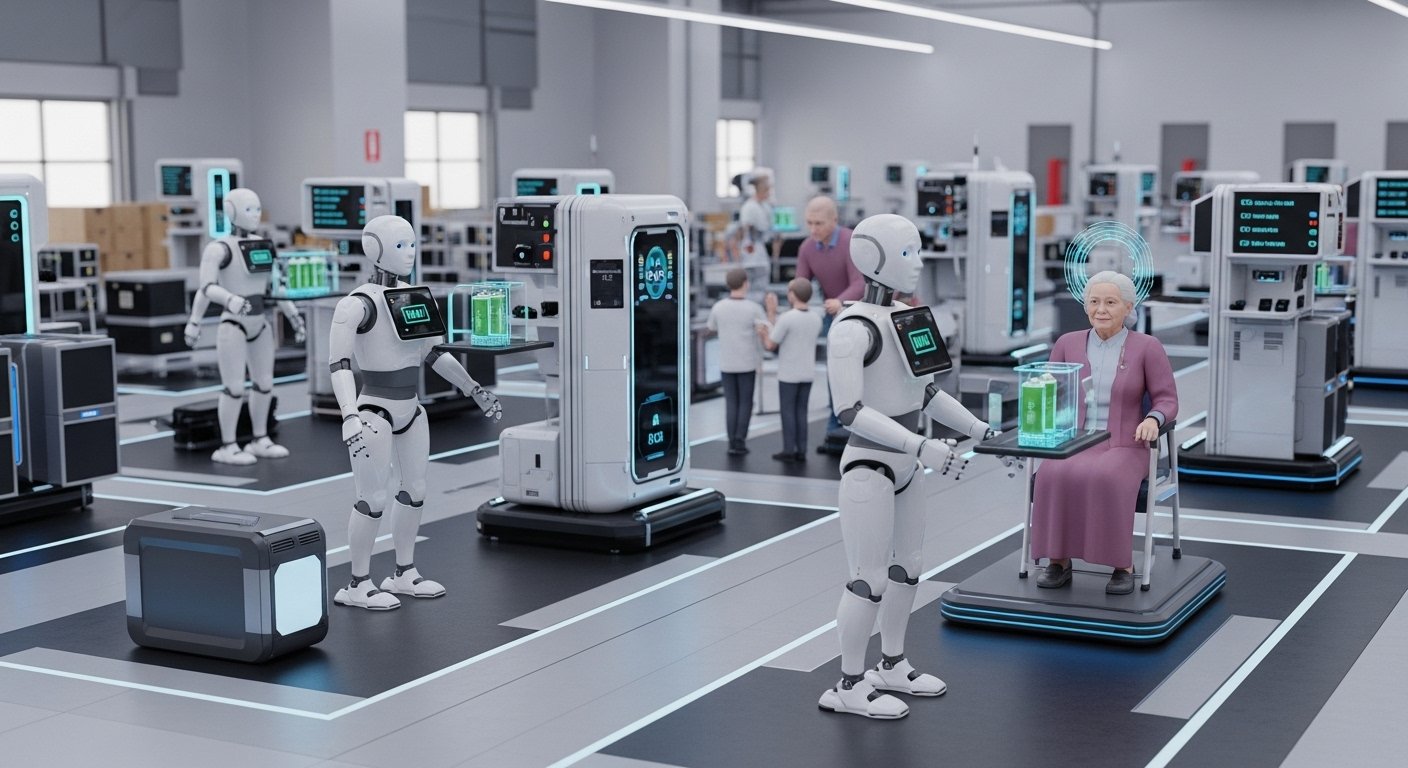
A cornerstone of the 24/7 operation capability is autonomous power management. UBTech’s Walker S2, for example, is specifically engineered for continuous performance across demanding factory environments.17 A key innovation is its novel hot-swappable power system, which enables a full battery exchange in approximately three minutes without any human intervention.16 The robot maintains continuous power during this process thanks to a dual-battery architecture, allowing it to continue functioning even if one battery module runs low.16 Critically, the Walker S2 possesses the intelligence to sense a low or overheating battery and autonomously decide whether to initiate a charge or a swap based on the urgency of its current tasks.18 Its precision-engineered limbs and advanced sensors ensure perfect alignment at the charging station, facilitating accurate and autonomous battery removal and installation.18 The autonomous hot-swappable battery system is the linchpin for achieving true 24/7 operational efficiency for humanoids in industrial settings. By virtually eliminating the downtime associated with traditional charging, it maximizes the robot’s utilization rate, significantly improving the return on investment for businesses. This capability transforms humanoids from being merely automated tools to continuous, self-managing assets, which is a fundamental shift in their economic value proposition and a direct fulfillment of the “24/7” aspect of the user query. It mirrors the efficiency gains from continuous production lines in manufacturing. This breakthrough positions Chinese humanoids as highly attractive solutions for industries with high uptime requirements, such as manufacturing, logistics, and warehousing, accelerating their adoption in these critical sectors. It also sets a new benchmark for operational autonomy in the global robotics industry.
Wireless Power Transfer (WPT) Advancements
While hot-swapping addresses immediate needs for continuous operation, research is actively advancing in complementary power solutions. Wireless power transfer (WPT) systems are being explored for humanoid robots, with proposals for effective U-shaped wireless charging systems designed to address challenges like coil misalignments and electromagnetic safety.29 Inductive power transfer, a form of WPT, is already widely used for autonomous mobile robots (AMRs) and offers distinct advantages such as high efficiency and significant positioning tolerance.30 This technology also has the capability to transmit data alongside power, which could enable more seamless and flexible charging solutions in future humanoid applications.30 The simultaneous development and exploration of WPT, even as hot-swapping is being deployed, indicates a forward-looking strategy to diversify and future-proof continuous operation. WPT offers advantages like greater flexibility in positioning and potentially less wear-and-tear than physical battery swaps, which will be crucial as humanoids move into more varied and less structured environments, such as public spaces or homes. This suggests that China is not content with a single solution but is investing in a portfolio of energy management technologies to ensure sustained 24/7 functionality across an expanding range of applications. The ability to transfer data via magnetic fields during wireless charging also hints at a deeper integration of power management with robot intelligence and ecosystem data. This could enable real-time energy optimization, predictive maintenance, and more efficient fleet management, further enhancing the overall operational efficiency and economic benefits of 24/7 humanoid deployment. It also points to a holistic approach to energy infrastructure for robotics.
VI. Supply Chain Mastery and Cost Advantage
China’s rapid ascent in humanoid robotics is deeply rooted in its unparalleled mastery of supply chain management and its ability to leverage existing industrial ecosystems to achieve significant cost advantages. This mirrors the strategic advantages that propelled its EV industry to global dominance.
Leveraging Industrial Robotics Ecosystem
The foundation of Chinese humanoid robot development lies in its comprehensive collaborative robot (cobot) supply chain.10 China has a rich history and extensive experience in the production of modularized joints and components for industrial robots, which are directly transferable to humanoid robot development.10 This pre-existing expertise has allowed Chinese companies to focus on improving movement capabilities and reducing manufacturing costs, a stark contrast to the emphasis on software development seen in many U.S. humanoid robot makers.10 The nation’s industrial robot sector has already seen accelerated localization, with domestic brands accounting for nearly half of the Chinese market, driven by the demand for lightweight robots from electronics manufacturers.10 This pre-existing, massive industrial base for robotics adoption in China creates a fertile ground for the seamless integration and rapid scaling of humanoid robots. It signifies that Chinese industries are already highly accustomed to, and invested in, automation, accelerating the adoption curve for humanoids as cultural and infrastructural barriers are significantly lowered. This high rate of industrial robot installation also implies a vast amount of operational data being generated within Chinese factories, which can be leveraged to train and refine AI models for humanoid robots, creating a powerful feedback loop that further accelerates development and deployment.
Vertical Integration and Domestic Component Control
China’s strategy involves creating a deeply embedded, vertically integrated ecosystem through collaboration between state and private actors.7 This is a critical asymmetric advantage for China. While U.S.-based companies like Figure AI acknowledge the lack of established supply chains for humanoids and are forced to bring much of their manufacturing in-house 31, Chinese firms benefit from a robust, localized ecosystem capable of providing nearly all necessary components. Reports indicate that China produces 90% of humanoid robot components domestically, significantly slashing costs.8 The efficiency of this domestic supply chain is remarkable, with local suppliers able to deliver materials within hours, a speed unmatched globally.8 This level of control and efficiency, built on the foundation of the collaborative robot supply chain, gives China a decisive cost and speed advantage over international competitors, effectively disrupting established global supply chain dynamics.10 The ability to build a humanoid robot “from scratch using only local suppliers” at a Chinese expo powerfully demonstrates this unparalleled vertical integration and self-sufficiency.32 This self-sufficiency means that while Western firms may struggle with component sourcing, Chinese firms can rapidly scale production without external dependencies. This positions China not only as a leading producer of humanoids but also as a critical global supplier of their core components, potentially creating a new layer of strategic dependence for other nations, similar to its dominance in EV batteries and rare earths.
Cost Competitiveness and Global Impact
The combination of a mature domestic supply chain and aggressive cost control measures allows Chinese humanoid robot manufacturers to offer products at significantly lower price points. For example, Unitree’s G1 humanoid robot is priced at approximately $13,600, substantially undercutting Western counterparts like Tesla’s Optimus, which is estimated to cost between $50,000 and $60,000.8 Analysts project that component prices for humanoids could fall to as low as $17,000 per unit by 2030, enabling mass adoption across various sectors.8 This aggressive pricing strategy, enabled by mass production and cost control, is a direct replication of China’s EV success model and signifies a strategic intent to democratize humanoid robot access. This will rapidly expand the market beyond high-end industrial applications to consumer and service sectors. This aggressive cost curve will likely lead to a “race to the bottom” in humanoid robot pricing, making them accessible for a wider range of applications and accelerating adoption globally. This could severely challenge Western competitors who may struggle to match these production efficiencies and cost structures, potentially leading to market consolidation or strategic partnerships where Western firms provide AI and Chinese firms provide hardware.
VII. Government Strategy and Investment: Fueling the Revolution
The rapid advancement of China’s humanoid robot industry is not merely a product of market forces but is strategically driven by a comprehensive and ambitious national AI strategy, backed by substantial government investment and a coordinated ecosystem.
National AI Strategy and Policy Goals
China’s national AI strategy is state-led, mission-driven, and aims for global leadership in artificial intelligence by 2030.5 This overarching goal is articulated in key policy documents like the State Council’s New Generation Artificial Intelligence Development Plan (2017) and the 14th Five-Year Plan for Digital Economy Development.5 The strategy integrates centralized governance with localized experimentation, leveraging ministries, industry alliances, and city-level pilot zones to rapidly deploy AI across sectors and shape regulatory norms at scale.5 This detailed outline of China’s national AI strategy confirms that the government is applying the same highly successful, centrally planned, and mission-driven approach that propelled its EV industry to the humanoid robot sector. The “global leadership by 2030” goal for AI, which explicitly includes robotics, indicates a long-term, sustained commitment that transcends market cycles. This top-down strategic direction, combined with localized experimentation, creates a powerful engine for rapid development and deployment, making an “EV moment” in robotics not just possible, but highly probable. This state-led approach provides a systemic advantage that private-sector-driven economies may struggle to match, particularly in terms of coordinated investment, infrastructure development, and regulatory agility. This deep integration of AI into industrial policy suggests that China views robotics as a core pillar of its future economic and strategic power, intensifying geopolitical competition.
Massive Financial Commitments and Incentives
Beijing’s commitment to AI and robotics is underpinned by unprecedented financial backing. Over $20 billion in subsidies have been allocated to the robotics sector, with a planned ¥1 trillion ($137 billion) fund specifically designated to support AI and robotics startups.8 This massive capital injection is further augmented by state-led AI investment funds, including an $8.2 billion fund for startups and a $138 billion National Venture Capital Guidance Fund targeting AI-related fields like robotics and “embodied intelligence”.6 Local governments, such as Shenzhen and Wuhan, offer targeted incentives, including subsidies of up to ¥5 million for meeting sales targets, which accelerate innovation and commercialization.8 Major banks have also initiated AI industry lending programs, with the Bank of China launching a five-year, $138 billion financing program for AI-related industries.6 The sheer scale of government-backed financial commitment dwarfs many private sector investments globally. This massive capital injection, combined with local government incentives and bank lending programs, creates an exceptionally fertile ground for rapid innovation, scaling, and commercialization in the humanoid robot sector. This level of coordinated financial backing is a direct parallel to the early, heavy subsidies in the EV sector and signals a national imperative to transform industries through robotics. This flood of capital will likely accelerate the market maturation process for humanoids, potentially compressing the typical development and adoption cycles seen in other industries. However, similar to the EV sector, such aggressive, state-backed investment also carries the risk of overcapacity and inefficient allocation of resources, which could lead to market volatility or consolidation in the long term.
Research and Development Ecosystem
China is building a robust R&D ecosystem for AI and robotics. Leading institutions like Tsinghua University, the Chinese Academy of Sciences, and specialized labs such as the Beijing Academy of Artificial Intelligence (BAAI) and Shanghai AI Lab are conducting fundamental research and developing foundational models.5 The Research Center for Intelligent Robotics at Zhejiang Lab, for example, is a cross-disciplinary hub focusing on cutting-edge basic science areas like autonomous operation, intelligent decision-making, and intuitive human-machine interaction, with specific projects on bipedal humanoid robots.33 This focus on intuitive human-machine interaction and intelligent decision-making indicates a strategic understanding that broad adoption of humanoids, especially in service and household settings, hinges on sophisticated software and seamless human integration. This implies a long-term vision to overcome the current US lead in AI software by building foundational capabilities for general-purpose humanoids, not just specialized industrial ones.
Talent Development and Acquisition
To sustain its leadership, China is investing heavily in talent development. Demand for AI professionals in China surged by 37% in the first half of the year, with robotics engineers seeing the highest demand and algorithm engineers ranking third.34 Projections from McKinsey suggest that demand for AI professionals in China will increase sixfold by 2030 from 2022 levels.34 The government’s AI Innovation Action Plan for Colleges and Universities (2018) has seeded AI programs at over 345 institutions, producing a deep pipeline of academic researchers and applied technologists.5 This is complemented by K-12 integration of STEM and robotics, reskilling programs for the workforce, and active international talent recruitment initiatives like the Thousand Talents Plan.5 The significant investments by major tech companies like JD.Com, coupled with the surging demand for and supply of AI and robotics talent, indicate a virtuous cycle of innovation and growth.20 This robust human capital pipeline ensures a continuous flow of expertise necessary to sustain the rapid development and scaling of the humanoid robot industry. This strong talent pool and investment environment positions China not just as a manufacturing hub but as a global innovation hub for embodied AI. The ability to attract and train such a large number of skilled professionals will be a long-term competitive advantage, allowing China to continuously push the boundaries of humanoid robot capabilities and applications, ensuring sustained leadership beyond initial mass production.
VIII. Challenges and Implications: Navigating the New Frontier
While the “EV moment” in humanoid robotics presents immense opportunities, its rapid acceleration, particularly driven by China’s strategic initiatives, also brings forth significant economic, social, ethical, and geopolitical challenges that require careful consideration.
Economic and Social Implications
A primary concern is the potential for job displacement and exacerbation of economic inequality.35 As humanoid robots become more efficient and capable of performing tasks traditionally done by humans, particularly in manufacturing, logistics, and customer service, there is a risk of widespread unemployment.35 While some argue that new job opportunities will emerge in areas like programming and engineering, it remains uncertain whether these will fully offset losses or if the workforce can seamlessly adapt through retraining and upskilling.35 This could disproportionately affect low-skilled laborers, worsening financial disparity.35 The rapid scaling of 24/7 humanoids, driven by China’s industrial policy, will accelerate these societal pressures. This creates an urgent imperative for robust regulatory frameworks and social safety nets, which China is already attempting to address through its AI strategy.5
The increasing prevalence of humanoids also raises concerns about human-robot interaction and potential emotional attachment or dependency.35 As robots integrate into personal and professional environments, understanding the psychological and social implications of these interactions is vital for developing ethical standards that promote healthy and beneficial relationships.35 Excessive reliance on robots may weaken human interpersonal relationships, highlighting the need for ethical design and clear boundaries.36
Ethical Considerations
The deployment of humanoid robots brings forth critical ethical dilemmas. Privacy and data security are paramount, as humanoids equipped with sophisticated sensors and AI capabilities will collect vast amounts of personal data.35 The potential for privacy breaches, unauthorized access, and intrusive surveillance necessitates stringent regulatory measures and robust data protection policies.35
Autonomy and accountability become complex as robots gain advanced decision-making capabilities.35 Determining responsibility in cases of harm or unethical decisions by autonomous systems—whether it falls on the manufacturer, programmer, or user—requires clear legal and ethical frameworks.36 Autonomous robots must operate within ethical boundaries and remain subject to human oversight.36
Furthermore, bias in AI algorithms used in humanoids can perpetuate and amplify existing societal inequalities, potentially leading to unfair treatment in areas like hiring or law enforcement if not addressed through transparent and fair AI design.35 How effectively China (and other nations) addresses these ethical and social challenges—e.g., through transparent data collection, fair labor practices, and clear ethical guidelines—could become a competitive differentiator and influence global acceptance and adoption. A failure to build public trust could lead to backlash, similar to privacy concerns with data collection in other tech sectors.
Geopolitical Dynamics and Dual-Use Technology
The “race” for humanoid robot dominance is not solely economic but also carries significant geopolitical implications. The underlying AI, locomotion, and manipulation capabilities developed for commercial humanoids have direct dual-use applications in military and security operations.36 The development of autonomous drones and robotic soldiers introduces complex ethical and social dilemmas regarding accountability, civilian safety, and potential misuse, challenging traditional ethical norms in warfare.36 The explicit mention of “military & security applications” for advanced robotics reveals the dual-use nature of humanoid robot technology. While the report focuses on industrial and service applications, the underlying AI, locomotion, and manipulation capabilities developed for commercial humanoids have direct military relevance. This introduces a significant geopolitical risk factor, as the “race” for humanoid dominance is not just economic but also strategic, potentially leading to an AI arms race and further exacerbating US-China tensions.6
This intensifies geopolitical rivalry, as countries vie for supremacy in AI and robotics.25 The ethical complexities, particularly around autonomy, accountability, and the “moral status” of advanced robots, suggest a growing governance vacuum at the international level.36 Without clear global norms or treaties, the rapid development and deployment of humanoids, especially by a state-led actor like China, could lead to unforeseen ethical dilemmas and a lack of consensus on responsible AI development, potentially hindering global collaboration or leading to fragmented regulatory landscapes.
Technological Hurdles and Safety
Despite rapid progress, humanoid robots still face technological hurdles. While continuous operation is being achieved through battery swapping, challenges remain in maximizing battery life and thermal management for sustained high-demand operations.37 Ensuring
safe interactions with human workers in fast-paced environments requires extensive testing and thoughtful implementation strategies.2 Humanoids also currently have
speed and strength limitations compared to dedicated fixed industrial automation.37 However, the fact that companies like UBTech are already demonstrating 24/7 autonomous battery swapping indicates that China is actively and effectively addressing these specific limitations.16 This rapid problem-solving, coupled with advancements in automated quality control, suggests a high capacity for iterative improvement and industrialization, which is essential for an “EV moment” in robotics.38 The need for custom mechanical design, rapid prototyping, small-batch production, and tight-tolerance machining implies that the design process for humanoids is becoming increasingly geared towards manufacturability and scalability.37 This focus on production-ready designs, combined with automated quality control, indicates that the industry is maturing rapidly from research prototypes to commercially viable products, accelerating their readiness for mass deployment.
IX. Conclusion: A Transformative Trajectory
China’s humanoid robot revolution is indeed demonstrating clear parallels to its “Electric Car” moment, signaling a profound transformation in global manufacturing, services, and human-machine interaction. The analysis unequivocally indicates that China is leveraging a strategic blueprint proven successful in the EV sector: aggressive government support, a deeply integrated and cost-effective domestic supply chain, and a relentless drive towards mass production and market penetration.
The rapid scaling of production by key Chinese players like UBTech and Unitree, coupled with disruptive pricing strategies, is poised to democratize access to humanoid robots. Technological breakthroughs, particularly in autonomous power management enabling true 24/7 operation, are unlocking unprecedented levels of productivity and operational efficiency. Furthermore, China’s comprehensive national AI strategy, backed by immense financial commitments and a robust talent ecosystem, positions it as a global innovation hub for embodied AI. The use of public proving grounds and phased deployment strategies underscores a calculated approach to both technological refinement and societal integration.
However, this transformative trajectory is not without its complexities. The potential for widespread job displacement, critical ethical considerations around privacy, accountability, and AI bias, and the dual-use nature of advanced robotics demand proactive regulatory frameworks and international discourse. Navigating these challenges responsibly will be crucial for ensuring that the benefits of this revolution are broadly realized.
In essence, China is not merely participating in the global robotics race; it is actively shaping its trajectory. The convergence of state-led industrial policy, advanced AI capabilities, and manufacturing prowess suggests that the “EV moment” in humanoid robotics is not a hypothetical future, but an unfolding reality that will profoundly impact global industries and societies in the coming decades.