NVIDIA Jetson Thor: The Tiny, Affordable AI Supercomputer/ Unleashing the Future of AI and Robotics at the Edge
1. Introduction: The Dawn of a New Robotic Era
The landscape of artificial intelligence and robotics is undergoing a profound transformation. What was once confined to controlled environments and pre-programmed tasks is now evolving into a realm of intelligent, adaptive machines capable of interacting seamlessly with the complexities of the real world. This shift demands unprecedented computational power at the very edge of operations.
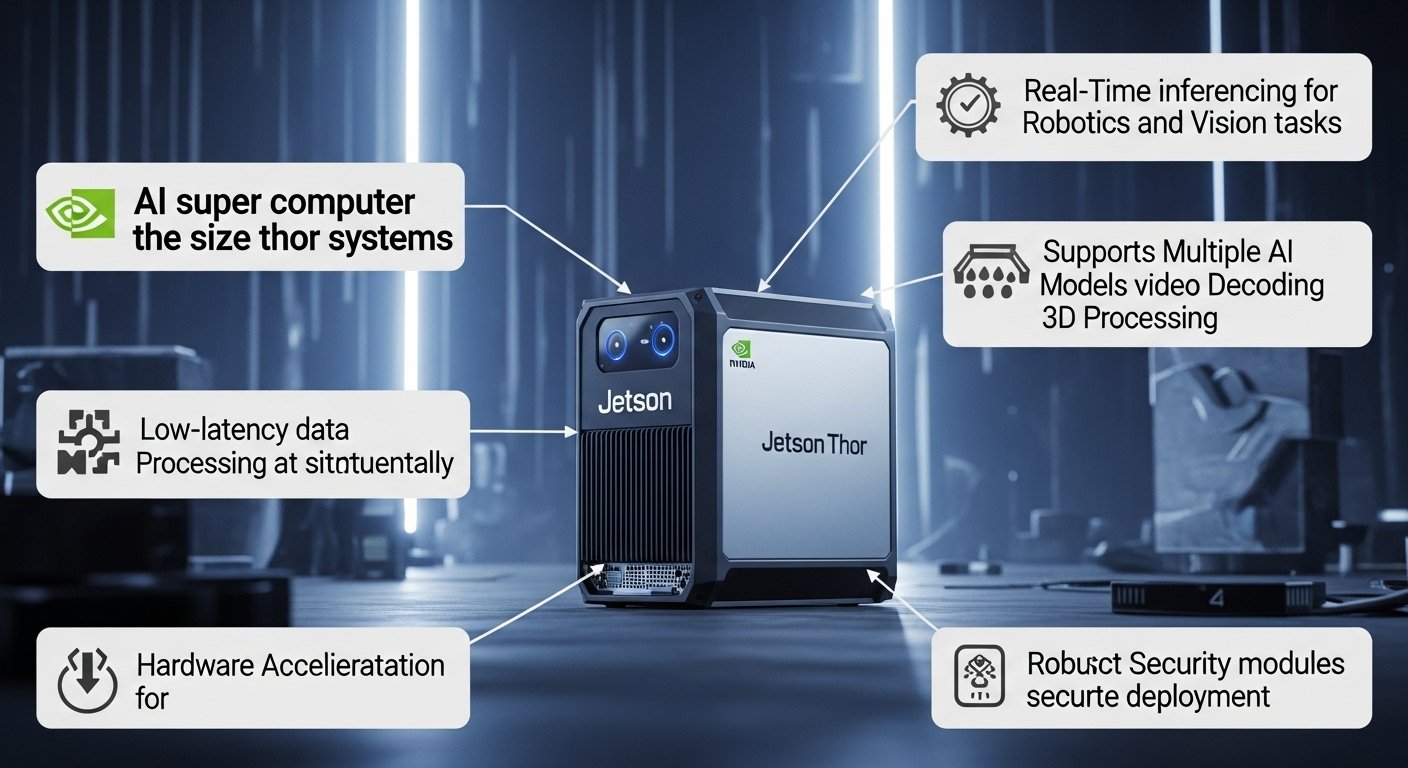
Stepping into this new era, NVIDIA, a vanguard in high-performance computing and AI, has unveiled its latest groundbreaking innovation: the Jetson Thor. This compact yet immensely powerful system-on-module (SoM) is engineered to redefine the capabilities of AI at the edge, particularly for the burgeoning field of advanced robotics.1 NVIDIA is strategically shifting its focus from being merely a component provider to becoming a platform enabler for the entire robotics industry. This approach mirrors how companies like Google provide the Android platform for smartphones, fostering an entire ecosystem of hardware, software, and simulation tools (like Isaac Sim/Lab) to accelerate development for a wide range of robot manufacturers.4 This signifies a long-term commitment to dominating the embedded AI market for physical AI, extending beyond traditional data center applications.
Positioned by NVIDIA as a “tiny, affordable AI supercomputer,” Jetson Thor aims to bring previously unattainable levels of AI performance directly to robotic platforms.1 This enables robots to perceive, reason, and interact with their physical surroundings in real-time, fundamentally shaping the future of autonomous systems. The consistent emphasis on terms like “Physical AI,” “embodied AI,” and “humanoid robots” across various sources indicates a clear industry trend where AI is moving beyond virtual spaces to directly interact with and manipulate the physical world.1 Jetson Thor is designed “from the ground up” for this purpose, highlighting a focused engineering effort to meet the unique demands of real-world robotic interaction, such as real-time processing and robust sensor fusion. This report will delve into what makes Jetson Thor a pivotal development, exploring its advanced specifications, unparalleled performance, transformative applications, and its strategic role in shaping the future of robotics.
2. What Makes Jetson Thor a Powerhouse? A Deep Dive into its Architecture
2.1. The Brain: Blackwell GPU and Arm Neoverse V3AE CPU
At the core of Jetson Thor’s computational prowess is the NVIDIA Blackwell GPU. This cutting-edge architecture features 2560 CUDA cores and 96 fifth-generation Tensor Cores.1 A significant advancement is its support for Multi-Instance GPU (MIG) technology, which allows the GPU to be dynamically partitioned into separate, isolated instances. This enables multiple AI workloads to run concurrently without interference, optimizing resource utilization and providing “one-chip-multitask” capabilities.1
Complementing the powerful GPU is a robust 14-core Arm Neoverse V3AE CPU, capable of clocking up to 2.6 GHz, with a generous 1MB L2 cache per core and 16MB shared L3 cache.1 This high-performance CPU cluster provides substantial general-purpose computing power, which is indispensable for complex robotic control algorithms, path planning, and managing real-time operating systems and I/O.1 The strategic combination of NVIDIA’s latest Blackwell GPU architecture with the high-performance Arm Neoverse V3AE CPU is a deliberate design choice aimed at tackling the unique demands of physical AI. Blackwell’s prowess in generative AI, coupled with the CPU’s real-time processing capabilities and the MIG feature, allows Thor to simultaneously manage complex AI inference (e.g., understanding human commands), execute precise robotic movements, and handle multiple sensor streams. This integrated approach is crucial for robots that must operate autonomously and interact dynamically in unstructured physical environments.
2.2. Massive Memory and Bandwidth for Next-Gen AI
Jetson Thor is equipped with an impressive 128GB of LPDDR5X memory. This memory operates on a 256-bit bus, delivering a substantial bandwidth of 273 GB/s.1 This enormous memory capacity is a critical enabler for running large language models (LLMs), vision-language models (VLMs), and complex transformer networks directly on the device.1 These cutting-edge generative AI models demand significant memory resources to load and process their vast parameters, allowing robots to understand natural language instructions, learn from human demonstrations, and perform sophisticated cognitive tasks in real-time without constant cloud dependency.1
This 128GB LPDDR5X memory is more than just “more RAM”; it is a foundational component for realizing a new paradigm of “embodied AI”.10 By facilitating the execution of large, multimodal generative AI models (such as NVIDIA Isaac GR00T N) directly on the robot, Thor empowers truly intelligent, adaptive, and interactive robotic behavior.2 This capability allows robots to move beyond pre-programmed actions to genuine understanding, reasoning, and learning within dynamic, real-world environments, fundamentally blurring the lines between human and machine interaction. The ability to perform “full in-memory AI” drastically reduces latency and reliance on cloud processing for real-time robotic intelligence.1
2.3. Advanced I/O and Multimedia for Sensor Fusion
Jetson Thor is equipped with four 25GbE MACs, providing a total bandwidth of 100 Gbps.1 This high-speed networking capability is crucial for ingesting and processing massive, real-time data streams from multiple high-resolution sensors, such as cameras, LiDAR, and radar, which are essential for autonomous operation.1 It also supports 16 CSI-2 lanes, allowing direct connection of up to 6 cameras and supporting 32 virtual channels, ideal for developing sophisticated multi-camera systems and performing real-time video analytics, a cornerstone of robotic perception.1
Beyond networking and cameras, Thor offers a comprehensive suite of I/O, including PCIe Gen5 for high-speed NVMe storage (the developer kit includes 1TB NVMe) 3, multiple USB 3.2 ports, CAN bus for real-time control, I2C, UART, PWM, and GPIO for seamless integration with a wide array of robotic components and peripherals.1 The module further includes dual NVDEC and NVENC engines, enabling high-performance video decoding (up to 4x 8Kp30 or 10x 4Kp60 video streams) and encoding (up to 6x 4Kp60 simultaneously).1 This is vital for processing and transmitting visual data in vision-based AI applications. The extensive and high-bandwidth I/O capabilities are fundamental enablers for robust “sensor fusion”.1 This allows robots and autonomous vehicles to ingest, process, and fuse diverse data from multiple sensor types in real-time and at high throughput, which is paramount for building a comprehensive, 360-degree understanding of their dynamic environment, critical for safe, reliable, and effective autonomous navigation and interaction in complex scenarios.
2.4. Compact Form Factor: Power in a Small Package
The Jetson Thor module itself is remarkably compact, measuring approximately 87×100 mm.1 The complete developer kit, including the carrier board and thermal solution, has dimensions of 243.19mm x 112.40mm x 56.88mm.2 This “tiny” form factor is a significant advantage for integration into space-constrained robotic platforms. It allows for high-performance AI to be embedded directly into a wide range of autonomous machines, including humanoid robots, Autonomous Mobile Robots (AMRs), and drones, without requiring bulky external compute units.1
The miniaturization of Jetson Thor, combined with its powerful compute capabilities, is a strategic enabler for the widespread and practical deployment of high-performance AI. This allows for creating truly ubiquitous, agile, and energy-efficient autonomous machines. These compact, intelligent robots can operate effectively in diverse environments, from tightly packed factory floors and warehouses to retail spaces and even human homes, making advanced AI more accessible and integrated into daily life.
3. Performance Beyond Expectations: A Quantitative Leap
3.1. Raw AI Compute Figures: Understanding the Metrics
Jetson Thor delivers an astounding AI compute performance, reaching up to 2070 TFLOPs (FP4 sparse), 1035 TFLOPs (FP8 dense), and 8.064 FP32 TFLOPs.1 It also boasts 500 FP16 TOPS, 1000 FP8 TOPS, and 2000 FP4 TOPS.15
It is important for developers and enthusiasts to understand the context of these figures. NVIDIA, like many industry leaders, often highlights peak theoretical performance using lower precision (FP4, FP8) and sparse calculations. While these modes are increasingly vital for optimizing AI inference, particularly for large models, the FP32 performance (8.064 TFLOPs) provides a more traditional and universally comparable baseline for general-purpose compute. This distinction is crucial for accurately assessing real-world performance and optimizing models for specific deployment scenarios.15 This transparency offers genuine, non-hyperbolic insight into the true capabilities and optimization considerations for developers.
3.2. Direct Comparison: Thor vs. Orin vs. Xavier
Jetson Thor represents a monumental leap in performance when compared to its predecessors. It offers up to 7.5x higher AI compute performance compared to the Jetson AGX Orin.2 For context, the Orin AGX itself delivered up to 275 TOPS, a significant improvement over the Jetson AGX Xavier’s approximately 30 TOPS.1
Thor’s 14-core Arm Neoverse V3AE CPU marks a substantial upgrade from Orin’s 12-core Cortex-A78AE, boasting a reported 2.6x performance improvement for the CPU.1 Furthermore, Thor doubles the memory capacity of the top-tier Orin modules, featuring 128GB of LPDDR5X RAM with a higher bandwidth of 273 GB/s, compared to Orin AGX’s 64GB LPDDR5 at 204.8 GB/s.1 Thor also integrates PCIe Gen5, a generational leap from Orin’s Gen4. This doubles the bandwidth per lane, crucial for high-speed peripherals and next-generation NVMe storage, ensuring data can move efficiently to and from the GPU and CPU.1
The power consumption profile also reflects this performance leap. Thor’s configurable power range is 75W-120W, with a maximum thermal design power (TDP) of 130W. This is a notable increase compared to Orin’s 15W-60W range, indicating its higher performance ceiling.1 These direct comparisons reveal that Jetson Thor is not merely an incremental upgrade but a substantial generational leap across all critical metrics. This magnitude of performance increase—especially in AI compute and memory—is directly correlated with the ability to handle the computational demands of emerging generative AI models and increasingly complex, multi-modal robotic tasks. This significant power increase, however, comes with a higher power consumption, indicating that Thor is specifically targeting higher-performance, more power-intensive applications where raw compute capability is paramount, rather than ultra-low power scenarios.
Table 1: NVIDIA Jetson Thor vs. Select Jetson Modules: Key Specifications Comparison
| Feature | Jetson Thor | Jetson AGX Orin | Jetson Orin NX | Jetson Orin Nano | |
| GPU Architecture | Blackwell, 2560 CUDA, 96 Tensor Cores, MIG | Ampere, up to 2048 CUDA, 64 Tensor Cores | Ampere, 1024 CUDA, 32 Tensor Cores | Ampere, 512 (4GB) / 1024 (8GB) CUDA, 16 Tensor Cores | |
| AI Performance | Up to 2070 TFLOPs FP4 (sparse) / 1035 TFLOPs FP8 (dense), 8.064 FP32 TFLOPs | Up to 275 TOPS | Up to 100 TOPS | Up to 40 TOPS | |
| CPU | 14× Arm Neoverse V3AE (up to 2.6 GHz) | 12× Cortex-A78AE (up to 2.2 GHz) | 8× Cortex-A78AE (up to 2.0 GHz) | 6× Cortex-A78AE (up to 1.7 GHz) | |
| RAM | 128 GB LPDDR5X, 273 GB/s | 32–64 GB LPDDR5, 204.8 GB/s | 8/16 GB LPDDR5, ~102 GB/s | 4/8 GB LPDDR5, ~68 GB/s | |
| Storage | >64 MB NOR, NVMe (PCIe Gen5, x4), SSD via USB 3.2 | 64 GB eMMC, NVMe over PCIe Gen4 | External eMMC supported | External eMMC supported | |
| Networking | 4× 25GbE MACs (100 Gbps total) | 1× 10GbE + 1× 1GbE | 1× 1GbE | 1× 1GbE | |
| PCIe | Gen5 (x8+x4+x2) | Gen4 (up to 22 lanes) | Gen4 (up to 16 lanes) | Gen4 (up to 8 lanes) | |
| Camera Interfaces | 16× CSI-2 lanes | 16× CSI-2 lanes | 8× CSI-2 lanes | 8× CSI-2 lanes | |
| Display Outputs | 4× HDMI 2.1 / DP 1.4a, up to 8K @30Hz | 3–4× outputs, up to 8K | 2× 4K | 1× 4K | |
| Video Decode | Dual NVDEC, 10× 4Kp60 or 4× 8Kp30 | 3x4K@60 / 11x1080p@60 | 2x4K@60 / 9x1080p@60 | 1x4K@60 / 5x1080p@60 | |
| Video Encode | Dual NVENC, 6× 4Kp60 | 1x4K@60 / 7x1080p@60 | 1x4K@60 / 6x1080p@60 | No HW Encoder | |
| Power (Configurable/Max) | 75W, 95W, 120W (Max 130W) | 15W–60W | 10W–40W | 7W–20W | |
| Form Factor | 87×100 mm | 100×87 mm AGX | 70×45 mm SO-DIMM | 70×45 mm SO-DIMM | |
| (Sources: 1) |
This table is valuable for developers and decision-makers. It allows for an immediate, side-by-side comparison of Thor’s capabilities against its predecessors, clearly illustrating the generational leap. Readers can quickly identify the specific areas where Thor excels (e.g., Blackwell GPU, Neoverse V3AE CPU, 128GB RAM, Gen5 PCIe, 4x 25GbE, dual encoders/decoders). For those evaluating embedded AI platforms, this table provides the critical data points needed to assess whether Thor’s advanced capabilities justify its likely higher cost and power demands for their specific application, or if an Orin module would suffice.
4. The Future is Now: Real-World Applications Powered by Thor
4.1. Humanoid Robotics and Embodied AI
Jetson Thor is explicitly “architected from the ground up to power next-generation humanoid robots”.1 It serves as the foundational computing platform for NVIDIA’s ambitious Project GR00T foundation model, designed to enable general-purpose humanoid robots.3 This empowers robots to understand natural language, learn complex movements by observing human actions, and adapt intelligently to diverse, unstructured real-world tasks.4
Thor powers real-time AI for humanoids, facilitating critical functions such as Simultaneous Localization and Mapping (SLAM), advanced planning, and dexterous control for intricate manipulations.1 Its 14-core CPU and real-time I/O (CAN, GPIO) are vital for coordinating complex physical interactions.1 NVIDIA is actively collaborating with leading humanoid robot companies, including Agility Robotics (maker of Digit), Boston Dynamics, Figure AI, and Sanctuary AI.4 Thor’s capabilities are accelerating the development and deployment of these human-centric robots, which are poised to transform industries by automating tasks, improving efficiency, and addressing labor shortages.6 Thor’s central role in Project GR00T and its ability to run sophisticated VLA (Vision Language Action) models 2 signifies NVIDIA’s direct and profound contribution to the pursuit of Artificial General Robotics (AGR). This isn’t just about making robots faster; it’s about enabling them to generalize, learn, and interact intelligently across a wide array of dynamic, unstructured environments. This capability is crucial for fostering true human-robot collaboration, where robots can understand human intent, adapt to unforeseen circumstances, and perform complex tasks alongside people, fundamentally blurring the lines between human and machine capabilities.
4.2. Autonomous Vehicles and Intelligent Machines
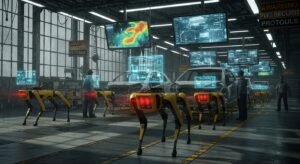
Jetson Thor is designed to power the next generation of Autonomous Mobile Robots (AMRs), drones, and intelligent vehicles. It enables advanced capabilities such as comprehensive sensor fusion, integrating data from cameras, LiDAR, radar, and IMUs for a complete environmental understanding, and robust onboard AI for real-time perception and control.1
For safety-critical applications, Thor incorporates essential features like ECC (Error-Correcting Code) memory, secure boot mechanisms, and a high-performance Neoverse CPU cluster with integrated functional safety processors. It is designed to meet stringent automotive functional safety standards like ASIL-D and ISO 26262/ISO 21434, ensuring reliable operation in demanding scenarios.1 A key breakthrough is Thor’s “one-chip-multitask” capability. Leveraging Multi-Instance GPU (MIG) technology and advanced virtualization, Thor can consolidate multiple workloads—such as autonomous driving (perception, planning, decision-making), intelligent cockpit features (infotainment, occupant monitoring), and in-cabin smart functions—onto a single SoC.10 This significantly reduces system cost, weight, and wiring complexity in vehicles, transforming traditional distributed ECU architectures. The integration of high-performance AI with robust functional safety features and the ability to consolidate multiple vehicle Electronic Control Units (ECUs) onto a single chip represents a profound paradigm shift in automotive and autonomous machine architectures. This approach not only enhances the capabilities and responsiveness of autonomous driving and robotic systems but also streamlines vehicle design, manufacturing, and maintenance. By reducing hardware complexity and wiring, Thor makes advanced autonomy more practical, scalable, and inherently safer for mass deployment across various industries.
4.3. Edge AI Inference Servers and Smart Spaces
Jetson Thor’s immense processing power enables the deployment and execution of complex large language models (LLMs), transformer networks, and advanced vision models directly on edge devices. This capability is crucial for analyzing high-resolution data, such as 4K/8K video streams, at scale and in real-time.1 Thor is perfectly suited for applications in smart cities, intelligent buildings, and edge analytics, where real-time insights from vast amounts of sensor data are required for immediate decision-making.1
Deploying AI at the edge, as enabled by Thor, offers significant advantages: it facilitates immediate, on-site decision-making, drastically reduces latency by eliminating the need to send data to centralized cloud servers, and minimizes strain on network bandwidth.16 Furthermore, processing data locally enhances privacy and security, as sensitive information remains on the device.17 By bringing server-class AI performance to compact edge devices, Jetson Thor democratizes the deployment of highly complex AI models, including generative AI, across a vast array of applications beyond traditional data centers. This enables real-time, localized intelligence in environments where cloud connectivity is unreliable, intermittent, or where ultra-low latency is critical. This capability accelerates the widespread adoption of sophisticated AI in smart infrastructure, industrial settings, and consumer devices, making AI ubiquitous and highly responsive.
4.4. Expanding Horizons: Industrial Automation and Healthcare
Thor’s capabilities extend beyond just robotics to other mission-critical sectors. In industrial automation and vision systems, Thor is ideal for AI-powered defect detection and inspection systems, multi-display dashboards for operators, and predictive maintenance solutions that leverage complex sensor fusion.1 Its rugged design and long lifecycle support make it suitable for demanding industrial environments.
In the medical field, Thor can accelerate AI diagnostics for modalities like MRI and ultrasound, power surgical robotics, and enable advanced patient monitoring systems.1 It supports secure, real-time 3D imaging workflows and offers on-device privacy features via TrustZone and encryption. Thor’s ability to handle high-throughput, real-time AI in demanding environments signifies a broader impact on industrial efficiency, safety, and advanced medical applications.
5. Addressing “Affordability” and Availability: A Realistic Look
5.1. The “Affordable” Proposition: Value vs. Price
While a specific retail price for the NVIDIA Jetson Thor module or developer kit has not been officially announced 1, the term “affordable” in the context of an “AI supercomputer” should be interpreted in terms of its value proposition rather than a low absolute cost. Jetson Thor delivers up to 7.5x higher AI compute and 3.5x better energy efficiency compared to the Jetson AGX Orin.2 This translates into significantly more AI performance per watt and, implicitly, a more cost-effective solution for highly demanding edge AI workloads than previous generations or custom solutions.
To provide context, existing Jetson products range from the Orin Nano at $249 to the AGX Orin Developer Kit at around $2000.5 Given Thor’s superior specifications, it is expected to be at the higher end of this spectrum, reflecting its advanced capabilities.14 The “affordable” aspect is not about being cheap, but about providing a highly integrated, high-performance platform that reduces the overall cost and complexity of developing and deploying cutting-edge physical AI systems, especially compared to assembling discrete components or relying on cloud infrastructure for similar performance. It represents an investment that pays off in capabilities and simplified development.
5.2. Availability and Release Timeline
NVIDIA revealed Jetson Thor’s specifications during GTC 2025.5 The developer kit and modules are expected to be available in June 2025, with a new webpage and technical documentation released around July 9, 2025.8 Mass production is slated for 2025.30 This clear release timeline indicates that Jetson Thor is not a distant concept but an imminent product set to impact the robotics and edge AI market very soon, adding a sense of urgency and relevance to the discussion.
5.3. Power Consumption: A Key Consideration
Jetson Thor’s configurable power ranges from 75W to 120W, with a maximum thermal design power (TDP) of 130W.1 This is notably higher than the Jetson AGX Orin’s 15W-60W range.1 While offering immense power, this higher TDP requires careful consideration for battery-powered or size-constrained mobile robotic applications, where thermal management and energy efficiency are critical.20
NVIDIA provides a suite of tools to help developers optimize power consumption and manage thermals. These include nvpmodel for setting power modes (e.g., 75W, 95W, 120W, or MAXN for unconstrained performance), jetson_clocks for locking frequencies, the Jetson Power GUI for real-time monitoring of CPU/GPU usage and temperature, and tegrastats for command-line statistics.36 JTOP offers a user-friendly way to visualize and control these resources.38 The increased power consumption is a direct trade-off for the unprecedented performance. However, highlighting NVIDIA’s provided tools demonstrates that this challenge is addressable, allowing developers to fine-tune Thor for diverse robotic needs, from high-throughput industrial applications to more energy-sensitive mobile platforms.
6. Why Developers and Innovators Should Pay Attention: The Ecosystem Advantage
NVIDIA’s commitment to the future of AI and robotics extends far beyond hardware. Jetson Thor runs the full NVIDIA AI software stack for physical AI applications, providing a comprehensive and integrated development environment. This includes:
- NVIDIA Isaac for Robotics: This platform provides essential tools for robotic simulation (Isaac Sim and Isaac Lab), advanced perception (Isaac Perceptor), and precise manipulation (Isaac Manipulator), significantly accelerating robot development and learning.2
- NVIDIA Metropolis for Visual Agentic AI: Designed for advanced video analytics, visual inspection, and smart city applications, enabling intelligent visual processing at the edge.2
- NVIDIA Holoscan for Sensor Processing: A robust framework for real-time sensor data processing, crucial for low-latency AI applications that rely on immediate data interpretation.1
- Core Acceleration Libraries: Thor supports foundational NVIDIA libraries such as CUDA, TensorRT, cuDNN, and VPI, which are essential for optimizing AI model performance and leveraging the full capabilities of the GPU.10
The Jetson family, including Thor, utilizes the same NVIDIA CUDA-X software and supports cloud-native technologies like containerization and orchestration.9 This enables a seamless development workflow from cloud-based training to edge deployment. The availability of such a mature, unified software stack significantly reduces the development burden for complex AI and robotics projects. Developers do not need to build everything from scratch; they can leverage NVIDIA’s optimized libraries and frameworks, accelerating prototyping, deployment, and ultimately, time-to-market. This is a critical factor in making advanced robotics more accessible and “affordable” in terms of development effort and risk.
Furthermore, NVIDIA fosters a broad ecosystem of partners who offer essential components like carrier boards, design services, cameras, and other sensors.3 This network, combined with pre-validated hardware reference designs (such as the developer kit with its integrated 1TB NVMe storage and WiFi connectivity) 3, allows developers to begin software and algorithm testing immediately. NVIDIA’s strategy extends beyond selling chips to cultivating a complete ecosystem of hardware, software, and partners. This approach fosters rapid innovation, minimizes design uncertainty, and allows companies to focus on their core differentiators, rather than reinventing the foundational AI and robotics infrastructure. This is how NVIDIA aims to transform the robotics market.6
7. Conclusion: Powering the Next Wave of Intelligent Machines
NVIDIA Jetson Thor stands as a groundbreaking AI supercomputer, combining immense processing power, large memory capacity, and advanced I/O capabilities within a compact form factor. Its Blackwell GPU architecture, 14-core Arm Neoverse V3AE CPU, 128GB LPDDR5X memory, and high-speed networking are specifically engineered to meet the rigorous demands of next-generation AI at the edge.
This powerful platform is set to accelerate the development of sophisticated humanoid robots, highly capable autonomous vehicles, and advanced edge AI systems. By enabling on-device generative AI models, real-time sensor fusion, and complex multi-tasking, Jetson Thor empowers machines to achieve new levels of intelligence, autonomy, and natural interaction with the physical world. While its power consumption represents a step up from previous Jetson generations, NVIDIA’s comprehensive software stack and robust ecosystem provide the necessary tools and support for developers to optimize performance and manage power efficiently across diverse applications.
Jetson Thor is not merely a product launch; it is a catalyst for the widespread adoption of sophisticated AI in real-world applications, fundamentally shaping the future of robotics. Developers and innovators are encouraged to explore the NVIDIA Jetson platform and its extensive resources to envision how Jetson Thor can unlock new possibilities in their own pioneering projects.21