Robo-Dogs on the March: China’s New Battlefield Tech and What It Means for Ukraine, Russia, and the Future of War
Imagine a battlefield where the most relentless soldiers aren’t human, but four-legged machines bristling with firepower – that future just got a lot closer with China’s latest military drills. Recent reports confirm China’s People’s Liberation Army (PLA) has conducted live-fire exercises featuring armed robotic dogs near its northern border, not far from Russia. This isn’t just a technological showcase; it’s a profound signal about the evolving nature of modern warfare, with ripple effects stretching from the ongoing conflict in Ukraine to the very concept of human involvement on the battlefield. This blog post delves into what these drills reveal, their potential impact on the Ukraine-Russia war, and how they shape the debate around humanoid robots in combat. The immediate demonstration of these advanced systems underscores a dramatic shift in military strategy, linking China’s technological advancements directly to broader geopolitical dynamics and the accelerating global pursuit of autonomous warfare.
I. China’s Robotic Vanguard: Unpacking the Drills Near Russia’s Border
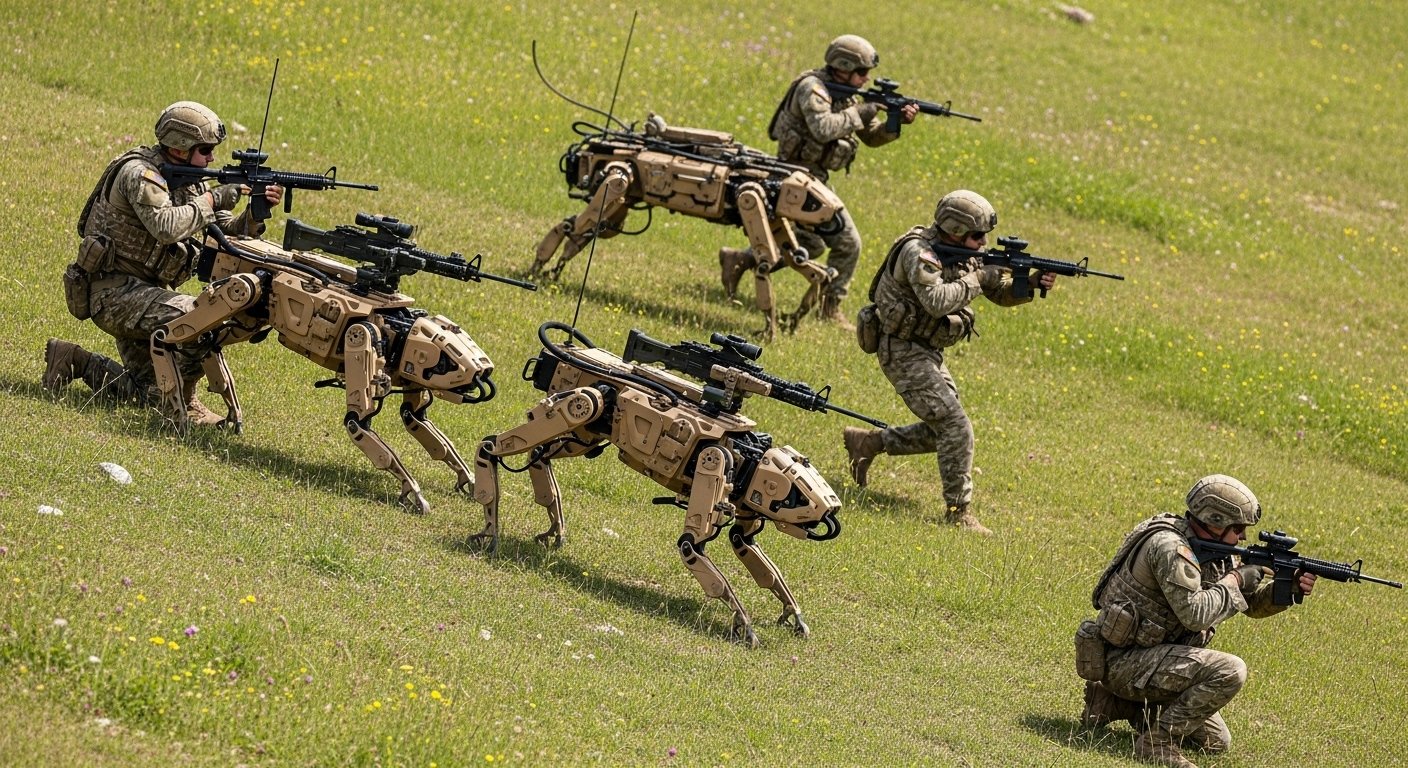
The recent live-fire drills conducted by China’s People’s Liberation Army represent a significant step forward in the integration of unmanned ground systems into conventional military operations. These exercises, carried out by units of the PLA’s 76th Group Army in a mountainous area of northern China, near the Russian border, featured rifle-equipped robotic dogs operating alongside human infantry.1 While the exact location was not disclosed, its proximity to the Russian border carries strategic implications, suggesting a focus on northern defenses or potential areas of interest.
Footage released by state broadcaster CCTV-7 provided a public glimpse into these maneuvers, showcasing “mechanical dogs” or “robotic quadrupeds” seamlessly integrated into infantry formations. These robotic systems were observed advancing across challenging, uneven terrain, providing crucial covering fire for human soldiers. This demonstration highlights a new level of human-machine coordination in tactical scenarios, moving beyond mere support roles to direct participation in combat.1
Demonstrated Capabilities
The drills showcased a range of impressive capabilities for these armed robotic platforms:
- Fire Support: The robotic systems were explicitly shown engaging simulated enemy positions with automatic rifles mounted on their backs, effectively providing covering fire for advancing PLA troops. This capability signifies a move beyond passive reconnaissance to active engagement in direct combat scenarios.1
- Mobility & Navigation: The “robotic quadrupeds” demonstrated remarkable mobility, capable of following soldiers across complex and rough terrain while actively avoiding obstacles. The inherent advantage of a four-legged design over traditional wheeled or tracked vehicles in navigating diverse and challenging environments, such as mountainous regions or urban rubble, was clearly on display.1
- Reconnaissance & Surveillance: PLA officials confirmed that these machines are designed to carry out reconnaissance missions, scout enemy positions, and assist in close-quarters combat. Equipped with advanced sensors, they can maintain reliable radio links with human operators at a distance, relaying critical battlefield intelligence in real-time.1
- Human-Robot Teaming: A PLA instructor emphasized that these robotic systems are designed to “supplement ground troops in areas where human soldiers face heightened risk”.1 This focus on reducing human vulnerability is a key motivator for military robotics development globally, aiming to preserve human lives by assigning dangerous tasks to machines.4
- Drone Integration: A particularly significant aspect of these exercises was the sophisticated integration of the robotic ground systems with small tactical drones. These aerial drones provided overwatch, aerial surveillance, and relayed targeting information directly to ground forces, showcasing a highly networked combat approach. This synergy between air and ground robotics is intended to significantly enhance situational awareness and operational efficiency in contested environments.1
Broader Context of China’s Military Modernization
These recent drills are not isolated events but rather a tangible manifestation of a “broader shift in PLA operational doctrine” with an “increased focus on unmanned systems and networked combat”.1 This strategic pivot reflects China’s commitment to transforming its military into a technologically advanced force. The scale of China’s ambition in robotics is evident in its industrial output; from 2022 to 2023, China added over 276,000 “roboworkers,” accounting for more than half of all industrial robots used globally during that period.7 This industrial capacity underscores a national commitment to scaling robotics across various sectors, including defense.
The PLA has a documented history of showcasing and deploying armed robotic dogs. In May 2024, a version armed with a QBZ-95 rifle was unveiled, followed by an even more advanced model in January 2025 equipped with M40 Seeker missiles, reportedly capable of intercepting airborne threats at speeds up to 200 km/h.8 These systems have already seen use in assault operations, as demonstrated during the “Golden Dragon 2024” joint exercise with Cambodia.6 To support these sophisticated systems and enable complex operations, China has invested in dedicated infrastructure, including 5G base stations, to maintain control over large “packs of mechanical hounds,” facilitating highly intelligent and networked combat operations.8
The explicit mention of a “shift in PLA doctrine” and the rapid increase in “roboworkers” signals a deliberate and accelerated strategy by China to integrate advanced robotics into its core military capabilities. This goes beyond merely defensive support, extending to direct assault operations, indicating a proactive stance in future conflicts. This strategic intent is a fundamental change in how China plans to engage in warfare. The public demonstration of these advanced systems, alongside the acknowledgment of similar efforts by the United States and Russia, underscores an intensifying global arms race in autonomous military technologies.1 China’s rapid development, including its pioneering integration of 5G for swarm control, positions it as a leading innovator. This technological leadership could set new benchmarks and accelerate the pace of military robotics development for other nations, creating a competitive cycle that drives even faster innovation and deployment worldwide. This dynamic creates a more complex and potentially volatile international security environment as nations vie for technological superiority.
Table 1: Key Capabilities of China’s Armed Robotic Dogs
| Capability | Description |
| Fire Support | Engages simulated enemy positions with mounted automatic rifles, providing covering fire for advancing troops. |
| Reconnaissance | Carries out scouting missions, identifies enemy positions, and relays critical battlefield intelligence. |
| Mobility | Follows soldiers across complex and rough terrain, including mountainous areas, with impressive agility. |
| Obstacle Avoidance | Navigates challenging environments by actively identifying and bypassing obstacles. |
| Close-Quarters Combat | Assists human troops in confined spaces and direct engagement scenarios. |
| Human-Robot Teaming | Designed to supplement ground troops, reducing human exposure to heightened risks. |
| Drone Integration | Coordinates with small tactical drones for aerial surveillance and real-time targeting information. |
| Remote Communication | Maintains stable radio links with human operators from a distance. |
| All-Terrain Navigation | Leverages quadrupedal design for superior stability and movement across diverse and uneven landscapes. |
II. The Geopolitical Chessboard: Implications for the Ukraine-Russia War
China’s advancements in military robotics, exemplified by the recent armed robotic dog drills, resonate deeply with the ongoing conflict in Ukraine, underscoring a global shift towards robotic warfare. The battlefield in Ukraine has, in many respects, become a “real-time laboratory” for the deployment and regulation of artificial intelligence in war.10 Ukrainian forces have already achieved significant milestones, including a successful assault conducted entirely by unmanned systems—Unmanned Ground Vehicles (UGVs) and drones—which targeted entrenched Russian positions with precision, thereby sparing human personnel from direct combat.11 This innovative approach highlights a fundamental change in military doctrine, moving beyond robots as mere support tools to their role as independent, frontline combatants.11
Ukrainian forces have demonstrated the practical effectiveness of these technologies. Ukrainian marines, for instance, have successfully utilized combat robots and FPV (First-Person View) drones to dislodge Russian troops and even capture prisoners, marking an unprecedented operation in modern conflict.12 The utility of these systems is so pronounced that a Ukrainian commander from the 28th Mechanized Brigade reportedly stated, “every unit should have one of these dogs”.8 This sentiment is backed by action, as British company Robot Alliance has delivered 30 robotic units to Ukrainian forces, further solidifying the role of these mechanical companions on the frontline.8
Pressure on Russia’s Conventional Tactics
The increasing integration of robotics offers Ukraine significant strategic advantages in its defense. These systems reduce reliance on human soldiers in high-risk engagements and allow Ukraine to leverage technological innovation to counter Russia’s numerical superiority in manpower.11 This technological edge forces adversaries, particularly those like Russia who have historically relied on massed forces and more conventional tactics, to adapt rapidly to a more unpredictable and dynamic battlefield environment.11
Moreover, robotic systems enhance operational reliability, especially in environments saturated with Russian electronic warfare (EW) capabilities. Advanced drones, for example, can operate autonomously even after their signal is jammed, utilizing optical recognition and neural-network-based guidance systems to autonomously strike targets.11 This resilience against electronic interference is critical in heavily contested theaters, enabling continuous intelligence, surveillance, and reconnaissance (ISR) and maintaining operational effectiveness.
China’s Complex Stance and Tech Transfer
Publicly, Beijing has maintained a stance of neutrality regarding the Ukraine war, asserting respect for Ukraine’s territorial integrity while also acknowledging Russia’s security concerns.14 China has consistently abstained from United Nations votes condemning the invasion and even voted against condemning Russia in December 2023.15 However, this public posture belies a more complex strategic alignment with Moscow.
Behind the scenes, China’s actions suggest a deeper partnership. European Union officials have reported that Chinese Foreign Minister Wang Yi privately conveyed that Beijing “couldn’t accept Russia’s defeat” in the war, viewing it as an outcome that would free up Washington to intensify its focus on China.14 This perspective reveals a shared strategic interest in preventing a decisive Western victory in Ukraine.
The EU has accused China of actively siding with Moscow, citing China’s responsibility for “approximately” 80 percent of the circumventions of sanctions against Russia.14 Chinese companies have faced scrutiny and targeted sanctions for selling dual-use items, such as all-terrain vehicles (ATVs) and infrared detectors, to the Russian armed forces for use in Ukraine.14 Crucially, evidence indicates that Russia has gained access to Chinese technology for producing combat drones, with Ukrainian security services finding Chinese-made components in “Shahed”-type drones.16 This suggests that while China may not directly supply complete armed robotic systems, its underlying advancements in military robotics, including AI, sensors, and manufacturing processes, can contribute to Russia’s overall military-industrial capacity and its ability to adapt to modern warfare. This indirect yet tangible technological support effectively prolongs the conflict and exerts additional pressure on Ukraine.
Economically, China has provided a vital lifeline to Russia. Total trade between the two nations reached a record $240 billion in 2023, with Russia’s dependence on the Chinese yuan increasing heavily following international sanctions.15 While recent reports indicate that Russian transactions with smaller Chinese banks have faced closures due to the threat of secondary sanctions, the broader economic and technological connection remains significant.15 NATO Secretary General Mark Rutte has voiced concerns that the deepening strategic alignment between China and Russia presents growing threats to the transatlantic alliance, even suggesting the potential for coordinated attacks to divert Western resources and attention.14
This “no limits strategic partnership” and China’s stated inability to accept Russia’s defeat point to a deeper geopolitical alignment that extends beyond mere economic transactions. This shared strategic interest, combined with China’s rapid military technological advancements, increases the potential for a broader, more technologically sophisticated conflict globally, rather than just influencing the current war. The implications are that China’s military modernization, including its robotic capabilities, could be leveraged in concert with Russia’s strategic objectives, creating multifaceted threats that challenge global security.
III. The Future Frontline: Robotic Dogs vs. Humanoid Robots
The recent Chinese drills with armed robotic dogs highlight a critical divergence in military robotics development. While both quadrupedal and humanoid robots are being explored for battlefield roles, their current utility and future trajectories differ significantly.
Quadrupedal Prowess: Why Robotic Dogs Lead the Pack (For Now)
Robotic dogs, or “quadrupeds,” are demonstrating immediate and practical utility on the modern battlefield due to their inherent design advantages. Their four-legged configuration offers superior stability compared to bipedal robots, particularly when navigating uneven terrain.3 This makes them exceptionally well-suited for complex environments such as rubble-strewn urban areas, dense forests, or mountainous regions, where traditional wheeled or tracked vehicles would struggle.1
Their versatility is a major asset. Robotic dogs excel in a multitude of roles, including reconnaissance, surveillance, and target acquisition (RSTA), providing crucial logistics support (carrying heavy gear to reduce soldier burden), assisting in bomb disposal, and offering direct combat support.1 A primary advantage is their ability to keep human soldiers out of harm’s way in high-risk scenarios, such as scouting enemy positions, clearing mines, or engaging in close-quarters combat, thereby preserving human lives.1
These mechanical companions offer significant operational efficiency. They can operate for extended periods—some models boast up to 5 hours of operation and a 2-mile range—and perform tasks at lightning speed without experiencing fatigue, stress, or emotional interference that can affect human soldiers.4 From a long-term economic perspective, while initial procurement costs can be notable (ranging from thousands to tens of thousands per unit), robots are generally more cost-effective to maintain over their lifecycle compared to human soldiers, reducing expenses related to training, healthcare, and salaries.5 Models like the Unitree Go2 Pro, weighing under 30 pounds, are relatively lightweight and can be rapidly deployed to the field.8 Furthermore, some armed robotic dogs, such as the US Ghost Robotics Vision 60, are being tested for emerging roles like counter-drone missions, showcasing their adaptability to evolving threats.8
Despite their numerous advantages, robotic dogs do have limitations. They lack the ultra-sensitive noses of real military dogs, meaning they cannot detect explosives or track scents in the same way.8 They also require regular maintenance, are susceptible to hacking, and have a more limited payload capacity compared to larger tracked vehicles.3 Their energy consumption, particularly for battery-powered models, can also limit their operational time.3
Humanoid Hurdles: The “Terminator Myth” on the Battlefield
While military researchers worldwide have made substantial strides in developing bipedal robots that can stand, walk, and run like humans, their widespread battlefield deployment remains “decades” away.17 The challenges facing humanoid robots are fundamental to their design.
Their bipedal locomotion presents significant mobility and stability issues. Humanoid robots frequently struggle with maintaining balance on uneven terrain and lack the natural agility for complex human movements like jumping, crouching, or quickly standing up.17 Their two-legged design is inherently less stable than the four-legged configuration of quadrupeds, particularly in unpredictable environments.3
Cost and complexity are also major hurdles. Humanoid robots are currently highly expensive, primarily existing as research pieces due to their intricate design and numerous precision components.17 Integrating weapons and managing recoil for automatic fire on a bipedal platform presents a significant engineering challenge, and their form factor can limit the amount of weaponry and ammunition they can carry.20 Furthermore, their relatively higher profile can make them easier targets on the battlefield, and they are susceptible to falling over, which could effectively disable them in combat.22
Despite these challenges, humanoids might find niche roles in environments designed for humans, such as city-based door-to-door combat, manipulating everyday objects like doorknobs, or operating within ships.17 China, notably, has ambitious plans, with a stated 2025 goal for mass production of humanoid robots like the agile, martial arts-capable G1, which costs approximately $16,000. China envisions these humanoids for reconnaissance, support, and combat roles.9
However, even within China, there appears to be an internal debate regarding the widespread use of humanoid robots in warfare. China’s own PLA Daily has published articles warning against their deployment due to concerns about “indiscriminate killings” and “accidental deaths,” suggesting that ethical and legal considerations are being discussed internally despite President Xi Jinping’s broader push for AI and automation in the military.7
The contrasting capabilities and limitations of robotic dogs and humanoid robots highlight that military robotics development is driven by practical utility and form factor optimization for specific tasks. Quadrupedal robots are currently superior for general ground mobility and combat support in diverse terrains, making them the preferred choice for immediate deployment. Humanoids, conversely, face fundamental engineering and cost hurdles that limit their immediate battlefield viability, despite their potential for human-like interaction in structured environments. This suggests that the ethical battleground surrounding autonomous weapons, which is gaining traction even within highly centralized military powers like China, could significantly influence the pace and direction of humanoid robot development, potentially leading to a more cautious approach to their full-scale deployment.
Table 2: Battlefield Roles: Robotic Dogs vs. Humanoid Robots
| Feature/Role | Robotic Dogs (Quadrupedal) | Humanoid Robots (Bipedal) |
| Primary Form Factor | Four-legged (e.g., Unitree Go2 Pro, Ghost Robotics Vision 60) | Two-legged (e.g., G1) |
| Mobility & Terrain | Excellent: Navigates rough terrain, obstacles, stairs, mountainous areas with high stability.1 | Limited: Struggles with balance on uneven terrain; complex movements like jumping or crouching are challenging.17 |
| Current Battlefield Utility | Actively deployed for reconnaissance, fire support, logistics, bomb disposal, counter-drone missions, close-quarters combat.1 | Niche/Future: Potentially suited for human-designed environments like urban combat (door-to-door), manipulating objects, ship operations.17 |
| Key Advantages | Superior stability, versatility, risk reduction for humans, high efficiency, lower long-term maintenance costs, rapid deployment.3 | Potential for human-like interaction and manipulation in specific environments; intimidation factor.17 |
| Key Limitations | Cannot smell explosives, requires maintenance, susceptible to hacking, limited payload capacity vs. tracked vehicles, battery life limitations.3 | High cost, significant mobility challenges, complex weapon integration/recoil management, higher profile as target, prone to falling.17 |
| Development Status | Actively deployed, tested, and integrated into military operations globally.1 | Largely in research and development phase; widespread battlefield deployment “decades” away.17 China aims for mass production by 2025.9 |
| Cost | Moderate (thousands to tens of thousands per unit).8 | High (research pieces, though some models like G1 are ~$16K).9 |
IV. Ethical Battlegrounds and the Dawn of Autonomous Warfare
The rapid evolution and deployment of military robotics, particularly those with increasing levels of autonomy, usher in a new era of warfare fraught with profound legal and ethical challenges. The central concern revolves around Lethal Autonomous Weapon Systems (LAWS)—systems capable of selecting and engaging targets without direct human intervention.23
The Rise of Lethal Autonomous Weapon Systems (LAWS)
International bodies and experts have voiced grave concerns. The International Committee of the Red Cross (ICRC) has issued a stark warning: without clear limits, the proliferation of autonomous weapons risks crossing a moral and legal threshold that humanity may not be able to reverse.10 The potential for LAWS to escalate conflicts is significant, as they could blur legal and ethical chains of accountability, potentially leading to violations of international humanitarian law (IHL) and international human rights law (IHRL).24 A key argument from critics is that machines, lacking human judgment and empathy, cannot reliably differentiate between combatants and noncombatants, which could lead to an increase in civilian casualties.5
The argument that autonomous weapons can make war “less destructive and harmful” through greater precision presents a complex dilemma. While these systems might indeed offer technical precision, this very capability, coupled with reduced human risk for the deploying force, could inadvertently lower the threshold for military intervention and increase the frequency of conflicts.5 This suggests that technological advancement, without robust ethical and legal frameworks, could paradoxically lead to more frequent and potentially more widespread warfare.
The Debate on Human Oversight and Accountability
A universally agreed definition of LAWS remains elusive in international forums, complicating efforts to regulate them.25 However, the debate largely centers on the degree of human control:
- “Human-in-the-loop” systems: Require a human to make the final decision to fire.
- “Human-on-the-loop” systems: Allow a human operator to monitor the weapon’s target identification and engagement, with the ability to intervene and stop it if necessary.
- “Human-out-of-the-loop” (full autonomy): Systems that, once activated, select and engage targets without further human authorization, supervision, or intervention.24
The United States Department of Defense (DODD 3000.09) mandates “appropriate levels of human judgment over the use of force.” This emphasizes broader human involvement in decisions about how, when, where, and why a weapon will be employed, rather than merely manual control.25 The U.S. does not support an outright ban on LAWS, arguing that these technologies can offer humanitarian benefits through greater precision in targeting.23
In contrast, organizations like Human Rights Watch and the “Stop Killer Robots” campaign advocate for a new international treaty. Their goal is to ensure meaningful human control over the use of force and to prohibit systems that inherently operate without such control or that target people.27 A critical issue is accountability: while human operators, commanders, and superiors are expected to remain accountable under IHL for the use of LAWS, the ability of machines to make life-or-death decisions without human moral judgment or the capacity for empathy remains a core ethical concern.5
The inherent difficulty of holding a machine accountable, combined with the lack of an agreed international definition for LAWS, creates a significant “accountability gap” in international law. As autonomous systems become more prevalent, existing legal frameworks (IHL, IHRL) are being severely tested. This situation compels the international community towards an urgent, unprecedented need for new treaties and norms to govern warfare itself, pushing the boundaries of traditional legal thought.
International Efforts and the Path Forward
Despite the complexities, there is a growing international consensus for regulation. The UN General Assembly adopted a resolution on LAWS with overwhelming support (166 votes in favor), indicating a broad desire to address the issue, even if a full ban is not universally embraced.28 This resolution supports a two-tiered approach: prohibiting some LAWS while regulating others under international law.28
Key principles of IHL, such as distinction (between civilians and combatants) and proportionality (ensuring civilian harm is not excessive compared to military advantage), are particularly challenged by autonomous systems.28 To mitigate these risks, various strategies have been proposed, including maintaining context-appropriate human oversight, limiting LAWS operations (e.g., restricting target types, duration, or geographic scope), enabling deactivation mechanisms, incorporating self-destruct capabilities, and avoiding deployment in densely populated civilian areas.28 Addressing and mitigating biases in AI algorithms is also recognized as crucial for ethical deployment.28
Despite these efforts, gaps in specificity and enforcement highlight the pressing need for a dedicated international treaty to harmonize interpretations and ensure accountability.28 Interestingly, China, while rapidly advancing its own military AI capabilities, has publicly urged “responsible AI” development, reflecting the global pressure to address these ethical considerations.9
V. Conclusion: Navigating the Robotic Revolution’s Next Chapter
The deployment of armed robotic dogs by China near Russia’s border is more than just a military exercise; it is a powerful indicator of the accelerated shift towards a new era of warfare. This development underscores the PLA’s strategic pivot towards integrated, unmanned, and networked combat systems, driven by the dual objectives of reducing human risk and enhancing battlefield efficiency.1
While China maintains a public stance of neutrality regarding the Ukraine-Russia war, its substantial economic support and documented provision of dual-use technologies to Russia mean that its advancements in military robotics have an indirect but tangible impact on the conflict.14 This technological lifeline contributes to Russia’s overall military-industrial capacity and its ability to adapt to modern warfare, pushing both sides further into an AI-driven arms race. Concurrently, Ukraine has emerged as a pioneer in deploying combat robots and autonomous drones, continuously innovating to counter Russia’s conventional forces and gain an asymmetric advantage.11
The current landscape of military robotics clearly favors quadrupedal robotic dogs over humanoid robots for general battlefield roles. The former’s superior stability, mobility across diverse terrains, and practical applications in reconnaissance, fire support, and logistics make them immediately viable and increasingly deployed.3 Humanoid robots, despite ambitious plans from nations like China, continue to face significant technological and cost hurdles, largely remaining a long-term vision rather than an immediate battlefield reality.7
However, the proliferation of autonomous weapons systems, regardless of their form factor, raises critical ethical and legal dilemmas. Concerns surrounding human oversight, accountability, and adherence to international humanitarian law are paramount. The “precision paradox,” where increased technological precision might inadvertently lower the threshold for conflict, and the “accountability gap” in international law, where responsibility for autonomous actions becomes blurred, highlight the urgent need for robust international frameworks and treaties to govern the future of warfare.5
Looking ahead, the battlefield will increasingly feature collaborative human-AI teams and sophisticated autonomous systems, operating with greater speed and precision at the “edge”—meaning processing data on the device itself rather than relying on central cloud connectivity.29 The development of swarm tactics, where numerous unmanned systems communicate and coordinate to overwhelm adversaries, represents a significant future threat and capability that militaries worldwide are actively pursuing.9 These rapid advancements are not merely changing
how wars are fought, but fundamentally blurring the lines between human and machine decision-making, raising profound questions about the very nature of combat and responsibility in the age of intelligent machines. The simultaneous acceleration of military AI and robotics development and the urgent, yet often slow, international debates on ethical and legal frameworks reveal a critical “race” between technological innovation and governance. The outcome of this race will ultimately determine whether the future of warfare is guided by shared norms and human control or descends into an unregulated, potentially more destructive, era of autonomous conflict.