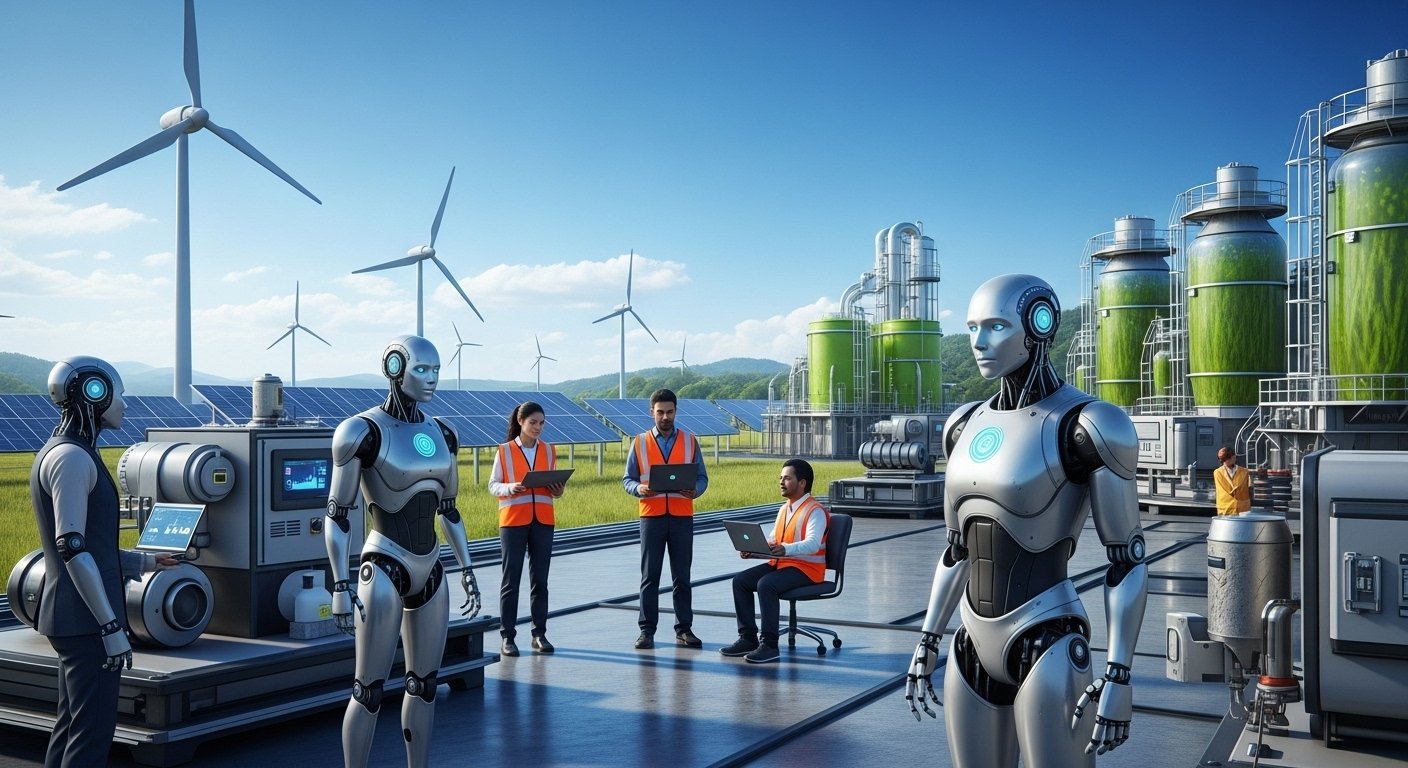
Total Shock in the Energy World: This Tesla Rival Just Moved to Take Over a Wind Blade Titan With Its Robot Army
- The Big Move: AgiBot’s shock acquisition plan unveiled
- AgiBot, the Robot Startup: China’s rising humanoid maker
- Swancor Advanced Materials: The wind-blade materials titan
- Deal Structure: How the takeover is arranged
- Market Reaction: Swancor’s stock surges 20%
- Building the Robot Army: AgiBot’s production ramp-up
- Strategic Shift: Diversifying into energy materials
- Innovation Synergy: Robots and renewables collide
- Regulatory Hurdles: Listing rules and approvals
- Global Impact: Tech and energy sectors intersect
- Future Speculations: A robot-driven energy revolution?
The Big Move: AgiBot’s shock acquisition plan unveiled
AgiBot – a Tencent-backed robotics start-up founded in early 2023 – has announced plans to buy a controlling stake in Swancor Advanced Materials. In practical terms, AgiBot’s affiliates will spend roughly CNY 2.1 billion (about US$279 million) to acquire at least 63.62% of Swancor. Swancor is a Shanghai-listed maker of high-performance materials for industry, notably wind turbine blade components and corrosion-resistant composites. If the deal is approved, AgiBot’s CEO Deng Taihua would become Swancor’s new de facto controller (the current controllers have agreed to cede their voting rights). Official filings make clear the transaction still needs shareholder and regulatory sign-off, but even the announcement has sent shockwaves through the energy and tech sectors. Observers note AgiBot insists this isn’t merely a back-door IPO scheme – the company has publicly pledged not to alter Swancor’s core business for at least 12 months – yet the boldness of a young robot maker moving into wind energy materials has made headlines worldwide.
AgiBot, the Robot Startup: China’s rising humanoid maker
AgiBot (also called Zhiyuan Robotics) rapidly emerged as a star in China’s robot race. Its founders include former Huawei talent and EV veterans, and by 2025 it had pulled in massive investment. In March 2025 the company closed multiple funding rounds (backers include Hillhouse, Tencent, JD.com, etc.), pushing AgiBot’s valuation above 10 billion yuan. The firm’s flagship humanoid, the Lingxi X2, debuted in early 2025 and quickly went into production. AgiBot proudly rolled out its 1,000th robot by January 2025 and now aims to ship 3,000–5,000 units in 2025 – a dramatic jump from under 1,000 in 2024. In fact, AgiBot executives openly say they will match Tesla’s own Optimus robot targets: they are “targeting production of up to 5,000 robots this year, matching Elon Musk’s Optimus plans”. This meteoric growth – in funding, valuation and robot output – has led many to dub AgiBot a potential “Tesla of humanoids” in China. (Its CEO Deng Taihua, backed by tech giants, even calls this move into energy materials a part of the company’s long-term strategy, not just a side project.)
Swancor Advanced Materials: The wind-blade materials titan
Swancor Advanced Materials (stock code 688585) is a veteran in the wind energy supply chain. Based in Taiwan and listed on Shanghai’s STAR Market, Swancor manufactures the high-performance resins and composites used to build wind turbine blades. It is a world-leading maker of vinyl ester, polyester and epoxy resin for composites. In practical terms, Swancor provides the very materials that major windfarm developers use when fabricating blades and nacelles. (For example, it has partnerships with companies like Siemens Gamesa on recyclable blade technology.) In short, Swancor is a titan of wind energy components – exactly the kind of company that a wind-power builder or investor would prize. AgiBot’s bid to take over Swancor therefore represents a robot start-up stepping directly into a cornerstone renewable-energy business. As one report notes, this is the first time a Chinese “embodied intelligence” (humanoid robot) company has moved to control a STAR-market manufacturer, highlighting how unusual the pairing is.
The wind turbines shown above illustrate the market Swancor serves. As City News reports, “Swancor Advanced Materials produces materials for wind turbines and is a world leading manufacturer of … resin used in composites.” Its products sit in blade factories globally. For AgiBot, capturing this supplier means instantly plugging into billions of dollars of clean-energy hardware manufacturing. This strategic thrust into renewable-energy components has made investors and industry watchers sit up and take notice.
Deal Structure: How the takeover is arranged
The acquisition will happen in two phases under AgiBot’s proposal. First, about 29.99% of Swancor’s shares will be transferred by agreement from the current majority shareholder. Next, AgiBot’s consortium (via its own affiliates) will conduct a cash tender offer for additional shares – roughly another 33% – taking its total to at least 63.62%. The offer price is set at CNY 7.78 per share (matching Swancor’s closing price on July 2). In total this comes to about CNY 2.1 billion (≈US$290M) to gain majority control. If all goes through, AgiBot CEO Deng Taihua would effectively become Swancor’s controller, since the seller agreed to relinquish voting rights. Importantly, AgiBot has also committed (in official filings) to leave Swancor’s core business intact for at least a year, suggesting the takeover is meant to be strategic rather than disruptive. As of mid-July, the deal is still subject to approvals from Swancor’s shareholders and the Shanghai exchange, so its final form could be tweaked by regulators or investors before it is completed.
Market Reaction: Swancor’s stock surges 20%
News of the AgiBot bid sent Swancor’s share price soaring. On July 9 (the first trading day after the announcement), Swancor’s stock hit the daily regulatory limit up – a 20% jump. It closed around CNY 9.34 (up from ~7.78 on July 2). Trading volumes spiked as investors rushed in, reflecting optimism (or at least speculation) about the deal. Yicai News reported simply: “Swancor jumps by limit after saying Chinese robotics startup AgiBot to take control”. Analysts interpret the rally as a bet on the merged company’s future potential: markets clearly like the idea of a robot-maker controlling a wind-blade supplier. At minimum, the strong reaction underscores how rare it is for a technology startup’s move to drive such big swings in an energy-related stock.
In AgiBot’s case, the growth has come by building a literal robot army. The SCMP reports AgiBot “is targeting production of up to 5,000 robots this year”, compared to fewer than 1,000 in 2024. The photo above (from AgiBot’s own facility) shows dozens of its humanoid Lingxi X2 robots lined up in a factory – a visual testament to that scale-up. By one estimate, China’s robotics industry expects six domestic humanoid makers (including AgiBot) to each produce over 1,000 robots in 2025. AgiBot’s leader has even named Tesla’s Optimus as a yardstick – the company openly says it will match Musk’s 5,000-unit target. In short, AgiBot has gone from a fledgling start-up to a mass-production contender within two years. The question now is whether it can leverage that “robot army” to revolutionize industries – starting with Swancor’s wind-materials business.
Strategic Shift: Diversifying into energy materials
Analysts say this acquisition is as much about diversification and funding as it is about technology. SCMP notes that Chinese humanoid robot firms are scrambling for capital to fuel mass production, and deals like this are a way to get it. By controlling a listed company like Swancor, AgiBot gains the option to raise money under Swancor’s ticker (for example via new share issues) without a traditional IPO. In other words, Swancor’s stock becomes a funding platform for AgiBot. At the same time, AgiBot broadens its portfolio beyond pure robotics into the lucrative renewable-energy supply chain. This “blending of robotics and materials technology,” as one report put it, is intended to spur innovation. For example, AgiBot could potentially apply its advanced automation to Swancor’s production processes, improving efficiency in making turbine blades. Whatever the exact plans, the move is being painted as a strategic hedge: robotics firms can offset risk by also owning part of the booming green energy sector.
Innovation Synergy: Robots and renewables collide
The true innovation payoff is still to be seen, but the possibilities excite many observers. As Yicai Global notes, “AgiBot’s acquisition of Swancor […] marks the first time that a Chinese humanoid-robot startup has taken control of a company listed on the Star Market”. It’s a novel pairing, which hints at untested synergies. One can imagine AgiBot’s humanoids automating wind turbine manufacturing or maintenance – perhaps inspecting blades on offshore farms or assembling towers. Conversely, Swancor’s materials expertise might feed into lighter, stronger robot bodies or even advanced battery enclosures. These scenarios are speculative, but the media buzz suggests people are already daydreaming about robot-run wind farms or smart grids managed by AI. In short, merging a robotics pioneer with a wind-blade manufacturer could accelerate research at the intersection of clean energy and advanced automation. For now, we’ll have to wait and see whether such futuristic applications materialize, but the deal is already being framed as a hint of China’s next technology frontier.
Regulatory Hurdles: Listing rules and approvals
Despite the fanfare, the AgiBot-Swancor deal faces real legal and regulatory questions. Chinese stock rules generally require companies to be at least three years old before using an acquisition to list themselves publicly. AgiBot (founded Feb 2023) is shy of that mark, which could complicate any reverse-IPO route. AgiBot has flatly denied that the move is purely a back-door listing scheme, but regulators will still scrutinize the structure. In practice, the takeover still needs multiple sign-offs: Swancor’s other shareholders (including the state) must approve the sale, and the Shanghai Stock Exchange and regulators must clear it. The filing itself explicitly notes the transaction is pending approval from Swancor’s shareholders and the bourse. Any objections or delays could force AgiBot to revise its plan. For now, the size of the investment suggests both sides have prepared legal teams – but navigating China’s securities laws will be a test for the young startup.
Global Impact: Tech and energy sectors intersect
China is already a global leader in both robotics and renewable energy, and this deal highlights how those fields can converge. The country has announced massive investments (hundreds of billions of yuan) into high-tech and robot industries, even as it builds the world’s largest wind and solar capacity. AgiBot’s acquisition shows local firms are turning those state goals into real M&A moves. Internationally, it raises an interesting question: will Western companies attempt similar cross-industry mergers? At least on Wall Street and in Silicon Valley, the idea of combining AI/robotics with energy is gaining buzz. For example, Tesla’s own energy division and robot division have long been seen as siblings. If AgiBot’s play succeeds, it could inspire more deals where clean-energy companies partner with AI or robotics firms. Conversely, if it stumbles, it may serve as a cautionary tale. Either way, the world’s tech and energy sectors will be watching this case as a potential bellwether for future “clean-tech meets AI” strategies.
Future Speculations: A robot-driven energy revolution?
Where does all this lead? It’s still early, but the merger hints at a bold vision: a future where robots don’t just work in factories, but help power the grid itself. Imagine fleets of AI-enabled robots managing offshore wind farms, or humanoids installing and repairing turbine blades at dizzying heights – scenarios that once seemed like science fiction. If AgiBot and Swancor can truly mesh their technologies, China might leap ahead in areas like self-maintaining renewable installations or new smart materials for green tech. Even Elon Musk might take note: his Optimus program at Tesla and his interest in sustainable energy may face a new kind of challenge from this homegrown rival. Of course, many hurdles remain, and skeptics caution that merging two very different industries could lead to complications. But if nothing else, AgiBot’s move has set the stage for a dramatic new chapter in both robotics and energy. Whether it ultimately sparks a full-blown “robot-powered energy” revolution or simply fades as an ambitious experiment, it will be a trendsetter to watch. In the meantime, one thing is clear: the convergence of robotics and renewables has just taken a giant leap forward, and the global tech world will be watching closely.
Sources: Verified news reports and filings on AgiBot’s bid and Swancor’s business, along with related market coverage.