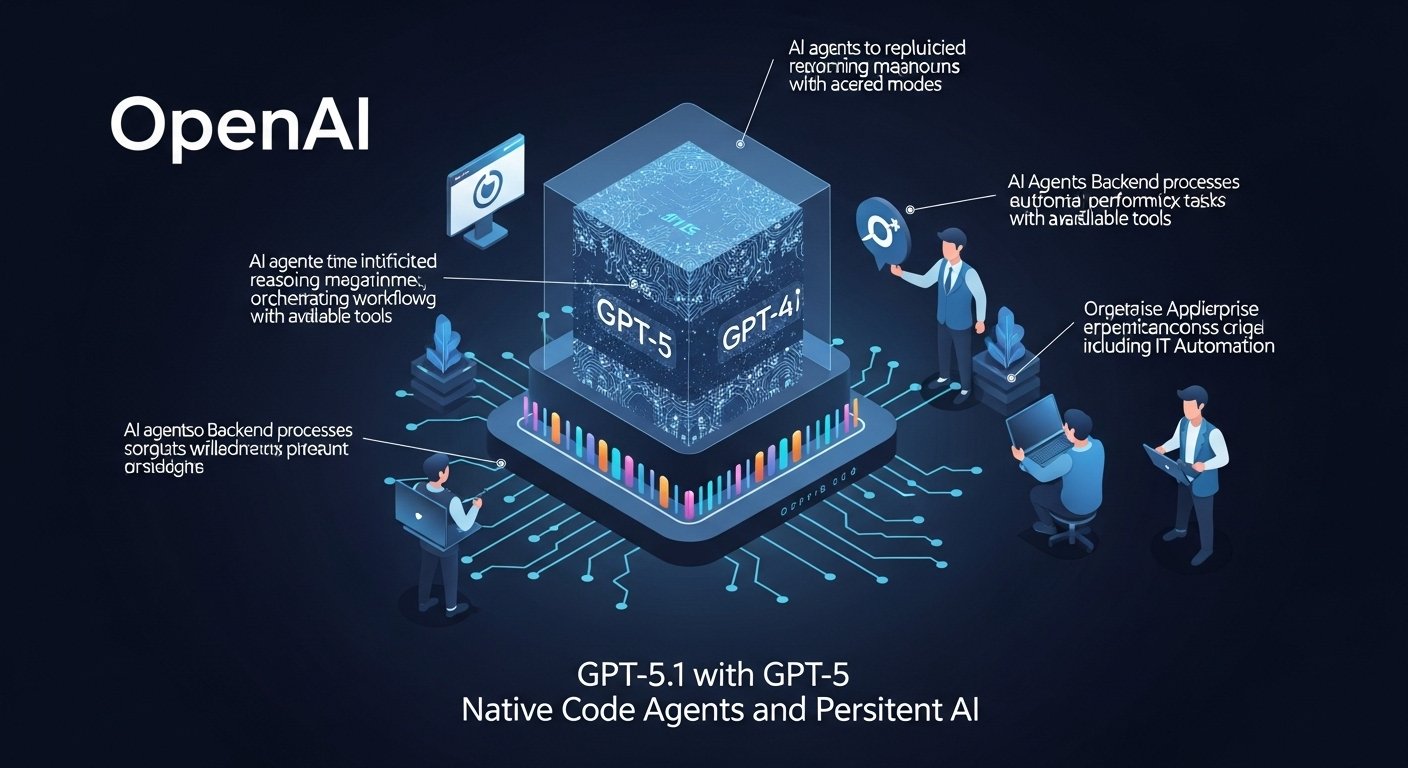
Unlocking Enterprise Agility: How OpenAI’s GPT-5.1 with Native Code Agents and Persistent AI is Revolutionizing Backend Automation
1. Introduction: The Dawn of Autonomous Enterprise AI
The landscape of enterprise technology is undergoing a profound transformation, driven by the rapid advancements in artificial intelligence. AI is no longer merely an incremental optimization layer; instead, it represents a fundamental inflection point that is reshaping enterprise software development at its core.1 This shift transcends traditional efficiency improvements, such as enhanced frameworks or APIs, by introducing intelligent, adaptive, and predictive capabilities previously unattainable. Large Language Models (LLMs) are at the forefront of this revolution, significantly enhancing language understanding and automating complex tasks. Their evolution has expanded into multimodal capabilities, seamlessly integrating text, image, and video processing, thereby broadening their applicability across diverse industries.2
OpenAI’s GPT-5, anticipated for a mid-2025 debut, is poised to mark a new standard in artificial intelligence capabilities. This model is designed to integrate the sophisticated reasoning mechanisms from OpenAI’s “O-series” models with the versatile multi-modal functionalities of the GPT-4o family.3 GPT-5.1, envisioned as a subsequent and refined iteration, will build upon this powerful foundation, offering a unified architecture. This integrated structure is expected to deliver unprecedented reasoning accuracy, enhanced problem-solving precision, comprehensive multi-format content processing, and superior contextual awareness, setting a new benchmark for AI capabilities within the enterprise.3
The strategic significance of this development lies in a fundamental reorientation of AI adoption within enterprises. The planned “unified structure” and “integrated intelligence architecture” of GPT-5, with its promise of “unified programming interfaces” and “reduced technical implementation overhead,” indicates a deliberate move by OpenAI beyond simply offering a powerful LLM. This approach positions OpenAI as a provider of a comprehensive, cohesive platform.3 This platform-centric strategy is vital for enterprise adoption because it substantially lowers the technical barriers traditionally associated with deploying sophisticated AI solutions. Rather than requiring engineers to painstakingly integrate disparate LLMs and tools, OpenAI is offering a more cohesive, end-to-end solution, which is expected to accelerate the time-to-value for businesses.
The core pillars of this transformation—native code agents, backend automation, and persistent AI—represent the vanguard of AI-powered change. These advancements enable software to move beyond simple responsiveness, actively predicting needs, adapting to dynamic conditions, and supporting complex decision-making processes. This evolution positions digital tools not as mere utilities, but as genuine partners in enterprise innovation.1
2. GPT-5.1: The Next Frontier for Enterprise Intelligence
OpenAI has confirmed a mid-2025 launch window for GPT-5, a release that aims to unify the sophisticated reasoning mechanisms derived from their “O-series” models with the versatile multi-modal functionalities of the GPT-4o family.3 GPT-5.1 is expected to represent a subsequent, likely minor, iteration that will further refine and build upon this robust foundation. This “unified structure” is specifically designed to streamline AI adoption processes, reduce operational complexity and costs, and provide unified programming interfaces, thereby significantly lowering the technical implementation overhead for developers.3 OpenAI’s current models, such as GPT-4o, are already recognized for their precision, performance, and speed, particularly in function calling, which is a critical element for advanced agentic capabilities.4
Enterprise-Grade Features: Security, Privacy, Performance, and Integrated Tools
For enterprise adoption, security and privacy are paramount considerations. ChatGPT Enterprise currently offers robust features in these areas, including custom data retention policies, encryption at rest and in transit, and a crucial default policy that prevents training on business data.5 These provisions are non-negotiable for large organizations and are essential for compliance and trust. The enterprise plan further provides unlimited high-speed access to powerful models such as GPT-4o and the advanced OpenAI o3 reasoning models, ensuring high performance for demanding workloads.6
The platform integrates a suite of native tools, including deep research capabilities, data analysis, file uploads, canvas, projects, search, advanced voice functionalities, and image generation.6 To enhance relevance and personalization, seamless connectors to internal data sources like Google Drive, SharePoint, GitHub, and Dropbox are available, allowing AI responses to be contextually rich and tailored to specific organizational data.5 Furthermore, OpenAI supports data residency options across seven regions, offers 24/7 priority support, provides Service Level Agreements (SLAs), and includes custom legal terms for eligible customers, demonstrating a comprehensive commitment to enterprise-level operational and compliance needs.5
The provision of robust security, privacy, and compliance features directly fosters trust and mitigates legal and reputational risks, which are essential for enterprises to confidently deploy AI in sensitive backend processes. This foundational trust, combined with the high scalability offered by unlimited access to advanced models, enables organizations to expand their AI use cases across the entire business. This is particularly crucial for multi-tenant architectures, where isolation and control over data and operations are paramount.7 Without these fundamental elements, even the most advanced AI model would face significant barriers to widespread enterprise adoption.
How GPT-5.1’s Advanced Capabilities Elevate Business Operations
The unified architecture of GPT-5, and by extension GPT-5.1, is expected to bring substantial advantages to organizations. These include streamlined AI adoption, reduced operational complexity and costs, enhanced productivity workflows, and advanced automation capabilities.3 Existing models already demonstrate significant real-world impact. For instance, Retell, by leveraging OpenAI models for voice automation, achieved an 80% reduction in call handling costs and maintained 24/7 availability with customer satisfaction (CSAT) scores exceeding 85%, matching or even surpassing human agents.4
OpenAI’s “o” series models, such as o3 and o4-mini-high, are specifically tailored for complex, multi-step tasks, strategic planning, detailed analyses, and extensive coding. These models emphasize structured reasoning and higher accuracy, which are critical for core enterprise functions.6
A key design principle in OpenAI’s approach is the integration of human oversight, not merely as a fallback, but as an integral part of the system. While the overarching narrative points towards increasing AI autonomy, the inclusion of “intelligent warm transfers or escalations to human agents” within voice automation scenarios indicates a planned integration of human intervention.4 Furthermore, discussions on navigating AI risks emphasize the need for “human-in-the-loop models” and “transparent implementation” to address issues like bias and ensure explainability.1 This design philosophy suggests that the goal of GPT-5.1 in the enterprise is not to replace human capabilities entirely, but rather to empower and foster collaboration with human expertise. By strategically integrating human oversight and intervention points, enterprises can leverage AI’s speed and scale while maintaining control, ensuring ethical deployment, and effectively addressing complex edge cases that AI alone might struggle with. This approach builds trust and facilitates responsible AI adoption.
3. Native Code Agents: Accelerating the Software Development Lifecycle
OpenAI’s suite of code agents, including Codex, the Responses API, and the Agents SDK, are designed to profoundly impact the software development lifecycle, accelerating processes from code generation to debugging and refactoring.
Deep Dive into OpenAI’s Code Agent Capabilities
Codex: OpenAI Codex, powered by the Codex-1 model, which is an adaptation of the o3 reasoning model, is engineered to translate natural language into executable code.8 It operates within secure cloud sandbox environments, preloaded with the user’s repository, granting it the ability to read and edit files, execute commands such as tests and linters, and even propose pull requests.10 A critical aspect of Codex is its commitment to transparency; it provides verifiable evidence of its actions through terminal logs and test outputs, enabling users to trace each step taken during task completion.10 For optimal performance, Codex can be guided by
AGENTS.md files placed within a repository. These text files, similar to README.md, provide explicit instructions on how Codex should navigate the codebase, which commands to run for testing, and how best to adhere to project-specific standards.10 The primary objective of Codex is to accelerate human programming by automating repetitive tasks, particularly excelling at “mapping simple problems to existing code”.8 Current specialized models like GPT-4.1 are already highly proficient in “precise coding and instruction-following”.6
Responses API: This new API primitive represents a significant advancement, merging the simplicity of Chat Completions with the sophisticated tool-use capabilities of the Assistants API.11 It supports a range of new built-in tools, including web search, file search, and, critically, a “computer use” tool. These tools are designed to connect models to the real world, simplifying the development of agentic applications by enabling them to solve complex tasks with a single API call using multiple tools and model turns.11 The “computer use” tool specifically empowers agents to perform tasks on a computer by translating model-generated mouse and keyboard actions into executable commands within their environments. This functionality is powered by the Computer-Using Agent (CUA) model, which has achieved state-of-the-art results in benchmarks involving complex computer and web-based interactions.11
Agents SDK: An open-source Software Development Kit (SDK) has been released to simplify the orchestration of multi-agent workflows. This SDK offers improvements over earlier experimental versions by providing features such as easily configurable LLMs with clear instructions, intelligent “handoffs” for seamless transfer of control between agents, “guardrails” for configurable safety checks on inputs and outputs, and “tracing & observability” tools for debugging and optimizing performance.11 The SDK is designed for broad compatibility, supporting models from other providers that offer a Chat Completions style API endpoint.11
Key Functions: Code Generation, Debugging, Testing, and Refactoring
OpenAI’s code agents are capable of performing a wide array of functions critical to the software development lifecycle:
- Code Generation: These agents can generate functional code snippets across a diverse range of programming languages, including Python, SQL, Go, and JavaScript.8 They demonstrate an ability to infer schemas and correctly place newly generated code within existing project structures, ensuring proper integration.9
- Debugging & Error Handling: AI-assisted coding tools are highly proficient at detecting syntax errors, suggesting effective fixes, and providing real-time debugging assistance.14 Codex, for instance, can explicitly communicate uncertainties or test failures, enabling developers to make informed decisions on how to proceed.10 Furthermore, advanced frameworks such as UTGEN and UTDEBUG teach LLMs to generate unit tests specifically designed to expose errors, significantly enhancing the effectiveness of iterative, robust debugging processes.15
- Testing: Code agents possess the capability to write and execute tests autonomously.10 The UTGEN framework, in particular, focuses on generating unit test inputs that reveal errors along with their correct expected outputs, which is crucial for automated validation and ensuring code quality.15
- Refactoring: Codex can intelligently refactor code, detecting common patterns (e.g., callback patterns), suggesting modern syntax (
await), and automatically wrapping logic intry/catchblocks without requiring explicit human hints. This capability results in the production of production-grade output, saving significant development time.9
Transforming Developer Productivity and Efficiency
AI-assisted coding significantly enhances developer productivity by automating repetitive tasks, minimizing coding errors, and improving overall code efficiency.14 This automation liberates developers to concentrate on higher-value activities such as creativity, architectural design, and solving complex business challenges.1 Case studies consistently demonstrate substantial time savings: small development teams have reported a 30-40% reduction in development time, while large enterprises have observed a 15-25% increase in completed tasks.14 A GitHub Copilot study further revealed that 75% of developers felt more productive when using AI-generated code suggestions, with tasks completed 55% faster.14 AI is evolving into an “advanced pair programming assistant,” fostering human-AI collaboration, enabling real-time code review, and adaptively learning from individual developer styles.14
This transformative impact extends to the democratization of software creation. The ability of AI-powered automation to enable non-programmers to build functional applications through natural language commands, coupled with the rise of AI-driven low-code platforms, allows business professionals to develop applications without deep coding expertise.14 This aligns with the concept of an “AI-native, no-code platform” described for voice agents.4 This expansion of who can contribute to software development bridges the traditional skill gap, allowing domain experts and business users to directly translate their needs into functional applications. This acceleration of innovation across the enterprise shifts the value proposition from specialized coding to problem-solving and domain knowledge.
Furthermore, the evolution of code quality and maintainability is being driven by AI-driven feedback loops. Codex’s ability to generate “cleaner patches,” “adhere precisely to instructions,” and “iteratively run tests until it receives a passing result,” providing “verifiable evidence through terminal logs and test outputs,” is a testament to this.8 The UTGEN/UTDEBUG frameworks, which teach LLMs to generate unit tests to reveal errors and then iteratively debug faulty code—even incorporating “backtracking” to prevent overfitting—represent a sophisticated advancement.15 The AI’s capability to not just generate code but also to generate tests, provide detailed logs, and iteratively refine its own code directly leads to higher code quality, fewer post-deployment bugs, and improved maintainability.14 The “backtracking” mechanism, in particular, acts as a sophisticated feedback loop, ensuring the AI learns from its mistakes and produces more robust, production-ready solutions, transforming AI from a simple code generator into a proactive quality assurance and self-correction mechanism.
A strategic imperative for organizations is the development of “agent-aware” codebases. The explicit mention of AGENTS.md files guiding Codex on codebase navigation, testing commands, and adherence to project standards 10 implies that for optimal performance, AI agents require explicit guidance and a structured environment. This indicates that it is not solely about the AI’s intelligence, but also about the environment being “AI-ready.” This introduces a new dimension of “AI readiness” for software development teams. Enterprises will need to proactively evolve their documentation practices, coding standards, and development environments to be “agent-aware.” This means creating structured metadata, clear API specifications, and well-defined testing setups that AI agents can readily interpret and leverage, thereby maximizing the efficiency and effectiveness of these powerful tools.
Key Capabilities of OpenAI’s Code Agents
| Capability | Description | Key OpenAI Tools/Models | Enterprise Benefits |
| Code Generation | Translates natural language into functional code snippets, inferring schemas and placing new code correctly within existing structures. | Codex, GPT-4.1, Responses API, Agents SDK | Accelerated Development Cycles, Faster Time-to-Market, Reduced Manual Coding Effort |
| Automated Debugging | Detects syntax errors, suggests fixes, and provides real-time assistance; can communicate uncertainties and test failures. | Codex, GPT-4.1, UTGEN, UTDEBUG | Reduced Errors & Bugs, Faster Issue Resolution, Improved Code Quality |
| Test Automation | Generates and executes unit tests to validate code correctness and expose errors. | Codex, UTGEN, UTDEBUG | Enhanced Code Quality, Comprehensive Test Coverage, Streamlined QA Processes |
| Code Refactoring | Intelligently restructures and modernizes existing code, applying best practices and improving efficiency. | Codex | Improved Code Maintainability, Enhanced Performance, Reduced Technical Debt |
| Code Review | Analyzes pull requests, writes context-aware commit messages, summarizes diffs, and suggests safe inline changes. | Codex | Streamlined Collaboration, Faster Code Integration, Consistent Code Standards |
| Documentation Generation | Automatically generates docstrings and comments, improving code readability and maintainability. | GPT-4.1, Codex | Better Code Understanding, Reduced Onboarding Time, Enhanced Project Clarity |
4. Revolutionizing Backend Processes with AI-Powered Automation
AI agents are poised to revolutionize backend processes by autonomously performing complex tasks and orchestrating workflows with available tools across various enterprise applications, including critical IT automation functions.16 These agents are increasingly deployed to power automated, production-level workflows, enabling them to orchestrate intricate sequences of operations such as chained API calls and conditional logic to execute business-critical tasks.17
Automating IT Operations: API Deployment, Server Management, and System Debugging
- API Deployment & Management: LLM APIs serve as the essential bridge for integrating LLM functionalities into existing systems, facilitating rapid deployment and ensuring scalability for AI-powered applications.2 Tools like Apidog and Postman, enhanced with AI assistants such as Postbot, are transforming the entire API lifecycle, from design and debugging to automated test creation and comprehensive documentation.18
- Server Management & Monitoring: AI agents can be leveraged for advanced server management, including analyzing issues within Kubernetes clusters using powerful LLMs like GPT-4, as exemplified by K8sGPT.19 Beyond monitoring, AI agents are capable of setting up and managing cloud infrastructure. This includes designing cloud architectures and CI/CD pipelines, analyzing GitHub and Docker repositories, estimating AWS resource costs, and then automatically generating and applying Terraform code and GitHub Actions files to build the planned infrastructure.20 This capability marks a significant shift from reactive IT operations to proactive, predictive management. AI agents’ ability to predict and correct synchronization errors 1, automate anomaly detection in payment data 21, and analyze cluster issues 19 moves beyond simply fixing problems after they occur. Instead, it enables the anticipation and prevention of issues. This fundamental transformation of IT operations can lead to significantly reduced downtime, optimized resource allocation, improved system reliability, and substantial cost savings, fundamentally changing the role of IT teams.
- System Debugging: Beyond code-level debugging, AI tools provide real-time assistance for system-wide debugging.14 LLMs can be trained to generate unit tests that specifically identify problems in code, thereby significantly enhancing the effectiveness of automated debugging processes.15
Practical Enterprise Use Cases: Data Mapping, Error Prediction, and Intelligent Integrations
AI is fundamentally simplifying the creation and maintenance of smart integrations across disparate enterprise platforms, such as CRMs, databases, analytics tools, and internal systems. This is achieved by automatically generating data mappings, predicting and correcting synchronization errors, and intelligently suggesting automation rules based on observed user behavior.1 A practical example includes custom CRM automation, where AI can analyze marketing data flow patterns between platforms like HubSpot and Salesforce to recommend optimal syncing schedules, thereby reducing API throttling and improving data accuracy.1
AI agents are transforming core enterprise workflows, such as enterprise search, by dynamically retrieving contextual answers using vector databases, moving beyond traditional keyword matching.22 In financial services, AI agents can automate a range of tasks, from sending order confirmations and managing inventory checks to integrating with shipping and warehouse systems for seamless fulfillment.23 Stripe, for instance, integrates with OpenAI’s Agents SDK, enabling agents to create and manage Payment Links, support customer workflows, and even facilitate usage-based billing for LLM token consumption.24 Real-time payment analytics, facilitated by data pipelines from Stripe to AWS, allows businesses to swiftly identify fraud, gain deep insights into customer behavior, and predict churn, enhancing security and informing marketing strategies.21
The emergence of “AI-native” infrastructure and development practices is another significant development. The concept of an “AI-native, no-code platform” 4 and AutoAgent being a “Fully-Automated and highly Self-Developing framework” 25 suggests a new paradigm for building systems. The detailed requirements for “LLM-Ready APIs” 17 imply that APIs are no longer designed solely for human developers but must be structured specifically for AI consumption. This increasing sophistication and autonomy of AI agents necessitate a re-evaluation of how backend systems and APIs are architected and developed. This drives the creation of “AI-native” infrastructure and development practices, where systems are built from the ground up to be easily discoverable, consumable, manageable, and extendable by AI agents. This represents a deeper architectural shift from retrofitting AI into existing systems to designing systems that inherently facilitate AI integration and operation.
The Concept of “LLM-Ready APIs” for Seamless Integration
An “LLM-ready API” is an interface specifically designed for intelligent agents to use reliably and programmatically, minimizing the need for human translation, extensive customization, or fragile workarounds.17 Key features that define an LLM-ready API include:
- Well-structured schemas with OpenAPI: Explicit and thorough specifications for request/answer formats, data types, authentication mechanisms, and error responses are paramount. This precision is crucial for machine-generated or machine-parsed responses, as ambiguity can severely disrupt AI workflows.17
- Consistent naming and semantics: Predictability is vital for automation. Field names must clearly represent business logic, adhere to naming conventions, and intuitively map to the tasks AI agents are intended to perform. This consistency provides crucial semantic clues for LLMs to intelligently decide which “tool” to invoke for a given task.17
- Support for real-time operations: AI workflows, particularly those involving chat-based agents, often demand sub-second reaction times to ensure a consistent user experience. APIs must be optimized for speed and responsiveness, minimizing latency, especially in multi-step workflows where cumulative latency can quickly degrade performance.17
- Clear authentication and authorization flows: Secure access is fundamental for AI integrations. LLM-ready APIs must employ standard, automatable authentication methods (e.g., OAuth 2.0, API keys) that are clearly defined within the OpenAPI specification, enabling AI agents to authenticate without human intervention.17
The financialization of AI agent operations is also becoming a notable trend. AI agents, as they become more autonomous and perform business-critical tasks, are increasingly integrated with cost awareness. For example, AI agents can have “live access to the costs of AWS resources and the cost is accounted for in the planning” for cloud infrastructure.20 More directly, Stripe’s integration facilitates “usage-based billing” by prompt and completion token usage, allowing for the forwarding of LLM costs directly to users.24 This development means that the operational costs of AI agents become a direct and measurable factor in their deployment and value proposition. This leads to the development of sophisticated cost-awareness, cost-optimization, and billing mechanisms within AI agent frameworks. This transforms AI from a pure technology cost center into a potentially revenue-generating or cost-optimized operational unit, requiring new financial models and cost management strategies for enterprise AI.
5. Persistent AI Agents: The Future of Intelligent Automation
AI agents are intelligent systems capable of pursuing and achieving complex goals by leveraging the reasoning capabilities of LLMs to plan, observe, and execute actions autonomously.16 These agents are poised to drive transformative changes across the workforce in 2025, significantly impacting productivity and efficiency, from supporting daily employee tasks to deploying digital humans for critical business functions.26 Persistent memory is the cornerstone of truly intelligent AI agents, enabling them to maintain context over extended periods, engage users with continuity, and develop a meaningful understanding of past interactions.27 This capability elevates AI from simple, stateless responders to genuinely helpful, context-aware assistants.27 Unlike traditional AI that treats each interaction as a fresh start, persistent memory allows AI to recall previous conversations, user preferences, and learned behaviors seamlessly, even across days, weeks, or months.27
This represents a fundamental paradigm shift in AI’s role within the enterprise. AI moves beyond being a simple query-response tool to becoming a true “partner” that can build rapport, understand evolving context, anticipate needs, and provide personalized, continuous assistance, mirroring human-like interaction. This is crucial for deep enterprise integration where long-term relationships and cumulative knowledge are paramount.
Overcoming LLM Statelessness: Short-Term and Long-Term Memory Management
A fundamental challenge with LLMs is their inherent statelessness; they do not inherently remember past interactions or maintain context beyond their immediate input window.26 This limitation necessitates sophisticated memory management strategies.
- Short-term memory: This functions akin to a computer’s RAM, holding relevant details for an ongoing task or conversation. This working memory is typically brief and constrained by the LLM’s limited context window.26 Agentic frameworks like LangGraph simplify this by providing tools such as Checkpointers, which efficiently store thread-specific context in high-performance databases like Redis.26
- Long-term memory: This acts more like a hard drive, storing vast amounts of information that persists across multiple task runs or conversations. This enables agents to learn from feedback, adapt to user preferences, and build a cumulative knowledge base.26 Long-term memories are typically categorized into:
- Episodic memory: Stores specific past events and experiences, akin to an AI’s personal diary of interactions (e.g., remembering a user’s prior trip booking details).26
- Procedural memory: Stores learned skills, procedures, and “how-to” knowledge, forming the AI’s repertoire of actions (e.g., learning the optimal process for booking flights, including layover times).26
- Semantic memory: Stores general knowledge, facts, concepts, and relationships, comprising the AI’s understanding of the world (e.g., information about visa requirements or average hotel costs).26
Architectural Strategies for Memory: Summarization, Vectorization, Extraction, and Graphication
Due to the constraints of LLM context windows and the risk of “context pollution,” efficient memory storage and retrieval are critical. Most production deployments are expected to use a combination of these techniques.26
- Summarization: The simplest approach involves an LLM incrementally summarizing previous conversations. These summaries are then stored as strings (e.g., in Redis) and retrieved to contextualize future queries.26
- Vectorization: Central to modern AI memory management, this technique transforms textual information into numerical representations (embeddings) that capture the meaning of words and concepts. By segmenting memories into discrete chunks and vectorizing them, developers can use vector search (e.g., with RedisVL) to efficiently retrieve relevant memories.22 Vector databases (e.g., Pinecone, Weaviate) are crucial for fast semantic searches.27
- Extraction: An emerging alternative where key facts are extracted from conversation history and stored in an external database (e.g., RedisJSON) with contextual metadata.26
- Graphication: This advanced approach stores AI agent memories by mapping information as interconnected entities and relationships, enabling dynamic, context-rich memory storage and complex reasoning.26 Graph databases (e.g., Neo4j) are particularly useful for mapping complex relationships.27
- Model Context Protocol (MCP): This acts as a sophisticated orchestration layer that connects AI models to various data sources, maintaining an ongoing, natural, and uninterrupted memory stream. It structures how past interactions and contextual data are stored and retrieved to balance speed and accuracy.27
- Memory Decay: This is crucial for preventing “memory bloat” and maintaining efficiency. As AI agents interact over time, they accumulate vast amounts of information, some of which becomes irrelevant or outdated. Mechanisms for “forgetting” are necessary to prevent slower retrieval times, decreased accuracy, and inefficient resource utilization.26
The inherent statelessness and limited context windows of LLMs necessitate the development and implementation of sophisticated external memory architectures. This creates a new, specialized domain within data architecture and engineering, focusing on efficient storage, intelligent retrieval, and strategic decay of AI memories. It requires enterprises to invest in new database technologies, orchestration layers like MCP 27, and specialized data engineering expertise to support stateful AI.
The importance of “memory decay” in persistent AI is not merely a technical optimization. As AI agents become persistent and accumulate vast amounts of data, enterprises must implement robust data governance policies that extend beyond data retention to include data expiration or “forgetting” mechanisms. This aligns with crucial compliance requirements, such as GDPR, HIPAA, and SOC 2 1, and addresses ethical concerns related to privacy, bias, and explainability. It ensures that AI decisions are based on relevant and current information, preventing the perpetuation of outdated or inappropriate historical context.
Memory Management Strategies for Persistent AI Agents
| Memory Type | Purpose | Management Techniques | Typical Storage Solutions | Key Benefits/Considerations |
| Short-Term Memory | Holds relevant details for an ongoing task/conversation, limited by LLM context window. | Context Window Management, Checkpointers (e.g., LangGraph) | In-memory stores (e.g., Redis) | Real-time conversational context, Coherence within a single session. |
| Long-Term Memory: Episodic | Stores specific past events and experiences, AI’s personal interaction history. | Summarization, Knowledge Extraction, Vectorization | Redis, Document Stores (e.g., RedisJSON), Vector Databases | Recalls user-specific interactions, Enables personalized follow-ups. |
| Long-Term Memory: Procedural | Stores learned skills, procedures, and “how-to” knowledge. | Reinforcement Learning, Graph-based Memory | Graph Databases (e.g., Neo4j), Specialized Knowledge Bases | Improves task execution efficiency, Adapts to optimal workflows. |
| Long-Term Memory: Semantic | Stores general knowledge, facts, concepts, and relationships, AI’s understanding of the world. | Vectorization/Embeddings, Knowledge Graphs | Vector Databases (e.g., Pinecone, Weaviate), Graph Databases | Provides broad factual context, Enhances reasoning capabilities. |
| Overall Memory Management | Orchestrates memory flow, balances speed/accuracy, prevents bloat. | Model Context Protocol (MCP), Memory Decay Mechanisms | Hybrid approaches combining various databases | Hyper-personalization, Continuous learning, Smarter decision-making, Compliance. |
Benefits: Hyper-Personalization, Continuous Learning, and Smarter Decision-Making
The benefits of persistent AI agents are substantial:
- Hyper-Personalization: Persistent agents remember user preferences, enabling uniquely tailored interactions that drive increased customer loyalty and lifetime value.27
- Efficiency & Cost Savings: By eliminating repetitive questions and repeated onboarding, support bots can instantly access a customer’s history, providing faster and more accurate solutions. This significantly cuts down resolution times and reduces operational costs, as demonstrated by Retell’s 80% reduction in call handling costs.4
- Smarter Business Decisions: Through continuous analysis of historical data and interaction patterns, AI agents evolve into powerful decision-support tools. They can detect subtle trends, such as early fraud attempts or shifts in customer sentiment, that might be invisible in isolated data snapshots.27
- Continuous Learning: Agents equipped with persistent memory can learn from past interactions and adapt their behavior over time, constantly improving their performance and responsiveness.23
6. Strategic Implications and Future Outlook for Enterprises
The increasing integration of AI into enterprise systems presents both unprecedented opportunities and critical challenges that organizations must proactively address.
Navigating Risks: Data Privacy, Security, and Ethical Considerations
As AI integration deepens within enterprise systems, organizations must proactively address critical risks. These include protecting sensitive data from misuse, ensuring AI-driven decisions are explainable and fair, and maintaining strict compliance with regulatory standards such as GDPR, HIPAA, and SOC 2.1 Transparent implementation, coupled with human-in-the-loop models and robust ethical AI frameworks, is essential to prevent AI from operating as an opaque “black box” and to ensure responsible deployment.1 OpenAI’s Codex-1 model, for example, is designed to identify and refuse requests related to malware or policy violations, operating within a restricted container environment that lacks outbound internet access, thereby minimizing potential risks.8
Despite these safeguards, concerns persist regarding the security implications of AI-generated code. Studies indicate that a significant percentage (approximately 40%) of code generated by tools like GitHub Copilot in high-risk scenarios contained glitches or exploitable design flaws.8 Furthermore, intellectual property and copyright issues, particularly concerning the training of AI models on public repositories, remain a complex area of debate.8
While AI agents offer unprecedented autonomy, the consistent highlighting of significant risks—such as the misuse of sensitive data, challenges in explainability and fairness, the potential for vulnerable AI-generated code, and complex copyright issues—suggests that as AI takes on more independent actions, the question of ultimate responsibility for errors, biases, or security breaches becomes paramount. This “responsibility gap” necessitates that enterprises proactively establish clear accountability frameworks, legal policies, and robust auditing mechanisms. This requires a shift from purely technical implementation to comprehensive governance, ensuring that human oversight, ethical guidelines, and legal compliance are deeply embedded in the entire AI lifecycle. This is a complex, evolving challenge that demands interdisciplinary collaboration.
The Shift from Automation to True AI Autonomy
The evolution of AI in enterprise software is moving beyond mere assistance and automation towards genuine autonomous action, where systems can act independently and make decisions.1 Real-world examples of this shift include logistics systems autonomously re-routing delivery trucks based on real-time weather and traffic conditions, fundraising platforms personalizing donor outreach, and learning platforms adapting in real-time to student performance.1 These autonomous systems are sophisticated blends of machine learning, large language models, and business logic engines, promising a future where software actively collaborates with users rather than simply serving predefined functions.1 By definition, AI agents are systems capable of pursuing and achieving goals by leveraging LLM reasoning to plan, observe, and execute actions, embodying this shift towards greater autonomy.26
Preparing Your Organization for GPT-5.1’s Transformative Impact
Enterprises face a critical balancing act: moving too quickly with AI adoption risks privacy violations, biased outcomes, or compliance failures, while moving too slowly risks irrelevance in a rapidly evolving market.1 The discourse surrounding AI is fundamentally shifting from purely technical discussions to strategic ones, emphasizing its potential to unlock new capabilities and drive competitive advantage.1
The transformative capabilities offered by advanced AI models like GPT-5.1, particularly their integrated code agents and persistent memory, will create significant and potentially insurmountable competitive differentiation. Enterprises that strategically adopt, master, and responsibly deploy these technologies will gain substantial advantages in operational efficiency, customer experience, product innovation, and data-driven decision-making, potentially disrupting markets and leaving slower adopters at a severe disadvantage. This elevates AI from a technological trend to a core business strategy and a key determinant of future market leadership.
Key areas for organizational preparation include:
- Robust Data Governance: Implementing comprehensive policies for data privacy, security, and, crucially, memory decay for persistent AI agents, ensuring ethical and compliant data handling.
- Talent Development: Proactively upskilling existing developers and IT professionals to work effectively alongside AI tools, shifting their focus towards higher-level problem-solving, architectural design, and quality assurance.14
- Ethical AI Frameworks: Establishing clear internal guidelines and frameworks for ensuring explainability, fairness, and human oversight in all AI deployments.
- API Modernization: Investing in the design and development of “LLM-ready APIs” characterized by well-structured schemas, consistent naming conventions, real-time capabilities, and clear authentication flows.17
- Controlled Pilot Programs: Initiating small, controlled pilot programs to gain practical experience with AI agents in real-world enterprise scenarios, allowing for iterative learning, risk assessment, and refinement before broader deployment.24
7. Conclusion: Embracing the Autonomous Enterprise
OpenAI’s GPT-5.1, with its groundbreaking native code agent integration and sophisticated persistent AI capabilities, represents a monumental leap towards truly autonomous and intelligent enterprise operations. This new era of AI promises accelerated software development cycles, revolutionized backend automation, and the deployment of hyper-personalized, continuously learning AI agents that enhance every facet of business.
Crucially, this transformation is not about replacing human expertise but empowering it. AI agents handle repetitive and complex tasks, freeing developers, IT professionals, and business leaders to focus on higher-value, creative problem-solving, strategic thinking, and innovation. Enterprises must proactively strategize, invest in robust data governance, prioritize ethical AI practices, modernize their infrastructure (especially APIs), and cultivate their talent to effectively harness this transformative technology. The future of enterprise software is undeniably intelligent, adaptive, and human-centered. GPT-5.1 is poised to be a pivotal enabler, driving unprecedented levels of agility, efficiency, and innovation across industries.