Xpeng AeroHT’s ‘Land Aircraft Carrier’ Soars Towards Mass Production
Introduction: A New Era of Mobility Takes Flight
The long-held dream of personal aerial transportation is rapidly transitioning from science fiction to tangible reality. At the forefront of this transformative shift is Xpeng AeroHT, a prominent Chinese electric vehicle and aviation company. Their recent regulatory milestone, the acceptance of the Type Certificate application for their modular flying car’s air module, marks a pivotal moment in the global advanced air mobility (AAM) landscape. This groundbreaking vehicle, known as the ‘Land Aircraft Carrier’ (with its air module codenamed X3-F), represents a revolutionary step in personal transportation, offering a unique dual-mode capability that seamlessly transitions between ground driving and vertical takeoff. This report delves into the specifics of this crucial approval, the vehicle’s innovative design, its projected market entry timeline, and the broader ecosystem in China that is enabling its deployment, signaling a new chapter in how individuals will navigate their daily lives.
Unpacking the Approval: Type Certificate and the Path to Production
The Regulatory Green Light: A Critical Step Forward
Xpeng AeroHT achieved a significant regulatory milestone on March 21, 2024, when the Type Certificate (TC) application for its modular flying car’s air module (X3-F) was officially accepted by the Civil Aviation Administration of Central and Southern China (CAAC).1 This acceptance is a crucial development, signifying that the model has entered the airworthiness certification phase. The CAAC’s deep involvement in Xpeng AeroHT’s development work underscores the rigorous review process for the product’s compliance and safety levels.1
A Type Certificate (TC) is a fundamental approval of the design of civil aviation products, including aircraft, engines, or propellers. It is issued by the Civil Aviation Administration of China (CAAC) to the design unit of civil aviation products, ensuring adherence to the “Regulations on the Qualification Approval of Civil Aviation Products and Parts”.1 The acceptance of this TC application acknowledges Xpeng AeroHT’s comprehensive capabilities and the overall feasibility of their project.1 This step is a monumental stride towards mass production, as it validates the air module’s fundamental design and initiates the comprehensive airworthiness evaluation necessary before large-scale manufacturing can commence. It is important to note that while the user query mentions “mass production approval,” the specific regulatory achievement detailed in the provided information is the acceptance of the Type Certificate application for the air module, which is a prerequisite for, but distinct from, a final, blanket mass production approval from a single “Ministry of Industry.” This distinction highlights the ongoing, multi-faceted regulatory journey for such a novel vehicle.
Dual Certification Process: A Unique Challenge and Strategic Approach
A defining characteristic of Xpeng AeroHT’s flying car is its modular design, which divides the vehicle into separate ground and air components that can autonomously separate and combine.1 This modularity extends to its regulatory pathway, presenting both a unique challenge and a strategic advantage. The air module is undergoing certification according to stringent aviation standards set by the CAAC, while the ground module will be certified under Chinese mandatory automotive standards.1
This segmented certification approach is not merely a technicality; it represents a pragmatic strategy to navigate the complex regulatory landscape for a product that bridges two highly regulated industries. By leveraging existing, established frameworks for both aviation and automotive, Xpeng AeroHT can potentially accelerate its path to market. This allows for parallel development and approval processes, rather than waiting for a unified “flying car” regulation that might take years to materialize. This foresight in tackling regulatory hurdles for a novel product category demonstrates an adaptive approach to innovation, acknowledging the inherent complexities of integrating air and ground mobility.
Introducing the ‘Land Aircraft Carrier’: A Dual-Mode Marvel
Design Philosophy: Integration of Intelligent Vehicles and Modern Aviation
Xpeng AeroHT’s overarching mission is to develop the safest intelligent electric flying car for individual users, ultimately providing comprehensive solutions in three-dimensional transportation.1 The ‘Land Aircraft Carrier’ embodies this vision with a futuristic, cyber-mechanical aesthetic, drawing comparisons to a ‘lunar exploration vehicle’ due to its sharp lines and sleek surfaces.5 This design philosophy integrates cutting-edge automotive intelligence with modern aviation principles, aiming to redefine personal mobility.
The Ground Module: A Land-Based “Mothership”
The ground module of the ‘Land Aircraft Carrier’ is engineered for terrestrial travel and is uniquely designed to fully accommodate the air module within its structure.1 This “mothership” concept is central to the vehicle’s dual functionality. The ground module features a spacious 4-5 seat intelligent cabin, catering to practical passenger needs.1 Powering its road capabilities is a range-extending electric drive system, which also serves a crucial secondary function.1
For robust mobility across diverse terrains, the ground module employs a three-axis, six-wheel design, enabling 6×6 all-wheel drive and rear-wheel steering. This configuration provides excellent load-bearing capacity and off-road performance.1 Designed with urban convenience in mind, it can be driven with a standard license and is sized to fit into standard parking spaces and underground garages.7 The vehicle integrates a world-first 800V High-Voltage Silicon Carbide Range-Extended Platform, contributing to a CLTC combined range of over 1,000 km.9
A particularly innovative aspect of the ground module is its function as a “Mobile Supercharging Station”.7 It provides high-power recharging for the air module during both driving and parking, capable of facilitating up to six flights on a full charge of its own energy reserves.9 This integrated mobile charging capability directly addresses a significant challenge for electric vertical takeoff and landing (eVTOL) aircraft: their typically limited range and the nascent nature of supporting charging infrastructure. By making the ground vehicle a self-contained charging hub, Xpeng AeroHT effectively extends the operational radius and utility of the air module, potentially reducing reliance on fixed vertiport charging stations in the early stages of adoption. This provides a practical solution for flexible deployment and diverse use cases, particularly in regions where urban air mobility infrastructure is still under development.
The Air Module (X3-F): An eVTOL for the Skies
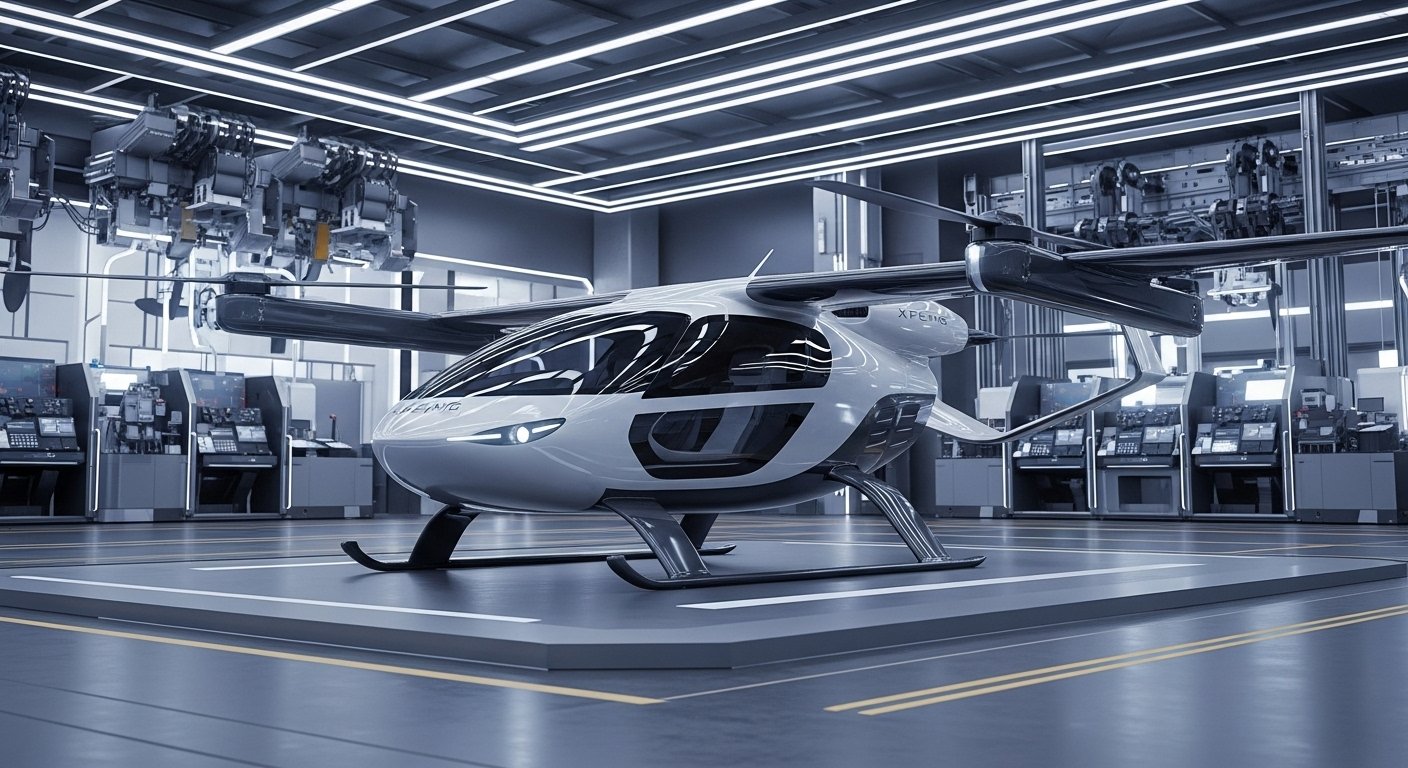
The air module, codenamed X3-F, is a fully electric piloted aircraft designed for vertical takeoff and low-altitude flight.5 It stands as the first Chinese-developed manned electric vertical takeoff and landing aircraft specifically for individual users.2 Its propulsion system features an innovative six-rotor, dual-duct design with foldable blades and arms.9 A key safety feature is its distributed electric propulsion system, engineered to meet single-point failure safety requirements, enhancing reliability.2
The cockpit offers a 270-degree panoramic two-seat cabin, constructed from polycarbonate glass that boasts 200 times the impact resistance of regular glass, providing both expansive views and enhanced safety.2 For ease of operation, the air module supports both manual and autonomous dual driving modes, featuring simplified controls and a pioneering single-lever control system designed to make flying more accessible.2 The main structure and rotor blades are crafted from carbon fiber, ensuring optimal strength while maintaining lightweight durability essential for flight.9
Safety is paramount, with redundant safety systems integrated throughout the aircraft. These include Ultra-Low Altitude 3D Flight Navigation, Multi-Environment Fusion Perception, Intelligent Collision Warnings, and Ultra-Wide-Angle Ground Assistance Imaging.9 The battery system incorporates a Cell-to-Body (CIB) integrated structure, complies with aviation-grade impact standards, and features AI real-time battery safety monitoring, along with redundant control for enhanced safety backup and high-heat safety protection.9 The advanced propulsion unit features an embedded 800V silicon carbide power module, delivering top-class high-speed, bidirectional electric duct performance with millisecond-level power response and redundant communications control.9 An emergency ballistic parachute is also included as a critical safety measure.12
From Road to Sky: The Seamless Transition
The Promise of Effortless Transformation
The ‘Land Aircraft Carrier’ is distinguished by its unique two-part design, which enables a seamless transition between terrestrial and aerial modes.5 The ground module ingeniously envelops the air module, allowing for integrated ground transportation.5 Xpeng AeroHT has actively showcased this capability through live demonstrations of the vehicle’s transition from land to flight mode, including international debuts at events like CES.5 These demonstrations emphasize the fluid and effortless nature of the transformation, highlighting the company’s focus on user experience and operational reliability. While the user query mentions a transition time of “under 60 seconds,” the detailed information available consistently describes the transition using qualitative terms such as “seamlessly switching” and “effortlessly transition,” without providing a specific numerical duration.5 This suggests that the company prioritizes the quality and reliability of the transformation, ensuring a smooth user experience, rather than emphasizing a precise time, which may still be subject to optimization or not yet publicly disclosed.
Charting the Course: Pre-Orders, Deliveries, and Pricing
Market Entry Timeline
The market introduction of the ‘Land Aircraft Carrier’ is proceeding with clear milestones. Pre-orders for the modular flying car are anticipated to open in the fourth quarter of 2024.5 Following this, customer deliveries to individual users are planned to commence in early 2026.5 While some earlier reports indicated a Q4 2025 delivery target, more recent updates confirm the 2026 timeline.15
Significant progress is also being made on the manufacturing front. The Xpeng AeroHT factory, located in the Guangzhou Development District, is 70% complete, with full construction projected to conclude by Q4 2025.18 This facility is poised to become the world’s first modern assembly line for the large-scale production of flying cars, with an initial annual capacity of 10,000 units.6 This dedicated manufacturing base is crucial for realizing the company’s ambitious production and delivery targets.
Pricing Strategy
The anticipated price point for the modular flying car is set at not exceeding RMB 2 million, which translates to approximately $278,240 USD.15 This pricing strategy is characteristic of disruptive, early-stage technologies. By positioning the ‘Land Aircraft Carrier’ in the luxury or specialized vehicle segment, Xpeng AeroHT targets high-net-worth individuals, early adopters, and potentially niche commercial applications such as luxury tourism or emergency services. This allows the company to recoup substantial research and development as well as manufacturing costs, refine the technology in real-world operational scenarios, and establish a strong market presence. This approach signals a strategic focus on premium market penetration, laying the groundwork for potential future price adjustments and broader accessibility as the technology matures and scales.
| Feature | Specification |
| Vehicle Name | Xpeng AeroHT ‘Land Aircraft Carrier’ (X3-F Air Module) |
| Type | Modular Flying Car (Ground and Air Modules) |
| Air Module Capacity | 2 passengers 2 |
| Ground Module Capacity | 4-5 passengers 1 |
| Ground Module Drive | 3-axis 6-wheel, 6×6 All-Wheel Drive, Rear-Wheel Steering 1 |
| Ground Module Range (CLTC) | Over 1,000 km 9 |
| Air Module Propulsion | Six-rotor, dual-duct eVTOL, Distributed Electric Propulsion 3 |
| Air Module Control | Manual/Automatic Dual Modes, Single-Lever Control 3 |
| Estimated Price | Not exceeding ~$278,240 USD (RMB 2 million) 15 |
| Pre-order Availability | Q4 2024 5 |
| First Deliveries | Early 2026 5 |
Building the Future: Urban Air Mobility Infrastructure in Guangzhou
Guangzhou: A Pioneer in Urban Air Mobility (UAM)
Guangzhou has been designated as a global pilot city for urban air mobility, with an explicit goal to establish a comprehensive low-altitude aviation transportation network.22 This strategic focus has fostered an environment conducive to UAM development. Other key players, such as EHang, also based in Guangzhou, are actively engaged in building the foundational infrastructure necessary for this new mode of transport. This includes setting up command-and-control centers to safely and efficiently manage multiple autonomous aerial vehicles (AAVs) simultaneously.22 These efforts extend to establishing basic infrastructure, defining safety rules, and setting market entry thresholds, all crucial for the operationalization of urban air mobility.23 EHang, for instance, is already testing flight routes and planning to initiate commercial services in designated areas within Guangzhou by the end of the year.23
Xpeng AeroHT’s Role in Guangzhou’s Vision
Xpeng AeroHT’s decision to establish its large-scale flying car manufacturing factory in the Guangzhou Development District is deeply integrated into this broader urban air mobility initiative.6 This center is designed to be a comprehensive hub, focusing on research, development, intelligent manufacturing, testing, production, sales, and operational management of flying cars.6 The strategic partnership with the Guangzhou Development District provides Xpeng AeroHT with extensive support, including land, financing, and opportunities for application scenarios, all aimed at jointly accelerating the advancement of flying car technology.6
The establishment of Xpeng AeroHT’s world-first mass production factory in Guangzhou is not an isolated corporate decision; it is a direct manifestation of a broader, government-backed initiative to cultivate a robust urban air mobility ecosystem. The presence of multiple companies contributing to foundational elements—from manufacturing to regulatory frameworks and operational infrastructure like vertiports and control centers—indicates a highly collaborative and centrally supported environment. This integrated approach, driven by strong government policies and financial backing, suggests a faster and more coordinated deployment of UAM services compared to more fragmented, company-specific efforts observed in other global regions. This concentrated effort in Guangzhou underscores a national competitive advantage in accelerating the entire UAM industry, positioning the city as a crucial testbed and launchpad for the future of aerial transportation.
| Date | Company | Vehicle/Module | Milestone Achieved | Regulatory Body | Significance |
| August 6, 2019 | EHang | N/A | Guangzhou selected as first global citywide UAM pilot city | Guangzhou Government | Establishment of low-altitude aviation transportation network 23 |
| October 2023 | EHang | EH216-S eVTOL | World’s first approval to operate an autonomous flying taxi | CAAC | Permission for commercial operations and ticket sales for test flights 22 |
| March 21, 2024 | Xpeng AeroHT | X3-F Air Module | Type Certificate (TC) application accepted | Civil Aviation Administration of Central and Southern China (CAAC) | Entry into airworthiness certification phase, validating design 1 |
| May 12, 2024 | Xpeng AeroHT | X3-F | Production Certificate application accepted | Chinese regulators | Initiating formal assessment for mass production 19 |
| June 2025 (Projected) | AutoFlight | Prosperity eVTOL | Permission to operate on certain fixed routes (initially sightseeing) | Chinese authorities | Step towards public transport services 16 |
| Early 2026 (Projected) | Aerofugia (Geely) | AE200 eVTOL | Airworthiness review latter stages, commercial certificate possible | Chinese authorities | Plans for flying taxi pilot services in Chengdu 16 |
The Broader Landscape: China’s Ambition in the Low-Altitude Economy
A National Strategic Imperative
The advancements by Xpeng AeroHT and other Chinese companies are not isolated corporate endeavors but are deeply embedded within a national strategic imperative. China’s Central Economic Work Conference in December 2023 explicitly proposed the development of strategic emerging industries, prominently featuring the “low-altitude economy”.6 This sector is widely recognized as a critical new growth engine for the nation’s economy.16 The low-altitude economy is viewed as “one of the few business models created by China,” representing a unique opportunity for the nation to secure a leadership role on the global stage.16 Market projections underscore this ambition, with the low-altitude economy expected to expand significantly from an estimated $5 billion this year to $24 billion by 2030.22 This top-down national strategy to cultivate and dominate this new economic frontier provides a powerful impetus for companies like Xpeng AeroHT.
A Competitive and Innovative Landscape
Xpeng AeroHT operates within a vibrant and increasingly competitive landscape of Chinese companies dedicated to developing flying cars and eVTOLs. This group includes established players like EHang, which has already received the world’s first approval for autonomous flying taxi operations and conducts regular demonstration flights.22 Other notable companies include AutoFlight, TCab Tech, Volant Aerotech, and major automakers like Changan, FAW, Chery, and Geely’s subsidiary Aerofugia, all announcing ambitious timelines for their respective flying vehicle projects.16
Beyond passenger transport, Chinese companies are actively exploring a diverse range of applications for low-altitude aircraft. These include aerial mapping, agricultural monitoring, infrastructure inspections, package and food delivery, medical supplies delivery to remote areas, disaster relief, and law enforcement operations.22 This broad spectrum of applications highlights a comprehensive vision for the low-altitude economy. Furthermore, Chinese innovators are pushing the boundaries with original designs and integrated applications, exemplified by BYD’s collaboration with drone giant DJI to integrate a drone directly into vehicle roofs.22 This integrated approach, combining government policy, substantial investment, and a competitive yet collaborative industry, signifies that China is actively constructing a comprehensive ecosystem for three-dimensional transportation, with the clear objective of achieving global leadership in this transformative sector.
Conclusion: Redefining Personal Mobility
The acceptance of the Type Certificate application for Xpeng AeroHT’s X3 air module marks a profound step forward in the realization of personal flying cars. This regulatory milestone, coupled with the ongoing progress towards mass production and planned deliveries in early 2026, positions the ‘Land Aircraft Carrier’ as a tangible embodiment of future multi-dimensional travel. The vehicle’s innovative modular design, with its ground module serving as a mobile supercharging station, offers unprecedented flexibility and efficiency, addressing key challenges in the nascent urban air mobility landscape.
While significant regulatory progress has been made, challenges remain in scaling production to meet future demand, establishing widespread and standardized urban air mobility infrastructure (including vertiports and sophisticated air traffic management systems), and ensuring broad public acceptance. The evolution of global regulatory frameworks will also be critical for international expansion. However, the opportunities presented by this new era of mobility are immense. The ‘Land Aircraft Carrier’ and similar innovations have the potential to unlock new services, such as emergency rescue and tourism, significantly reduce urban congestion, and stimulate the creation of entirely new industries within the burgeoning low-altitude economy. Driven by innovators like Xpeng AeroHT and supported by China’s strategic national vision, the dawn of a new era in transportation is upon us, where the sky is no longer the ultimate limit for personal travel.