I. Introduction: The Dawn of Autonomous Robot Sports
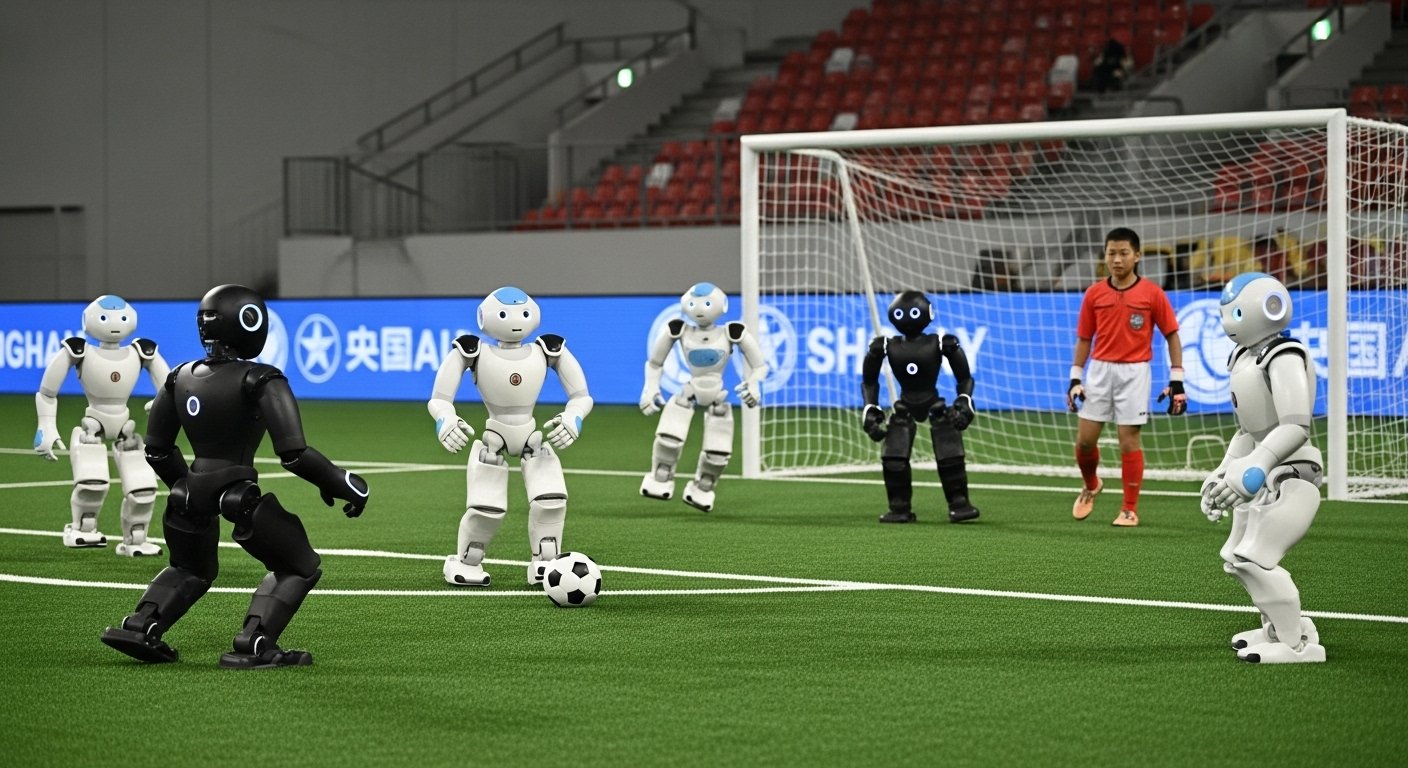
Imagine a soccer match where every player is a marvel of engineering and artificial intelligence, moving with uncanny autonomy, making split-second decisions without human intervention. This isn’t a scene from a sci-fi film; it’s the reality unfolding in Beijing, where humanoid robots are captivating audiences and reshaping the future of sports. On June 28, 2025, Beijing hosted the inaugural RoBoLeague, China’s first fully autonomous 3-on-3 AI robot football competition.1 This groundbreaking event showcased humanoid robots from various university teams, all powered by AI-driven strategies, competing entirely independently.3
This development extends far beyond mere entertainment; it represents a critical proving ground for advanced artificial intelligence and robotics, offering a fascinating glimpse into a future where intelligent machines play increasingly complex roles in our world, far beyond the sports arena. The public enthusiasm surrounding these robot soccer matches has been notably high, often drawing more excitement than China’s human men’s soccer team in recent years.1 This widespread public interest, despite visible “awkward movements, slow collisions, and occasional stumbles” during gameplay, suggests that audiences are currently drawn more by the novelty and technological spectacle of autonomous AI than by the robots’ athletic perfection.6 This public engagement creates a powerful positive feedback loop, attracting funding and talent, which in turn accelerates technological development and leads to even more impressive demonstrations. Such public-facing events are not merely exhibitions but strategic tools for national technological advancement and fostering broader public acceptance of AI.
II. The RoBoLeague Unpacked: A Historic Kickoff
The inaugural RoBoLeague featured four university teams, with the hardware for the robot players supplied by Booster Robotics. These teams competed in fully autonomous 3-on-3 format matches, where robots operated solely on AI-driven strategies without any human intervention or supervision.1 This event marked a significant milestone as China’s first fully autonomous 3v3 AI robot football competition, setting a new precedent for robot sports within the country.2
The competition culminated in a thrilling final match where Tsinghua University’s THU Robotics team emerged victorious, defeating China Agricultural University’s Mountain Sea team with a score of 5-3.1 Other notable participating teams included the Vulcan Team from Tsinghua University and the Blaze Light Team from Beijing Information & Science Technology University.10 Spectators reacted to the matches with a mix of awe and amusement, with reports noting “laughter from spectators” at the robots’ tumbles and comparisons to watching “a group of 90-year-old men playing soccer”.6 The occasional need for staff to carry off some fallen robots on stretchers even “added to the realism of the experience,” highlighting the nascent but dynamic nature of the competition.1
Crucially, the RoBoLeague served as a vital test match for the upcoming World Humanoid Robot Games, which are scheduled to take place in Beijing in August 2025.1 This larger event is poised to feature robots competing in eleven different disciplines, including various athletics, free gymnastics, and football games in different team sizes, underscoring China’s ambitious vision for humanoid robotics.13 The consistent emphasis on the RoBoLeague as a “test match” and a “real-world proving ground” for AI and robotics points to a deeper, more pragmatic objective behind these events.2 Cheng Hao, founder and CEO of Booster Robotics, explicitly stated that sports competitions offer “the ideal testing ground for humanoid robots, helping to accelerate the development of both algorithms and integrated hardware-software systems”.1 This signifies that these sporting events are not primarily for entertainment but are a deliberate, government-backed national strategy for accelerating research and development in embodied AI and humanoid robotics. By creating controlled yet dynamic competitive environments, China is fostering rapid iteration, exposing technological weaknesses, and driving the integration of complex hardware and software systems, directly feeding into broader industrial and strategic applications. This model represents a highly efficient approach to technological advancement, leveraging public interest to fund and validate cutting-edge research.
III. Inside the Bots: Unpacking the Technology
The technological backbone of the RoBoLeague was the T1 humanoid robot, supplied by Booster Robotics. These open-source humanoids are meticulously engineered for advanced robotics and AI applications, emphasizing agility, versatility, and durability in research and development contexts.14
The T1 robots boast impressive specifications, including 23 degrees of freedom (DoF) across their legs, arms, waist, and head, enabling fluid and naturalistic movements.15 At their core, these robots are powered by an NVIDIA Jetson AGX Orin 32GB processor, delivering a substantial 200 TOPS of AI computing power. This processing capability facilitates sophisticated onboard tasks such as object recognition, environmental mapping, and autonomous navigation.15 An optional Edge Large Language Model (LLM) further enhances their ability to understand and respond to natural language commands efficiently.16 The robots are equipped with a rich array of sensors, including an RGBD camera, microphone array, 9-axis IMU, and speaker, allowing them to perceive and interact effectively with their surroundings. A 3D LiDAR is also an optional feature for precise mapping. Their advanced visual sensors enable them to detect the soccer ball from up to 65 feet away with over 90% accuracy.7 In terms of mobility and durability, the T1 robots feature omnidirectional walking capabilities with a forward speed exceeding 0.5 m/s. They are also designed with advanced motion control and push recovery mechanisms, allowing them to stand up on their own after falling, although some still required assistance during the matches.1 For researchers and developers, the T1 robots are fully compatible with ROS2 and various simulators like Isaac Sim, Mujoco, and Webots, offering extensive interfaces for custom development and control.14
The following table summarizes the key technical specifications of the Booster Robotics T1 Humanoid Robot:
| Feature | Specification |
| Height | Approx. 1.2 meters (118 cm) 15 |
While Booster Robotics provided the standardized hardware, each university’s research team was responsible for developing and embedding their own AI algorithms. These proprietary algorithms governed critical functions such as perception, decision-making, player formations, and passing strategies, including variables like speed, force, and direction.1 Beyond simply detecting the ball, the robots’ perception systems, utilizing advanced optical sensors and camera technologies, also recognized teammates, field markings, goals, and opponents.7
The robots operated entirely without human control, relying on onboard cameras, sensors, and deep reinforcement learning algorithms to detect the ball, make tactical decisions, and navigate the field.6 A notable achievement was their ability to devise their own strategies without human direction, showcasing significant progress in autonomous AI behavior.4 For multi-robot coordination, particularly in quadruped systems, a hierarchical Multi-Agent Reinforcement Learning (MARL) framework is employed. This framework separates low-level locomotion skills (like walking, dribbling, and kicking) from high-level strategic planning, enabling coordinated teamwork.20 Research also emphasizes learning-based locomotion, including two-stage curriculum learning for agile dribbling maneuvers and active sensing for continuous ball perception, crucial for dynamic interaction.21
The division of labor, where Booster Robotics supplies identical T1 robots to all university teams while each team develops its own proprietary AI algorithms, represents a deliberate strategic choice.1 This model fosters rapid innovation by creating a competitive ecosystem for AI development on a common, high-performance hardware platform. It effectively lowers the barrier to entry for AI researchers, allowing them to concentrate solely on algorithmic advancements without the need to design and build complex robot hardware from scratch. This accelerates the pace of progress in AI capabilities, as teams can directly compare and iterate on their software solutions, leading to faster breakthroughs in areas like perception, decision-making, and multi-agent coordination.
The robots’ capacity to operate “fully autonomously using AI-driven strategies without any human intervention or supervision” and to “devise their own strategies without having to be directed by humans” represents a hallmark of embodied AI development.1 This goes beyond traditional AI, which often operates in simulated or static environments. The RoBoLeague serves as a crucial step in the development of real-time, adaptive AI capable of operating in complex, dynamic physical environments. While challenges persist, such as difficulties with object identification and fast motion tracking, especially with a speedy ball, the fact that the robots can perform at all, make decisions, and even self-right demonstrates significant progress.4 This research is directly applicable to creating more capable service robots, autonomous workers, and machines for disaster zones, where real-time physical interaction and adaptation are paramount.6 Organizers concede that the current skill level of the robots mimics that of young children aged five or six, indicating the significant room for further development.4
IV. Beyond the Pitch: China’s Grand Robotics Ambition
China’s engagement in competitive robot sports is not merely for entertainment; it is a strategic initiative to accelerate developments in artificial intelligence, humanoid mechanics, and autonomous systems.4 Cheng Hao of Booster Robotics explicitly stated that sports competitions provide “the ideal testing ground for humanoid robots” because they enable the testing of robot abilities in controlled yet dynamic environments.1 The ultimate aspiration is for these sporting robots to evolve into agile, smart workers capable of performing actual applications in diverse fields such as warehouse logistics, elder care, and even national defense.4 Projections suggest that humanoid robots could automate up to 40% of manual activities, initially in logistics (sorting, transporting) and later managing high-variance, complex assembly processes.13
This approach, which can be described as the “gamification” of robotics research and development, provides a highly effective and publicly engaging framework for rapid prototyping and testing under dynamic and unpredictable conditions. It also fosters competitive innovation among research teams. This systematic use of diverse sports competitions allows for the identification of practical limitations, such as falls or tracking issues, that might not emerge in controlled lab settings, thereby directly informing improvements for real-world deployment. This model positions China to potentially leapfrog traditional R&D pathways by integrating public spectacle with serious technological advancement.
The RoBoLeague is part of a broader national effort to advance humanoid robot technology, with the Chinese government actively supporting this growth through finance, policy favor, and an increasing list of competitive events.4 The domestic market for humanoid robots is estimated to reach 870 billion yuan (approximately $120 billion) by the next decade, underscoring the scale of this national ambition.4 China’s robotics industry is rapidly catching up with global leaders, positioning itself as a significant player in this evolving sector.22
Beyond soccer, China has systematically utilized other sporting events as testbeds for humanoid robot development. In April 2025, a Beijing half-marathon saw 21 humanoid robots compete alongside 12,000 human runners, with the fastest robot, Tiangong Ultra from X-Humanoid, completing the race in an impressive 2 hours, 40 minutes, and 42 seconds.4 In May 2025, robot warriors engaged in a martial arts competition in Hangzhou, demonstrating combat skills and reflexes, though it is important to note that some of these early combat robot events were still remotely controlled by human operators, illustrating the progression towards the full autonomy seen in the RoBoLeague.4 The culmination of these efforts will be the first World Humanoid Robot Games, set to take place in Beijing from August 15-17, 2025. This historic event will be held in iconic venues like the National Stadium and the National Ice Skating Career, featuring robots competing in eleven different disciplines, including athletics, free gymnastics, and various football game sizes.1
While the RoboCup initiative, founded in 1996, has a long-standing goal for humanoid robots to beat human champions by the middle of the 21st century and has hosted various China Open events, the RoBoLeague is consistently touted as “China’s first fully autonomous 3-on-3 AI robot football competition”.2 Furthermore, the T1 robots used in the RoBoLeague are 118 centimeters tall, larger than the standard Nao robots (58 cm) often used in RoboCup’s 5-a-side competition, yet they do not qualify for RoboCup’s AdultSize league (130-180 cm).10 This indicates that China is not simply participating in existing global competitions but is actively carving out its own distinct, high-profile competitive framework to drive its specific national goals and potentially validate different hardware platforms and AI development methodologies. By focusing on “fully autonomous” matches with humanoids of a specific size, China is pushing the boundaries in areas directly relevant to its industrial ambitions, potentially establishing a new benchmark or parallel track for humanoid robot development on the world stage. This highlights a strategic move towards technological self-reliance and leadership.
The following table provides a comparison between China’s RoBoLeague and the long-established RoboCup Humanoid League:
| Aspect | China’s RoBoLeague | RoboCup Humanoid League |
| :— | :— | :— | | Founding Year | 2025 (Inaugural Competition) 2 | 1996 24 | Primary Goal | Accelerate AI and humanoid R&D for industrial and defense applications 4 | Develop a team of fully autonomous humanoid robots to win against human World Cup winner by mid-21st century 24 | Autonomy Level | Fully Autonomous (AI-driven strategies, no human intervention) 1 | Fully Autonomous (AI-driven, human-like senses) 27 | Typical Robot Size | Booster T1 (118 cm height) 10 | KidSize (e.g., Nao, 58 cm), TeenSize, AdultSize (130-180 cm) 10 | Team Size (Soccer) | 3-on-3 1 | Varies by league (e.g., 5-a-side for Nao) 10 | Hardware Platform | Standardized Booster Robotics T1 1 | Varies by team/league; Nao standard for KidSize 10 | Recent Focus/Innovation | Real-world proving ground for industrial applications; rapid iteration of AI algorithms on standardized hardware 1 | Research on dynamic walking, running, kicking, visual perception, self-localization, team play 27 | Global Scope | China-centric; preview for upcoming World Humanoid Robot Games in Beijing 1 | International annual competition with regional opens 24
V. The Road Ahead: Challenges and the Future of Human-Robot Interaction
Despite the impressive advancements demonstrated, humanoid robots in sports still face significant limitations and present clear areas for improvement. During the RoBoLeague, robots frequently tripped, exhibited awkward movements, and engaged in slow collisions, drawing laughter from spectators.4 A persistent challenge noted was the robots’ inability to consistently self-right after falling, often requiring staff to carry them off the field on stretchers, indicating ongoing issues with robust balance recovery in dynamic scenarios.1 Organizers also conceded difficulties with object identification and fast motion tracking, especially when dealing with a speedily moving ball.4
Research indicates that “pure optimization-based approaches” for control in highly dynamic environments face challenges due to the high dimensionality of state and action spaces and the complexity of robot dynamics.18 Furthermore, current models can exhibit a “strong bias to keep standing still” if there was no prior motion in their context window, and a general “lack of high-level behavior” such as intentional kicking or strategic positioning on the soccer field.18 Sensor noise originating from locomotion vibrations and a limited camera field of view also remain significant challenges for accurate real-time localization on the field.30 These observed limitations, such as frequent stumbles, awkward movements, and the need for human intervention to remove fallen robots, highlight a critical challenge in robotics: the persistent gap between simulation and real-world performance.1 While AI models can be trained extensively in simulation, transferring that robustness and agility to the unpredictable dynamics of the physical world, especially in contact-rich and fast-paced tasks like soccer, remains inherently difficult. This reinforces the indispensable role of real-world testing and competitions like RoBoLeague, which serve as essential feedback loops, exposing the subtle discrepancies between simulated and real-world physics, sensor noise, and environmental variability that are crucial for refining algorithms and hardware designs. Overcoming this gap is fundamental for the widespread deployment of humanoid robots in practical applications.
The long-term vision for robot soccer, championed by the international RoboCup initiative since its founding in 1996, is formidable: “By the middle of the 21st century, a team of fully autonomous humanoid robot soccer players shall win a soccer game, complying with the official rules of FIFA, against the winner of the most recent World Cup”.10 This ambitious objective serves as a grand challenge, driving decades of fundamental research in AI and robotics globally.
Looking to the future, Cheng Hao, founder and CEO of Booster Robotics, envisions a time when robots could play football with humans.1 He strongly emphasizes that “we must ensure the robots are completely safe” for such interactions, suggesting that initial matches might focus on “real offensive and defensive interactions” where winning is not the primary objective, but rather building human trust and understanding of robot capabilities.1 This repeated emphasis on safety, particularly when discussing future human-robot interactions, indicates that as humanoid robots become more capable and move towards interacting with humans in shared spaces, safety is being treated as a fundamental design and development constraint, not an afterthought. This proactive approach to safety, driven by the need to build public trust and enable complex human-robot co-existence, is crucial for the successful integration of advanced AI into society and suggests a mature and responsible trajectory for China’s robotics development.
As robots become increasingly integrated into society and sports, important ethical questions inevitably arise. These include considerations about the inherent meaning of sports to human athletes, the enduring value of human contribution in competitive arenas, issues surrounding personal data protection, and the potential for technology to exert undue control over coaching and performance ratings.31 It will be imperative for sports administrators and policymakers to ensure that technology serves to aid and enhance human endeavor rather than to replace human roles, thereby protecting the true nature and spirit of sport.31
VI. Conclusion: A New Era of Athleticism and Innovation
China’s inaugural RoBoLeague represents a pivotal moment in the advancement of humanoid robotics and artificial intelligence. By hosting the first fully autonomous 3-on-3 robot soccer matches, China has not only generated significant public excitement but also established a dynamic and highly effective testbed for cutting-edge technologies. This strategic approach, leveraging public competitive events as a rapid research and development proving ground, distinguishes China’s efforts and accelerates progress in embodied AI.
The advancements observed in robot soccer, from enhanced perception and real-time decision-making to improved mobility and coordination, have profound implications that extend far beyond the sports field. These developments are directly accelerating the creation of more agile, intelligent machines poised to revolutionize industries such as warehouse logistics, elder care, and national defense. While challenges persist, particularly in bridging the gap between simulated and real-world performance and ensuring robust autonomous operation in dynamic environments, the rapid progress, coupled with a strategic national vision and a proactive focus on safety, points towards a future where humanoid robots will play an increasingly integrated role in human society. The dream of seamless human-robot interaction, potentially even on the soccer pitch, is steadily moving from the realm of science fiction to a tangible reality, ushering in a new era of athleticism and innovation driven by the remarkable capabilities of artificial intelligence.