The Dawn of a New Era: How Embodied AI and Humanoid Robotics Are Reshaping Everyday Life
I. From Science Fiction to Sidewalks
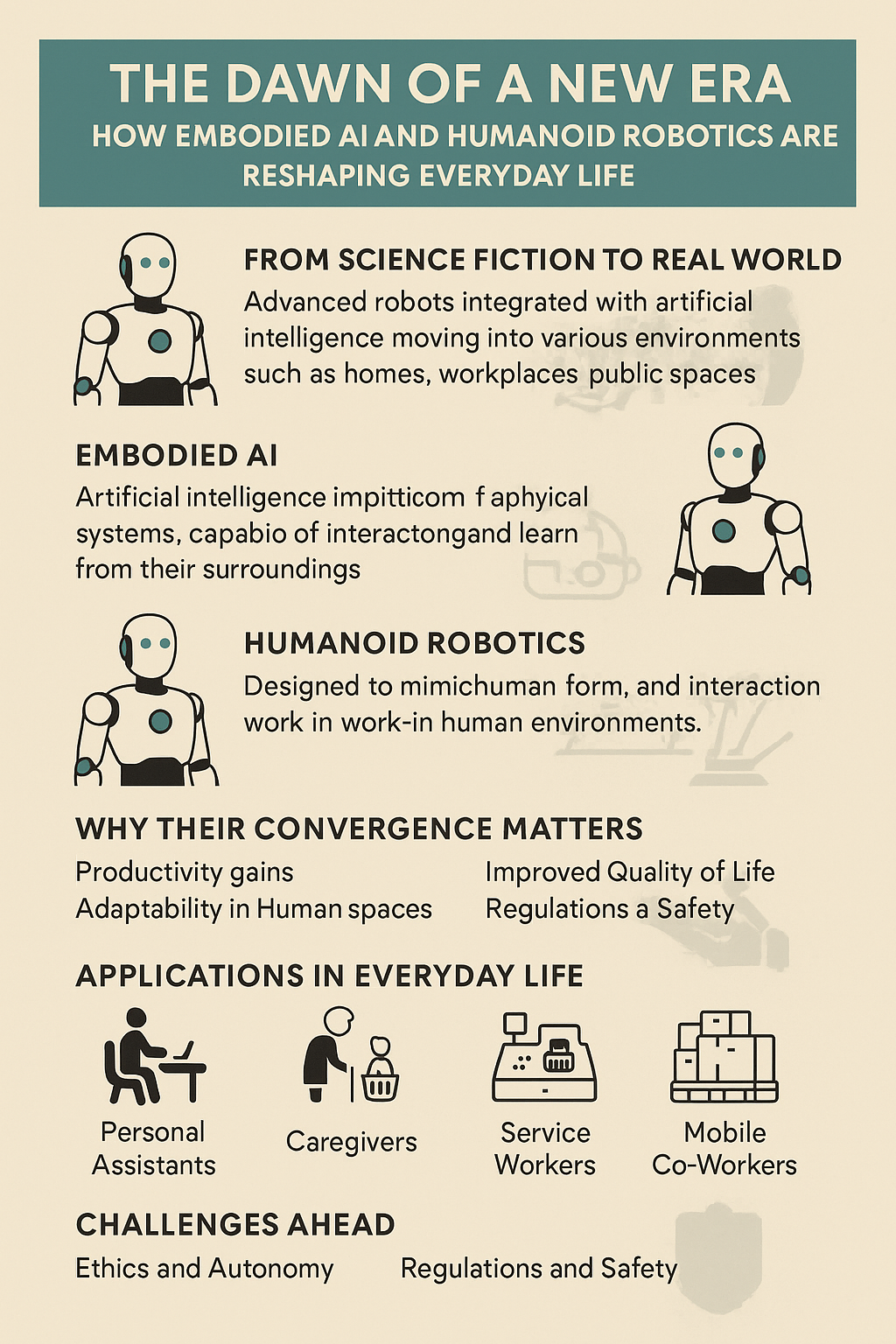
Not long ago, intelligent robots were the stuff of movies and novels. We imagined polite protocol droids or helpful housekeepers, but they remained fantasies – until now. Today, those visions are “inching toward reality,” as McKinsey analysts note. General-purpose robots powered by embodied AI are already being tested in warehouses, factories, hospitals and beyond. In fact, industry data underscore this shift: the latest World Robotics report finds 4.28 million industrial robots operating worldwide (a 10% jump in 2023). These figures show we are crossing into the age of walking, talking machines – machines moving off the page and onto our streets.
II. What Is Embodied AI?
At its core, embodied AI is simply AI with a body – a robot, vehicle or smart device that learns by interacting physically with the world. Unlike “disembodied” AI (think chatbots or image generators), an embodied system gathers real-time sensory feedback as it moves, refining its behavior through trial and error. In other words, it learns by doing. Much like a toddler learns to walk by tripping and getting back up, embodied AI “connects perception, cognition, and action through direct physical interaction”. This means the system constantly updates its model of the world – so robots can adapt to new situations on the fly. Because they perceive and learn from their surroundings, embodied AI agents can handle messy, unpredictable environments that would stump purely software-based systems. In practice, this has huge benefits: instead of relying only on pre-labeled data, embodied robots collect rich, immediate information as they perform tasks, allowing them to navigate complex settings more safely and flexibly.
III. Enter the Humanoid: A Robot Built for the Human World
If embodied AI is the brain, humanoid robotics is the body. Humanoid robots are engineered to mirror the human form – two arms, two legs, and often a head or “face” – so they can operate in spaces built for people. This compatibility is a major advantage. As McKinsey points out, humanoids can “maneuver in spaces designed for people,” from climbing stairs and opening doors to using tools and picking items off shelves. In effect, these robots need no special re-engineering of the workplace – they simply adapt to human environments. Over the years, researchers have built several examples: Honda’s ASIMO (an early bipedal walker), Boston Dynamics’ Atlas (a remarkably agile robot that can run and jump), and SoftBank’s Pepper (a social robot made to interact with people). Newer models are now pushing the frontier of capability. For instance, Sanctuary AI’s Phoenix – a 5’7” humanoid – has dexterous hands designed for tasks like stocking shelves and unloading trucks. And startups like Figure have demonstrated robots that can walk and perform routines: their Figure 01 prototype can autonomously ambulate, pour coffee, and handle bins on a factory floor. These advanced humanoids are built to learn and work safely alongside people. They prove that robots with human-like bodies can bring embodied AI into our homes, stores, and offices without needing a robot-only environment.
- Honda’s ASIMO – a pioneering bipedal robot (introduced in 2000) known for its smooth walking and running.
- Boston Dynamics’ Atlas – a cutting-edge humanoid that has demonstrated backflips, balancing, and complex movements (showing the limits of agility).
- SoftBank’s Pepper – a friendly social robot used for customer interaction, capable of recognizing faces and emotions.
- Sanctuary AI’s Phoenix – a general-purpose humanoid (6th generation) with dexterous hydraulic hands for tasks like shelf-stocking and register operation.
- Figure 01 – an advanced humanoid worker that autonomously walks and manipulates objects. By late 2023 it was shown performing tasks like making coffee and moving inventory in a warehouse.
Each of these robots brings embodied AI into the real world. By matching the human form, they can tackle jobs – loading, carrying, sensing, and even conversing – in spaces and scenarios that would befuddle wheeled carts or fixed machines.
IV. Why Their Convergence Matters
Bringing together embodied intelligence and human-shaped robots is more than a technical milestone – it’s a turning point for society and industry. Historically, AI (software brains) and robotics (mechanical bodies) advanced on separate tracks. Now their fusion is creating versatile “general-purpose” robots. In practical terms, this means machines that can think, move, and adapt like people do. McKinsey analysts emphasize that we should focus on what these robots can do in human-designed environments, not just how they look. With embodied AI, robots can handle a wide range of tasks – packing, picking, lifting, inspecting, or collaborating – learning new motions and even following verbal commands in real time. Early signposts show how rapidly this sector is growing: funding for general-purpose robotics exploded fivefold from 2022 to 2024, topping $1 billion per year, and patent filings are surging. Governments are taking notice too – China has made embodied AI a national priority with a $138 billion innovation fund. In short, the world is placing big bets on these technologies.
This convergence effectively turns robots into adaptive co-workers in many contexts. Instead of fixed machines doing only one job, these new robots can be retrained on the fly for different tasks. That unlocks many potential roles:
- Personal Assistants in homes, helping with chores, errands or companionship.
- Caregivers for the elderly or disabled, aiding with mobility, reminders, or social interaction.
- Service Staff in retail and hospitality – for example, robot receptionists or guides that speak multiple languages.
- Warehouse Co-workers that pick and pack goods, handle inventory, or move pallets, flexibly switching tasks.
- Tourist Guides and Educators that can lead groups through museums, parks or aid in teaching environments.
The key is adaptability. Because embodied AI connects sensing and action, these robots can quickly learn new environments and processes. For businesses, that means the same robot hardware could be deployed in different settings without costly retrofits. For workers, it means robots can offload repetitive, mundane, or dangerous tasks, allowing humans to focus on creative, social, or supervisory roles. Indeed, experts believe this will raise productivity without wholesale job losses: one McKinsey study finds robots can handle tedious work while actually creating new opportunities for people. In effect, embodied AI + humanoids promise an automation coexistence – smart machines working alongside us, not simply replacing us.
V. Real-World Applications Are Already Here
This is not science fiction. Robots combining AI and humanoid form are already being trialed in everyday scenarios:
- Retail & Hospitality: Sanctuary AI’s Phoenix has been piloted in a Canadian Tire store, autonomously stocking shelves and scanning products. The robot successfully performed over 110 store tasks, about 40% of the workload. Similarly, SoftBank’s Pepper has been used as a concierge in malls and hotels, greeting customers and answering questions (a model of robots in service roles).
- Warehousing & Logistics: Agility Robotics’ Digit is active in warehouses; it can carry and place packages and is already used at GXO logistics centers and being tested in Amazon fulfillment centers. Amazon itself has deployed robots like “Vulcan” to pick items from shelves more efficiently, and is even trialing humanoid robots for last-mile delivery alongside human drivers. These systems leverage embodied AI (vision, motion planning) to navigate busy facilities and cooperate with human coworkers.
- Manufacturing: Tech companies are integrating humanoids onto factory floors. For example, Xiaomi’s CyberOne robot is designed for manufacturing and customer service tasks – it walks on two legs and has an OLED face with 3D vision. CyberOne can recognize dozens of sounds and human emotions. Xiaomi plans to use it for repetitive assembly work to boost efficiency, although its current cost (around $90–100K per unit) is still a barrier.
- Research & Prototypes: Many labs and startups are demonstrating progress. Figure AI’s Figure 01 robot has shown autonomous walking and object handling (e.g. pouring coffee) in a lab setting by 2023. Tesla’s Optimus project aims to deploy humanoids on auto assembly lines and beyond, although recent reports note hardware and design delays. Even universities and tech giants are in the game: robots like NASA’s Valkyrie or Samsung’s Bobcat are being developed to work alongside humans in tough tasks.
These examples illustrate a trend: machines once limited to research labs are stepping into real jobs. They aren’t expected to replace people entirely but to augment the workforce – handling repetitive, precise, or risky work. In each case, companies report that humans are still in the loop, supervising or guiding the robots as they learn.
VI. Challenges on the Horizon
The rise of embodied humanoids brings big challenges that we must confront:
- Ethical and Privacy Concerns: Autonomous robots collecting sensory data raise questions about privacy and control. Who is responsible if a robot makes a decision or mistake? The World Economic Forum warns that we “can’t ignore” risks like data misuse, errant behavior, and accountability. Ensuring robots respect social norms and consent (for example, not intruding in private homes or misusing personal data) is paramount.
- Workforce Impact: It’s natural to worry about job displacement. However, many experts argue that humanoid robots will augment rather than outright replace human labor. WEF analysts note that while some roles will change, robots can make jobs safer and more fulfilling by taking on the dangerous or dull tasks. In fact, new jobs are likely to emerge – people will be needed to train, monitor, maintain and collaborate with robots. The key will be retraining and education so workers can transition to higher-value functions (for instance, robot supervisors, AI specialists, or creative roles).
- Safety, Regulation and Infrastructure: Humanoids interact physically with people, so rigorous safety standards are essential. Robots must have built-in “guardrails” – emergency stop features, reliable object detection, and fail-safes – to avoid accidents. The WEF emphasizes that new policies and technical safeguards are needed, involving engineers, companies and governments working together. Regulations (like safety certifications and liability laws) and public trust must catch up with the technology. There are also practical hurdles: current humanoids still have limitations – for example, many run only 2–4 hours on a battery charge (far below a full shift), and robot “hands” are not yet as dexterous as human hands. Overcoming these engineering challenges (battery life, fine manipulation, robust AI perception) will be crucial before robots become commonplace in our neighborhoods.
Navigating these issues will require thoughtful leadership. Governments, industry and communities must set standards for safety, data use and fair labor practices before these robots proliferate. Only with clear rules and open dialogue can society reap the benefits of embodied AI without unacceptable risks.
VII. Conclusion: A Turning Point for Humanity
We are witnessing more than just Automation 2.0 — it’s coexistence with intelligent machines. The fusion of AI and robotics means machines that can think, move, and learn in the real world, just as we do. As the World Economic Forum observes, humanoid robots are “not a futuristic concept” – they are already here and poised to have a “great” industrial and social impact. The true breakthrough is their alignment: an AI that isn’t locked behind a screen, embodied in a body built for our world.
This new era offers extraordinary opportunities: safer workplaces, higher productivity, and novel services (from robot caregivers to warehouse assistants). But it also demands wise stewardship. We must ensure that these agents are developed ethically and inclusively, so that the benefits of embodied AI uplift everyone. With proactive planning – updating regulations, investing in worker training, and fostering public dialogue – we can guide this revolution.
In short, the future we once only dreamed of is arriving now, walking beside us. The dawn of embodied AI and humanoid robotics is here, and it’s up to us to shape it for the good of humanity.