✅ AI Technology Trends in 2025 (Artificial Intelligence, Generative AI, Robotics)
📚 Table of Contents
- Introduction: The Rise of AI in 2025
- 1. The Direction of AI Development
- 2. The Rise of Generative AI
- 3. AI-Powered Robotics and Human Interaction
- Conclusion: Summary and Strategic Action
Introduction: The Rise of AI in 2025
In 2025, artificial intelligence is no longer just a futuristic concept—it is a transformative force reshaping industries, societies, and individual lives. From advanced natural language processing to autonomous humanoid robots, AI has evolved into a core infrastructure of modern innovation. Especially with the rapid growth of generative AI and AI-driven robotics, companies and individuals alike are reevaluating their strategies to adapt and thrive in this evolving technological landscape. This article provides a comprehensive overview of the most significant AI trends shaping 2025 and how these technologies are being applied in real-world contexts.
1. The Direction of AI Development
Artificial intelligence in 2025 has progressed far beyond basic automation. It now mimics human reasoning, generates original content, and performs cognitive tasks at near-human levels of proficiency. Cutting-edge language models like GPT-4.5, Claude, and Google’s Gemini are redefining what AI can accomplish. These models are not only excelling in text generation but are also increasingly used for decision support, customer service, legal analysis, and even medical diagnostics.
AI is being integrated into enterprise workflows for data processing, intelligent automation, and customer interaction. This not only increases efficiency but also reduces operational costs dramatically. For instance, AI chatbots are replacing traditional customer support roles by delivering accurate, real-time assistance across platforms.
Beyond performance, AI ethics has become a central concern. In 2025, there’s a growing demand for transparent, explainable AI systems. Governments and regulatory bodies across the globe are implementing frameworks that require AI to be fair, unbiased, and accountable. Research into debiasing models, interpretability, and algorithmic fairness is accelerating. The future of AI development is not just about capability but also about responsibility—ensuring AI benefits humanity without unintended consequences.
In essence, AI is no longer a tool—it is becoming an active participant in societal structures, shaping education, governance, and the global economy.
2. The Rise of Generative AI
Since 2023, generative AI has been one of the fastest-growing subfields within artificial intelligence. It enables machines to create new, original content—from text and images to music and video—based on learned data patterns. In 2025, this capability is revolutionizing industries such as marketing, media, education, and entertainment.
Text-based generative AI models are now used to write blogs, automate product descriptions, create email campaigns, and even co-author books. Content creation that once took days can now be accomplished in minutes. Tools like ChatGPT, Jasper AI, and Copy.ai are empowering both professionals and amateurs to produce high-quality content with minimal effort.
Visual and multimedia generative AI is also thriving. Sora, OpenAI’s video generation model, is enabling users to create realistic video clips from textual prompts. Meanwhile, tools like Midjourney, DALL·E, and RunwayML are enhancing creativity in graphic design, architecture, and advertising. In film and animation, generative AI is being explored to create storyboards, character designs, and full motion sequences.
This rapid adoption brings new challenges—especially legal and ethical ones. Ownership of AI-generated content, copyright disputes, and misinformation risks are under scrutiny. Still, the collaboration between human creators and AI is opening entirely new workflows, where AI is no longer just a tool but a co-creator.
In 2025, generative AI is not simply automating tasks; it is redefining creativity.
3. AI-Powered Robotics and Human Interaction
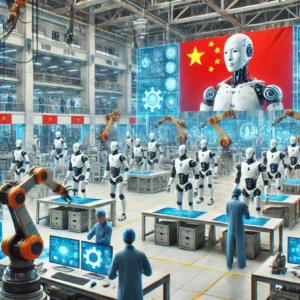
One of the most transformative aspects of AI in 2025 is its integration with physical robotics. This convergence is fueling the next wave of automation, especially in sectors such as manufacturing, healthcare, logistics, and elder care. Tesla’s Optimus robot is now operational in several of its factories, performing tasks that were once reserved for human workers. With advanced sensors and real-time AI decision-making, these robots can navigate complex environments and adapt to unexpected scenarios.
Across Asia and Europe, robotics companies are racing to develop autonomous humanoids and service bots. In Japan and South Korea, hospitals and nursing homes have deployed AI-driven robots capable of not just physical tasks but also basic emotional interaction. They recognize faces, understand vocal cues, and even hold basic conversations with patients.
These developments are making robotics more personal and socially acceptable. For example, home assistant robots are now being used in smart homes to perform household chores, remind elderly residents about medications, or even serve as conversation partners for those living alone. Emotion recognition and contextual awareness are enhancing how robots interact with people in natural, human-like ways.
This shift is raising important ethical and social questions, particularly about labor displacement, human-robot relationships, and social dependency on machines. Nonetheless, the fusion of AI and robotics is creating a future where machines are not only tools but companions, collaborators, and caretakers.
In 2025, AI-powered robots are no longer science fiction—they are a part of daily life.
Conclusion: Summary and Strategic Action
As AI technology continues to evolve rapidly in 2025, its influence spans across generative content, ethical design, and robotic integration. Now more than ever, individuals and organizations must understand these shifts and prepare strategically. Whether you’re a content creator, business leader, or policy maker, embracing AI intelligently will be essential. Stay informed, stay adaptable, and explore the possibilities AI can unlock for you.