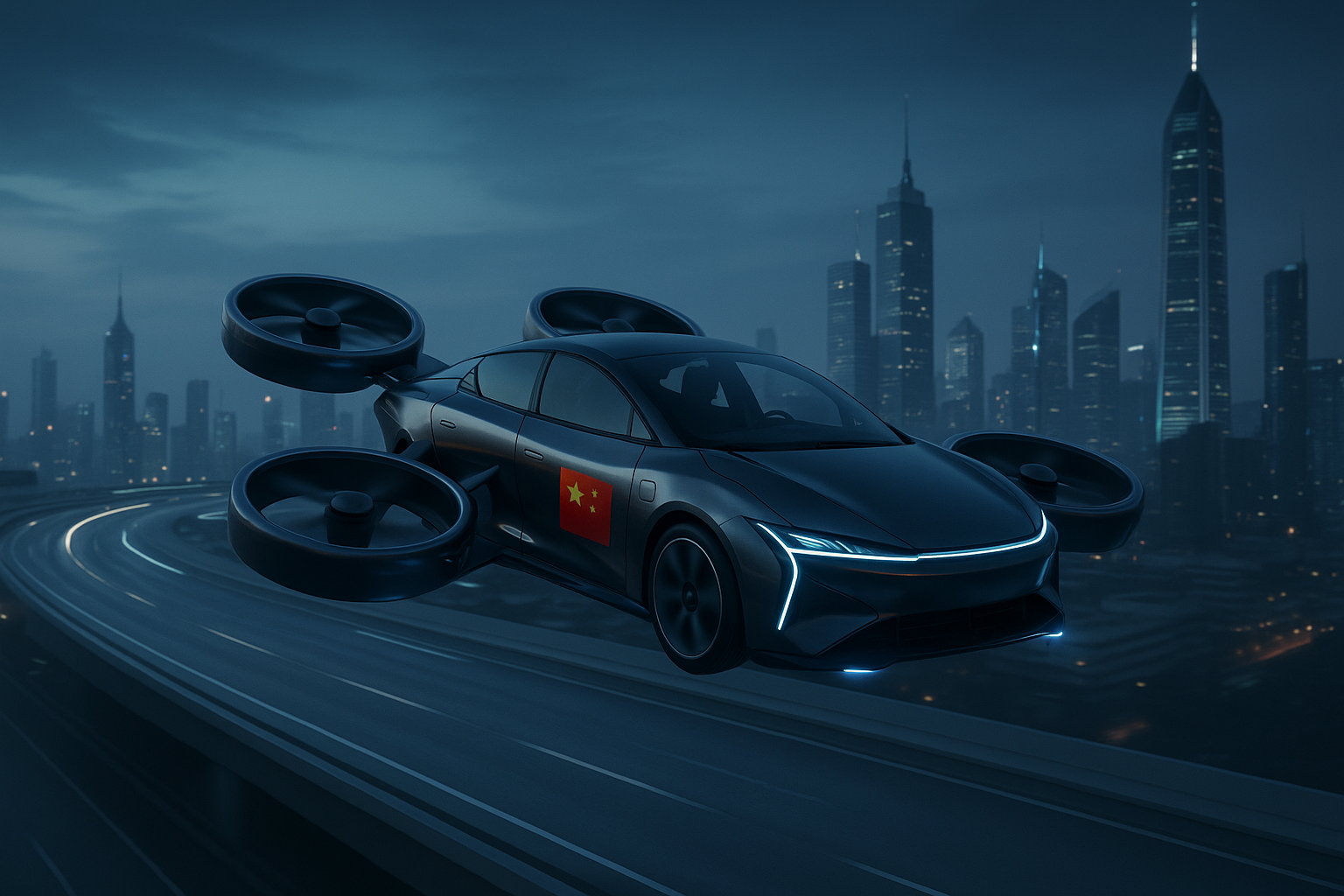
China is rapidly emerging as a global leader in the development and deployment of flying cars, particularly electric vertical takeoff and landing (eVTOL) vehicles. With significant investments from major automotive manufacturers, supportive government policies, and a focus on integrating these vehicles into urban transportation systems, China is poised to revolutionize the way people and goods move through cities.(The Sun)
The Rise of China’s Flying Car Industry
The Chinese government has set ambitious goals for the adoption of flying cars, aiming to have 100,000 eVTOLs operating in its cities within the next six years. These vehicles are envisioned to serve as taxis, delivery vans, and personal transport options, transforming urban mobility. To support this vision, China is developing air traffic networks and ground facilities, with mass production of flying cars expected by 2026. Advancements in artificial intelligence and unmanned technology are also paving the way for autonomous eVTOLs in logistics and emergency services. (The Sun)
Key Players and Innovations
XPeng AeroHT: Modular Flying Cars
XPeng AeroHT, a subsidiary of XPeng Motors, is at the forefront of China’s flying car innovation. The company has developed the “Land Aircraft Carrier,” a modular flying car that combines a ground vehicle with a detachable flying pod. This design allows for seamless transitions between driving and flying, addressing urban congestion challenges. The Land Aircraft Carrier is scheduled for mass production and delivery by 2026, with a planned annual capacity of 10,000 units at its new manufacturing base in Guangzhou. (Electrek, CnEVPost, The Sun, CnEVPost)
AutoFlight: Record-Breaking eVTOLs
AutoFlight, a Shanghai-based startup, has made significant strides in eVTOL technology. Its Prosperity I air taxi set a world record by flying 250.3 kilometers on a single charge, showcasing the potential for long-range urban air mobility. The company has also received airworthiness certification for its unmanned CarryAll aircraft, marking a milestone in China’s eVTOL industry. (Time, South China Morning Post, Business Insider)
GAC’s Govy AirJet: Advanced Design and Capabilities
Guangzhou Automobile Group (GAC) has introduced the Govy AirJet, an eVTOL designed for both short and medium-distance travel. With a flight range of up to 200 kilometers and a maximum speed of 250 km/h, the Govy AirJet features an intelligent sensing and obstacle avoidance system. GAC plans to launch demonstration operations in select cities by 2027, further integrating flying cars into urban transportation networks. (CarNewsChina.com)
Government Support and Infrastructure Development
China’s rapid advancement in the flying car sector is bolstered by proactive government support. The Civil Aviation Administration of China (CAAC) has expedited regulatory approvals for eVTOLs, facilitating quicker development and deployment. Additionally, cities like Shenzhen are offering substantial incentives, up to $2.81 million, to attract eVTOL companies and support infrastructure development. (Business Insider, Caixin Global)
To further integrate flying cars into urban environments, China is establishing pilot zones in six major cities, including Shenzhen, Chongqing, and Hangzhou. These zones will enable the testing and operation of eVTOLs, with plans to gradually open airspace and develop necessary ground facilities. The eVTOL market in China is projected to reach 9.5 billion yuan by 2026, reflecting the country’s commitment to this emerging industry. ( The Sun)
Challenges and Future Outlook
While China’s flying car industry is progressing rapidly, challenges remain. Ensuring the safety and reliability of eVTOLs, developing comprehensive air traffic management systems, and addressing public concerns are critical for widespread adoption. However, with continued investment, technological innovation, and supportive policies, China is well-positioned to lead the global transition to urban air mobility.(The Sun)
The integration of flying cars into daily life could revolutionize transportation, reduce congestion, and open new possibilities for logistics and emergency services. As China continues to push the boundaries of what’s possible, the dream of flying cars becoming a common sight in our skies moves closer to reality.