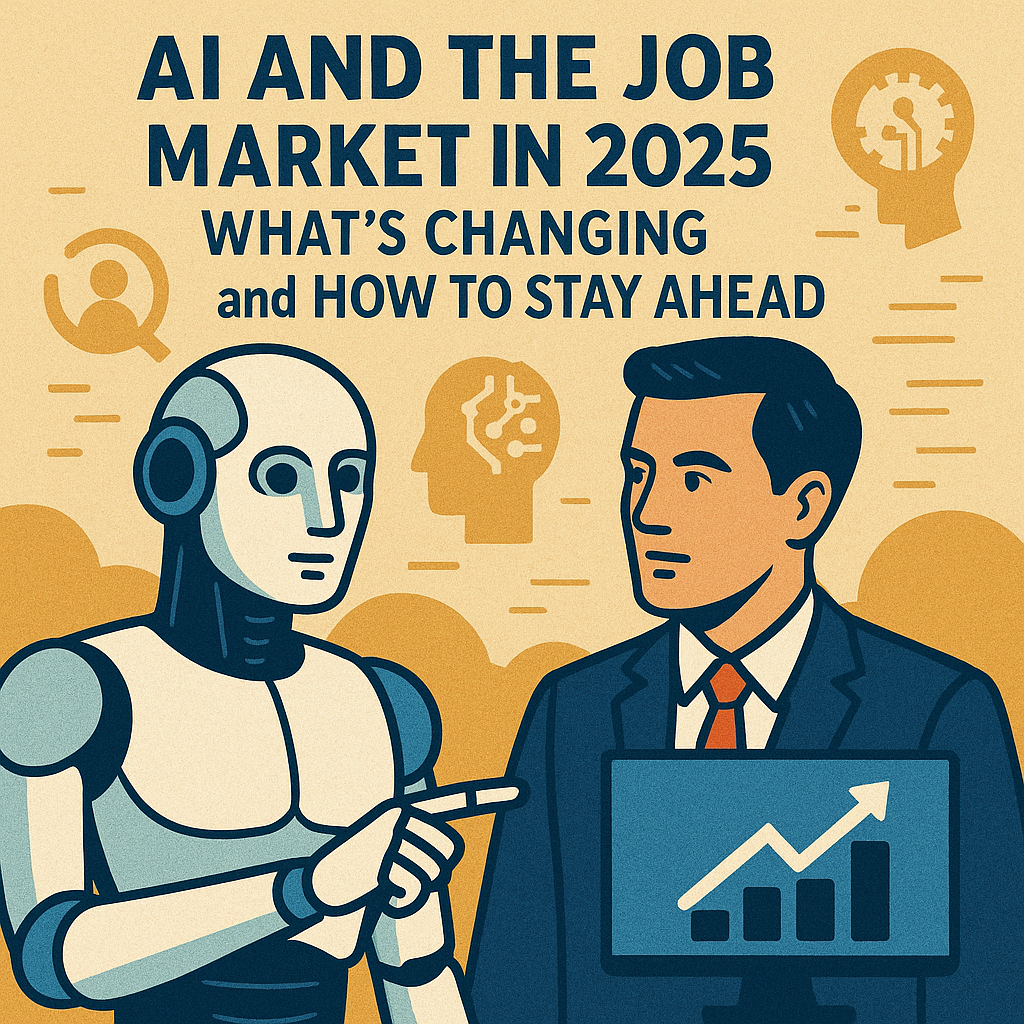
AI and the Job Market in 2025: What’s Changing and How to Stay Ahead
As artificial intelligence (AI) continues to reshape the global workforce, understanding its impact on jobs is crucial. Here’s a comprehensive guide on how AI is transforming the job market in 2025—and what you can do to stay competitive.
📚 Table of Contents
- Introduction: The Rise of AI in the Workforce
- How AI Is Changing the Job Market in 2025
- Automation of Routine Tasks
- The Rise of AI-Augmented Roles
- Growth in Hybrid and Tech-Enabled Jobs
- Impact on Traditional Career Paths
- Industries Most Affected by AI in 2025
- Healthcare
- Finance
- Education
- Retail & E-commerce
- Manufacturing
- Top In-Demand Skills in the AI Era
- How to Prepare for the AI-Driven Job Market
- Upskilling in AI and Data Literacy
- Soft Skills: The Human Edge
- Certifications That Boost AI Readiness
- Emerging Careers Created by AI
- AI Prompt Engineer
- Human-AI Collaboration Manager
- AI Ethics Consultant
- How to Work With AI, Not Against It
- Conclusion: Future-Proofing Your Career
- Frequently Asked Questions (FAQ)
🔍 Introduction: The Rise of AI in the Workforce
Artificial Intelligence is not a buzzword anymore—it’s a core driver of workplace innovation and transformation. In 2025, AI is not just influencing how we work—it’s redefining what work looks like, which jobs are valuable, and how people can stay competitive in a rapidly evolving market.
Whether you’re a professional looking to stay ahead or a student preparing for your future, understanding the AI-driven job market trends in 2025 is essential.
⚙️ How AI Is Changing the Job Market in 2025
🔁 1. Automation of Routine Tasks
AI is increasingly taking over repetitive, predictable tasks. These include:
- Data entry and validation
- Scheduling and calendar management
- Customer service chatbots
- Report generation and analytics
💻 2. The Rise of AI-Augmented Roles
Instead of replacing entire roles, AI often augments existing jobs. For instance:
- AI-assisted writing tools help marketers and content creators.
- Radiologists use AI to identify patterns in medical imaging.
- Financial analysts use predictive algorithms for forecasting.
🧠 3. Growth in Hybrid and Tech-Enabled Jobs
Hybrid roles that blend soft and technical skills are in high demand:
- Data-savvy HR managers
- Sales professionals trained in AI-driven CRM tools
- Teachers using AI to personalize learning
🔀 4. Impact on Traditional Career Paths
AI is disrupting career planning:
- Some traditional roles are shrinking (e.g., telemarketers, clerks).
- Others are evolving into more strategic and AI-focused versions
🏭 Industries Most Affected by AI in 2025
🏥 Healthcare
- AI in diagnostics and patient monitoring
- Automation in administrative tasks
💰 Finance
- Fraud detection through machine learning
- AI-powered investment analysis
📚 Education
- AI tutoring systems
- Personalized curriculum development
🛒 Retail & E-commerce
- AI-driven inventory and customer analytics
- Virtual shopping assistants
🏗️ Manufacturing
- Smart robots and predictive maintenance
- AI-powered supply chain managemen
🔑 Top In-Demand Skills in the AI Era
- Data Literacy – Understanding how to interpret and work with data
- AI Fundamentals – Knowing how AI works, even at a basic level
- Critical Thinking – Making decisions where AI lacks judgment
- Emotional Intelligence – Managing interpersonal relationships
- Digital Communication Skills – Working effectively in tech-enabled environments
📈 How to Prepare for the AI-Driven Job Market
✅ Upskilling in AI and Data Literacy
Take online courses in:
- Python and machine learning
- AI ethics and governance
- Data visualization tools like Power BI and Tableau
✅ Focus on Human-Centric Skills
- Team collaboration
- Leadership in tech-driven environments
- Conflict resolution and empathy
✅ Earn Industry-Recognized Certifications
Consider certifications like:
- Google’s AI for Everyone
- IBM AI Engineering
- Microsoft Certified: AI Fundamentals
🌐 Emerging Careers Created by AI
These are not science fiction—they’re real, fast-growing roles:
🧩 AI Prompt Engineer
Crafts effective prompts to optimize outputs from generative AI tools.
🤝 Human-AI Collaboration Manager
Facilitates workflow between human teams and AI systems.
⚖️ AI Ethics Consultant
Ensures AI solutions meet ethical and legal standards across industries.
🤝 How to Work With AI, Not Against It
Rather than fearing replacement, professionals should aim to collaborate with AI. Key strategies include:
- Treating AI as a digital teammate
- Knowing when to rely on AI and when to override it
- Using AI to amplify your creativity and productivity
🧭 Conclusion: Future-Proofing Your Career
AI is changing the landscape, but it’s not eliminating opportunity—it’s reshaping it. The best way to thrive is by staying curious, being adaptable, and treating learning as a lifelong process.
Remember: The future of work is not AI vs. humans—it’s AI with humans.
❓ Frequently Asked Questions (FAQ)
1. Will AI take my job in 2025?
AI will transform many jobs but not eliminate all of them. Roles that require creativity, empathy, and complex decision-making will remain essential.
2. What jobs are safe from AI?
Jobs in healthcare, education, creative fields, and those requiring deep human interaction are more resistant to automation.
3. How can I start learning AI skills?
Start with free platforms like Coursera, edX, and YouTube. Begin with Python, machine learning, and AI ethics.
4. Is prompt engineering a real job?
Yes! Prompt engineering is a growing career field, especially in companies using generative AI tools like ChatGPT.