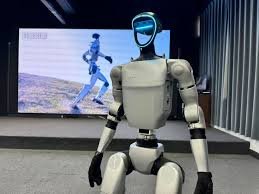
China Surges Ahead in Humanoid Robot Race, Challenging U.S. Manufacturing Powerhouses
The race for humanoid robot dominance is shifting gears—and China is gaining ground fast. While the United States has long been home to robotics pioneers like Boston Dynamics and Tesla, China is now emerging as a serious challenger, thanks to a wave of government-backed innovation, aggressive investment, and next-generation startups like UBTech (UBtree) and Fourier Intelligence.
This isn’t just about robotics anymore—it’s about who controls the future of smart labor, automation, and AI-integrated machines.
🇨🇳 China’s Humanoid Robot Boom: UBTech, Fourier & Beyond
Chinese tech companies are pushing the boundaries of what humanoid robots can do, and they’re doing it fast.
🔹 UBTech Robotics (UBtree)
A major player in China’s humanoid robotics push, UBTech has unveiled a range of robots, most notably Walker X—a bipedal humanoid capable of walking, climbing stairs, carrying items, and interacting with humans using advanced voice and vision systems. Walker X made waves at CES and the World AI Conference, demonstrating increasingly fluid movement and real-time decision-making.
UBTech’s goal? To create robots that can serve in homes, offices, hospitals, and public spaces.
🔹 Fourier Intelligence
Another standout, Fourier Intelligence, focuses on versatile humanoid robots designed for medical rehabilitation and industrial tasks. Their latest models feature human-like gait, balance control, and object manipulation—essential components for use in caregiving or factory environments.
These robots aren’t just tech demos—they’re close to deployment, with Fourier already partnering with institutions for real-world testing.
🔹 Other Notables
- Unitree Robotics is producing low-cost, agile quadrupeds and bipedal robots.
- Agibot and Xiaopeng Robotics are entering the scene with AI-powered humanoid prototypes.
- All of these are backed by China’s state innovation strategy, part of the broader “Made in China 2025” initiative.
🇺🇸 U.S. Robotics: The Manufacturing-Centric Model
Meanwhile, U.S.-based companies continue to lead in manufacturing-focused humanoid robots, with a different set of goals and advantages.
🔹 Tesla Optimus
Elon Musk’s Optimus project aims to integrate humanoid robots into Tesla’s factories, handling repetitive, dangerous, or boring tasks. While still in early development, the vision is ambitious: to have thousands of robots working alongside humans in Tesla’s gigafactories, eventually transitioning to home and commercial environments.
🔹 Figure AI
A rising star in the U.S. robotics space, Figure AI recently raised massive funding to develop general-purpose humanoids capable of warehouse, retail, and logistics work. Their sleek robot, “Figure 01,” is focused on dexterity, safety, and AI learning for real-world tasks.
🔹 Boston Dynamics
Although Boston Dynamics isn’t as commercially focused on humanoids as others, its work on Atlas has set the global bar for bipedal mobility, agility, and control. Its parent company, Hyundai, could potentially commercialize the technology in future service robots.
⚔️ China vs U.S.: Diverging Philosophies
| Aspect | China | United States |
|---|---|---|
| Robot Purpose | Service, public interaction, eldercare, healthcare | Manufacturing, logistics, industrial automation |
| Leading Companies | UBTech, Fourier, Unitree, Agibot | Tesla, Figure AI, Boston Dynamics |
| Government Support | Strong state funding, policy incentives | Primarily private investment, light federal guidance |
| Development Focus | Rapid prototyping, AI integration, affordable deployment | High-performance machines, long-term industrial use |
| Market Timeline | 2–3 years to deployment in service roles | 3–5 years to deployment in factories |
🌍 Implications of a Shifting Landscape
China’s push is creating affordable, versatile robots designed for integration into society—particularly useful in a rapidly aging population. Meanwhile, U.S. players are focused on industrial environments, where labor shortages and rising costs are pushing automation forward.
This divergence could lead to a bifurcated global robotics market, with China leading in public and service robotics, and the U.S. dominating manufacturing-focused automation—unless either side begins to close the gap.
🔮 What’s Next?
As China moves toward mass production and real-world deployment of humanoid robots, the pressure is on U.S. firms to deliver on their vision. With geopolitical tensions and AI regulations on the rise, the race to humanoid dominance is more than a tech contest—it’s a strategic one.
Will the U.S. double down on innovation to maintain its edge? Or will China’s scalable, AI-powered robots become the global standard?
🔗 Further Reading:
📄 China surges ahead in humanoid robot race, taking on US competitors – CNBC