The Steering Wheel is Disappearing: Revolutionizing Transportation & Logistics in the Age of Physical AI
The year 2026 is officially the threshold. We are no longer talking about “future possibilities” or “lab experiments.” We are living in the era of Physical AI—the moment when digital intelligence finally broke out of our screens and started moving heavy objects in the real world.
From the driverless freight lanes of the American Sun Belt to the electric air taxis preparing for takeoff in Dubai, the rules of motion are being rewritten. This isn’t just an upgrade; it’s a total metamorphosis of how we move, work, and live.
📰 The Viral Pulse: 2026 Kickoff Highlights
Here is the most recent news and trending media shaking up the industry as we enter 2026:
-
The Permian Basin Ghost Fleet: Kodiak AI has successfully scaled its driverless operations to 10 Class 8 trucks hauling freight in West Texas with zero humans in the cab.(https://kodiak.ai/news/best-of-2025)
-
The Price of Labor Plummets: New market data reveals that mass-produced humanoid robots have hit a price floor of $13,000, making robotic labor officially cheaper than human warehouse wages.(https://www.mk.co.kr/en/world/11919925)
-
Amazon’s “DeepFleet” Revolution: Amazon has hit its one-millionth robot milestone and launched “DeepFleet,” a generative AI model that acts as a traffic controller for its entire global robotic network. Check out Amazon’s Announcement
-
Trending on YouTube: “The Autonomous Road Trip” has gone viral, documenting a journey from San Francisco to Austin using only Waymo, Tesla FSD, and Zoox.(https://www.youtube.com/watch?v=8y8By67Fq28)
🚀 The Story (In a Nutshell — 2026 Reality Edition)
Not long ago, transportation meant roads, drivers, and waiting.
Today, it means algorithms, autonomy, and airspace.
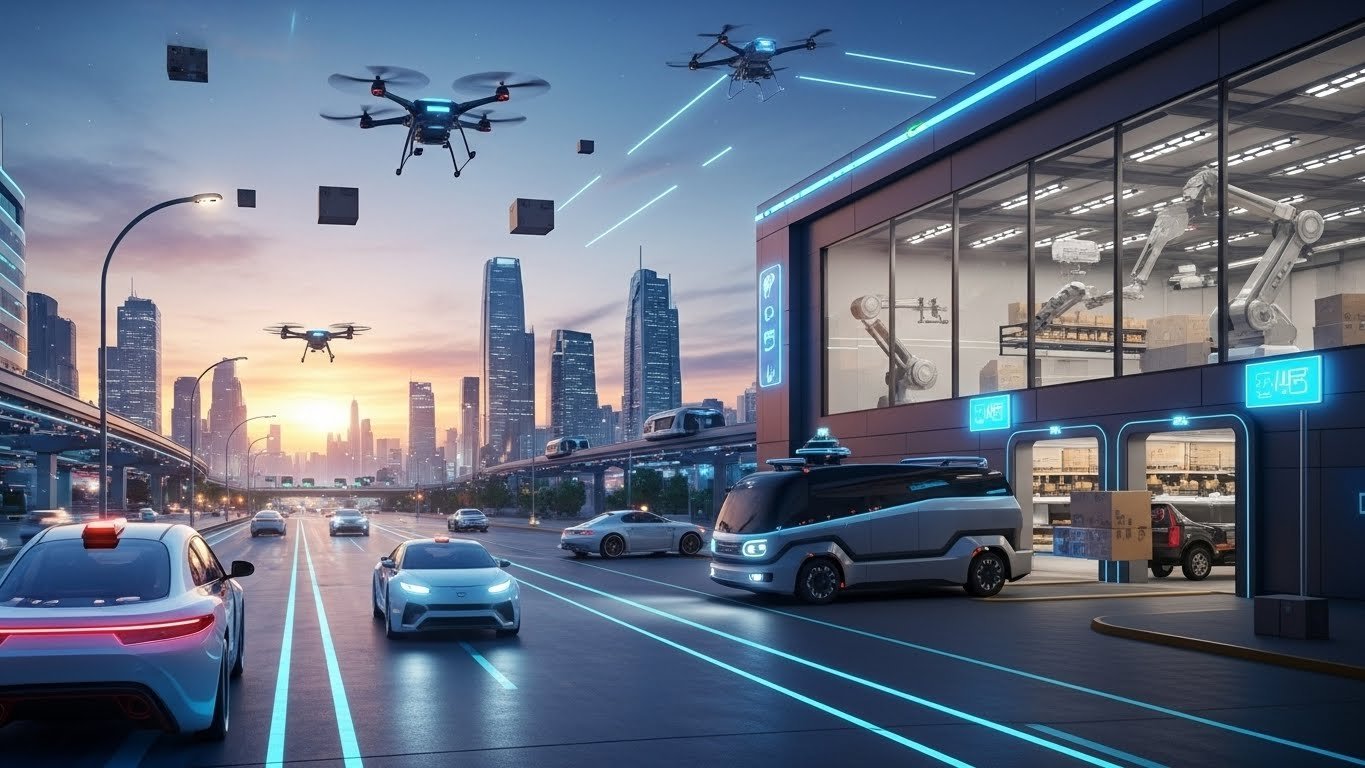
On our highways, AI-driven trucks are no longer “testing”—they are hauling. They navigate the dead of night with eyes made of lidar and neural networks trained on billions of miles of human behavior. These systems don’t get tired. They don’t text. They don’t panic. They calculate the safest, most efficient path forward with mathematical precision.
Inside the warehouse, the “living system” has arrived. Robots no longer follow simple paths; they coordinate. One robot moves a 1,200-pound shelf, another predicts a surge in demand for electronics, and a third reroutes inventory before an order is even placed. The warehouse has become an intelligent organism, guided by AI brains rather than clipboards.
And now, the story is lifting off.
In cities choked by gridlock, electric air taxis (eVTOLs) are moving through the final stages of certification. These aren’t sci-fi “flying cars”—they are quiet, electric, autonomous-ready vehicles designed to skip the traffic entirely. AI manages the air just as it manages the road—predicting weather, battery health, and safety risks in real time.
The result is a new logistics stack:
-
Ground Autonomy moves bulk freight with 24/7 consistency.
-
Robotic Humanoids eliminate errors on the factory floor.
-
Aerial Mobility handles the urgent—the medical supplies and critical parts.
Transportation is no longer reactive. It is predictive, multi-layered, and intelligent. The revolution isn’t about machines moving faster; it’s about decisions being made earlier, safer, and smarter—on the road, in the warehouse, and now, in the sky.
Part I: The Heavy Haulers — The $1.5 Trillion Highway Shift
The trucking industry is the backbone of global commerce, moving over 70% of all freight. But for decades, it has been plagued by driver shortages and safety risks. 2026 is the year the industry provides a systemic answer.
Kodiak AI and the Industrial Vanguard
Kodiak AI has distinguished itself by focusing on high-value, “dirty” jobs first. By late 2025, they delivered the world’s largest customer-owned autonomous fleet to Atlas Energy Solutions. These trucks operate in the Permian Basin, moving frac sand across private roads without a single human in the cab. This isn’t just a pilot; it’s a revenue-generating operation that has already logged over 5,200 hours of paid driverless service.
The Economics of Autonomy
The shift is driven by a brutal financial reality: autonomous trucking can reduce the cost per mile by as much as 42%. These savings come from three pillars:
-
Labor Efficiency: Trucks can run 24/7, limited only by fuel and maintenance.
-
Fuel Optimization: AI drivers avoid the erratic acceleration and braking that waste fuel.
-
Safety: With 94% of accidents caused by human error, insurance and medical costs are expected to drop by $100 million annually across the industry.
Part II: The Metal Collar Workforce — Humanoids Take the Floor
If 2024 was the year of the LLM (Large Language Model), 2026 is the year of the LBM (Large Behavior Model). We have reached the “Economic Crossover Point” where robotic labor is now undeniably cheaper than human labor.
The $5.71 Per Hour Worker
As of early 2026, the operating cost for a humanoid robot has fallen to an average of $5.71 per hour. When you compare that to the $28–$30 per hour earned by human warehouse workers in the U.S., the business case for automation becomes a requirement for survival.
The Humanoid War: U.S. vs. China
The race for dominance is a geopolitical contest. In the U.S., Boston Dynamics’ electric Atlas is working at Hyundai’s Georgia plant, while Figure AI has integrated robots into BMW facilities. However, China is playing a “volume game.” Companies like BYD and UBTech are targeting production of 20,000 units this year, leveraging their control over 90% of the world’s rare-earth magnet production—a critical component for robot “muscles.”
Part III: The Urban Skyway — Air Taxis Enter the Arena
The dream of skipping the 405 or the I-95 traffic is finally materializing. Urban Air Mobility (UAM) is moving from the realm of science fiction into the final stages of FAA certification.
Joby Aviation: The 50,000-Mile Milestone
Joby Aviation enters 2026 as the frontrunner. In the past year alone, they completed more than 850 flights and covered 50,000 miles across the U.S., the UAE, and Japan. They are now entering the “Type Inspection Authorization” (TIA) phase—the final exam where FAA test pilots take the controls to verify the aircraft is safe for public service.
Archer Aviation and the eIPP Pathway
While Joby focuses on global operations, Archer is partnering with major U.S. cities under the White House’s eVTOL Integration Pilot Program. Their “Midnight” aircraft is designed for rapid-turnaround urban hops, with a vision of turning a 60-minute commute into a 10-minute flight.
Part IV: The Digital Nervous System — DeepFleet and AI Agents
Underpinning all these physical machines is a digital nervous system.
DeepFleet: The Traffic Controller of the Future
Amazon’s DeepFleet AI is a perfect example of this intelligence. It doesn’t just “move” robots; it coordinates them. By optimizing the paths of one million robots, Amazon has improved fleet travel efficiency by 10%. This allows them to store more products closer to customers, enabling the “30-minute delivery” standard that is becoming the 2026 expectation.
SaaS and RaaS Models
Technology is also changing how companies buy logistics. We are seeing a massive shift toward Robot-as-a-Service (RaaS). Instead of buying a million-dollar fleet, companies pay a monthly fee for “autonomy hours.” This keeps businesses agile and ensures they always have the latest software updates.
Part V: CES 2026 — A Glimpse of the Near Future
The Consumer Electronics Show (CES) in Las Vegas is currently showcasing the tech that will hit the streets later this year:
-
GoLe-Robotics AA-2: A last-mile delivery robot designed for premium apartments. It has a pneumatic frame that deflates to save space and can autonomously call and ride elevators to deliver packages directly to your door.
-
Doosan Scan&Go: A “Best of Innovation” winner that uses 3D vision and AI to sand, grind, and inspect massive structures like aircraft fuselages without any human programming.
-
LG’s AI Cabin: A car interior powered by generative AI that monitors your attention and turns your windshield into a transparent OLED display for personalized entertainment.
🧠 Test Your Knowledge: The 2026 Physical AI Quiz
1. What is the projected value of the global autonomous truck market by 2034?
-
A) $350 Billion
-
B) $1.5 Trillion
-
C) $800 Billion
-
D) $2.2 Trillion
2. As of early 2026, what is the estimated hourly operating cost of a humanoid robot?
-
A) $30.00
-
B) $13.00
-
C) $5.71
-
D) $1.50
3. Which metric does Kodiak AI use to measure the readiness of its autonomous system?
-
A) Driver-as-a-Service (DaaS)
-
B) Autonomous Reliability Metric (ARM)
-
C) Safety Flow Index (SFI)
-
D) Lidar Precision Score (LPS)
4. Amazon reached a massive milestone in late 2025 by deploying its how many-eth robot?
-
A) 100,000th
-
B) 500,000th
-
C) 1 Millionth
-
D) 5 Millionth
5. What is unique about the GoLe-Robotics AA-2 residential delivery robot?
-
A) It can fly like a drone.
-
B) It has a pneumatic frame that deflates for storage.
-
C) It is made of 100% recycled coffee cups.
-
D) It uses a jet engine for speed.
6. Which company is leading the eVTOL race with over 50,000 miles of flight testing?
-
A) Uber Elevate
-
B) Joby Aviation
-
C) Tesla Aero
-
D) Boeing Air
7. “DeepFleet” is an AI foundation model designed to do what?
-
A) Drive trucks on the highway.
-
B) Coordinate warehouse robots to reduce congestion.
-
C) Manage the rare-earth magnet supply chain.
-
D) Pilot commercial drones in the UAE.
8. By how much can autonomous trucking reduce the cost per mile, according to research?
-
A) 15%
-
B) 25%
-
C) 42%
-
D) 94%
🔑 Quiz Answer Key
-
B) $1.5 Trillion
-
C) $5.71
-
B) Autonomous Reliability Metric (ARM)
-
C) 1 Millionth
-
B) It has a pneumatic frame that deflates for storage.
-
B) Joby Aviation
-
B) Coordinate warehouse robots to reduce congestion.
-
C) 42%