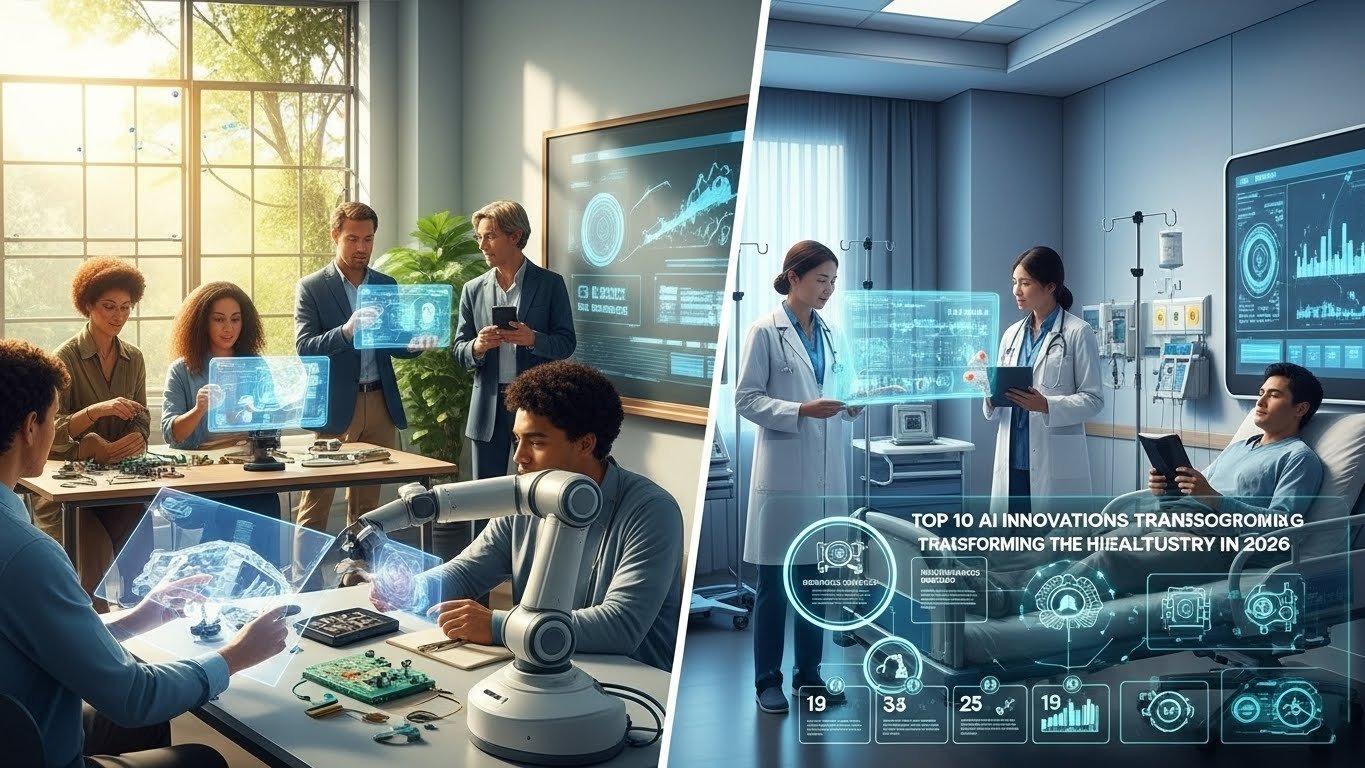
Top 10 AI Innovations Transforming the Healthcare Industry in 2026: Synergizing Adaptive Machines with Human Creativity
The following report analyzes the pivotal transition of artificial intelligence from a speculative digital tool to a foundational, adaptive infrastructure within the global healthcare and medical education sectors as of 2026. This transformation is characterized not by the replacement of the human professional, but by a profound augmentation of human creativity and operational efficiency.
Primary Media and Real-Time Intelligence Briefing
Before delving into the technical architecture of these innovations, it is essential to contextualize the current landscape through existing expert discourse and recent breakthroughs that have defined the early months of 2026.
Recommended Expert Analysis and Multimedia Resources
The following resources provide high-fidelity insights into the transition from experimental AI pilots to the governed, large-scale deployments that characterize the 2026 healthcare environment.
- 2026 Health IT Predictions: The Era of Invisible AI[https://www.youtube.com/watch?v=uOf_6CnKkM8]
This analysis explores the shift toward “invisible AI,” where technology recedes into the background of clinical workflows, focusing on context-aware systems and autonomous memory management that support long-term patient-provider relationships.1
-
The Future of Work: AI Agents as Clinical Teammates
A deep dive into how 2026 has become the “year of reality” for AI, emphasizing the move from simple text generation to agentic systems capable of executing complex, multi-step clinical tasks without constant human intervention.2
-
The Data Flywheel: Self-Improving Ecosystems in Medicine
An examination of why integrated platforms, such as the Aura ring or modern EHR-integrated GPT-4 modules, are dominating the 2026 market by eliminating friction and creating self-improving loops of patient-specific data.4
-
2026 Outlook: Global Markets and the AI Infrastructure Reckoning
A broader economic perspective on how the arrival of AGI-like capabilities is impacting healthcare investment and the global labor market for specialized clinical talent.5
Strategic News Headlines for January 2026
The early weeks of 2026 have been marked by several landmark events that have accelerated the adoption of adaptive machines in clinical and educational settings.
-
The Global Interoperability Accord (January 2026): Nations and major health systems have officially converged on shared FHIR-based data standards, finally enabling the “medical digital twin” to function seamlessly across international borders.6
-
FDA Clearances for Multimodal Devices Hit Record Highs: The FDA has announced the approval of the 500th multimodal AI device, capable of synthesizing imaging, genomic data, and real-time biosignals into a single diagnostic output.8
-
Clinical-Grade LLMs Replace Generalist Tools: Major medical schools, led by institutions like the University of Miami, have announced a total transition to domain-specific language models (DSLMs) trained exclusively on validated, peer-reviewed clinical evidence.10
-
Google and Warby Parker Launch “Third Act” Smart Glasses: The release of AI-powered wearables that provide real-time diagnostic overlays and surgical guidance, blending physical reality with deep-learning insights for frontline providers.12
In the Nutshell: The Patient and the Polymath
To understand the 2026 landscape, one must look beyond the code and into the consultation room. Imagine Dr. Elena, a neurologist, meeting with a patient exhibiting early, ambiguous signs of cognitive decline. In 2024, Dr. Elena would have spent forty percent of this appointment typing into a rigid electronic health record (EHR), her back turned to the patient.13
In 2026, the room itself is an adaptive machine. An ambient intelligent system, discreet and secure, listens to the cadence of the patient’s speech, detecting subtle linguistic “markers” of neurodegeneration that are invisible to the human ear.9 Simultaneously, an AI agent reviews the patient’s five-year history of wearable sleep data and recent retinal scans, synthesizing them into a visual “probability map” on Dr. Elena’s smart glasses.16
The “efficiency” gained here is not merely speed; it is the reclamation of human presence. Dr. Elena can look her patient in the eye, exercise her “creativity” by interpreting the emotional and social nuances of the case, and work with the patient to design a treatment plan that fits their specific lifestyle.13 The machine provides the data-driven foundation, but the human professional provides the creative architecture of care.15
1. The Rise of Agentic AI: From Digital Assistants to Clinical Coworkers
The most significant evolution in 2026 is the transition from “reactive” AI to “agentic” AI. While 2025 was defined by chatbots that waited for prompts, 2026 is defined by agents that understand goals and take autonomous action.15 In healthcare, this represents a shift from a tool that helps a human work to a “digital coworker” that owns entire workflows.20
Mechanism and Autonomous Workflow Integration
Agentic AI systems are built on multimodal models that don’t just generate text; they reason, plan, and execute.21 In a hospital setting, an agent might oversee the entire prior authorization process—a task that previously consumed weeks of administrative labor. The agent identifies the need for a specific procedure, gathers the necessary clinical documentation from the EHR, interacts with the payer’s system, and monitors the status until approval is granted, only involving a human supervisor if a complex ethical or clinical exception arises.13
This autonomy is supported by “context engineering” and “memory management,” allowing agents to remember patient preferences and previous clinical decisions across different care settings.1 This prevents the “fragmented care” common in traditional systems where different departments operate in silos. In 2026, agents act as the connective tissue, ensuring that a pharmacist, a surgeon, and a physical therapist are all working from the same real-time, AI-coordinated plan.7
Economic and Operational Impact
The move to agentic systems is driven by a desperate need for efficiency in the face of global clinical shortages.8 Organizations that have successfully integrated these “silicon-based workforces” report massive improvements in throughput and clinician well-being.8
| KPI Metric | Traditional Workflow (2024) | Agentic Workflow (2026) |
| Documentation Time | 2-3 hours per patient hour | < 15 minutes (ambient) |
| Prior Authorization | 7-14 days | < 2 hours (autonomous) |
| Patient Triage Time | 45 minutes | 5 minutes (predictive) |
| Clinician Burnout Rate | 63% report high fatigue | 28% report high fatigue |
| Data Integration | Manual/Fragmented | Real-time/Multimodal |
8
2. Physical AI: Humanoid Robots and Adaptive Machines in the Ward
While the first waves of AI were confined to screens, 2026 is the year AI “went physical”.15 The convergence of deep learning and advanced robotics has created adaptive machines that can perceive, reason about, and interact with the three-dimensional world of a hospital.25
Humanoid Assistance and Collaborative Robotics (Cobots)
In 2026, the sight of a humanoid robot navigating a hospital hallway is no longer a novelty but a staple of operational efficiency.25 These machines are not designed to replace nurses but to act as “cobots”—collaborative robots that handle the “three Ds” of labor: tasks that are Dull, Dirty, or Dangerous.26
Humanoid robots in 2026 use “physical AI” to perform tasks such as repositioning bedbound patients to prevent pressure ulcers—a physically taxing job that often leads to nurse injury—and managing the delivery of biohazardous materials.25 Because these machines are “adaptive,” they don’t follow rigid, pre-programmed paths. They use 3D integrated sensors and real-time spatial understanding to navigate around a dropped tray, a wandering patient, or an emergency stretcher without requiring human intervention.25
The Creativity Angle: Freeing the “Nurturing” Human
The impact of physical AI on “human creativity” is best seen in the nursing profession. By 2026, leading health systems have leveraged robotics to reclaim up to $30\%$ of a nurse’s daily schedule.29 This time is redirected toward complex patient education, emotional support, and the “art” of nursing—tasks that require a level of empathy and creative problem-solving that remains uniquely human.11 The machine handles the heavy lifting, while the human handles the heart.31
3. Multimodal Diagnostic Synthesis: The Convergence of Senses
The diagnostic process in 2026 has been revolutionized by Multimodal AI, which treats various types of data—text, images, audio, and video—as a single, unified language.15 This “all-seeing” capability allows for a level of diagnostic precision that was previously impossible.
Synthesizing the Clinical Narrative
In a standard 2026 diagnostic workflow, an AI system analyzes a patient’s medical history (text), recent MRI scans (images), and even the sound of their heart valves recorded during a tele-consult (audio).9 This multimodal alignment allows the AI to catch “cross-domain” patterns. For instance, it might identify that a subtle change in a patient’s gait (captured on video) combined with a minor shift in their blood-oxygen patterns (from a wearable) suggests the early onset of a specific neurological condition, even if their traditional lab results are still within the “normal” range.9
Clinical Breakthroughs in Precision
The efficiency gains in 2026 are perhaps most visible in the field of oncology. Multimodal models now analyze tumor genomic profiles alongside pathology slides and real-time lifestyle data to recommend “hyper-personalized” treatment plans.34
| Diagnostic Category | Traditional Accuracy (2024) | AI-Enhanced Accuracy (2026) |
| Early Lung Nodule Detection | 65% | 94% |
| Diabetic Retinopathy | 82% | 97% |
| Sepsis Prediction (Lead Time) | 2 hours | 12-48 hours |
| Breast Cancer (Sensitivity) | 78% | 91% |
| Melanoma Identification | 85% | 96% |
14
This diagnostic power serves as a “creative springboard” for clinicians. Instead of spending hours attempting to synthesize disparate data points, the physician acts as a “strategic coordinator,” evaluating the AI’s proposed pathways and using their creative judgment to decide which treatment aligns best with the patient’s unique values and psychological state.13
4. Domain-Specific Language Models (DSLMs): The Foundation of Trust
By 2026, the healthcare industry has largely moved away from “general-purpose” AI like the early versions of ChatGPT. The new standard is the Domain-Specific Language Model (DSLM)—AI that has been “raised” exclusively on medical textbooks, peer-reviewed journals, and an institution’s own validated clinical guidelines.10
Solving the Hallucination Crisis
The primary innovation of DSLMs is the virtual elimination of “hallucinations”—the tendency of general AI to invent medical facts.15 In 2026, a doctor can ask a DSLM for the latest antibiotic stewardship protocol for a specific strain of resistant bacteria, and the system will provide a cited, evidence-based answer that reflects the exact inventory of the hospital’s pharmacy.11
Integration into Medical Education
These domain-specific machines are transforming how we train the next generation of healers. In 2026, medical students use DSLMs as “adaptive tutors” that personalize the curriculum to their specific strengths and weaknesses.10 If a student struggles with renal physiology but excels in cardiology, the AI “machine” automatically adjusts the difficulty and focus of their daily simulations, ensuring that the student reaches a baseline of “clinical readiness” much faster than the old “one-to-many” lecture model allowed.10
This efficiency creates space for “creative pedagogy.” Professors, no longer burdened by the need to deliver basic factual lectures, can spend their time in high-value “mentorship circles,” leading students through complex ethical dilemmas and the creative nuances of patient-centered communication.10
5. Synthetic Data: The Privacy-Preserving Innovation Engine
One of the most paradoxical innovations of 2026 is the use of “fake” data to save real lives. Synthetic data—information generated by AI that mimics the statistical properties of real patient records without containing any identifiable information—has become the standard for medical research and AI training.15
Mechanism: Digital Twins and Rare Disease Research
In 2026, researchers use synthetic data to create “digital twins” of patient populations.9 This is particularly transformative for the study of rare diseases, where the number of actual patients is too small to build a statistically significant dataset without compromising privacy.22
Using Generative Adversarial Networks (GANs), scientists can “expand” a small cohort of twelve patients into a synthetic population of twelve thousand, allowing them to simulate how a new drug might interact with various genetic markers.37 This process is immensely efficient, reducing the time required for the initial “discovery” phase of drug development from years to weeks.9
The Creative Frontier of Drug Discovery
The “creativity” in this domain shifts to the researchers, who are now empowered to ask “what if” questions on a massive scale. Instead of being limited by the data they have, they can creatively design synthetic environments to test how a treatment might perform under extreme or rare conditions, leading to “revolutionary” design solutions in pharmacology that were previously unimagined.19
6. Edge AI and Tiny AI: Intelligence at the Bedside
By 2026, the “brain” of healthcare AI is no longer just in the cloud; it is in the device.22 “Edge AI” and its smaller cousin, “Tiny AI,” refer to models that run locally on wearables, surgical instruments, and even implantable biosensors.9
Decentralized Intelligence and Real-Time Intervention
The innovation here is the elimination of “latency”—the delay caused by sending data to a remote server for processing. In 2026, a wearable patch for a patient with congestive heart failure doesn’t just record data; it thinks on the patient’s chest.9 If the “Tiny AI” detects a specific pattern of fluid buildup and heart rate variability that signals a crisis, it alerts the patient and their care team in milliseconds, potentially preventing a fatal event.9
| Feature | Cloud AI (Traditional) | Edge/Tiny AI (2026) |
| Latency | High (seconds/minutes) | Ultra-low (milliseconds) |
| Privacy | Data must be transmitted | Data stays on the device |
| Connectivity | Requires internet | Functions offline |
| Energy Use | High (transmission costs) | Extremely efficient (low power) |
| Clinical Use | Population analytics | Life-saving real-time alerts |
9
Enhancing Human Autonomy
This efficiency empowers patients to manage their own health with a level of creativity and freedom previously impossible for chronic disease sufferers. An AI-enabled “closed-loop” insulin system, for example, learns the patient’s specific metabolic “rhythm” and adapts insulin delivery to their unique lifestyle—whether they are running a marathon or enjoying a creative culinary experiment—without requiring the patient to manually calculate every carb.9
7. Predictive Healthcare and the End of “Wait-and-See”
Healthcare in 2026 has moved from being reactive to being proactive.18 Predictive analytics, powered by machine learning, allow clinical teams to see a crisis coming long before it arrives.35
Sepsis and Acute Kidney Injury (AKI)
Two of the most impactful breakthroughs involve the prediction of sepsis and AKI—conditions that traditionally carry high mortality rates due to their rapid onset. In 2026, systems like Johns Hopkins’ TREWS are embedded in almost all major hospital EHRs, flagging at-risk patients up to $48$ hours before symptoms appear.14
This predictive “machine” acts as a guardian, but it requires human “creative intervention” to be effective. When a system flags a patient, the human care team must decide the most effective way to pivot treatment, balancing the AI’s data with their own intuitive understanding of the patient’s overall frailty and history.18
The Future of Preventive Medicine
By analyzing anonymized patient data at a “machine scale,” 2026 systems can uncover subtle environmental and genetic patterns that suggest disease risks months or even years in advance.33 This shifts the entire “efficiency” model of the hospital from treating the sick to maintaining the well, fundamentally altering the economics of the industry.23
8. Surgical Digital Twins and Co-Manipulative Precision
The operating room of 2026 is perhaps the most advanced example of “adaptive machines” supporting human “creativity and efficiency.” The integration of “Digital Twins”—virtual, real-time models of a patient’s specific anatomy—allows surgeons to “practice” a complex procedure hundreds of times in a simulated environment before making a single incision.9
Real-Time Augmented Reality Guidance
During the actual surgery, AI-powered computer vision identifies anatomical landmarks with “pixel-perfect” precision.9 If a surgeon is working near a delicate nerve or a variant blood vessel, the AI provides a visual warning on their smart glasses or the robotic console.9
This “machine-scale support” allows surgeons to attempt procedures that were once considered too risky or complex. The “creativity” in surgery now lies in the surgeon’s ability to design novel approaches to reconstruction or tumor removal, knowing that the “adaptive machine” will ensure the mechanical execution is flawless, filtering out hand tremors and providing sub-millimeter stability.36
9. Adaptive Pedagogy: The Virtual Patient Revolution
Education in 2026 is no longer a static event but an “adaptive journey.” Medical schools have embraced AI-driven virtual patient simulators that provide students with unscripted, natural-language interactions.10
Immersive Simulation and Generative Scenarios
A 2026 medical student doesn’t just read about a heart attack; they “manage” a virtual patient who is currently experiencing one in a VR environment.10 The patient’s “brain” is a generative AI that responds differently based on the student’s tone of voice, their choice of questions, and the speed of their interventions.10 If the student makes a mistake, the “adaptive machine” doesn’t just say “incorrect”; it generates a feedback loop that explains the physiological consequences of that mistake and adjusts the next scenario to help the student master that specific concept.10
Efficiency in “Clinical Readiness”
This shift has significantly shortened the “readiness” timeline. By 2026, medical students are entering their clinical rotations with the equivalent of years of experience in high-stakes emergency scenarios.10 This efficiency allows for a curriculum that focuses more on “humanistic medicine”—the creative art of empathy, ethics, and leadership in a tech-driven world.10
10. Ambient Intelligence: The Invisible Electronic Health Record
The tenth and perhaps most quietly revolutionary innovation of 2026 is Ambient Intelligence—the technology that has finally “slain the dragon” of clinical documentation.8
The Documentation Revolution
In 2026, the interaction between a doctor and a patient is purely human. Microphones in the room capture the dialogue, and an AI agent “distills” it into a structured clinical note, accurately assigning ICD-11 billing codes and drafting referral letters in real-time.9
The “efficiency” gained is staggering: the average physician in 2026 has reclaimed $15$ to $20$ hours of their week—time that was previously spent on “pajama time” charting at home.8 This is the ultimate gift of the “adaptive machine”: it handles the bureaucratic efficiency, so the human can handle the creative healing.
The Synthesis: A Global Mandate for Human-Centric AI
As 2026 progresses, the conversation has moved from “Can AI do this?” to “How do we ensure AI serves the human mission of healthcare?”.42 The “AI Reckoning” of early 2026 has forced organizations to prioritize governance, ethics, and “explainability”.2
The New Professional Skillset
In this new era, the most valuable clinicians are no longer those who have memorized the most facts, but those who are “AI-literate” polymaths.10 They understand the limitations of the machine, they know how to question a “black-box” algorithm, and they are masters of the “creative synthesis” of data and empathy.10
Conclusion: The Future is Symbiotic
The top 10 innovations of 2026 represent a world where the “machine” has finally become a true partner to the human. Whether it is a humanoid robot assisting a nurse on a busy ward, an AI agent managing the complexity of a rare cancer diagnosis, or an adaptive simulator training a future surgeon, the goal is the same: to use technology to amplify, not replace, the creative brilliance and tireless efficiency of the human spirit in medicine.15
Quiz: The 2026 Healthcare AI Innovation Challenge
Q1: What defines “Agentic AI” in the 2026 healthcare context?
A) It is a simple voice-to-text tool used for basic transcription.
B) It is a proactive system that can understand goals and autonomously execute complex workflows like prior authorization.
C) It is a diagnostic tool that only works when a human provides a direct prompt.
D) It is a robotic arm used exclusively in the pharmacy.
Q2: How does “Physical AI” differ from traditional industrial robotics in hospitals?
A) It is more expensive and requires specialized cleanrooms.
B) It is “adaptive,” using real-time sensory data to navigate unstructured environments like busy patient wards.
C) it is pre-programmed to follow a single, unchangeable path.
D) It does not require any AI or deep learning to function.
Q3: What is the primary benefit of using “Synthetic Data” for medical research?
A) It is cheaper than real data but much less accurate.
B) It allows for massive data sharing and rare disease research while ensuring total patient privacy.
C) It is used to replace doctors in clinical trial oversight.
D) It is primarily used for creating marketing videos for new hospitals.
Q4: In 2026, what has been the most significant impact of “Ambient Intelligence” on the medical profession?
A) It has increased the time doctors spend on their computers during appointments.
B) It has replaced the need for human primary care physicians.
C) It has eliminated the “documentation burden,” reclaiming up to 20 hours a week for clinicians.
D) It is used to monitor doctors to ensure they don’t take breaks.
Q5: What is a “Domain-Specific Language Model” (DSLM), and why is it preferred in 2026?
A) It is a general model like ChatGPT that can talk about any topic.
B) It is an AI trained exclusively on validated medical data to reduce hallucinations and increase clinical trust.
C) It is a tool used to translate medical documents into different languages.
D) It is a model used only for financial accounting within the hospital.
Quiz Answers
-
B: Agentic AI is defined by its ability to act as an autonomous coworker owning entire workflows.15
-
B: Physical AI allows machines to perceive and adapt to real-time, 3D environmental changes.25
-
B: Synthetic data mimics statistical patterns for research without exposing sensitive personal information.15
-
C: Ambient intelligence automates clinical notes, drastically reducing burnout and “pajama time”.8
-
B: DSLMs provide high-fidelity, evidence-based responses tailored to the medical field.10