A New Economic Era: Navigating the Global Shift to Physical AI and Humanoid Robotics
The glass doors glide open, and you step into a world that feels more like a cinematic vision of tomorrow than a shop in today’s Beijing. Under a canopy of precision lighting, over fifty robots stand on polished platforms, each bathed in its own halo of white light. Humanoids with eerily human expressions greet you with smooth, practiced gestures; delivery units hum quietly as they glide past; and advanced AI assistants seem to study you as much as you study them. Across the showroom, a cleaning robot glides silently through a perfectly staged smart home, while a humanoid concierge in a tailored uniform demonstrates its ability to converse in multiple languages. Customers move between the displays with the same sense of deliberation you’d see at a luxury car dealership — discussing features, upgrades, and payment plans for what may be the most important “appliance” of the next decade. This is not just a store. This is the threshold of a new age in consumer technology.
Executive Summary
The global economy is on the precipice of a transformative shift, an inflection point referred to as “AI’s Day Zero,” where artificial intelligence transitions from a digital-only tool to a physical, embodied force. This paradigm shift, driven by advancements in robotics and AI, is projected to generate a new economic wave worth upwards of $20 trillion, fundamentally reshaping entire industries from logistics and manufacturing to healthcare and retail. China is positioned at the forefront of this revolution, pursuing a deliberate and comprehensive national strategy that combines massive state subsidies, rapid product deployment, and innovative commercial models.
This report analyzes the key dynamics of this emerging market, focusing on five critical areas: the economic potential of “Physical AI,” the strategic implications of China’s “Robot Mall” retail model, the competitive landscape between Chinese and Western firms, the evolution of robot ownership paradigms, and the societal challenges of job displacement and public perception. The analysis indicates that China is not merely following but actively leading the charge, creating a powerful ecosystem that addresses the full lifecycle of robotics adoption. The introduction of ultra-affordable humanoid robots and flexible ownership models is democratizing access and accelerating market maturation. However, the path forward is not without challenges, including fierce global competition, technical hurdles in bipedal locomotion, and the crucial need to manage the social and ethical implications of widespread automation. Success in this new era will depend on a nuanced understanding of these converging factors, moving beyond technological capability alone to embrace strategic vision, economic accessibility, and public trust.
The Anatomy of the Robot Mall
| Location | Beijing, Yizhuang Robotics Industrial Park |
| Size | 4,000 sqm, four floors |
| Inventory | Over 100 robots from more than 40 brands |
| The 4S Model | Sales, Service, Spare Parts, Survey |
| Key Examples | Robot chefs, dancing dogs, chess players, Albert Einstein replica |
| Economic Context | China’s $20B+ subsidies and a planned $137B fund for AI and robotics |
I. The Dawn of “Physical AI”: A Global Market Shift
The concept of “AI’s Day Zero” marks a pivotal moment in technological history, signifying the point at which artificial intelligence moves beyond software and algorithms to actively transform the physical world.1 This is an evolution from the digital into the tangible, where AI-powered robots become integral to our daily lives and industrial operations. According to analysts, this is not just an incremental improvement but a new technological wave comparable to the advent of the internet and mobile computing. Following the “Tech Rule of Three”—the observation that each major technology wave generates at least three times the value of the one before it—this shift is forecast to create a staggering economic wave of $20 trillion or more.1 Market projections support this outlook, with the global robotics market expected to quadruple from $74 billion to $287 billion by 2032, representing a robust Compound Annual Growth Rate (CAGR) of 18.4%.
This monumental shift is being spearheaded by China, whose government has embarked on a multifaceted national strategy to become a global leader in robotics and AI. This is evidenced by massive state-backed initiatives, including the allocation of over $20 billion in subsidies to its robotics sector in the past year alone.1 Furthermore, Beijing has announced plans for a fund of one trillion yuan (approximately $137 billion) to support startups in AI and robotics, a clear signal of long-term commitment to the sector.1 These financial efforts are complemented by a strategic push for commercialization, with the opening of the Beijing Robot Mall serving as a physical manifestation of this national ambition.
This government-driven approach provides a stable, long-term foundation that allows companies to scale rapidly. The massive influx of capital is not merely intended to spur innovation but to deliberately create the multiplier effect predicted by the “Tech Rule of Three.” While Western companies rely heavily on venture capital, which often demands a quick return on investment, China’s strategy leverages state power to build an entire industrial ecosystem, enabling faster deployment and iteration. The scale of this investment suggests a comprehensive plan to overcome the inherent financial volatility of early-stage technologies and secure a dominant position in the global market.
The “Physical AI” revolution is already visible in the operations of major corporations. Amazon, for example, serves as a prime case study in the United States, with its robotic workforce now exceeding one million units, a number nearly matching its human headcount. These robots, which range from wheeled units moving inventory to sophisticated robotic arms, have become integral to the company’s “dark factories,” facilities so automated they require minimal human presence. The company’s work with bipedal robots like “Digit” in a dedicated “humanoid park” further demonstrates its long-term vision to extend robotic efficiency to last-mile delivery, creating a more streamlined “supply chain 2.0”. The internal automation efforts of companies like Amazon illustrate that the shift to physical AI is not a distant possibility but a present reality, reshaping supply chains and the workforce from the inside out.
II. A New Commercialization Paradigm: The “Robot Mall” Model
The opening of the Beijing Robot Mall in August 2025 represents a landmark moment in the commercialization of robotics. Located in the robotics industrial park in Beijing’s Yizhuang district, the mall is heralded as the world’s first “4S” store for embodied AI robots. This model, borrowed from the automotive industry, provides a full-lifecycle approach to robotics, encompassing
Sales, Service, Spare parts, and Surveys (customer feedback). This is a strategic move designed to solve the critical “last mile” problems of customer adoption. By addressing maintenance, diagnostics, parts replacement, and gathering user feedback under one roof, the mall directly confronts the key barriers to widespread consumer and enterprise trust that have historically plagued the sector.
The four-story, 4,000 square meter facility offers a deeply immersive and futuristic visitor experience. Visitors can explore seven major categories of robots, including medical, manufacturing, and consumer-oriented models. The exhibits range from functional warehouse models to whimsical companion robots, such as dancing robotic dogs, a chess-playing automaton, and a lifelike replica of Albert Einstein capable of teaching physics. The mall’s third floor is dedicated to an integrated service model, while the fourth floor features a premium business negotiation area to facilitate industrial matchmaking and cooperation between manufacturers and potential buyers.3 This dual function as both a public showroom and a B2B hub reveals the mall’s strategic purpose: to build a self-sustaining industrial ecosystem that connects every part of the supply chain.
Adjacent to the mall, a robot-themed restaurant operates as a live demonstration and testing platform. Here, customers can experience a fully automated dining environment, complete with robot chefs making pancakes, robot bartenders pouring drinks, and a robot band performing rock music.4 This public-facing venue is a powerful tool for shaping public perception. By showcasing robots in entertaining and non-threatening roles, the initiative is designed to build trust and normalize human-robot interaction, a crucial step toward mass acceptance. This approach demonstrates a sophisticated national strategy that combines technological, economic, and social policy to accelerate the market and address potential public hesitations proactively.
Robots on Display
Beijing’s Robot Mall features a stunning array of robots designed for a variety of tasks, showcasing the diversity and maturity of China’s robotics industry. The four floors are thoughtfully designed to showcase everything from industrial applications to companion bots and interactive demonstrations. The first floor, for example, provides immersive demonstrations in industrial and medical fields, while the second floor is a futuristic, interactive space where visitors can play games with robot athletes. The mall also features unique exhibits like a life-size replica of Albert Einstein capable of teaching physics, as well as robots modeled after historical figures such as Isaac Newton and Li Bai, one of China’s greatest poets. Other robots are designed to play soccer and Chinese chess with visitors.
Humanoid AI Companions
The humanoid robots on display are designed to demonstrate a range of functions, from general-purpose tasks to specialized roles. These are not just prototypes; many are available for commercial and educational use.
- Unitree G1: This humanoid agent is described as an “AI avatar” and is a popular platform for research, education, and entertainment.
- Price: Approximately $21,600.
- How to Use: The G1 comes with a pre-configured operating system and an intuitive control interface, and features an 8-core CPU and 3D LiDAR for real-time navigation. It can be customized with dexterous hands for complex tasks.
- Availability in the USA: Yes, the Unitree G1 is available for purchase in the U.S. and includes a one-year warranty and local support.
- Unitree R1: An ultra-lightweight, fully customizable humanoid robot, the R1 has gained attention for its surprisingly low price point.
- Price: Starting from about $5,900 for the base kit.
- How to Use: Standing about four feet tall and weighing 55 pounds, the R1 is designed for universities, hobbyists, and early consumer adopters. While the standard model has fixed open fists, an advanced “EDU” version offers movable fingers.
- Availability in the USA: The robot was unveiled in July 2025 and is a major step toward making humanoid robots affordable for a broader audience, including regular consumers, researchers, and educators. Some are skeptical, however, questioning whether the impressive promo footage is the result of CGI or overly scripted demos. The R1’s affordability is a game-changer, but observers are still wondering if it’s a reliable research tool or just a “flashy demo machine”.
- UBTECH Walker S: As an industrial humanoid robot, the Walker S is being piloted with major car manufacturers for tasks on the assembly line.
- Price: A version of the Walker S is priced at 972,000 yuan (over $139,000). The Walker S1 model is listed for $24,500 for a single unit.
- How to Use: The Walker S2 model features the world’s first autonomous battery-swapping system, allowing it to operate 24/7 without human intervention. This capability allows it to operate continuously for a full day without needing a human to change the battery, addressing a key limitation of many robotics systems.
- Availability in the USA: The main markets for the Walker S1 are Eastern Europe, Southeast Asia, and South America. Another model, the Walker S2, is still in the demonstration and prototype phase.
- Tiangong: This full-sized humanoid robot, developed in collaboration with the Beijing Humanoid Robot Innovation Center, is designed for research and educational purposes.
- Price: Priced at about $41,310 (299,000 RMB).
- How to Use: It is built as a research platform, offering full access to its motors, sensors, and motion control interfaces. It can run at speeds up to 10 km/h and navigate various terrains like slopes and snow.
- Availability in the USA: Preorders for the Tiangong Walker were opened, with shipments expected in the second quarter of 2025. Its relatively low price is intended to lower the barrier of entry for researchers.
Service & Cleaning Robots
The mall features robots designed to enhance efficiency in commercial and service-oriented sectors. From automated kitchen assistants to delivery bots, the technology is moving into everyday business.
- Restaurant and Hospitality Robots: The robot-themed restaurant adjacent to the mall showcases multilingual robot bartenders and cooks. The mall itself features bots that brew coffee and flip pancakes. A major player in this field is Pudu Robotics, a popular Chinese company that manufactures a variety of service robots, including the delivery robots BellaBot and KettyBot. The BellaBot, a premium delivery and advertising robot, is available for about $20,670 , while the flexible KettyBot is priced at around $9,500.
- U.S. Examples: In the United States, companies are also pioneering this space. Dexi Robotics has developed Alfred, a robot chef that prepares salads and dishes in a Boston restaurant, operating on a “robot as a service” model. Similarly, Miso Robotics created Flippy 2, a robotic arm used in some fast-food kitchens to grill burger patties and package fries.
Companion & Educational Bots
These robots go beyond simple tasks, providing interaction, entertainment, and educational value. A notable display is a life-sized replica of Albert Einstein, capable of teaching physics.
- U.S. Examples: U.S. consumers can purchase educational robots from companies like Miko and Moxie. Miko, based in Mumbai, India, offers conversational learning robots for children, with models like the Miko Mini priced at $149 and the Miko 3 at $199. These robots help with problem-solving, critical thinking, and social skills. Moxie is another educational robot for kids that acts as a tutor, mentor, and friend, helping with reading, mindfulness, and creative play. These robots are available for purchase in the United States and are certified as safe for children.
Industrial Helpers
The mall also serves industrial clients, showcasing robots like articulating robotic arms and wheeled bots for logistics. The third floor of the mall is dedicated to after-sales services, providing a hub for maintenance and diagnostics for these complex machines.
Beyond the Showroom: The Future of Robotics Retail
The Robot Mall’s significance lies in its ability to serve as a crucial bridge, bringing embodied AI out of the research lab and into a tangible retail environment where consumers and businesses can interact with, understand, and eventually purchase these technologies for their daily lives. The mall is more than a store; it is a blueprint for a new commercial standard, a fact evidenced by collaboration invitations already received from countries such as Germany and Saudi Arabia, which are hoping to replicate the 4S store model. This suggests that the model is not merely a Chinese innovation but a new standard for how robotics will be sold and serviced worldwide. The mall is already planning a 2.0 upgrade, set to debut in November 2025, which will incorporate more robot types and offer even richer real-world scenarios.
The mall’s success will be measured not just by sales figures but by its ability to accelerate the public’s acceptance of robotics and catalyze the industry’s growth. By making robots accessible for “test drives” and providing a clear path for ownership and support, the Robot Mall is helping to make the future of embodied AI a reality “sooner than we think”
III. The Competitive Landscape: China vs. The West
The global race in humanoid robotics is intensifying, with a stark contrast between the strategies of Chinese and Western firms. Chinese companies, backed by a comprehensive national strategy, are aggressively pushing to democratize access and deploy products at scale.
Key Chinese Players and Products:
- Unitree Robotics: This company has sent shockwaves through the industry with its disruptive pricing model. Its R1 humanoid robot, unveiled in July 2025, is priced from an “unprecedented” $5,900 for the base kit, making it the most affordable bipedal robot to date. This strategy is a “total game changer,” targeting a new demographic of universities, hobbyists, and early consumer adopters who were previously priced out of the market.20 While the standard R1 lacks dexterous hands, its 26 degrees of freedom, on-board 8-core CPU, and ability to perform complex physical feats like running and cartwheels make it a viable platform for testing AI and robotics projects. This approach is fundamentally democratizing the field, potentially fostering a new generation of innovation from the ground up.
- UBTECH Robotics: Collaborating with the Beijing Humanoid Robot Innovation Center, UBTECH has introduced the Tiangong Walker, a full-sized humanoid designed for research and educational purposes.22 Priced at approximately $41,300, its affordability aims to lower the barrier to entry for institutions and research teams. UBTECH also offers the industrial-focused Walker S, with its price ranging from $79,950 to over $150,000. The next-generation Walker S2 features an industry-leading autonomous battery swapping system, allowing it to operate continuously 24/7 without human intervention—a critical breakthrough for industrial applications.
The competitive landscape is best illustrated through a comparative analysis of these key models. The table below highlights the dramatic range in pricing and specialization.
Table 1: Comparative Analysis of Select Humanoid Robots
| Robot Name | Key Developer/Manufacturer | Price | Height (m) | Weight (kg) | Degrees of Freedom (DoF) | Key Features/Specialization | Target Market |
| Unitree R1 | Unitree Robotics | $5,900 | 1.22 | 25 | 26 | Ultra-affordable, sport-focused, developer platform | Educators, researchers, hobbyists |
| Unitree H1 | Unitree Robotics | >$90,000 | 1.8 | Not Specified | 44 | Full-sized, high-end competitor | Industrial, research |
| UBTECH Tiangong Walker | UBTECH/Beijing Humanoid Robot Innovation Center | $41,300 | 1.7 | Not Specified | 20 | Research & education platform, robust mobility | Universities, research labs |
| UBTECH Walker S | UBTECH Robotics | $960,000 or ~$24,500* | 1.7 | 77 | 36 or 41* | Industrial service, medical, restaurant supplies | Industrial, commercial, research |
| UBTECH Walker S2 | UBTECH Robotics | Not Specified | 1.62 | 43 | 52 | Autonomous battery swap, 24/7 operation | Manufacturing, industrial |
*$960,000 price for research platform, while industrial wholesale price for Walker S1 is much lower on Alibaba.
The Global Race: China vs. The West
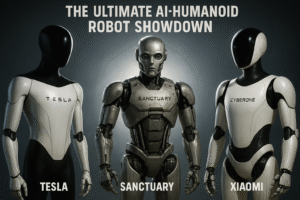
This analysis reveals a fundamental divergence in strategy. While Western companies like Tesla, Figure AI, and Agility Robotics are also racing to bring their humanoids to market, they are primarily focused on pilots and demonstration projects. In contrast, China’s government-backed strategy prioritizes a rapid deployment model, pushing products into factories and public spaces to “learn from real-world use” and quickly iterate toward more advanced models. A US automation leader has acknowledged that China holds a “clear advantage” in this race due to its national strategy and willingness to move faster, which allows it to gain a critical first-mover advantage. This different risk-reward calculation, enabled by state funding, allows China to build a mature ecosystem and accelerate innovation in a way that is difficult for purely venture-capital-driven markets to match.
IV. Economic Drivers and Emerging Ownership Paradigms
The rapid advancement and commercialization of robotics are underpinned by more than just technological breakthroughs; they are propelled by state-backed economic drivers and the emergence of new business models that democratize access.
The Chinese government’s focus on robotics is explicitly tied to national priorities, such as addressing an aging population and stimulating economic growth. By integrating humanoid robots into elderly care services, for example, the government aims to compensate for a lack of care infrastructure and an increasing number of citizens aged 65 or older. This national strategy is creating a powerful positive feedback loop: government funding lowers the initial cost of development, enabling companies to offer more affordable products like the Unitree R1. This, in turn, stimulates demand and a larger installed base, allowing manufacturers to achieve economies of scale and further reduce prices. The government is intentionally jump-starting the market to a point where it can become self-sustaining and globally competitive.
In parallel with this state-driven strategy, a new spectrum of robot ownership models is emerging, mirroring the choices available in the automotive industry. This shift is crucial for expanding adoption beyond large, capital-rich enterprises to small and medium-sized businesses.
- Direct Purchase: The traditional model of outright ownership is still a primary option, often offering benefits like tax breaks and full control over modifications.
- Leasing/Rental: For businesses that need to manage costs or stay current with the latest technology, leasing a robot for a few years is an attractive option. This model allows companies to implement automation without the burden of a large upfront capital expenditure and provides a clear path to upgrading to newer models as they become available.
- Robots as a Service (RaaS): This is a transformative, pay-per-use model that makes robotics accessible to businesses of all sizes. For example, the Alfred robot from Dexai Robotics is a robotic arm that prepares meals in commercial kitchens, and the company operates on a RaaS model where clients pay based on the number of dishes prepared. Similarly, Miso Robotics’ Flippy 2 is an AI-powered kitchen robot that automates the fry station, helping restaurants address labor shortages and increase efficiency. This model is a critical innovation that converts a large capital expense into a manageable operational cost, unlocking a massive market of restaurants and small-scale manufacturers who previously could not afford automation.
The lifecycle of robot ownership is also being supported by an emerging service ecosystem. Companies like iRobot are already offering trade-in programs for older consumer models, providing credit toward new purchases and promoting responsible recycling. Furthermore, the need for robot-specific insurance and maintenance plans is being addressed, with commercial policies emerging to cover risks ranging from product liability and property damage to cyber vulnerabilities. These developments demonstrate that the industry is rapidly maturing, building out the foundational infrastructure required for widespread adoption.
Table 2: Emerging Robot Ownership Models
| Model | Description | Key Benefits | Key Drawbacks | Ideal Use Case |
| Direct Purchase | Outright ownership of the robot. | Full control, tax breaks, total ownership after final payment. | High upfront capital expense, maintenance responsibility, risk of obsolescence. | Large corporations with significant capital and long-term needs. |
| Leasing | Long-term rental with an option to purchase or upgrade at the end of the term. | Lower upfront cost, flexible terms, easy to upgrade to newer models. | No ownership, potential long-term fees, limited customization options. | Companies needing automation for specific projects or to stay current. |
| RaaS (Robots as a Service) | A subscription or pay-per-use model, often with all-inclusive support. | No upfront cost, low financial risk, all maintenance and service included. | No ownership, dependency on the provider, long-term costs may exceed purchase. | Small businesses facing labor shortages, or temporary needs. |
V. Societal Implications, Challenges, and the Road Ahead
The rapid march of robotics and “Physical AI” presents a complex set of societal and technical challenges that will define the future of this industry.
The Debate over Jobs and the Workforce: The most significant and contentious implication is the impact on employment. The narrative is often polarized between job displacement and job creation. On one hand, figures like Amazon CEO Andy Jassy have stated that as generative AI and robotics expand, the company “will need fewer people doing some of the jobs that are being done today”. This sentiment is echoed by observations of “dark factories” and declining average employee numbers per facility. However, Amazon also claims that this shift has led to the creation of new, upskilled roles like “flow control specialists” and that it has trained over 700,000 employees for technical positions. The real concern, as some analysts suggest, may not be the total number of jobs, but rather the devaluation of skills for a large segment of the population, potentially creating a significant societal divide between a highly skilled minority and a larger population with limited access to meaningful, high-paying work.
Technical Hurdles and Skepticism: Despite impressive demonstrations, significant technical challenges remain. Bipedal robots, for example, face the fundamental problem of maintaining stability and energy efficiency in unpredictable, unstructured environments. The complexity of these non-linear systems makes them prone to instability, as highlighted by footage of “total systems failure” during live tests. This fragility leads to public skepticism, with some questioning whether viral promotional videos of robots performing acrobatics are “overly scripted” or even use CGI. While technologies like virtual simulation environments are being developed to train robots on real-world physics and data , the gap between controlled demonstrations and reliable, robust performance in dynamic real-world settings is a key challenge that must be overcome for widespread adoption.
Ethical and Perceptual Challenges: As robots become more human-like, they must navigate the “uncanny valley”—a psychological phenomenon where people feel unease or revulsion toward robots that are almost, but not quite, human.27 This discomfort is a significant barrier to public acceptance. To mitigate this, experts argue that robot design should be transparent and non-deceptive, clearly distinguishing the machine from a human to avoid exploiting vulnerable users. Ultimately, public perception, shaped by media, culture, and education, will be a deciding factor in the pace of robotic adoption. This is where initiatives like the Beijing Robot Mall, with its emphasis on public interaction and engagement, play a crucial role. By allowing the public to experience robots in a positive and entertaining context, these efforts are strategically designed to build familiarity, acceptance, and a future workforce inspired to pursue careers in robotics.
In conclusion, the robotics revolution is transitioning from the laboratory to the showroom, from theoretical potential to tangible commercial reality. The success of this new economic era hinges not only on continued technological innovation but also on the development of comprehensive ecosystems that address every stage of the robot lifecycle, from sales and service to social and ethical integration. While fierce competition from all global players is expected, the evidence suggests that the country that most effectively bridges the gap between technological prowess and practical, consumer-friendly commercialization will ultimately lead the way.
Quiz: Are You Ready for a Robot?
- What does the term “AI’s Day Zero” refer to in the report?
- A) The day humanoid robots were first invented.
- B) The moment AI moves from the digital world to the physical one.
- C) The start of the World Robot Conference.
- D) The point when AI becomes self-aware.
- What does the “4S” model used by the Beijing Robot Mall stand for?
- A) Service, Sales, Sustainability, Support
- B) Sales, Service, Spare Parts, Survey
- C) Solutions, Software, Security, Systems
- D) Showroom, Support, Strategy, Sales
- True or False: The Unitree R1 is notable for its high price, making it accessible only to major corporations and research labs.
- Which two countries have reportedly sent collaboration invitations to replicate the 4S store model?
- A) Japan and South Korea
- B) Germany and Saudi Arabia
- C) The United States and the United Kingdom
- D) France and Italy
- What is a key technical challenge faced by bipedal robots, as mentioned in the report?
- A) The lack of a charging infrastructure.
- B) The inability to lift heavy objects.
- C) Maintaining stability and energy efficiency in unpredictable environments.
- D) The difficulty of autonomous battery swapping.
Quiz Answers:
- B) The moment AI moves from the digital world to the physical one.
- B) Sales, Service, Spare Parts, Survey
- False. The Unitree R1 is noted for its low price, starting around $5,900.
- B) Germany and Saudi Arabia
- C) Maintaining stability and energy efficiency in unpredictable environments.
Resources
News & Articles
- Global Times:https://www.globaltimes.cn/page/202508/1340296.shtml)
- NDTV:https://www.ndtv.com/world-news/lifelike-robots-now-available-to-public-at-chinas-first-robot-mall-9045087
- AP News:https://apnews.com/photo-gallery/china-beijing-humanoid-robot-store-c9fb9f2880084b2cd6c5eda638d019fa
Official Websites
- Pudu Robotics:https://www.pudurobotics.com/
- Unitree Robotics:https://www.unitree.com/
- UBTECH Robotics:https://www.ubtrobot.com/en/humanoid/products/WalkerS2
Videos