Why Humanoid AI Robots Are Booming in Asia (AI, Robotics, Asia Tech)
🗂 Table of Contents
- Introduction
- Cultural Comfort with Robotics
- Government Strategies and Smart Infrastructure
- Tech-Savvy Consumers and Market Trends
- Case Study: Japan vs South Korea vs China
- Final Thoughts: Is the Future Already in Asia?
1. Introduction
Humanoid AI robots — those machines designed to resemble and interact like humans — are beginning to reshape life across the globe. But no region is adopting them as rapidly, broadly, or enthusiastically as Asia. From robot baristas in Seoul to eldercare companions in Tokyo, humanoid robotics is no longer a futuristic fantasy — it’s today’s reality.
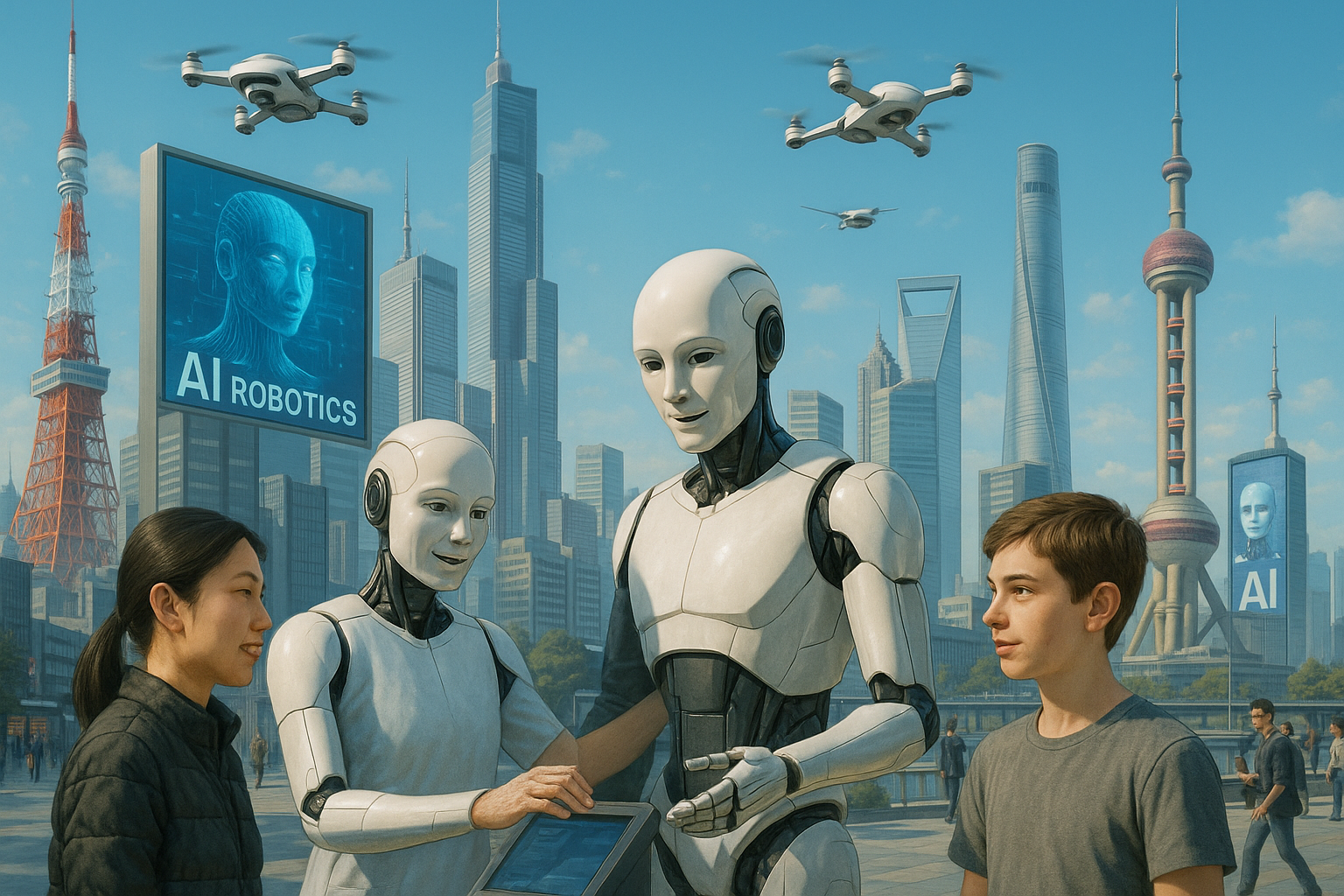
What makes Asia, particularly Japan, South Korea, and China, such fertile ground for this transformation? The answer lies in a compelling mix of cultural narratives, proactive policies, urban infrastructure, and consumer readiness. These countries aren’t just using humanoid robots — they’re building societal ecosystems where humans and machines coexist.
Let’s explore why Asia stands at the forefront of the humanoid AI revolution — and what lessons the rest of the world can learn.
2. Cultural Comfort with Robotics
Cultural narratives matter — and in Asia, robots are often seen not as threats but as trusted companions. This perspective is especially rooted in Japanese society, where decades of media portrayals have shaped a public that sees robots as helpful, even lovable, entities.
Characters like Astro Boy, Doraemon, and Gundam have normalized robots as allies in both everyday life and moral growth. Unlike Western media that often paints AI as dangerous (think Terminator or Ex Machina), Asian storytelling builds trust in machines.
There’s also a spiritual layer. In Japan, Shintoism, a belief system that attributes soul-like qualities to inanimate objects, creates emotional space for robots in human life. This helps explain why robots like Pepper or PARO — a therapeutic seal robot — are not only accepted but welcomed in eldercare and education.
Meanwhile, in South Korea and China, cultural openness to tech and modernity plays a huge role. In Korea, innovation is a national value, deeply connected to rebuilding the nation post-war. In China, Confucian respect for order and efficiency aligns with the logic-driven presence of AI.
Ultimately, these societies aren’t just tolerant of humanoid robots — they’re emotionally and culturally ready to live alongside them.
3. Government Strategies and Smart Infrastructure
Behind every robotic breakthrough is a national strategy pushing the limits. Asian governments are not waiting for global markets to dictate AI evolution — they’re investing, legislating, and even branding around it.
China, for instance, launched the Next Generation Artificial Intelligence Development Plan in 2017, with a goal to dominate global AI by 2030. This includes aggressive funding for humanoid robots in surveillance, healthcare, and customer service sectors.
Japan’s national vision, called Society 5.0, imagines a human-centered society that blends physical and digital realities. Robotics, AI, and IoT are positioned not as standalone industries but as interconnected pieces of a social upgrade. Government-subsidized projects often place humanoid robots in elderly homes, hospitals, and disaster zones.
South Korea is no less ambitious. Through its Smart City program, Korea uses humanoid AI in public libraries, government buildings, and subway stations. Government agencies also partner with corporations to deploy service robots in educational settings, reducing human labor and increasing accessibility in both urban and rural areas.
Importantly, these countries have the infrastructure to support AI operations — high-speed internet, 5G connectivity, and densely urbanized planning. This tech backbone allows humanoid robots to function in real-time, reliably, and across multiple public interfaces.
In the West, debates over regulation and ethics often delay integration. In Asia, regulation is structured not to delay but to guide safe, fast adoption.
4. Tech-Savvy Consumers and Market Trends
One reason humanoid robots thrive in Asia is that the people are ready for them. In cities like Tokyo, Seoul, and Shanghai, consumers already navigate highly digitized environments — using mobile payment systems, voice assistants, autonomous kiosks, and AI-driven apps for everything from grocery shopping to dating.
This has created a public that is not just tolerant of humanoid robots, but eager to interact with them. In fact, many Asian companies are finding that customer satisfaction improves with the presence of well-designed humanoid service robots — especially those with friendly faces, multilingual support, and the ability to remember customer preferences.
Examples:
- Japan’s Pepper robot is used in SoftBank stores, helping customers with product info and entertainment.
- South Korean cafés and hospitals deploy delivery and reception robots, reducing human workload during labor shortages.
- China’s UBTech and CloudMinds robots are featured in large trade expos, airports, banks, and even schools.
In some cases, these robots double as brand ambassadors, adding viral value through social media and public visibility. As Asian cities get denser and labor costs rise, robots provide a scalable solution that combines efficiency, novelty, and affordability.
5. Case Study: Japan vs South Korea vs China
To understand how this humanoid revolution is unfolding, let’s compare how the top three Asian powers are approaching it — each with their own emphasis and execution style.
Japan: Aging with Robots
Japan’s biggest challenge is demographic: a shrinking workforce and aging population. The country is leading in emotionally intelligent robots designed for empathy and physical support.
Examples include:
- PARO the robotic seal for dementia care
- Robear for lifting patients
- Pepper, used in retail and hospitality
Japan’s cultural acceptance and engineering excellence allow it to focus on human-centered robotics — ones that build trust and interaction over raw efficiency.
South Korea: Urban Smart Integration
Korea’s strength lies in urban automation and education. Cities like Seoul are testbeds for smart city robots that provide information, patrol streets, and help citizens in multiple languages.
Examples include:
- CLOi by LG — used in hotels and airports
- Kibo — Korea’s classroom assistant robot
- Around — delivery robot for urban environments
Korea’s approach is practical: make robots helpful, fast, and intuitive — especially where human workers are limited.
China: Mass Production Meets National Vision
China takes a bold, state-led approach. With centralized planning and access to massive data, it deploys humanoid AI in everything from education to facial recognition and surveillance.
Examples include:
- CloudMinds XR-1 used in healthcare
- AlphaMini used in Chinese classrooms
- UBTech robots for customer service and events
China’s focus is on scale and data, creating AI ecosystems that feed off mass usage to improve performance.
6. Final Thoughts: Is the Future Already in Asia?
Asia isn’t just embracing humanoid AI — it’s redefining what it means to be human in a robotic world. With cultural narratives that welcome robots, governments that support them, cities designed to house them, and consumers eager to use them, Asia is already living the future others are still imagining.
Whether you look to Japan’s caregiving robots, Korea’s smart urban bots, or China’s AI workforce, the message is clear: humanoid robots in Asia aren’t experimental — they’re essential.
As the world watches, Asia offers not just innovation but a model for how humanoid robots can be integrated safely, socially, and successfully.
Curious about what humanoid AI could do for your business or city? Keep following our blog — your future assistant might just be reading this post with you.